

A clean balance sheet is the perfect place to hide a dying company. You have seen the polished reports and the steady EBITDA projections, but you also know they don't tell the full story. Most due diligence consulting services fail because the consultants never leave their desks. They check boxes while ignoring the operational friction that actually destroys value once the deal closes. You're right to be wary of the information asymmetry. Inheriting hidden inefficiencies or legal liabilities isn't just a mistake; it's a disaster.
It is time to move beyond sterile financial audits. You need an operational hunt for the truth. This article promises to show you how to identify the real-world risks that sink deals and the immediate leverage points that drive growth. We will look at how to get total clarity on a target's health and mitigate risks before you commit your capital. This isn't about optimistic theories. It is about the hard-won wisdom required to protect your investment and ensure the deal actually delivers.
Key Takeaways
- Stop relying on sterile spreadsheets. Real due diligence is a boots-on-the-ground hunt for operational friction that financial audits always miss.
- Identify the three pillars of operational health. Professional due diligence consulting services look at the movement of goods and people, not just the flow of cash.
- Debunk the "synergy" myth. Learn to separate theoretical growth projections from the harsh realities of daily execution and inherited debt.
- Uncover hidden liabilities through unscripted interviews. Discover how talking to mid-level managers reveals the structural problems that sellers try to hide.
- Prioritize survival and recovery. Use a battle-hardened operator's perspective to ensure the target company is a durable asset rather than a liability.
What is Due Diligence? Beyond the Sterile Financial Audit
A seller's job is to paint a masterpiece. Your job is to find the rot behind the canvas. Understanding What is Due Diligence? starts with realizing it's not a polite request for information. It's a rigorous, high-stakes verification of every claim a seller makes before you sign the check. You aren't just buying assets. You're buying their history, their friction, and their future failures. Without specialized due diligence consulting services, you're essentially gambling on the seller's honesty. That's a losing bet.
Most investors mistake a clean audit for a healthy business. It's a dangerous assumption. A CPA looks at the past. They verify tax returns and balance sheets to tell you what happened three years ago. A due diligence consultant looks at the future. We look at operational viability to tell you what will happen three months from now. It's the difference between buying a growth engine and buying someone else's crisis. True diligence requires a no-nonsense investigation of assets, risks, and the hidden leverage points that actually drive value.
The Information Asymmetry Problem
Due Diligence vs. Traditional Auditing
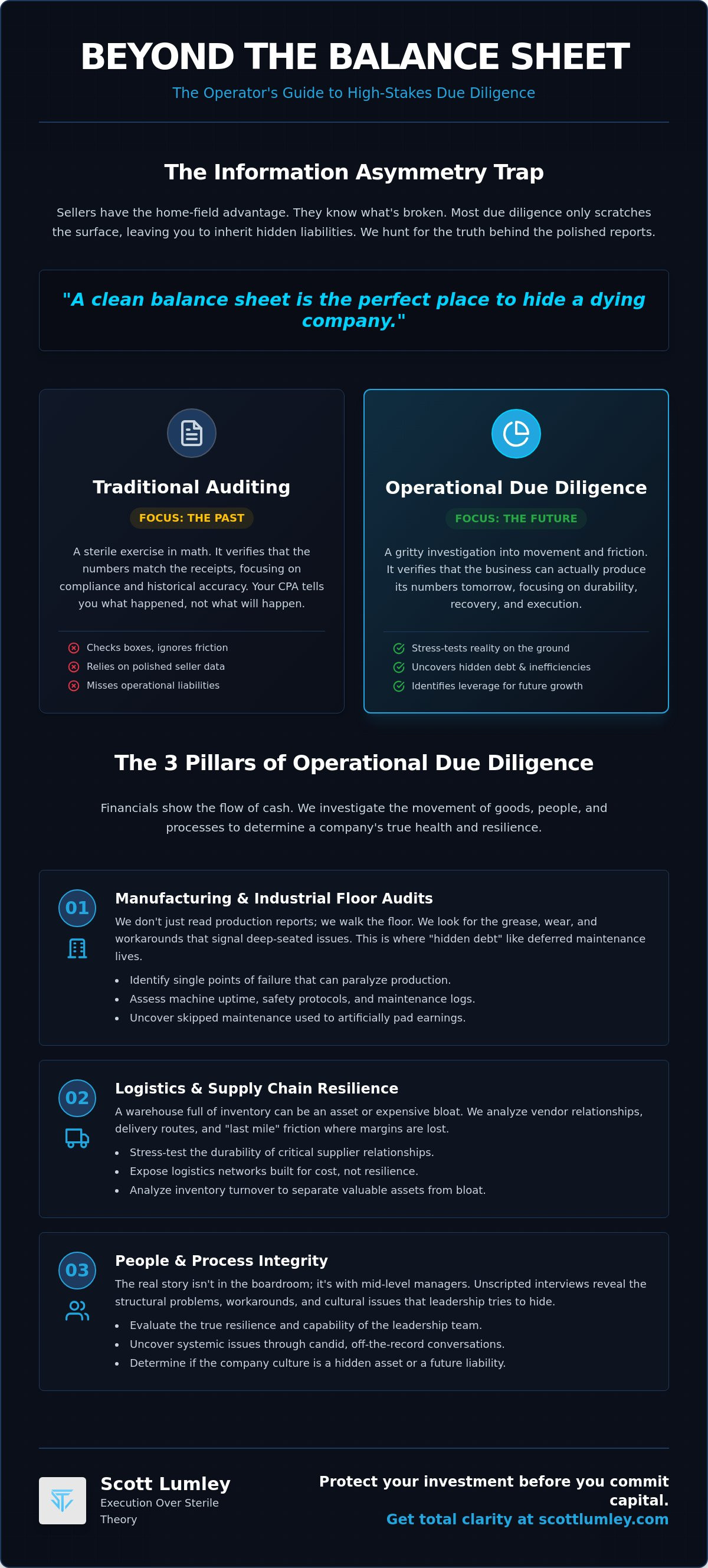
Your CPA is not equipped to spot a failing manufacturing line. They're trained for spreadsheets, not shop floors. They check boxes; we stress-test reality. Traditional auditing is a sterile exercise in math. Operational due diligence is a gritty investigation into movement and friction. It requires lived experience to know when a manager is lying or when a supply chain is one disruption away from a total collapse.
- Auditing: Verifies that the numbers match the receipts.
- Due Diligence: Verifies that the business can actually produce those numbers tomorrow.
- Auditing: Focuses on compliance and historical accuracy.
- Due Diligence: Focuses on durability, recovery, and strategic execution.
By utilizing due diligence consulting services, you move beyond the theoretical hope of "synergies." You get a high-level briefing on the target's actual health. It's efficient, focused, and entirely centered on your next actionable move. Don't settle for a paper trail when you need an operational hunt for the truth.
The 3 Pillars of Operational Due Diligence
Financial diligence is a rearview mirror. Operational diligence is the windshield. While the Legal Definition of Due Diligence involves the standard of care required in a transaction, the operational reality is far grittier. You aren't just checking boxes to satisfy a board. You're hunting for friction points that will stall growth. This is where due diligence consulting services provide a tactical advantage. We evaluate the resilience of the target's leadership team and hunt for "hidden debt." This includes deferred maintenance, technical debt, and outdated systems that will bleed your capital dry long after the deal is signed.
Manufacturing and Industrial Floor Audits
We don't just review production reports; we walk the floor. Machine uptime, safety protocols, and supply chain bottlenecks tell the real story. We identify single points of failure that can paralyze a business overnight. If one specialized CNC machine goes down and there's no backup or maintenance log, your entire production cycle ceases to exist. Operational friction in an industrial context looks like a 20-year-old hydraulic press failing mid-shift because the seller skipped three years of scheduled seal replacements to artificially pad their quarterly earnings. We look for the grease, the wear, and the workarounds that employees use to keep broken systems running.
Logistics and Supply Chain Resilience
A warehouse full of inventory looks like an asset on a balance sheet, but it's often just expensive bloat. We analyze the durability of vendor relationships and the logic behind delivery routes. Friction in the "last mile" of operations is where most companies lose their margin to inefficiency. You need to know if the logistics network is built for durability or if it's a house of cards waiting for a fuel spike to collapse. We stress-test the supply chain to see if it can handle recovery after a disruption or if it lacks the grit to survive a market shift.
Real Estate and Property Asset Valuation
Most consultants see a building; we see a strategic asset or a ticking clock. Leveraging 40 years of construction experience, we inspect physical assets for structural integrity and operational flow. We evaluate property tax debt systems and potential environmental liabilities that trigger massive, unbudgeted costs. If the roof is nearing the end of its life or the foundation is shifting, we find it before it becomes your debt. Securing a professional assessment of these physical assets ensures you aren't overpaying for a liability disguised as a flagship location. We prioritize survival and transparency over polished broker brochures.
Financial Theory vs. Operational Reality
Numbers don't tell the whole truth. They just tell the story the seller wants you to hear. The biggest misconception in M&A is that if the numbers look good, the business is healthy. It's a lie. A P&L statement is often a work of fiction designed to inflate the sale price through clever "window dressing." While traditional due diligence consulting services might stop at the balance sheet, a real operator looks for the rot underneath. You aren't buying a spreadsheet. You're buying a living, breathing machine that is either humming or grinding its gears to dust. Don't let a polished presentation blind you to the friction of daily operations.
"Synergy" is another red flag you'll find in most pitch decks. In the real world, it's usually just code for "theoretical hope." It assumes that two companies will magically work better together without accounting for the friction of merging different cultures, systems, and failures. Value is created through execution, but execution is never found in a slide deck. It's found on the warehouse floor and in the supply chain logs. If you rely on sterile data without a boots-on-the-ground inspection, you're walking into a trap. You need to see the grit and the grease to know if the deal is worth the capital.
Why Spreadsheets Lie
EBITDA is the ultimate distraction. It's easy to manipulate. A seller can pump up their EBITDA by deferring critical maintenance or slashing essential staff right before a sale. On paper, they look profitable. In reality, they're creating a crumbling operational core that you'll have to rebuild on your dime. There's a massive difference between paper profit and cash-flow reality. We hunt for "zombie assets," which are outdated technology or aging machinery that still appears as value on the books but actually costs more to maintain than it produces. These assets don't generate growth. They bleed capital and kill momentum.
The Value of a Battle-Hardened Perspective
Software can't smell a lie. Analytics tools are great for processing data, but they lack the intuition of someone who has actually survived a business crisis. You don't need a consultant who has only studied a textbook. You need an operator who has led from the trenches. Site visits aren't just about looking at equipment. They're about spotting the subtle signs of a failing culture or a stressed management team. A "rugged resilience" mindset prioritizes survival and transparency over superficial appearances. We value hard-won wisdom because we know that in the real world, execution beats theory every time. When we conduct an investigation, we're looking for the truth, not a reason to say "yes" to a bad deal.
The No-Nonsense Due Diligence Checklist
A generic checklist is a liability. If your due diligence consulting services only cover the basics, you are leaving the door open for disaster. You need a tactical "to-do" list that focuses on mid-market friction, not just high-level market scenarios. This process is about verifying reality. We move from the paper trail to the ground truth to ensure the deal you're signing is the deal you're actually getting. It requires looking at the last 36 months of real-world operational logs. Tax returns tell you what was reported; logs tell you what actually happened on the floor.
Phase 1: The Paper Trail (The Basics)
Phase 2: The Ground Truth (The Operator Audit)
Site visits are non-negotiable. We walk through manufacturing plants, retail outlets, and logistics hubs with an operator's eye. We look for the "hidden debt" discussed earlier, but we also test the "Crisis Management" protocols of the current leadership. How do they handle a production stoppage? What is their recovery plan for a supply chain break? During these visits, we conduct unscripted interviews with mid-level managers. These are the people who know the "real" problems that never make it into the board deck. Their insights reveal the friction that will prevent sustainable scaling once the capital is committed.
- Real Estate Holdings: We stress-test the "Property Tax Debt System" to ensure there are no looming liabilities or liens that will surprise you later.
- Strategic Growth Planning: We verify that the current assets can actually support the projected expansion.
- Physical Asset Inspection: A final, no-nonsense walk-through of inventory and machinery to ensure everything is as described.
You don't have to navigate these risks alone. Secure a no-nonsense due diligence investigation to protect your capital and ensure your next deal is built on a foundation of truth rather than sterile theory. We prioritize transparency and survival because in high-stakes business, there is no room for error.
Why Scott Lumley? Execution Over Sterile Theory
Most consultants have never actually run a business. They've spent their careers in air-conditioned offices, moving numbers around on a screen. Scott Lumley is different. He is a battle-hardened operator who has led from the trenches for four decades. His expertise isn't theoretical; it was forged in the high-stakes environments of construction, retail, and manufacturing. When you hire due diligence consulting services, you aren't looking for a cheerleader. You need a pragmatic strategist who understands that survival and recovery are just as important as expansion. Scott strips away the corporate jargon to deliver actionable moves that protect your capital and your reputation.
This isn't about optimistic theories. It is about hard-won wisdom. Scott has navigated extreme success and significant adversity across the globe. He brings a level of rugged resilience to every deal, focusing on the harsh realities of operations rather than polished marketing promises. He positions himself as a sobering voice of reason in a room full of people who just want the deal to close. If a deal has friction, he will find it. If a leadership team lacks the grit to scale, he will expose it. You get the truth, not a polished report designed to hide the rot.
Consulting for the Industrial and Property Sectors
In the property sector, surface-level inspections are a recipe for financial ruin. Scott's Real Estate Advisory and Leadership Consulting services are grounded in forty years of physical asset management and construction. He knows how to spot the structural rot or the liabilities within a Property Tax Debt System that a seller is trying to bury. His approach to global operational resilience is further defined by his experience in "I Survived Africa." This was not a corporate retreat. It was a lesson in transparency and navigating complex challenges in environments where the margin for error is zero. This gritty experience informs every investigation, ensuring that your deal is stress-tested against the harshest realities of business.
Taking the Next Decisive Step
Waiting to perform diligence is a high-stakes gamble you will likely lose. By the time the red flags become obvious to everyone, your capital is already at risk. Engaging Scott Lumley for fractional or interim business consulting provides you with an authoritative expert who prioritizes integrity over a quick commission. He offers a high-level briefing that provides absolute clarity on a target company's health. You get a direct source of practical wisdom focused entirely on your next move. Whether you need Strategic Planning to identify growth leverage or Crisis Management to save a failing asset, the mission is identical. Stop guessing and start executing. Secure your deal with battle-hardened due diligence consulting from Scott Lumley.
Secure Your Capital Through Operational Truth
A deal is only as strong as its weakest operational link. You've seen how sterile financial reports mask deep-seated friction and how "synergy" often collapses in the face of reality. To protect your investment, you must move beyond the paper trail. Conduct a gritty, boots-on-the-ground investigation. This is the only way to identify the hidden debt and single points of failure that destroy value after the check is signed.
Securing professional due diligence consulting services is about more than just compliance. It's about leveraging 40 years of hands-on experience in manufacturing, logistics, and real estate to stress-test every asset. Whether you're evaluating an industrial shop floor or navigating a specialized Property Tax Debt System, you need the perspective of an operator who has led from the trenches. Don't leave your capital to chance.
Get the battle-hardened due diligence you need to protect your capital.
Take the next move with total confidence. Your future growth depends on the clarity you find today.
Frequently Asked Questions
What is the primary goal of due diligence consulting?
The primary goal is to verify the truth behind every claim a seller makes before you commit capital. It isn't just about checking boxes for a board. It is an operational hunt for hidden friction that financial audits miss. By utilizing professional due diligence consulting services, you ensure that you are buying a durable growth engine rather than inheriting someone else's crisis or a crumbling operational core.
How long does a typical due diligence process take for a mid-market firm?
The average time to conduct due diligence has increased from 45 to 62 days over the last two years. This shift reflects the growing complexity of modern deals, especially with new regulations like the EU's CSDDD. For mid-market transactions between $10 million and $100 million, you should expect a timeline that allows for a thorough investigation of both the paper trail and the ground truth.
Can due diligence help in a business turnaround situation?
Yes, it is the most critical tool for a successful recovery. In a turnaround, you need to identify exactly where the friction is bleeding cash. Diligence reveals whether a target is a "zombie asset" or if it has the "leverage points" necessary for a strategic pivot. It provides the sobering reality check needed to decide if a business is worth the effort of a high-stakes rescue.
What is the difference between financial and operational due diligence?
Financial diligence is a rearview mirror that looks at past tax returns and EBITDA. Operational diligence is the windshield that looks at future viability. One verifies math; the other verifies physics. Operational investigations focus on machine uptime, supply chain resilience, and leadership grit. You need to know if the business can actually produce the numbers the CPA found on the balance sheet tomorrow.
Why do most M&A deals fail during the integration phase?
Deals fail because buyers fall in love with the numbers and ignore the operational friction. They rely on "theoretical hope" and corporate jargon like "synergies" instead of stress-testing the reality of the shop floor. When the deal closes, the hidden debt of deferred maintenance and failing culture finally surface. Integration fails when the buyer inherits problems they didn't have the grit to find during the investigation.
Is due diligence necessary for real estate and property investment?
It is non-negotiable if you want to protect your capital. Property investment diligence uncovers structural rot, environmental liabilities, and issues within a Property Tax Debt System. Most consultants just look at the concrete; we look at the strategic value and the potential liabilities that trigger unbudgeted costs. Without a no-nonsense inspection, you're likely buying a liability disguised as a flagship asset.
How does Scott Lumley identify "hidden friction" in a target company?
He uses forty years of lived experience in construction, manufacturing, and retail to spot what isn't being said. Identification happens through "boots on the ground" site visits and unscripted interviews with mid-level managers. These managers know the real problems that never reach the board deck. Scott looks for the workarounds, the duct-tape repairs, and the logs that don't match the polished sales pitch.
What happens if red flags are discovered during the diligence process?
You use the red flags as leverage to renegotiate the deal or you walk away entirely. Discovery isn't a failure; it's a victory for your capital. Identifying risks before the check is signed allows you to mitigate liabilities or adjust the purchase price to reflect the operational reality. Due diligence consulting services provide the transparency you need to make a decisive, results-driven move without the fear of inherited debt.


