

Most businesses don't fail because they lack potential; they fail because they wait too long to admit they're in trouble. Your cash reserves are thinning, and every operational friction point has become a glaring failure. When the stakes are this high, you don't need a passive advisor. You need a business turnaround consultant who understands the grit of the trenches. You've likely spent weeks chasing symptoms instead of fixing the engine. It's exhausting, and it's unsustainable.
You already know that traditional corporate advice won't save a sinking ship. This is about high-stakes execution, not polished theories. The goal isn't just to keep the lights on. It's to strip away the waste and rebuild a profitable machine. This guide offers a direct path to stop the bleeding and regain control of your trajectory. We'll examine how to stabilize your liquidity immediately, deploy a clear recovery plan, and secure sustainable growth that won't break the business again in 2026.
Key Takeaways
- Define turnaround as tactical stabilization rather than simple growth. It is a hunt for survival that requires immediate, decisive action.
- Partnering with a business turnaround consultant helps you identify operational friction through a brutal audit; this replaces corporate jargon with high-stakes execution.
- Secure your liquidity as the first priority. Cash is the lifeblood of recovery, and you must stop the bleeding before you can rebuild.
- Move beyond survival by using stabilization as a reset point. This allows for a transition from crisis management into a phase of sustainable expansion.
- Prioritize advisors with trench wisdom and real-world scars. Real recovery depends on hard-won experience rather than sterile corporate theories or polished marketing promises.
Beyond the Jargon: What a Business Turnaround Consultant Actually Does
A business turnaround is not a rebranding exercise or a simple "pivot" in marketing strategy. It is the tactical stabilization of a distressed operation that has lost its way. While many use the term loosely, true turnaround management is a high-stakes hunt for survival. It strips away the corporate ego to focus on one thing: keeping the doors open. This is about movement, not meetings. It's about fixing the engine while the plane is losing altitude.
There is a massive difference between a growth consultant and a business turnaround consultant. A growth consultant works with momentum, optimizing what is already functional. A turnaround consultant works against gravity. They enter when the momentum has shifted toward failure. In this environment, urgency isn't a buzzword; it is the only currency that matters. You don't need a theoretical strategy that looks good in a slide deck. You need immediate, execution-led recovery that stops the bleeding in days, not months.
Experience in sectors like manufacturing and retail is non-negotiable here. These industries don't run on theories; they run on tight margins and complex logistics. If an advisor hasn't spent years on the floor, they won't understand the friction points that are killing your profitability.
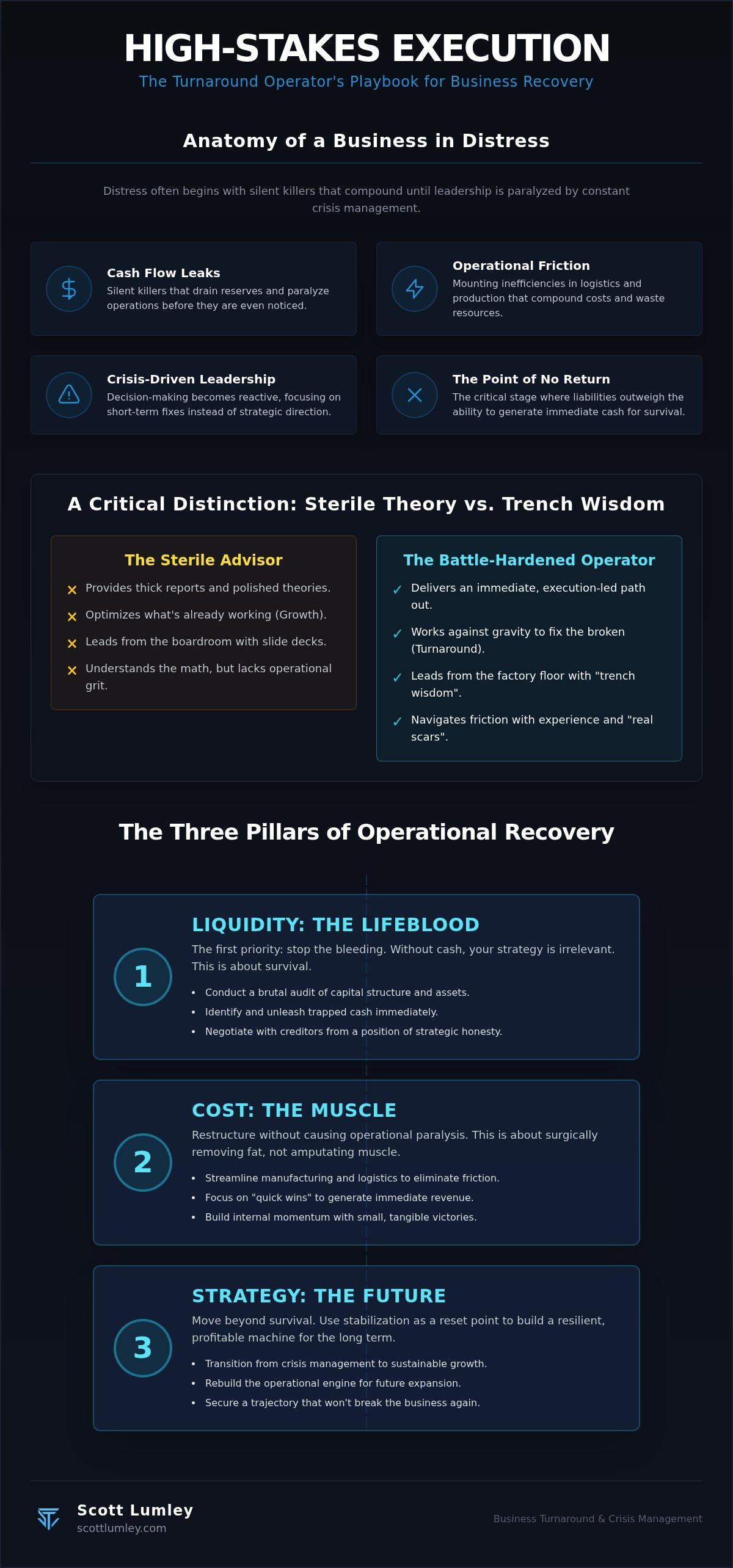
The Anatomy of a Business in Distress
Distress doesn't always look like a sudden crash. It often starts with silent killers like cash flow leaks and mounting operational friction. These issues compound until the leadership team is paralyzed by constant crisis management. The psychological toll is heavy. Decisions become reactive rather than strategic. The "Point of No Return" arrives when your liabilities outweigh your ability to generate immediate liquidity. Identifying this point early is the difference between a successful pivot and a total liquidation.
Consultant vs. Operator: Why the Distinction Matters
The market is flooded with advisors who provide thick reports filled with sterile theory. In a crisis, a report is just expensive paper. An operator provides a path out. This distinction is built on "scars" earned from 40 years in the trenches of construction, manufacturing, and logistics. A business turnaround consultant who has actually owned and operated businesses knows that spreadsheets don't tell the whole story.
A battle-hardened operator doesn't guess; they've seen the patterns before. They lead from the floor rather than the boardroom. While an MBA-certified advisor might understand the math, they often lack the grit to manage the friction of real-world recovery. When the stakes are this high, you need someone who has navigated both extreme success and significant adversity. Experience isn't optional. It is the foundation of every move you make to save the business.
The Three Pillars of Operational Recovery: Liquidity, Cost, and Strategy
Stabilizing a failing operation requires more than hope. It requires a three-front war. You need liquidity to survive the week, cost control to survive the quarter, and a new strategy to survive the decade. These pillars are the only things standing between your business and liquidation. A business turnaround consultant integrates these elements into a single, aggressive strike team. They don't treat these as separate silos. They are the integrated foundation for everything that follows.
Stabilizing Liquidity: Managing the Cash Crunch
Liquidity is the lifeblood. Without it, your vision is irrelevant. If you can't meet payroll, your strategy doesn't matter. You must find "unleashable" cash immediately. This involves a brutal audit of your capital structure to find trapped assets or underperforming inventory. When dealing with creditors, transparency is your best weapon. Negotiate from a position of strategic honesty. Show them the path to recovery so they have a reason to stay on the journey. Managing working capital isn't just about accounting; it's about survival.
Cost Restructuring Without Operational Paralysis
Cost restructuring is often mistaken for simple downsizing. Cutting too deep into your workforce or production capacity causes operational paralysis. You need to strip the fat, not the muscle. Focus on streamlining manufacturing and logistics to eliminate friction that wastes resources. Look for "quick wins" that generate immediate revenue. These small victories fund the larger recovery effort. They build internal momentum. If you aren't sure where the leaks are, a professional crisis management audit can reveal the hard truths your internal team might be missing.
Strategic Re-Alignment for 2026 Markets
Your old business model might be the very thing killing you. The industrial landscape of 2026 is defined by logistics volatility and shifting market demands. Strategic re-alignment is a total reset. It's about identifying new leverage points that allow for sustainable growth. This requires a business turnaround consultant who understands the grit of the industrial sector. You must adapt to current market realities rather than clinging to 2019 strategies.
These three pillars don't work in isolation. Liquidity buys you the time to restructure costs. Restructured costs provide the resources to execute a new strategy. Together, they create a durable foundation. This isn't about getting back to where you were. It's about building something that won't break when the next crisis hits.
Trench Wisdom vs. Sterile Theory: Choosing an Advisor with Scars
Business owners are right to be skeptical. Most consultants offer polished slide decks but have never felt the pressure of a thinning bank account on a Friday afternoon. They trade in "fluff" and generic frameworks that look good in a boardroom but fail on the warehouse floor. A business turnaround consultant with actual scars operates differently. They don't just identify the problem; they live the solution. This isn't about academic theory. It's about high-stakes operational execution. If an advisor hasn't navigated the friction of a manufacturing floor or a logistics bottleneck, they aren't an asset. They're a liability. You need someone who has smelled the diesel and managed the chaos.
The Red Flags of Theoretical Consulting
You can spot a theorist by their reliance on "one-size-fits-all" templates. These frameworks ignore the specific friction points of your operation. Every business has a unique pulse. Applying a generic template is a recipe for failure. Data without context is useless in a crisis. If an advisor can't explain how a supply chain shift affects your bottom line in real-time, they're just guessing. Real turnarounds require a national perspective, especially in manufacturing and logistics. You need someone who understands how regional shifts impact national distribution. If they spend more time on their presentation than on your warehouse floor, walk away. They're selling a theory, not a result.
What Real Experience Looks Like in 2026
In the current market, real-world resilience is the most important asset an advisor brings. This comes from four decades in the trenches of construction, retail, and logistics. It's the difference between a generalist and a strategic business advisor who understands distressed assets. During a pivot, your team needs more than a map. They need leadership that has survived the same storms. This is why leadership consulting services must be execution-led. You aren't looking for a cheerleader. You're looking for a battle-hardened operator who can stabilize the ship and prepare it for growth. A business turnaround consultant with scars knows that survival is earned, not planned. They understand that every decision has a ripple effect across your assets and your people. They prioritize durability over superficial appearances. They lead from the front.
Executing the Pivot: A Framework for High-Stakes Stabilization
Stabilization is a tactical hunt for survival. It requires a business turnaround consultant who can execute a five-step strike. First, conduct a brutal, no-nonsense audit of all operational friction. This isn't a high-level overview. It is a deep dive into every asset and liability. Second, execute immediate "Stop the Bleed" measures for liquidity. Cash is your only shield. Third, communicate the recovery plan with total transparency. Stakeholders don't want optimism; they want a roadmap. Fourth, shift from defense to offense. Identify the leverage points that will drive growth once the dust settles. Finally, implement a business crisis management consultant framework to ensure the stabilization sticks.
The First 72 Hours: Stabilization Tactics
The first three days determine whether the business survives. Your priority is neutralizing immediate threats. Secure the supply chain. If your vendors walk, the game is over. Establish a "Restructuring Office" mentality. This means high-speed decision-making and zero tolerance for bureaucracy. You must also stabilize the team. Your best people are looking for the exits. Give them a reason to stay by showing them a clear path through the wreckage. This isn't about being a cheerleader. It's about being an authoritative expert who leads from the trenches rather than a remote advisor.
The 90-Day Recovery Roadmap
Survival buys you the right to plan. The next 90 days are about hitting achievable milestones. Ignore the vanity metrics that look good on a slide deck. Monitor the KPIs that actually keep the lights on. Cash velocity is the most critical metric. It tells you how fast your capital moves through the system. This period marks the transition toward operational turnaround consulting goals. A seasoned business turnaround consultant knows that consistency beats intensity in this phase. If you don't hit these marks, you aren't recovering; you're just dying slowly. If you need an operator who has navigated these high-stakes pivots for 40 years, it's time for strategic crisis management that delivers results.
Strategic Leadership: Partnering for Sustainable Business Growth
A successful turnaround isn't the finish line. It is a hard-won reset. Most companies fail because they stop the bleeding but never fix the underlying infection. They survive the crisis only to drift back into the same inefficient habits that caused the collapse. A business turnaround consultant ensures that the stabilization phase leads directly into a phase of sustainable expansion. This transition requires moving from a reactive "defense" posture to a calculated "offense." You aren't just looking for survival; you're looking for a machine that can scale without breaking again.
Asset optimization is a critical lever in this phase. Many industrial firms overlook the strategic value of their physical footprint. Whether it's manufacturing plants or retail locations, your property must work for you, not against you. This is where real estate leadership advisory services provide a distinct advantage. By aligning your real estate strategy with your new operational roadmap, you unlock liquidity and reduce long-term friction. It's about making every square foot of your operation contribute to the bottom line.
Building a Resilient Infrastructure
Resilience isn't an accident. It is the result of rigorous systems and a culture of execution. To prevent a relapse, you must implement strict due diligence processes for every new deal or expansion. Using professional due diligence consulting services allows you to spot operational friction before it becomes a crisis. This isn't just about checking boxes; it's about deep-level risk assessment. You need to build a leadership team that values transparency and results over superficial appearances. When the consultant eventually departs, this culture of accountability is what keeps the business on track.
The Path Forward with Scott Lumley
Recovery is a process of grit and focus. It demands an advisor who has navigated the complexities of construction, manufacturing, and logistics for four decades. You don't need another slide deck or a theoretical growth plan. You need an operator who has lived through the same high-stakes pressure you're facing right now. The 2026 market doesn't reward hesitation. It rewards decisive action and strategic durability. A business turnaround consultant with trench wisdom knows that the time to execute is always now. Stop managing the decline and start leading the recovery. Partner with a battle-hardened operator today.
Reclaiming Control of Your Operational Trajectory
Survival in 2026 isn't about hoping for a market shift. It's about taking brutal, decisive action to stabilize your liquidity and strip away operational friction. You've seen that real recovery requires more than just spreadsheets; it demands a business turnaround consultant who leads from the trenches. By prioritizing cash velocity and executing a clear 90-day roadmap, you can transform a failing operation into a durable asset. This process isn't just about avoiding a crash. It's about a total reset that positions your business for sustainable, long-term expansion.
Scott Lumley brings 40 years of operational experience to every engagement. This is a no-nonsense execution strategy designed for high-stakes environments across national industrial sectors. Don't wait for the point of no return. You can still stop the bleeding and start the recovery with an operator who has the scars to prove it works. Secure Your Business’s Future with Scott Lumley and take the first step toward a profitable reset today. The path to stability is open to those ready to lead.
Frequently Asked Questions
What is the first thing a business turnaround consultant does?
The first step is always a brutal, no-nonsense audit of your liquidity and operational friction. A business turnaround consultant must identify where the cash is leaking before they can stop it. This involves a deep dive into your cash velocity and current liabilities. You can't fix a machine you don't understand. The goal is total transparency regarding your current survival window and immediate threats.
How long does a typical business turnaround take?
Stabilization usually happens within the first 72 hours to 30 days. However, a full operational recovery typically follows a 90-day roadmap to hit sustainable milestones. Every business is different, but the urgency remains the same. True growth planning starts once the foundation is no longer crumbling. It's a sprint followed by a marathon; there are no shortcuts to building a durable operation.
Is my business too far gone for a turnaround consultant to help?
Your business is only too far gone if your liabilities have completely eroded your ability to generate immediate liquidity. A business turnaround consultant can often find "unleashable" cash or trapped assets even in extreme distress. The key is acting before you lose all leverage with your creditors. If you still have an operational core, there's usually a tactical path toward recovery and growth.
What is the difference between restructuring and a turnaround?
Restructuring is often a legal or financial exercise involving debt and contracts. A turnaround is a tactical hunt for operational survival and efficiency. While restructuring might clean up the balance sheet, a turnaround fixes the engine that generates the revenue. You need both to survive, but one focuses on the paperwork while the other focuses on the warehouse floor and the logistics chain.
How much does a business turnaround consultant cost?
The cost of a consultant is secondary to the cost of failure. Most professional advisors structure their fees based on the complexity of the operation and the level of hands-on execution required. Instead of focusing on the price, evaluate the ROI of immediate operational stabilization. Saving a multi-million dollar asset from liquidation is the primary metric of value for any battle-hardened operator.
Do I need a consultant if I just need to cut costs?
Cutting costs blindly often leads to operational paralysis. You don't just need to cut; you need to optimize without destroying your production capacity. An outside expert identifies the "fat" while protecting the "muscle" of your operation. If you cut the wrong areas, you'll kill the business's ability to recover when the market shifts. Professional perspective prevents reactive mistakes during a crisis.
How does a consultant handle creditors and debt during a turnaround?
Consultants handle creditors through strategic transparency and a clear recovery roadmap. Creditors are more likely to work with you if they see a credible plan for repayment and stabilization. A seasoned advisor speaks their language and negotiates from a position of tactical honesty. This builds the trust necessary to secure the time you need to execute the pivot and regain your footing.
Can a turnaround consultant help with real estate and property assets?
Yes, real estate is often a massive source of trapped liquidity. A consultant with expertise in real estate advisory can help you optimize your property assets to fund the recovery. This might involve renegotiating leases, divesting underperforming locations, or utilizing property to secure working capital. Your physical footprint should be a leverage point for growth, not a weight pulling your operation down.


