

A hundred-page slide deck won't stop your company from hemorrhaging cash. Most consultants offer polished theories that fall apart the moment they hit the friction of a real-world warehouse floor or a chaotic boardroom. You're likely tired of the isolation that comes with senior management. You need more than a cheerleader. You need a strategic business advisor who has actually sat in the seat, felt the heat of a crisis, and navigated the way out. It's time to stop paying for "strategic insights" that don't translate into a single actionable move.
We agree that the traditional consulting model is broken. It often prioritizes billable hours over tangible results. This article promises to cut through the corporate fluff and show you how execution-led growth and aggressive turnaround strategies are the only ways to survive in 2026. We will preview the shift toward decisive leadership, risk reduction in real estate portfolios, and the exact mindset required to move from operational stagnation to sustainable recovery. Real growth isn't found in a binder; it's forged in the trenches.
Key Takeaways
- Learn why a battle-hardened operator delivers more value than a theoretical consultant when navigating high-stakes business transitions.
- Discover how a strategic business advisor identifies core operational friction points to stabilize distressed firms and secure rapid liquidity.
- Explore the two-step framework for stripping away corporate fluff and achieving sustainable, execution-led growth in 2026.
- Understand the core pillars of strategic planning and crisis management required to protect real estate portfolios and industrial assets.
- Find out how four decades of experience in the trenches of construction and manufacturing translate into pragmatic strategies for survival and expansion.
The Role of a Strategic Business Advisor in High-Stakes Environments
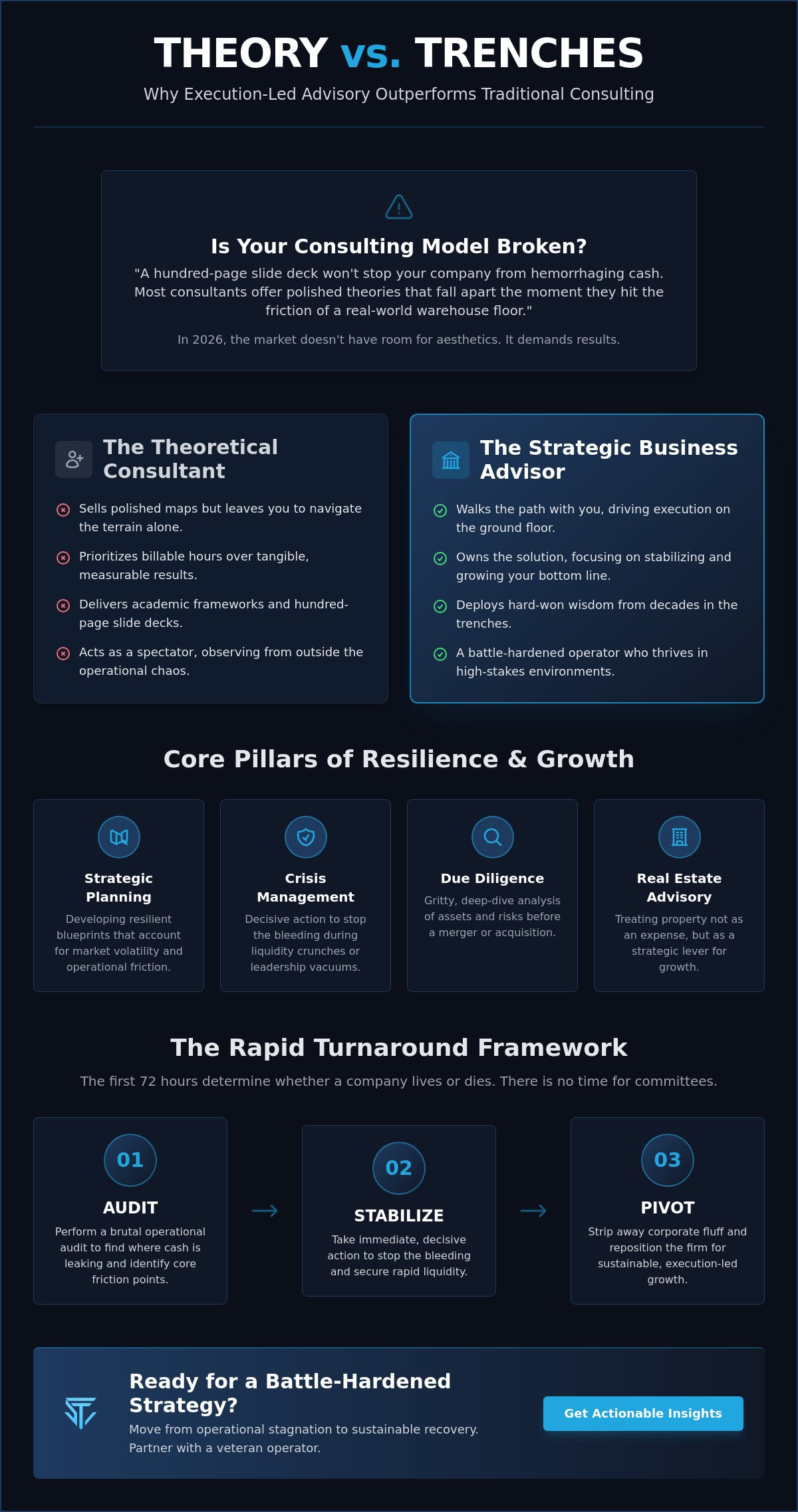
A strategic business advisor is not a spectator. In high-stakes environments, they are the primary driver of execution-focused leadership. Most consultants sell you a map and leave you to find the path. An advisor walks the path with you. They don't just identify the problem; they own the solution. This is the fundamental difference between a battle-hardened operator and a theoretical consultant. One understands the grit of the warehouse floor. The other understands the aesthetics of a slide deck. In 2026, the market doesn't have room for aesthetics. It demands results.
The landscape has shifted. We're seeing increased regulatory pressure, such as the SEC's 2026 priorities regarding fiduciary standards and cybersecurity. For investment advisers with less than $1.5 billion in assets, the June 3, 2026, deadline for incident response programs is a looming reality. Strategic planning is no longer a quarterly exercise. It's a daily requirement for survival. A veteran advisor acts as a voice of reason in these frantic operational zones. They strip away the noise and focus on what moves the needle. They prioritize hard-won wisdom over polished marketing promises.
Beyond the Boardroom: Why Industry Grounding Matters
Lived wisdom outperforms academic frameworks every time a crisis hits. In industries like construction, manufacturing, and logistics, theoretical advice is dangerous. These sectors deal with physical assets, complex labor forces, and tight margins. A gritty, no-nonsense approach isn't just a style choice. It's a survival mechanism. If you haven't managed a project through a liquidity crunch or a site shutdown, you can't lead a turnaround. This grounded experience allows an advisor to spot friction points that a spreadsheet would miss. They know that a minor delay in the supply chain can wipe out a year's profit.
The Strategic Advisor as a Fractional Leader
SMBs often face a specific kind of isolation at the senior level. The CEO is often the only one with the full picture, which creates a dangerous bottleneck. An interim or fractional strategic business advisor breaks this cycle. They provide a sobering voice of reason that isn't clouded by internal politics or ego. They find the leverage points where an external strategist adds immediate value. This might involve stabilizing a crisis, reducing risk in real estate portfolios, or preparing a firm for a major transition. It's about providing high-level clarity at high speed. You get the expertise of a veteran operator without the overhead of a full-time executive.
Core Pillars of Strategic Advisory: Growth, Turnaround, and Resilience
Growth is a liability if your foundation is cracked. A strategic business advisor doesn't just build for expansion; they build for durability. In high-stakes operations, the pillars of advisory must cover more than just revenue targets. They must address the structural integrity of the entire enterprise. This involves a rigorous focus on strategic planning, crisis management, and real estate advisory. It requires identifying friction points before they become terminal failures. If you're looking to stabilize a failing department or scale a manufacturing plant, the approach remains the same. You strip away the noise and focus on the assets that actually produce value.
Resilience is built through four critical disciplines:
- Strategic Planning: Developing blueprints that account for market volatility and operational friction.
- Crisis Management: Decisive action to stop the bleeding during liquidity crunches or leadership vacuums.
- Due Diligence: Gritty, deep-dive analysis of assets and risks before a merger or acquisition.
- Real Estate Advisory: Treating property not just as an expense, but as a strategic lever for growth.
When the stakes are high, you need a partner who understands that survival is the prerequisite for success. You can explore how these pillars apply to your specific transition by consulting a strategic business advisor who has navigated these exact storms.
Executing the Pivot: Turnaround Management
The first 72 hours of a turnaround determine whether a company lives or dies. There is no time for committees. You need a rapid stabilization framework: Audit, Stabilize, Pivot. First, you perform a brutal operational audit to find where cash is leaking. Second, you stabilize the immediate crisis, whether that's vendor relations or payroll. Finally, you pivot the strategy toward a sustainable recovery zone. Turnaround management isn't about optimistic forecasting. It's about the hard reality of survival. You must be willing to cut what isn't working to save what is.
Real Estate Leadership: Strategy Beyond Concrete
Property investment firms often treat real estate as a passive asset. This is a mistake. Strategic leadership advisory integrates property into the broader business strategy. In high-stakes environments, you need more than a broker; you need a strategist who understands risk reduction. This includes utilizing tools like the Property Tax Debt System to optimize asset performance and clear financial hurdles. Whether it's industrial development or retail portfolios, due diligence is the only thing standing between a profitable exit and a total loss. Real estate strategy is about movement and leverage, not just static holdings.
Strategic Advisory vs. Traditional Consulting: Why Experience Trumps Theory
Most consultants are analysts. They produce "The Deck"-a collection of polished slides that look great in a boardroom but fail in the field. A strategic business advisor lives in "The Trenches." They focus on operational execution. They don't just tell you what's wrong; they fix it. This is the fundamental reason most consultants fail to deliver tangible outcomes. They lack lived experience. They offer expert opinions without understanding the movement and friction of a real business. They haven't spent forty years navigating construction sites or manufacturing floors. Without skin in the game, their advice is just noise.
Traditional consulting firms often hide behind academic frameworks. They use words like "synergy" and "optimization" to mask a lack of practical knowledge. A true advisor speaks the language of operations. They understand supply chains, labor friction, and capital risk. They've spent decades in sectors where a single mistake can derail a project. This isn't theoretical. It's hard-won wisdom from four decades of navigating both extreme success and significant adversity. Evaluating an advisor requires a "No-Nonsense" test. If they can't explain how they've stabilized a distressed firm in your specific industry, they aren't the right partner.
Theory vs. Execution: The Performance Gap
Traditional consulting breeds analysis paralysis. You end up with more data but less movement. Execution-led growth is different. It's about making decisive moves that yield immediate, tangible outcomes. It prioritizes survival and recovery over generic expansion plans. Strategic execution is the bridge between vision and profit. It's the difference between a plan that sits on a shelf and a business that actually functions under pressure. You don't need a map; you need a guide who has already walked the path.
Identifying a Battle-Hardened Advisor
Identifying a battle-hardened advisor starts with spotting red flags. Beware of "sterile" firms that rely on generic templates or delegate work to junior analysts. You need transparency and integrity over polished marketing. Ask the hard questions before signing a retainer:
- "Have you ever managed a turnaround in my specific industry?"
- "Can you show me a time you stabilized a liquidity crisis in under 72 hours?"
- "What's the biggest operational failure you've had to navigate?"
If the answers are vague, the advice will be too. You need someone who leads from the front. High-level clarity at high speed is only possible when the strategist has already seen the worst-case scenario and survived it.
Navigating Operational Friction: A Framework for Strategic Execution
Strategic execution is the antidote to operational friction. It's the difference between a business that stalls and one that moves with purpose. Most firms fail because they treat strategy as a static document. A veteran strategic business advisor treats it as a living operation. To move from stagnation to growth, you need a framework that prioritizes movement over meetings. This isn't about minor adjustments. It's about a total realignment of your core assets and leadership mindset. Stop guessing. Start executing.
The framework consists of five non-negotiable steps:
- Operational Audit: Stripping away the corporate fluff to find where the gears are grinding.
- Rapid Stabilization: Addressing immediate liquidity issues or leadership voids to stop the bleeding.
- Strategic Blueprinting: Designing a gritty, realistic path toward recovery and sustainable growth.
- Execution & Leadership: Implementing the plan from the floor up, not just from the boardroom down.
- Resilience Training: Building systems that can survive future market shocks and operational storms.
If your organization is currently paralyzed by indecision, it's time to bring in a strategist who leads from the trenches. You can start the process of reclaiming your operational edge by partnering with a strategic business advisor today.
Stabilizing the Ship: The First 90 Days
The first quarter of a recovery engagement is about survival. A business recovery consultant doesn't look for venture capital funding. They look for internal efficiency. The priority is cash flow. You must restructure debt and protect core assets before you can even think about expansion. This phase is intense. It requires a sober assessment of what's truly essential. You cut the waste, secure the perimeter, and establish a baseline of stability. Without this foundation, any future growth will be built on sand. You can't scale a sinking ship.
Scaling Without Breaking: Sustainable Growth
Reckless expansion is a slow-motion disaster. Organic, sustainable growth is the only way to build a legacy. Strategic planning ensures that your infrastructure can handle the weight of new business. This requires a deep understanding of operational resilience. Take the "I Survived Africa" case study as an example. It serves as a brutal lesson in global operational resilience. It shows that survival in extreme environments depends on preparation, adaptability, and a total lack of ego. When you scale, you do it with the same level of discipline. You grow because your systems are ready, not because you're chasing a vanity metric.
Partnering with Scott Lumley: Battle-Hardened Strategy for Growth
Scott Lumley is a veteran operator. He doesn't trade in polished promises. He trades in hard-won wisdom. With over forty years of experience in construction and manufacturing, he has seen every failure point in the book. He's the pragmatic strategist for firms facing high-stakes transitions. His reach is national. Across the United States, he helps leaders navigate the harsh realities of business. He isn't a coach. He's a strategist who leads from the front. He understands the movement of heavy industry and the specific friction of large-scale operations. When the stakes are high, you need someone who has already survived the storm.
Most advisors offer a map. Scott walks the path with you. He understands that in high-stakes environments, theory is a liability. You need a strategic business advisor who can identify a liquidity crisis or an operational bottleneck in real-time. His approach is built on the reality of the warehouse floor and the boardroom. He's navigated the complexities of distressed firms and high-growth manufacturing plants. This isn't academic. It's lived experience. He focuses on the assets that produce value and strips away the noise that slows you down. Survival is the prerequisite. Growth is the result.
A Direct Source of Practical Wisdom
Practical wisdom is rare in the consulting world. Most firms sell a version of the truth that feels safe. Scott prioritizes transparency and integrity. His practice uses a "High-Level Briefing" communication style. It's fast-paced. It's decisive. Every briefing is designed to provide absolute clarity at high speed. There is no wasted space in the narrative. You won't find corporate jargon or motivational fluff here. You'll find actionable moves. If you're tired of sterile corporate theory, take the next step with Strategic Planning that actually works. It's time to stop talking about growth and start executing it.
Securing Your Operational Future
Time is running out to fix your foundation. 2026 brings new challenges that will expose every operational weakness in your firm. You need a strategic business advisor who understands both the peak and the pit. Scott has navigated extreme success and significant adversity. He knows what it takes to survive when the gears stop turning. The goal is simple. Stabilize the operation. Recover the losses. Expand aggressively. This isn't a passive process. It's an aggressive pursuit of durability. Don't wait for the friction to become a crisis. Consult with Scott Lumley today to build a blueprint that lasts.
Execute Your Recovery and Scaling Strategy
Theory is for boardrooms with time to waste. Your operation doesn't have that luxury. We've established that execution-led growth and rapid stabilization are the only metrics that matter in high-stakes environments. You need to move beyond polished slide decks and focus on the grit of the warehouse floor. A battle-hardened strategic business advisor provides more than just a report. They provide a blueprint for survival and the leadership to implement it across every level of your organization. This is about movement, not just analysis.
With 40 years of industry experience and national advisory coverage, Scott Lumley brings a direct, no-nonsense approach to complex transitions. He specializes in identifying friction points before they become terminal, utilizing tools like specialized Property Tax Debt Systems to optimize asset performance. Don't let operational friction or isolation at the senior level slow your progress. It's time to prioritize hard-won wisdom over sterile corporate promises. Secure Your Business Future with Scott Lumley and start building for durability today. You have the tools. Now, take the first move toward a resilient and profitable future.
Frequently Asked Questions
What is the difference between a business coach and a strategic business advisor?
A business coach focuses on your mindset and motivation. A strategic business advisor focuses on your operations and execution. Coaches ask questions; advisors provide answers and lead the implementation. It's the difference between someone cheering from the sidelines and someone standing in the trenches with you. In high-stakes environments, you don't need a cheerleader. You need a veteran who understands the friction of the warehouse floor and the boardroom.
How long does a typical business turnaround take to show results?
You should see stabilization within the first 72 hours. Tangible operational results typically manifest within the first 90 days of an engagement. Business turnaround isn't a slow burn; it's a series of decisive moves to stop liquidity leaks and secure core assets. If you aren't seeing movement in the first quarter, the strategy is failing. Speed is a requirement in crisis management. You can't afford to wait for a slow recovery.
Can a strategic advisor help with real estate portfolio optimization?
Yes. Real estate optimization is a core pillar of strategic advisory. Property shouldn't be a static expense. It's a strategic lever for growth. Advisors use tools like the Property Tax Debt System to clear financial hurdles and reduce risk. This transforms property assets from liabilities into optimized components of your broader business strategy. It's about movement and leverage, ensuring your real estate supports your overall operational goals.
What industries does Scott Lumley specialize in for advisory services?
Scott Lumley specializes in construction, manufacturing, and real estate. These are industries where physical assets and complex labor forces create significant operational friction. He brings forty years of experience navigating these specific sectors across the United States. His background isn't academic. It's built on the harsh realities of managing industrial sites and large-scale development projects under extreme pressure. He provides national advisory coverage for firms facing high-stakes transitions.
What happens in the first 72 hours of a business crisis management engagement?
The first 72 hours are dedicated to a brutal operational audit and rapid stabilization. We identify where cash is leaking and assess immediate liquidity needs. This phase is about stopping the bleeding. There's no time for committees or polished slide decks. We look at vendor relations, payroll, and core asset protection. It's a high-level briefing that leads to immediate action. We stabilize the ship so we can begin the pivot.
Is strategic advisory suitable for mid-size firms or just large corporations?
How does a strategic business advisor help with due diligence during an acquisition?
An advisor identifies the friction and risk that a standard accounting audit misses. We look at operational durability and hidden liabilities that could derail an acquisition. Due diligence isn't just about the numbers on a spreadsheet. It's about the reality of the assets and the viability of the leadership. We ensure you're buying a functional business, not a collection of expensive problems. We find the grit beneath the polished reports.
Why is "execution-led" consulting better than traditional strategy consulting?
Execution-led consulting bridges the gap between vision and profit. Traditional strategy consulting often ends with a binder on a shelf. Execution-led advisory starts with a blueprint and ends with implementation on the floor. It's better because it prioritizes tangible outcomes over theoretical reports. If a strategy doesn't lead to immediate movement, it isn't a strategy. It's just an opinion. You need results you can see in your cash flow, not just your slides.


