

Most growth strategies are nothing more than high-speed suicide notes written on expensive letterhead. You have seen it happen. A company chases a revenue target, scales too fast, and collapses under the weight of its own operational friction. It is a common tragedy fueled by theoretical advice from advisors who have never actually managed a payroll or a supply chain. You are right to be skeptical. Pushing the accelerator is useless if your transmission is about to fall out.
Effective long term business growth planning isn't about aggressive sales tactics; it's about removing friction before you accelerate. This guide provides a no-nonsense blueprint for building a strategy that survives market volatility and internal stress. We will move past the polished PowerPoint slides to focus on a stabilized, scalable business model. You will gain clear visibility into your five-year operational requirements and learn how to secure sustainable revenue growth without sacrificing your integrity. Here is how you build a business that lasts through the grit and the grind.
Key Takeaways
- Stop treating growth as a financial wish list. Real growth is an operational blueprint that prioritizes execution over sterile theory.
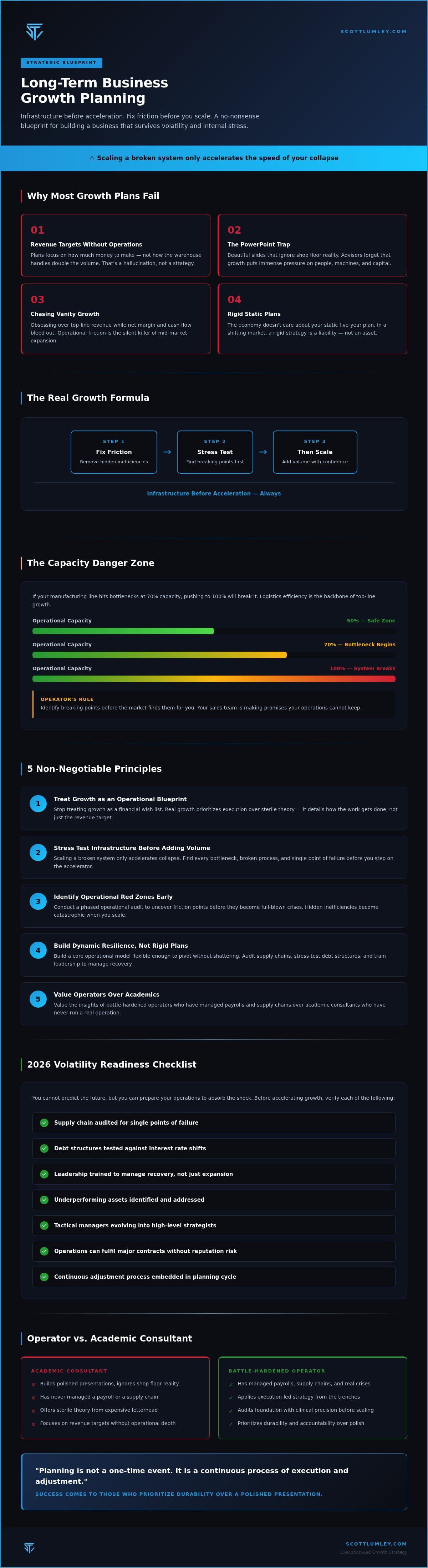
- Stress test your infrastructure before you add volume. Scaling a broken system only accelerates the speed of your collapse.
- Effective long term business growth planning requires identifying operational red zones before they become full-blown crises.
- Conduct a phased operational audit to uncover the friction points that will break your business during rapid expansion.
- Value the insights of battle-hardened operators who have managed payrolls and supply chains over academic consultants.
Beyond the Five-Year Deck: Why Most Growth Plans Fail
Most five-year decks are works of fiction. They are financial wish lists disguised as strategy. If your plan focuses on revenue targets without addressing how the warehouse handles double the volume, you don't have a strategy. You have a hallucination. Real long term business growth planning is an operational blueprint. It is the gritty, detailed map of how your infrastructure supports your ambition. It focuses on how the work gets done, not just how much money you hope to make.
Sterile theory belongs in a classroom. In the real world, we need execution-led strategy. Many advisors fall into the "PowerPoint trap." They build beautiful slides that ignore the reality of the shop floor. They forget that growth puts immense pressure on people, machines, and capital. Growth without a turnaround mindset leads to systemic failure. You must fix the leaks before you turn up the water pressure. If you scale a broken process, you are just building a bigger mess. This is the cornerstone of long term business growth planning that actually works.
The Friction Factor in Strategic Planning
Hidden inefficiencies are manageable when you are small. They become catastrophic when you scale. Rapid expansion acts as a magnifying glass for every broken process in your company. Many leaders chase "vanity growth," obsessing over top-line revenue while their net margin and cash flow bleed out. Operational friction is the silent killer of mid-market expansion. If you don't identify these friction points early, your growth will eventually grind to a halt. You need to know exactly where the gears are grinding before you add more load. It's about precision, not just speed.
Planning for Volatility in 2026
The economy does not care about your static five-year plan. In a high-stakes, shifting market, a rigid strategy is a liability. You need dynamic stabilization. This means building a core operational model that remains flexible enough to pivot without shattering. We are looking toward 2026. The goal is to build resilience into your assets and your team. You cannot predict the future, but you can prepare your operations to absorb the shock.
- Audit your supply chain for single points of failure.
- Ensure your debt structures can withstand interest rate shifts.
- Train your leadership to manage recovery as effectively as they manage expansion.
Planning is not a one-time event; it is a continuous process of execution and adjustment. It requires the perspective of someone who has been in the trenches. You need a strategy that survives the first contact with reality. Success comes to those who prioritize durability over a polished presentation.
The Mechanics of Sustainable Scaling: Infrastructure Before Acceleration
Scaling is not a reward for past success. It is a rigorous test of your current foundation. You must stress test your operations before you dare add volume. If your manufacturing line hits bottlenecks at 70 percent capacity, pushing for 100 percent will break it. Logistics efficiency is the backbone of top-line growth. Without a solid logistical flow, your sales team is just making promises your operations cannot keep. Applying strategic business advisor principles allows you to audit this foundation with clinical precision. It is about identifying the breaking points before the market finds them for you.
A successful transition requires your leadership team to evolve. The "doers" who built the company are often the same people who struggle to lead a scaled enterprise. Transitioning from a tactical manager to a high-level strategist is a difficult shift that requires a total retooling of priorities. Managing a business is about maintaining the status quo. Leading a massive expansion is about aggressive accountability. This is the only way to ensure your long term business growth planning isn't just a suicide mission. Most companies ignore this because they are blinded by the potential of a big contract. They sign the deal and then realize they cannot fulfill it without destroying their reputation.
Asset Optimization and Resource Allocation
Identify underperforming assets immediately. These are the anchors dragging down your future growth. Whether it is an outdated warehouse management system or a fleet that costs more in maintenance than it generates in value, these must be addressed. Long term business growth planning requires gritty due diligence. This isn't just checking boxes; it is digging into the dirt of your operations to see what is actually working. You must balance aggressive capital investment with operational liquidity. Do not starve your cash flow to buy a shiny new asset that won't pay for itself for three years. Survival depends on having the cash to weather the friction of expansion.
Building a Leadership Pipeline
Long-term growth requires leadership consulting services to align the team with new operational realities. You need frameworks that land with immediate impact. No fluff. No vague goals. Just clear targets and the consequences of missing them. If you are ready to move from survival to strategic execution, exploring professional Strategic Planning can provide the clarity your leadership team needs. Your leaders must be prepared to handle the recovery as effectively as they handle the expansion. Resilience is built in the trenches, not in a boardroom session.
Strategic Risk Mitigation: Growing Without Breaking Your Operations
The number one fear for any operator is losing control. You built your company on personal oversight and grit. Now, expansion threatens to turn your streamlined machine into a chaotic mess. This fear is valid. Growth naturally creates distance between the leader and the front lines. If your systems aren't designed to bridge that gap, you will lose the brakes. Effective long term business growth planning isn't about hoping for the best; it's about engineering control into the expansion itself. You must identify "operational red zones" before they turn into full-blown crises.
Most leaders only think of due diligence consulting services when they are acquiring a competitor. This is a mistake. You need that same level of clinical, cold-eyed scrutiny applied to your own internal growth. Internal due diligence uncovers the friction points that will kill your expansion before it starts. Every viable growth plan needs a built-in stabilization phase. You cannot sprint indefinitely. You must push for a period of growth, then pause to stabilize the new infrastructure before the next push. This rhythm prevents systemic collapse.
Crisis Pre-emption in High-Stakes Environments
Use crisis management consulting to bulletproof your strategy. This isn't about PR; it is about operational recovery. Build circuit breakers into your expansion strategy. These are pre-determined triggers that force a pause if specific metrics-like cash reserves or delivery accuracy-fall below a certain threshold. Radical transparency is the only way this works. If your reporting is opaque, your stakeholders won't see the cliff until you have already driven over it. Real-time data is your only defense against the fog of rapid scaling.
Navigating Regulatory and Market Shifts
Markets don't stay still. Political tides and economic shifts can turn a winning strategy into a liability overnight. You must stay grounded in the reality of the dirt, not the theory of the boardroom. When the market shifts, pivot your execution without losing your operational momentum. This requires a strategy that protects the core business while exploring new territory. Do not bet the farm on a single market trend. Diversify your operational risk so that a failure in one area doesn't trigger a total shutdown of the enterprise. Resilience is the ultimate competitive advantage in long term business growth planning.
Building Your 2026 Growth Roadmap: From Vision to Execution
A roadmap is not a decorative poster for your boardroom. It is a sequence of high-stakes moves designed to transition your company from where it is to where it must be. Most long term business growth planning fails because it jumps straight to acceleration without checking the engine. You cannot scale chaos. To reach 2026 with a stabilized, profitable enterprise, you need a phase-based approach that prioritizes operational integrity over rapid revenue spikes. Execution is everything. Theory is cheap.
- Phase 1: The Operational Audit. This is the search for truth. You are looking for the friction points, the broken processes, the underperforming assets, and the communication gaps that will widen under pressure.
- Phase 2: Stabilizing the Core. Before you add weight, you must strengthen the foundation. This involves applying business turnaround consultant tactics to recover lost efficiency and eliminate waste.
- Phase 3: Strategic Acceleration. Once the core is stable, you scale the processes that are proven to work. This is calculated growth, not a blind sprint.
- Phase 4: Continuous Optimization. You build a feedback loop that allows for real-time adjustments. The market shifts. Your plan must be able to shift with it.
The Audit: Finding the Truth in Your Numbers
Surface-level KPIs are often deceptive. They tell you what happened, but they rarely tell you why. To build a resilient plan, you must dig into trench-level data. This means talking to the people on the shop floor and looking at the actual movement of goods and capital. "A plan built on bad data is just a map to a cliff." If your inventory numbers are off or your labor costs are hidden in general expenses, your growth strategy will fail at the first hurdle. Precision is your only protection against operational collapse.
Execution: Turning the Plan Into Action
The first 90 days of your five-year plan set the pace for everything that follows. You must move quickly to secure early wins that build momentum. Communicate the plan to your team without using corporate jargon or motivational fluff. Tell them exactly what is changing, why it is changing, and what is expected of them. Establish clear accountability from day one. Maintain a sense of urgency, but don't burn out your best people. Real long term business growth planning balances high-speed execution with the need for a durable, motivated workforce. If you are ready to stop theorizing and start executing, my Strategic Planning services focus on building roadmaps that actually land.
The Operator’s Advantage: Why Hands-On Advisory Beats Sterile Consulting
Academic advisors love theories. They thrive on charts that always point up and to the right. A battle-hardened operator knows better. They know that growth is messy, violent, and full of friction. When you engage in long term business growth planning, you don't need a cheerleader. You need a strategist who has managed a payroll during a crisis and kept a supply chain moving when the world stopped. Sterile consulting offers a map. Hands-on advisory offers the experience to drive the truck through a storm.
Four decades in construction, manufacturing, and logistics changes how you see a balance sheet. It stops being a collection of numbers and starts being a reflection of assets, risk, and movement. Scott Lumley doesn't offer polished marketing promises. He offers hard-won wisdom from the trenches. This is the difference between a consultant who reads about business and an operator who has built, saved, and scaled them. Integrating real estate advisory, logistics, and turnaround expertise into a single growth strategy ensures no part of your operation is left exposed. It's about total operational awareness.
Real-World Wisdom Over Marketing Promises
Boardrooms often lack a sobering voice of reason. Everyone wants to talk about expansion. Few want to talk about the survival and recovery protocols needed when things go sideways. Leading from the trenches means identifying the leak in the warehouse before it drains the company's cash flow. It's about transparency and integrity. If a plan is going to fail, you need to know now; not six months after the capital has been spent. Long term business growth planning requires an advisor who values your survival as much as your expansion.
Engaging a Strategic Catalyst
A fractional advisor provides high-level strategy without the bloated overhead of a traditional firm. You get a direct, no-nonsense operational review that identifies exactly where your foundation is weak. This isn't about a three-month discovery phase. It's about immediate impact and rapid execution. By combining Strategic Planning with a deep understanding of manufacturing and logistics, you get a cohesive roadmap that accounts for every variable. Stop guessing about your future. Secure your operational future with Scott Lumley and build a business that is actually designed to last through the grit and the grind.
Building the Durable Enterprise
Building a business that lasts through 2026 and beyond requires more than a revenue target. It requires a total commitment to operational stability. You've seen how sterile theory fails when it hits the shop floor. Real success comes from stress-testing your infrastructure, identifying friction points through clinical audits, and building a leadership pipeline that can handle the grit of expansion. There is no shortcut to a stabilized, scalable model.
Effective long term business growth planning is a process of dynamic stabilization. It isn't about moving fast; it's about moving with precision. When you prioritize your foundation over your vanity metrics, you build a company that survives market volatility and operational stress. You don't have to navigate this transition alone.
With 40 years of hands-on experience in manufacturing, logistics, and construction, I provide the no-nonsense, results-driven consulting you need to scale without breaking. My expertise in turnaround management and real estate advisory ensures your strategy is grounded in the harsh realities of the dirt. Execute your growth strategy with a battle-hardened operator. Your business is capable of massive expansion. Now, give it the foundation it deserves.
Frequently Asked Questions
What is the difference between business growth planning and a standard business plan?
A standard business plan is often a static document used to secure funding or satisfy a board of directors. It's a snapshot of goals. In contrast, long term business growth planning is a live operational blueprint. It focuses on how your infrastructure, supply chain, and labor force will actually handle increased volume. It's about execution in the trenches, not just projections on a spreadsheet.
How often should a long-term growth plan be updated?
Your plan should be a living document. Review your operational metrics quarterly to ensure your infrastructure is keeping pace with your sales. A full strategic overhaul is typically needed every year to account for market shifts. If you wait five years to update your roadmap, you're driving with an outdated map. Markets move too fast for static strategies to survive.
Can a business in crisis still plan for long-term growth?
You can, but you must stabilize the core first. A business in crisis needs a turnaround strategy before it attempts to scale. If you try to grow while your operations are bleeding, you'll only accelerate the collapse. Fix the leaks, stabilize the cash flow, and then use that solid foundation to map out your future expansion. Recovery is the first step of growth.
What are the biggest risks of rapid business expansion?
The biggest risks are cash flow exhaustion and operational collapse. Rapid expansion demands massive capital and puts immense strain on your systems. If your processes aren't bulletproof, they'll shatter under the weight of new orders. You also risk diluting your brand integrity if quality drops during the rush. Scaling is a test of your transmission, not just your engine.
How does operational friction impact a company’s valuation?
Friction is a direct hit to your bottom line. It drags down net margins and creates a chaotic environment that scares off sophisticated investors. High operational friction signals a lack of control, which increases the risk profile of your company. A stabilized, frictionless business model always commands a higher multiple because it's seen as a durable, predictable asset that is easier to transition.
Why is due diligence important for internal growth planning?
Internal due diligence is about finding the truth before the market finds it for you. It uncovers the hidden friction points and underperforming assets that will drag down your expansion. You must be as cold-eyed and critical of your own operations as you would be during a hostile takeover. This level of scrutiny is the only way to ensure your long term business growth planning is grounded in reality.
What role does leadership consulting play in sustainable scaling?
Leadership consulting ensures your team is actually capable of managing a larger enterprise. Many "doers" who are great at small-scale operations fail when they have to lead through complex systems. You need to retool your leadership to focus on accountability and strategic oversight. Without this alignment, your expansion will be hamstrung by a team that's stuck in tactical firefighting mode rather than leading.
How do you balance short-term recovery with long-term growth goals?
It's a sequence, not a balance. Short-term recovery is the priority because you can't build a skyscraper on a swamp. Fix the immediate operational leaks and stabilize the cash flow today. Once the foundation is solid, you can pivot toward long-term goals. Every move you make during recovery should be designed to support the eventual scale of the business. You fix the core to earn the right to grow.


