

Cash flow isn't a math problem; it's an operational friction problem. When you're staring at a dwindling ledger in a manufacturing plant or a construction site, the numbers aren't just digits. They're oxygen. If you're hunting for how to fix cash flow problems, you've likely realized that standard accounting advice won't save a sinking ship. You're facing unpredictable revenue cycles and margins being eaten alive by internal drag. It's a heavy weight, especially with the fear of losing a legacy company looming over every decision.
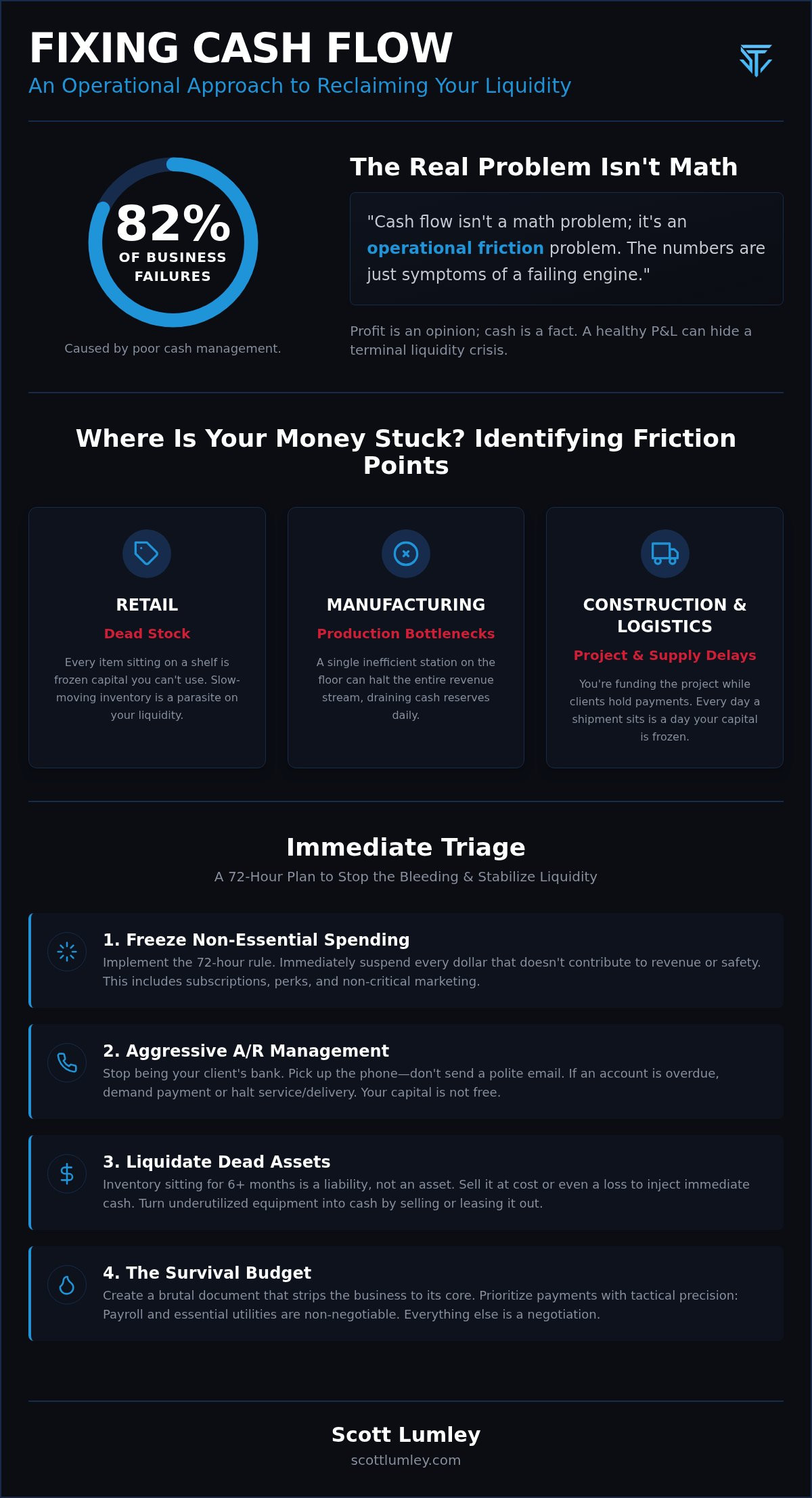
You know that poor cash management causes 82% of business failures. You don't need a cheerleader; you need a strategist who's survived the trenches. This article delivers a battle-hardened approach to stop the bleeding and reclaim your liquidity. We'll move past theoretical fluff to provide an immediate stabilization plan and a clear roadmap for operational recovery. We're going to restructure your operations to ensure long-term growth without the recurring threat of a bank balance hitting zero. It's time to strip away the corporate jargon and focus on the harsh realities of survival.
Key Takeaways
- Diagnose the root cause of liquidity issues by identifying operational friction rather than just balancing the books.
- Discover how to fix cash flow problems using a 72-hour triage rule and aggressive accounts receivable tactics.
- Optimize your operational engine for rapid throughput to increase margins without relying on shallow cost-cutting.
- Establish a permanent liquidity reserve and a gritty crisis recovery plan to future-proof your legacy.
- Transition from theoretical advice to pragmatic execution with a strategy built for the realities of the trenches.
The Cash Flow Crisis: Diagnosing the Operational Friction
Cash flow problems are rarely about the math. They are symptoms of a failing engine. If you want to know how to fix cash flow problems, you have to look at the shop floor, the job site, and the warehouse. It starts with understanding cash flow as a measure of operational speed. A temporary dip is a timing issue. A systemic crisis is a structural failure. One is a headache; the other is a terminal illness. You must identify the silent killers before they hollow out your company. Bloated inventory ties up capital in dust-covered boxes. Slow logistics prevent you from turning raw materials into revenue. In construction, delays mean you're funding the project while your client keeps their checkbook closed. Cash flow friction is the gap between execution and collection.
Why Profitability Doesn't Equal Cash
Profit is an opinion; cash is a fact. In manufacturing, your P&L might look healthy while your bank account is empty. These "paper profits" don't pay employees or suppliers. A growing construction firm often finds itself in a liquidity trap. High growth requires massive upfront costs. If your accounts receivable lag behind your payroll cycle, you're dead. Over-leveraging for expansion without a liquidity cushion is a gamble you'll eventually lose. You can't spend a projection. You need liquid reserves to survive the friction of daily operations.
Identifying Friction Points in Your Industry
Friction looks different depending on your sector. In retail, dead stock is a parasite. Every square foot of shelf space occupied by slow-moving items is capital you can't use. In manufacturing, inefficiencies on the floor drain your reserves. A bottleneck at one station halts the entire revenue stream. For logistics, supply chain bottlenecks are hidden costs that compound daily. Every day a shipment sits is a day your capital is frozen. Learning how to fix cash flow problems requires identifying these specific points of drag before they stall the company entirely. You don't need a cheerleader to tell you it's fine. You need a strategist to show you where the money is stuck.
Immediate Triage: Tactical Moves to Stabilize Liquidity
When the liquidity well runs dry, you don't have weeks to debate strategy. You have hours. The 72-hour rule dictates that you freeze every non-essential dollar the moment you recognize a crisis. This isn't about being popular; it's about survival. Learning how to fix cash flow problems requires you to stop being your client's bank. Aggressive accounts receivable management means picking up the phone, not sending a polite email. If a client is 30 days overdue, they are utilizing your capital for free. Demand payment or halt delivery. Using strategies to improve cash flow often requires making uncomfortable calls to vendors. Be transparent about your timeline. Most suppliers prefer a delayed payment plan over a total default.
Dead assets are fuel you're refusing to burn. If inventory has been sitting for six months, it's not an asset. It's a liability. Liquidate it at cost or even a slight loss to inject immediate cash into the business. This is how to fix cash flow problems in the short term while you prepare for deeper operational changes. If you find yourself over your head, professional Crisis Management Consulting provides the objective perspective needed to stop the bleeding and stabilize the ship.
The Survival Budget: Stripping to the Core
A survival budget is a brutal document. It identifies every expense that doesn't directly contribute to immediate revenue or safety and suspends it. Subscriptions, perks, and non-critical marketing go first. You must prioritize payments with tactical precision. Payroll and essential utilities are non-negotiable. Everything else is a negotiation. Don't fall into the VC funding trap. Injecting capital into a broken engine just creates a larger, more expensive wreck. Fix the business first.
Maximizing Asset Leverage
Look at your yard and your warehouse. In construction or manufacturing, underutilized equipment is frozen capital. Sell the idle machinery or lease it out to competitors. Review your real estate holdings. If you're sitting on equity while your operations starve, consider a sale-leaseback or a strategic divestment. Every piece of iron you own should be working. If it isn't, it needs to be turned into cash. For a deeper dive into stabilizing your firm, you might consider Leadership Consulting to steer through the storm.
Operational Restructuring: Fixing the Engine, Not Just the Paperwork
Triage stops the bleeding. Restructuring fixes the heart. If you've stabilized your immediate liquidity, the next step is to examine the engine that generates it. Cutting costs is a defensive move. It's often necessary, but it's never enough. You must optimize the flow of value through your organization. If your product isn't moving, your cash isn't moving. Restructuring the manufacturing floor for rapid throughput is how to fix cash flow problems at their source. It turns work-in-progress into liquid assets with speed. You're not just moving machines; you're removing the friction that traps your capital in unfinished goods.
Execution requires a total lack of interest in superficial fixes. You need to implement tighter Due Diligence on every new contract. Stop chasing every lead. If a deal has high operational friction and low payment certainty, it's a liability. You cannot afford to fund a client's project with your own survival. A battle-hardened approach means leading from the trenches and making the hard calls that theoretical advisors avoid. It's about movement, grit, and the refusal to let operational drag sink your legacy.
Manufacturing and Logistics Optimization
Lead times are the enemy of liquidity. Every hour a part sits on the shop floor is an hour your capital is dead. You need to shorten the cash conversion cycle by accelerating production. Eliminate the operational waste hiding in complex supply chains and redundant processes. Lean operations are not just an efficiency metric; they are a high-speed cash-generation strategy. When you reduce the time between buying raw materials and receiving payment, you solve the fundamental liquidity gap that kills most firms.
Turnaround Leadership in High-Stakes Environments
A Business Turnaround Consultant doesn't manage from a distance. They operate where the work happens. Maintaining team morale when cash is low requires a steady hand and absolute transparency. Don't hide the reality from your key stakeholders, but don't invite panic. Provide a clear, logical blueprint for recovery. When the team sees the engine being rebuilt with purpose, they stay in the fight. This is where industry experience in construction, retail, and logistics becomes non-negotiable. You need a pragmatic strategist who values survival as much as expansion.
Strategic Safeguards: Future-Proofing Against the Next Storm
Fixing the immediate bleed is a tactical win. Ensuring it never happens again is a strategic necessity. A gritty business crisis recovery plan for 2026 isn't a dusty binder on a shelf. It's a living protocol for survival. You must build a permanent liquidity reserve. Cash is king; it's the only asset that doesn't lie during a downturn. Diversifying revenue streams can provide a safety net, but only if you do it without over-extending your core operations. If you add complexity without adding speed, you're just creating new ways to fail. Use aggressive Due Diligence to identify operational friction before you sign a deal. If the contract doesn't allow for healthy flow, walk away. This is how to fix cash flow problems before they ever appear on your ledger.
Real Estate and Property Asset Strategy
For property investment firms, strategic planning is the difference between portfolio growth and total stagnation. You need to ensure your assets remain liquid enough to handle market shifts. Real Estate Leadership Advisory provides the high-level strategy needed to prevent your portfolio from becoming a weight. We also utilize the Property Tax Debt System as a strategic tool for asset recovery. It's about turning tax liabilities into leverage points. If your real estate strategy doesn't account for sudden liquidity needs, you're building on sand. You need a Real Estate Advisory partner who understands the stakes of high-pressure property operations.
Sustainable Scaling: Growing Without Breaking
Rapid expansion is the primary cause of cash flow failure. It feels like success, but it's often a death sentence for margins. You must set "hard" limits on your operational leverage. Don't let your ambition outpace your cash reserves. Growth should be fueled by efficiency, not just debt. When you scale, do it with the precision of an operator, not the optimism of a promoter. For those ready to lead their organization through a high-stakes transition, my Leadership Consulting Services offer an execution-led roadmap. Scaling shouldn't break your business; it should fortify it. If you're ready to build a durable legacy, let's talk about your strategic planning.
Navigating the Turnaround: Why Execution Trumps Sterile Theory
Theory is cheap. In the heat of a liquidity crisis, you don't need a cheerleader or a passive coach. You need a pragmatic strategist who understands the grit of the shop floor. Most advice on how to fix cash flow problems fails because it's written by people who have never had to tell a supplier they can't pay. Real-world application is about movement. It's about identifying friction in your logistics and removing it with surgical precision. Industry experience in construction, manufacturing, and retail is non-negotiable. If your advisor hasn't navigated a turnaround in the trenches, they're just guessing with your legacy.
Knowing when to bring in outside leadership is a mark of strength, not failure. When you're too close to the fire, your vision gets blurred by the heat. Stabilization requires an objective eye that isn't tied to the status quo. Survival isn't about optimistic theories; it's about hard-won wisdom and the courage to execute on difficult decisions. It's about the harsh realities of business, prioritizing survival and recovery as much as expansion.
The Value of an Interim Business Consultant
An interim consultant provides rapid deployment of leadership exactly when the stakes are highest. They don't waste time on polished marketing promises or sterile corporate jargon. Instead, they focus on tangible outcomes. They cut through the inertia that keeps a distressed firm paralyzed. This no-nonsense approach identifies exactly how to fix cash flow problems by restructuring the engine of the business. It's about results, not appearances. You get an authoritative expert who leads from the trenches rather than a theoretical advisor sitting in an office.
Next Steps: Taking Action Today
The first three moves every distressed leader should make are clear. First, freeze all non-essential spending immediately. Second, audit your accounts receivable to find every dollar trapped in the pipeline. Third, secure a high-level briefing to assess your recovery options. This isn't the time for hesitation. You need a clear roadmap for operational turnaround and long-term strategic growth. If you're ready for a sobering voice of reason to lead your recovery, Contact Scott Lumley for a Strategic Business Assessment. The next actionable move is yours to make.
Reclaim Your Liquidity and Secure Your Legacy
Cash flow isn't a spreadsheet error; it's an operational bottleneck. To survive, you must stop being your client's bank and start treating your floor operations as a cash-generation engine. We've covered the transition from immediate triage to deep operational restructuring. You now have the blueprint for identifying friction and future-proofing your reserves. Understanding how to fix cash flow problems requires a total commitment to movement over theory. It requires the grit to make hard calls before the market makes them for you.
You don't have to navigate this turnaround alone. With 40 years of operational experience, Scott Lumley is a specialist in industrial and manufacturing turnarounds who provides no-nonsense, results-driven consulting. This isn't about optimistic theories; it's about hard-won wisdom from the trenches. Secure your business's future with Scott Lumley's strategic advisory. Your company's history is worth the fight. It's time to stop the bleeding and build a durable future. You've survived the storm; now lead the recovery.
Frequently Asked Questions
What is the fastest way to fix cash flow problems in a business?
The fastest way to stabilize is immediate triage by freezing non-essential spending and collecting outstanding invoices. You don't wait for a monthly report. You pick up the phone and call every client with an overdue balance. Liquidating idle inventory or equipment provides an instant cash injection. This isn't a long-term fix; it's about buying time to address the structural drag in your operations.
Can a profitable business still have cash flow problems?
Profitability is an accounting opinion while cash is a hard reality. Many firms fail while showing a profit because their capital is trapped in accounts receivable or inventory. If you're growing too fast, you're likely spending cash on materials and labor long before the customer pays. This timing gap creates a "profitable" company that can't pay its own light bill.
How do I know if my business needs a turnaround consultant?
You need a consultant when you lose the ability to predict your bank balance 30 days out. If you're constantly shuffling payments or relying on high-interest loans to cover payroll, the engine is broken. A turnaround expert provides the objective distance required to cut through corporate inertia. They prioritize survival and recovery over maintaining appearances or protecting egos.
What are the most common causes of cash flow friction in manufacturing?
Friction in manufacturing usually stems from bloated work-in-progress and supply chain bottlenecks. Every hour a part sits on the floor is an hour your capital is dead. Inefficient floor layouts and long lead times extend the cash conversion cycle. Identifying how to fix cash flow problems in this sector requires a total focus on increasing throughput and reducing operational waste.
Is it possible to fix a struggling business without taking on more debt?
Restructuring your operations is the primary way to fix a business without adding debt. Debt often masks the underlying friction rather than solving it. By accelerating your cash conversion cycle and optimizing your supply chain, you generate internal liquidity. You fix the engine instead of just pouring more fuel into a leaking tank. It's about movement and efficiency, not more leverage.
How much cash reserve should a mid-size industrial firm maintain?
A mid-size industrial firm should aim for a liquidity reserve covering three to six months of operating expenses. This isn't a suggestion; it's a survival requirement. High-stakes industries like construction or manufacturing face unpredictable cycles. Having a permanent cash cushion allows you to navigate supply chain shocks or client delays without facing a total liquidity crisis that threatens your legacy.
What happens if I can't pay my vendors during a cash flow crisis?
Transparency is your only leverage when you can't pay vendors. Don't ghost your suppliers. Contact them immediately to negotiate a payment plan based on your actual cash flow projections. Most vendors prefer a partial, predictable payment over a total default. Honesty preserves the relationship for the recovery phase. Silence usually leads to legal action and a total operational shutdown.
How do I communicate cash flow issues to my employees without causing panic?
Communicate with absolute transparency and a clear plan of action. Employees sense trouble; hiding it creates a vacuum filled by rumors and panic. State the reality of the situation and immediately pivot to the steps being taken to stabilize the company. Focus on the operational changes required to win. Leadership from the trenches builds resilience instead of fear.


