

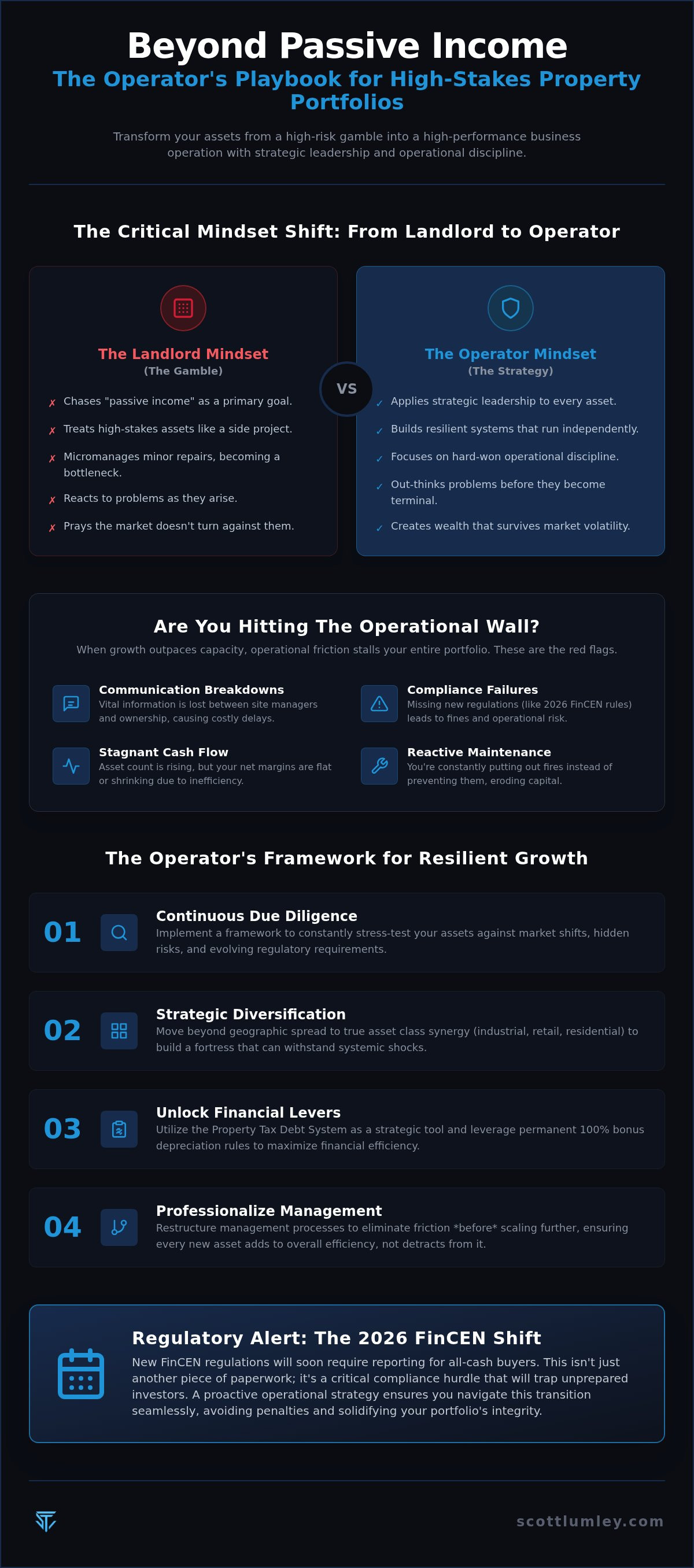
Most investors are just landlords playing at business. They collect keys, chase "passive income," and pray the market doesn't turn. That isn't a strategy; it's a gamble. If you want real property investment portfolio advice, you have to stop treating your assets like a side project. High-stakes assets require the same strategic leadership you'd apply to any other high-performance business operation. Real wealth is never truly passive; it's the result of hard-won operational discipline.
You've felt the friction. As your portfolio grows, the operational cracks widen and growth stagnates. Maybe your due diligence missed a critical risk, or you're struggling to navigate the 2026 regulatory shift where FinCEN now requires reporting for cash buyers. You aren't just managing buildings anymore. You're managing a complex web of tax debt systems, compliance hurdles, and operational bottlenecks that kill momentum. It's exhausting because the structure wasn't built for this scale.
We're going to fix that. This guide moves past the theory and into the trenches of strategic execution. You'll learn how to build a resilient, scalable structure that survives market volatility and leverages permanent 100% bonus depreciation rules. We're defining the pathway to reduced risk and a clear, professionalized growth strategy.
Key Takeaways
- Transition from a passive landlord to a strategic leader to eliminate the operational friction that stalls portfolio growth.
- Implement a continuous due diligence framework to stress-test your high-stakes assets against evolving 2026 regulatory requirements.
- Apply expert property investment portfolio advice to identify hidden risks and utilize the Property Tax Debt System as a powerful strategic lever.
- Break through the "Operational Wall" by restructuring your management processes before scaling further decreases your overall efficiency.
- Navigate complex transitions with guidance from a battle-hardened operator who prioritizes asset survival and recovery as much as expansion.
Beyond Passive Income: Why Property Portfolios Require Strategic Leadership
The "passive income" dream is a dangerous myth. For the small-time landlord with one or two units, it might feel real. For the high-stakes operator, it's a trap. Real wealth in property doesn't come from sitting back and waiting for a check. It comes from aggressive, strategic leadership. If you want property investment portfolio advice that actually moves the needle, you have to accept that your assets are a business operation. Nothing more, nothing less. Treat them like a hobby, and they'll bleed you dry.
The Operator Mindset vs. The Investor Mindset
Stop looking at buildings as static blocks of brick and mortar. They're dynamic operational systems. Every asset has moving parts: mechanical systems, tenant lifecycles, and shifting regulatory burdens. While real estate investing fundamentals focus on valuation and acquisition, they often ignore the "day two" reality of management. There's a point where being hands-on turns from an asset into a liability. If you're still the one approving every minor repair, you aren't leading; you're micromanaging your own stagnation. Transitioning to an execution-led strategy for 2026 means building systems that run without your constant interference. You don't need a cheerleader. You need a strategist who can identify why your portfolio is dragging.
Identifying Operational Friction in Your Current Assets
Operational friction is the gap between strategic intent and daily execution. It's the silent killer of ROI. You intend to scale, but your management structure is breaking under the weight of ten new acquisitions. You see it in the buildup of deferred maintenance or the slow creep of property tax debt. Inefficient leadership in property development doesn't just cost time; it erodes the capital you need for the next deal. Professional property investment portfolio advice focuses on removing these bottlenecks before they become terminal.
Signs your management structure is breaking include:
- Communication breakdowns: Vital information gets lost between site managers and ownership.
- Compliance failures: Missing new 2026 requirements, such as the FinCEN reporting rules for cash buyers.
- Stagnant cash flow: Your asset count is rising, but your net margins are flat or shrinking.
- Reactive maintenance: You're constantly putting out fires instead of preventing them.
Leadership consulting isn't about theory. It's about recovering lost efficiency. When your portfolio reaches a certain size, you can no longer outwork your problems. You have to out-think them. Strategic planning ensures that every asset in the portfolio serves the broader objective, rather than just existing as a drain on your resources.
Structuring for Resilience: Diversification and Risk Mitigation Strategies
Most investors think diversification is just buying a house in a different zip code. That's amateur logic. True resilience comes from asset class synergy, not just geographic spread. You need a mix of industrial, retail, and residential assets that don't all react to the same market pressures. This is where high-level property investment portfolio advice separates the winners from the casualties. You aren't just buying buildings; you're building a fortress that can withstand systemic shocks. If your entire net worth is tied to one asset class, you don't have a portfolio. You have a single point of failure.
The Role of Industrial and Manufacturing Assets
Industrial assets are the backbone of a high-stakes portfolio. They aren't just sheds. They're complex operational environments that require specialized leadership to handle logistics, heavy power requirements, and long-term tenant stability. If you have experience in manufacturing, you have an edge. You see the movement and friction others miss. Integrating these assets provides a stable counterweight to the volatility of residential markets. For those managing complex portfolios, a Real Estate Leadership Advisory approach ensures these assets are optimized for maximum output. You want tenants who are as invested in the building's functionality as you are.
Risk Reduction Through Strategic Safeguards
You don't wait for a crisis to check your armor. Mitigating systemic risk requires rigorous, front-end due diligence. It's more than a cursory glance at the books; it's a deep dive into the guts of the operation. You need to identify "red flags" in property tax debt and title history that can sink a deal before the ink is dry. Using a comprehensive due diligence checklist is a start, but you need the intuition of an operator who has seen distressed turnarounds firsthand. We use the Property Tax Debt System as a strategic lever to find value where others see only liability. Stress-testing your portfolio for economic volatility isn't optional. It's survival.
Balance is the key to longevity. You want high-yield distressed assets to drive aggressive growth, but you need stable core holdings to survive the lean years. With the 2026 permanent 100% bonus depreciation rules, the incentives for getting your structure right have never been higher. You can deduct the entire cost of certain assets in the first year, but only if your strategy is sound from day one. If you're feeling the weight of a growing portfolio, seeking Real Estate Advisory services can help you identify the leverage points you're currently missing. Don't let operational friction eat your margins.
Scaling the Wall: When Portfolio Growth Outpaces Capacity
Growth is a lie. At least, the way most people do it. In the property world, there is a phenomenon called the "Operational Wall." It's the point where adding one more unit doesn't increase your profit; it just increases your headache. Most mid-size firms hit this wall and crumble because they think scaling is a volume game. It isn't. Scaling is a systems game. If you scale a broken system, you just get a larger, more expensive broken system. Real property investment portfolio advice focuses on efficiency over sheer unit count.
When your portfolio growth outpaces your leadership capacity, your ROI starts to bleed. You see it in rising vacancy periods, ignored maintenance requests, and missed tax incentives. You're working harder but keeping less. This is the moment where "hands-on" management becomes a death sentence for your margins. You need to stop buying and start restructuring. You need to manage the portfolio like a high-performance machine, not a collection of buildings.
Restructuring for Operational Recovery
Pivoting your strategy is the only way to avoid total stagnation. If an asset is draining your leadership energy without providing a proportional return, it's dead weight. Cut it. You can't afford to be sentimental about properties that don't fit the new scale. This is where the expertise of The Business Turnaround Consultant becomes invaluable. Operational recovery isn't about minor tweaks. It's about a total overhaul of how decisions are made and how capital is deployed. You have to be willing to tear down the old ways to build a structure that actually supports expansion.
Building a Gritty Execution Framework
Moving from survival to expansion requires a gritty execution framework. It means moving past superficial growth metrics like "total doors" and focusing on tangible outcomes like net yield and operational velocity. Many high-growth firms utilize an interim business consultant to bridge the gap during rapid deployment phases. This fractional leadership provides the strategic weight you need without the long-term overhead of a full-time executive. It provides clarity when things get messy.
- Systematize the routine: Automate everything that doesn't require a high-level decision.
- Delegate the tactical: Hire for the trenches so you can stay in the command center.
- Audit the results: If a process isn't producing measurable ROI, kill it immediately.
Sound property investment portfolio advice isn't about telling you what to buy. It's about telling you how to lead. You don't need a cheerleader; you need a battle-hardened operator who knows how to navigate the friction of a growing business. Structure your operations for resilience, or the market will do it for you. Usually, that process is painful.
The Due Diligence Framework: Stress-Testing Assets for 2026
Due diligence is not a box you check during the closing process. It is a continuous interrogation of your assets. If you treat it as a one-time event, you will miss the slow creep of operational decay. High-level property investment portfolio advice demands a shift in perspective. You must analyze the Property Tax Debt System not just as a liability, but as a strategic lever. It is a diagnostic tool that reveals the true health of an asset. In distressed situations, tax debt is often the first signal of deeper operational failure. If you know how to read it, you can find massive value where others only see a mess.
A "Ground-Up" audit goes far beyond the financial statements. P&L sheets tell you what happened in the past; they don't tell you what is about to break. You need to look for hidden operational friction inside existing vendor contracts and tenant agreements. Are you locked into service terms that no longer make sense at your current scale? Is there a disconnect between the reported maintenance costs and the actual physical condition of the property? Identifying these gaps before they become crises is the difference between a resilient portfolio and a failing one.
Advanced Due Diligence for Real Estate
Construction quality is a long-term liability that many investors ignore until the roof leaks. You need to evaluate the structural integrity and future maintenance requirements with the eyes of an operator, not just a financier. Future liabilities are often baked into the original build. Utilizing professional Due Diligence Consulting Services allows you to identify these structural and operational frictions before you sign the contract. Strategic planning for development or turnaround projects is impossible without a clear, gritty understanding of the asset's physical reality.
Execution-Led Asset Evaluation
Evaluating a distressed retail business requires a different lens than a standard residential flip. You aren't just buying square footage; you are inheriting a broken operation. You must identify the specific leverage points where a strategic intervention can recover lost value. Is the failure due to the location, or is it a leadership void in the management structure? Due diligence is the art of identifying friction before it becomes a crisis. If you are ready to stop guessing and start executing, you need a professional Due Diligence audit to stress-test your next acquisition.
Navigating High-Stakes Transitions with Scott Lumley
Theory is cheap. Execution is expensive. When your portfolio is in a transition phase or a full-blown crisis, you don't need a cheerleader. You need a battle-hardened operator who understands the grit of construction, the friction of manufacturing, and the harsh realities of property turnarounds. Scott Lumley brings four decades of lived experience to the table. This isn't academic property investment portfolio advice; it's a strategic briefing from someone who has navigated extreme success and significant adversity. You don't get this level of insight from a textbook.
Moving from operational crisis to stabilized growth requires more than just capital. It requires a fundamental shift in leadership. If your assets are bleeding or your growth has hit the "Operational Wall" discussed earlier, the solution isn't more units. The solution is a more resilient structure. Scott leverages 40 years of hands-on experience in construction and manufacturing to see the operational gaps that financial analysts miss. He understands that a building is a system, and if the system is broken, the ROI will follow.
Direct Advisory for Property Investment Firms
Leadership in property is often reactive. You wait for a tenant to leave or a pipe to burst before taking action. Strategic advisory flips that script. By utilizing Leadership Consulting Services, firms move past theory and into execution-led strategy. This is especially critical in the "recovery zone" of distressed markets. When an asset is failing, every decision carries massive weight. You need a strategist who prioritizes survival and recovery as the necessary prerequisites for expansion. We focus on the harsh realities of the business, not optimistic theories.
Take the Next Step in Strategic Growth
Real-world success is built on the foundations of durability and transparency. If your current property investment portfolio advice sounds like motivational fluff, it’s time for a change. High-stakes assets don't care about your feelings; they care about your systems. Survival and recovery aren't just buzzwords; they're the floor you build your future growth on. We strip away the corporate jargon to deliver blunt, actionable solutions that work in the trenches.
Stop managing your properties like a side project. Start leading them like the high-performance business operation they are. If you're ready for a direct, no-nonsense assessment of your portfolio’s health and growth potential, contact Scott Lumley. We identify the leverage points that matter and provide the clarity you need to move forward with total confidence. The stakes are too high for anything less.
Master the Operational High Ground
Managing high-stakes assets isn't a spectator sport. You've seen how the myth of passive income leads to stagnation and how the "Operational Wall" breaks firms that scale without systems. True property investment portfolio advice isn't about finding the next deal. It's about building a structure that can survive it. You need to move from reactive maintenance to proactive strategic leadership. This means using continuous due diligence and specialized levers like the Property Tax Debt System to uncover value that others miss. If you aren't auditing your own friction, you're paying for it in lost ROI.
Scott Lumley provides the direct, execution-led advisory you need to navigate these complex transitions. With 40 years of operational experience in construction and property, he understands the friction in the trenches. Don't let your growth outpace your capacity to lead. It's time to professionalize your operations, reduce systemic risk, and secure your exit pathways. Secure Strategic Leadership for Your Portfolio today. You've built the foundation; now build the machine that sustains it. The market moves fast, but a resilient structure moves faster.
Frequently Asked Questions
What is the best property investment portfolio advice for scaling beyond 10 units?
The best property investment portfolio advice for scaling beyond 10 units is to stop being a landlord and start acting like a CEO. You must move from manual oversight to a systems-led operation. Most firms hit a wall because their processes aren't built for scale. You need a structure that handles maintenance, compliance, and tenant relations without your direct involvement. If you don't systematize, your margins will shrink as you grow.
How can a strategic business advisor help with a failing property portfolio?
A strategic advisor identifies the specific friction points killing your ROI. They don't just look at the numbers; they look at the operations. Whether it's high vacancy rates or a broken Property Tax Debt System, an advisor provides the objective leadership needed to stabilize the ship. They move you from a state of crisis management into a sustainable growth phase by aggressively cutting inefficiencies.
What are the biggest risks in high-stakes property investment for 2026?
The biggest risks for 2026 include increased regulatory scrutiny and shifting tax incentives. New FinCEN reporting requirements for cash buyers add a heavy compliance burden on LLCs and trusts. Additionally, while 100% bonus depreciation is now a permanent fixture, the phase-out of energy-efficient credits requires a pivot in strategy. Investors must also navigate a mortgage interest rate environment averaging around 6.18% according to current forecasts.
How do I identify operational friction in my real estate firm?
You identify operational friction by looking for the gap between your strategic goals and your daily results. If you're adding units but your net profit is flat, you have friction. Signs include communication breakdowns between site managers and ownership or a constant cycle of reactive maintenance. If your team is putting out fires instead of executing a plan, your management structure is likely broken and needs recovery.
What is the role of due diligence in property turnaround?
Due diligence in a turnaround is about uncovering hidden liabilities that weren't caught during the initial acquisition. It is a continuous stress-test of the asset's physical and financial health. You interrogate every vendor contract and tenant agreement to find leverage points for recovery. In a turnaround, due diligence is the diagnostic tool that tells you exactly where the cash flow bleeding is coming from.
Can a business turnaround consultant help with real estate assets?
Yes, a business turnaround consultant is essential for real estate assets because buildings are complex operational systems. They apply the same logic used in manufacturing or construction to property management. By focusing on execution-led strategy, they can recover failing assets that traditional property managers ignore. It's about fixing the underlying business model and leadership structure, not just the physical property.
How do I manage a property investment portfolio in a crisis?
Managing a portfolio in a crisis requires immediate stabilization and the removal of "dead weight" assets. You must prioritize cash preservation and identify the core holdings that will survive the storm. Panic is not a strategy. Instead, use a direct assessment to determine which assets are worth saving and which should be liquidated to protect the remaining portfolio. Focus on survival first, then recovery.


