

Most leadership consulting services offer a polished binder of theory when what you actually need is a map and a survival kit. If your business is navigating a high-stakes crisis or stalled by operational friction, a psychological assessment of your team’s potential won't stabilize the ship. You've likely sat through enough presentations to know that "agile mindsets" don't fix a fractured supply chain or a bleeding balance sheet.
It's frustrating to pay for advice from people who have never managed a multi-million dollar construction default or a manufacturing shutdown. You need strategy that lives in the trenches, not in a boardroom slide deck. This guide will show you how to move past corporate theory into the operational execution required to stabilize, turn around, and scale your business in 2026. We will break down the exact shift from academic leadership to the execution-led focus that high-stakes operations demand. You will learn how to find clarity in the chaos and build a resilient organization that survives the hard years and thrives during the good ones.
Key Takeaways
- Stop confusing coaching with execution. High-impact leadership consulting services solve operational bottlenecks by applying hard-won experience to your specific friction points.
- Prioritize cash flow and stability over corporate theory. Build a blueprint that identifies friction points before they become catastrophic failures.
- Ditch the sterile assessment frameworks. Real-world strategy requires a partner who understands industry grit and has navigated the harsh realities of the trenches.
- Evaluate your advisory partners based on their history with distressed turnarounds. Ensure they have sector-specific expertise in sectors like manufacturing, real estate, or logistics.
- Move from abstract goals to actionable results. Learn how 40 years of operational experience creates Strategic Planning that actually scales a business without breaking it.
What Are Leadership Consulting Services in a High-Stakes Economy?
Leadership consulting services aren't about holding hands or discussing feelings in a circle. In a high-stakes economy, this service is the strategic application of battle-hardened experience to dismantle operational bottlenecks. It's the bridge between a CEO’s high-level vision and the grit of floor-level reality. As we move through 2026, the market doesn't reward those who simply manage the status quo. It rewards those who can navigate volatility with precision. This is about movement. It's about taking a stagnant or failing operation and forcing it into a state of productivity through decisive action.
Effective consulting at this level isn't a luxury. It's a necessity for survival. When your margins are thin and the stakes are high, you don't need a cheerleader. You need a strategist who has seen the bottom and knows the way back up. This is execution-led advisory. It prioritizes the hard facts of the balance sheet and the physical reality of the supply chain over theoretical potential. Leaders in 2026 face a landscape defined by rapid regulatory shifts, such as the UK’s Data (Use and Access) Act and the transparency obligations of the EU AI Act. Navigating these requires more than just awareness; it requires an operational pivot that theory simply can't provide.
The Difference Between Leadership Coaching and Strategic Advisory
Coaching focuses on the individual's growth. Strategic advisory focuses on the organization’s survival and eventual expansion. When your business is in a recovery zone, a "feel-good" session won't pay the creditors or fix a broken distribution line. You need an interim business consultant who offers rapid deployment leadership. While broad Management consulting often deals with general corporate health, leadership advisory targets the decision-makers. It ensures the people at the helm have the tactical blueprints to lead through a crisis. It's the difference between learning how to be a better person and learning how to save a company.
Why Theory Fails in High-Stakes Operations
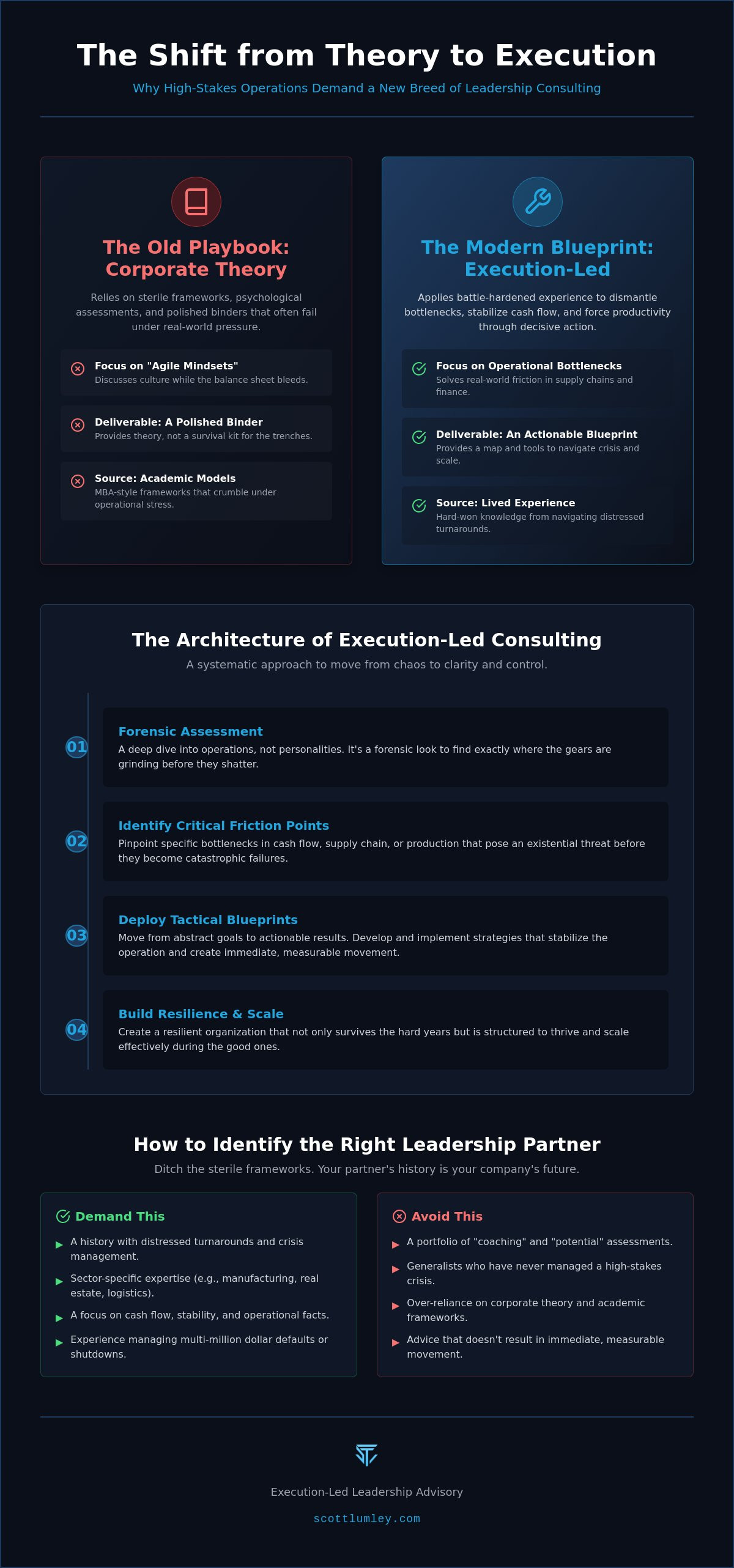
Slide decks don't fix supply chain friction. They don't resolve construction delays or stop a manufacturing bleed. Most firms offer sterile frameworks developed in ivory towers. These MBA-style models often crumble when they hit the reality of a distressed asset or a high-stakes turnaround. Lived experience is the only currency that matters in the trenches. You can't theorize your way out of a logistical nightmare. Leadership consulting is the tactical hunt for operational efficiency. It demands a partner who understands that every minute of friction is a minute of lost capital. If the advice doesn't result in immediate, measurable movement, it's just noise.
The Architecture of Execution-Led Leadership Consulting
Execution-led leadership consulting services don't rely on vague "agile potential" or culture-alignment surveys. They rely on blueprints. Identifying friction points before they escalate into catastrophic failures is the first step in stabilizing any operation. This requires a forensic look at the organization's current state. It's about finding where the gears are grinding and applying immediate pressure to fix them. While some Federal leadership development programs focus on long-term succession and policy-driven growth, private sector turnarounds require a much faster, asset-focused rhythm.
Effective leadership transitions often hinge on the accuracy of the initial assessment. This is where due diligence consulting services become critical. You cannot lead what you do not understand. If you're stepping into a new acquisition or a distressed real estate project, you must identify operational friction before the deal closes or the transition begins. Bridging the gap between a high-level real estate strategy and the concrete execution on the ground is what separates successful operators from those who simply hold assets until they bleed out. If you're ready to move from observation to action, it's time to evaluate your strategic planning needs with an operator who knows the stakes.
Operational Blueprints: Moving from Slide Decks to Results
A slide deck is a suggestion. A blueprint is a command. A 90-day stabilization plan maps out exactly what needs to happen to stop the bleed and start the build. This isn't about general improvement; it's about identifying leverage points. A leverage point is a specific area where a small change produces a massive result in cash flow or stability. Working with a strategic business advisor ensures you're scaling without breaking the infrastructure you've worked hard to build. You don't focus on every pain point. You focus on the ones that move the needle.
Crisis Management and Turnaround Leadership
Crisis doesn't wait for a quarterly review. Turnaround leadership requires a no-nonsense approach to asset management that stabilizes operations within the first 72 hours. In distressed situations, the priority is survival and recovery. This is the gritty reality of leadership. It involves making hard decisions about personnel, assets, and debt. It isn't pretty, and it isn't polished. It's a methodical process of stripping away what doesn't work to protect the core of the business. You need a partner who leads from the trenches, ensuring every move is calculated to reduce risk and restore operational clarity.
The Gap: Why Most Leadership Consulting Services Miss the Mark
Most consultants sell mirrors. They reflect your own corporate jargon back at you in a polished slide deck. They miss the mark because they prioritize "culture alignment" over operational survival. If your business is in the middle of a high-stakes turnaround, a theoretical concept won't stop the bleeding. You don't need a cheerleader who talks about "synergy." You need an operator who has lived through the crunch. Most leadership consulting services are built for HR departments, not for business owners facing the harsh realities of a distressed asset or a failing supply chain.
The danger lies in hiring advisors who have never managed a P&L in a crisis. It's easy to offer advice when the market is up and the margins are fat. It's an entirely different game when you're navigating a construction default or a retail collapse. The misconception that "culture" is the only thing that matters is a trap. Culture follows execution. If the operations are failing, the culture will be toxic regardless of how many workshops you host. You fix the friction first; the culture stabilizes as a result of winning.
The Problem with Sterile Assessment Frameworks
HR-led frameworks are often too soft for high-stakes environments. They look for "future-ready" leaders but ignore the current reality of a fractured organization. While an academic approach might help design a successful leadership development program for a stable corporation, it often fails in the trenches. "Agile potential" is a useless metric if your manufacturing floor is hemorrhaging cash. The disconnect between HR-led leadership search and operational reality is where most firms fail. You don't need predictive insights. You need tangible outcomes that show up on the balance sheet.
Why Industry Experience Trumps Academic Credentials
Academic credentials look good on a bio. They mean nothing when a project is six months behind and the bank is calling. This is why a hands-on business consultant is such a rare breed. Most firms are staffed by people who have never actually felt the pressure of a payroll they can't meet. Your advisor needs to understand the smell of the shop floor and the grit of the job site. Wisdom is earned through friction, not textbooks. Four decades of construction and logistics experience provides a level of intuition that a three-year consulting stint simply cannot match. Leading from the trenches isn't a catchphrase; it's the only way to ensure the strategy actually works when it hits the ground.
Identifying the Right Leadership Partner for Your Organization
Choosing a partner for leadership consulting services is a high-stakes decision. If you choose wrong, you don't just lose the consulting fee; you lose time, momentum, and potentially your business. Most firms will send a junior associate with a degree but no gray hair. You can't afford that. When the pressure is on, you need an operator who has navigated the same storms you're facing. Vetting a partner requires a methodical approach that prioritizes reality over reputation.
Follow these steps to ensure you aren't hiring another slide-deck architect:
- Step 1: Evaluate their history in distressed business turnarounds. Ask for specific examples of businesses they've pulled back from the brink. If they've only worked with healthy Fortune 500 companies, they won't understand your urgency.
- Step 2: Look for sector-specific expertise. Real estate, manufacturing, and logistics have unique friction points. A generalist won't understand the nuances of construction defaults or supply chain disruptions.
- Step 3: Demand a direct communication style. If they use words like "synergy" or "alignment" without defining the operational cost, walk away. You need a partner who tells you the truth, even when it's ugly.
- Step 4: Assess their ability for rapid deployment. In a crisis, you don't have six months for a discovery phase. You need someone who can land, assess, and execute within days.
- Step 5: Prioritize operational stability. Their goal shouldn't be to make your team feel better. Their goal should be to stabilize the asset and protect the cash flow.
Evaluating Industry-Specific Competencies
Generalists are a liability in high-stakes sectors. A consultant who doesn't understand the physical reality of property investment or the logistical grind of manufacturing will offer advice that is practically useless. You must perform due diligence on the advisor’s own background. Ask them about the hardest P&L they ever managed. Ask about the time they failed and what it cost. If they don't have a story about a loss, they haven't taken enough risks to lead you through yours. Before granting anyone access to your financials, ensure they understand the "smell of the shop floor."
Measuring Tangible ROI in Leadership Advisory
Success isn't a "better culture" if the business is still bleeding. In execution-led advisory, success is a healthier bottom line and reduced operational friction. You track this through measurable metrics: reduced project delays, stabilized debt, and improved margin. For mid-size firms, a fractional advisor often provides the best ROI. You get the weight of decades of experience without the overhead of a full-time executive. It's about surgical intervention rather than a permanent presence. If you're ready to stop the theory and start the recovery, it's time to secure a strategic partner who leads from the trenches.
Navigating Strategic Transitions with Scott Lumley
Scott Lumley isn't a career consultant who transitioned from a classroom to a boardroom. He's an operator. With four decades of experience navigating construction, retail, and logistics, he brings the weight of lived experience to every engagement. When you utilize his leadership consulting services, you aren't paying for a generic framework or a polished presentation. You're paying for a sobering voice of reason that has built, lost, and rebuilt businesses across multiple high-stakes sectors. This is advisory for those who value survival and recovery as much as expansion.
His approach to Strategic Planning moves past the abstract. It focuses on creating a roadmap that survives the first contact with reality. This is critical for industrial companies and property investment firms where a single error in judgment can result in millions in lost capital. Scott focuses on the harsh realities of the business. He strips away the motivational fluff to find the actionable path forward. He leads from the trenches, ensuring that the strategy isn't just a document, but a ground-level execution plan that stabilizes the organization.
Real Estate and Industrial Sector Leadership
Property investment firms often find themselves paralyzed by debt or stalled development projects. Most corporate consultants offer "board effectiveness" training, but Scott provides Real Estate Advisory rooted in forty years of asset management. For construction and manufacturing firms, the friction is usually physical. It involves logistics, supply chains, and labor inefficiencies. Specialized knowledge in these sectors is non-negotiable. You need an advisor who understands the mechanics of the shop floor as well as the nuances of the balance sheet. Scott provides the expert guidance required to navigate these complexities without losing momentum.
Sustainable Growth and Crisis Recovery
Growth is a risk. If you scale too fast without the right operational core, the organization breaks. Scott specializes in stabilizing distressed firms and preparing them for a strategic pivot. This involves Crisis Management that protects core assets while identifying new leverage points for expansion. It's a methodical, high-intensity process designed for survival and long-term durability. You don't just want to grow; you want to grow without breaking. If your organization is facing a high-stakes transition, you need a blueprint that works in the real world.
Secure your operational blueprint with Scott Lumley today and move past corporate theory into execution-led growth.
Stabilize Your Operations and Execute for Growth
Theoretical frameworks don't survive the friction of a distressed asset or a failing supply chain. You've seen how most leadership consulting services offer polished observations when you need tactical blueprints. Real-world results require a partner who has managed a P&L through the worst market conditions. Success in 2026 demands a shift from passive coaching to execution-led advisory that prioritizes cash flow and operational stability. It's about stripping away what fails and doubling down on what works.
With 40 years of hands-on experience in real estate, construction, and logistics, Scott Lumley provides the sobering voice of reason your business needs. You don't need a cheerleader; you need a strategist who leads from the trenches to deliver a tangible ROI. It's time to stop the operational bleed and build a resilient core that can withstand volatility. The path to recovery is narrow, but it's navigable with the right experience behind you.
Secure your operational blueprint with Scott Lumley and take control of your organization’s future today. Your business has the potential to thrive. You just need the right map to get there.
Frequently Asked Questions
What exactly is leadership consulting?
Leadership consulting is the strategic application of battle-hardened experience to solve operational bottlenecks and guide executive decision-making. These leadership consulting services aren't a theoretical exercise or a series of motivational workshops. This service provides the tactical blueprints needed to bridge the gap between high-level vision and floor-level reality. It focuses on identifying friction points and forcing a state of productivity through decisive action in high-stakes environments.
How is leadership consulting different from executive coaching?
Coaching focuses on the individual's personal growth and soft skills. Leadership consulting services focus on the organization's survival, operational efficiency, and bottom-line health. Coaching asks how you feel about your leadership style. Consulting asks how you fix a broken supply chain or stabilize a distressed asset. One is about personal development; the other is about organizational execution and asset protection.
Does my business need leadership consulting or a turnaround specialist?
If your business is stalling or bleeding cash, you likely need both. Leadership consulting provides the strategic guidance to realign the team's focus on execution. A turnaround specialist executes the physical recovery of the business. In many high-stakes operations, these roles are handled by the same battle-hardened operator who leads from the trenches to stop the bleed and restore operational clarity.
How much do leadership consulting services cost?
Fees are typically structured based on the complexity of the operation and the level of intervention required. While industry benchmarks exist for coaching and advisory retainers, execution-led consulting is priced according to the scale of the turnaround or the strategic project. You shouldn't view this as a standard expense. It's a strategic investment in stabilizing your assets and reducing costly operational friction that would otherwise drain your capital.
What industries benefit most from leadership consulting?
High-stakes sectors like manufacturing, construction, and logistics benefit the most. These industries have thin margins and high operational friction where a single mistake can be catastrophic. Any sector facing rapid regulatory shifts, like the EU AI Act transparency obligations starting August 2, 2026, needs this level of scrutiny. It's for businesses where the smell of the shop floor is more important than a slide deck.
Can leadership consulting help with real estate and property investment?
Yes. It provides the real estate advisory and due diligence necessary to identify risks before they become defaults. This specialized leadership helps firms navigate property tax debt, manage development timelines, and execute strategic pivots when market conditions turn. It's about applying a "no-nonsense" approach to asset management to ensure the investment remains viable even during a crisis or a high-stakes turnaround.
How do I measure the success of a leadership consultant?
Measure success through tangible ROI and the reduction of operational friction. Look for measurable improvements in cash flow, stabilized debt, and reduced project delays. If the bottom line isn't healthier and the operations aren't smoother within a defined timeframe, the engagement hasn't delivered. Culture improvements are a secondary result of winning. The primary metric is always the physical and financial health of the organization.
What is the first step in a leadership consulting engagement?
The first step is a forensic assessment of your P&L and current operational bottlenecks. This isn't a discovery phase for "company culture." It's a tactical hunt for leverage points where immediate action can stabilize the business. You start by stripping away the fluff to see the raw reality of the operation. This allows the consultant to build a 90-day stabilization plan that prioritizes survival and eventual growth.


