

Theory doesn't stop a tailspin. Only operational grit does. Most leadership advice is written by people who have never had to tell a crew their paychecks might be late. It's easy to talk about synergy in a boardroom. It's another thing entirely to fix a failing warehouse while the debt collectors are calling. You're likely feeling the weight of operational friction right now. You're tired of consultants who have never run a job site telling you how to manage your culture.
You need a tactical path forward that commands respect through results, not just a title. This is where resilient leadership consulting moves beyond the textbook and into the trenches. We're going to bridge the gap between high-level leadership theory and the hard-won operational resilience required to stabilize and grow your business under extreme pressure. You'll learn how to strip away the noise, identify your leverage points, and turn a failing turnaround into a steady recovery. It's time to stop managing the anxiety and start leading the execution.
Key Takeaways
- Discover why resilient leadership consulting focuses on operational execution and tactical grit rather than abstract theories or motivational fluff.
- Learn to identify friction in manufacturing and logistics before it scales into a crisis by leveraging deep-dive due diligence.
- Understand how to navigate the unique pressures of real estate investment and turn distressed assets into growth opportunities.
- Master a 5-step tactical framework designed to stabilize cash flow and operations within the first 72 hours of a business turnaround.
- See why a battle-hardened operator provides the transparency and integrity needed to lead a team through high-stakes recovery.
What is Resilient Leadership Consulting in the Recovery Zone?
Resilient leadership is not an emotional state. It's not about staying calm or finding your center while the business burns. In the recovery zone, resilient leadership is the ability to execute under extreme operational friction. It's the capacity to make hard decisions when the data is messy and the stakes are terminal. Most consultants offer sterile theory. They provide frameworks designed for stable boardrooms, not for the gritty reality of a high-stakes turnaround. Theory doesn't stop a tailspin. Execution does. Real resilience is measured in output, not in mindset shifts.
Traditional coaching often fails when a business enters the "red zone" of distress. Why? Because a coach asks questions, while a battle-hardened operator provides answers. When your logistics chain is snapped or your construction site is hemorrhaging cash, you don't need a cheerleader. You need a strategist who understands how to build Workplace resilience from the trenches. This is the core of resilient leadership consulting. It's an advisory model built on survival, recovery, and eventual expansion.
Resilience vs. Reaction: The Strategic Pivot
Most leaders in crisis are professional firefighters. They spend their days reacting to the latest disaster, chasing symptoms instead of curing the disease. This reactive cycle is a death trap. It burns through capital and exhausts your best people. Resilient leadership is the bridge between crisis management and sustainable scaling. It requires a strategic pivot from short-term panic to long-term tactical planning. Leadership anxiety is a massive hidden cost. It slows down decision-making, creates organizational friction, and signals weakness to your creditors. Resilience replaces that anxiety with a composed, methodical path forward. Stop reacting. Start leading.
Why Industry Experience is the Ultimate Leverage
You can't lead a boardroom if you don't understand the floor. A consultant who hasn't run a warehouse or managed a construction crew lacks the leverage to fix a broken operation. True authority is earned through results, not titles. With four decades of hands-on experience in retail, manufacturing, and logistics, I know that the solution to a turnaround is rarely found in a slide deck. It's found in the assets, the people, and the workflows. By integrating leadership consulting services into your recovery plan, you gain access to an execution-led strategy that prioritizes durability over hype. We don't just talk about grit. We apply it to your bottom line to ensure your business doesn't just survive, but dominates its space.
The Pillars of Operational Resilience in Industrial Sectors
Industrial resilience isn't found in a mindfulness app. It's found in the supply chain and the labor pool. Manufacturing, construction, and logistics firms face physical friction. When a machine breaks or a shipment is seized, a "positive mindset" won't fix the bottom line. You need operational grit. This is the foundation of resilient leadership consulting in the industrial space. It starts with brutal honesty about your current state. If the floor is failing, the boardroom is irrelevant.
Operational momentum is lost when leaders hesitate. In logistics, a two-hour delay at a port can ripple through an entire quarter. You don't have the luxury of reflection. You have the requirement of action. Resilient leadership is about maintaining that movement even when the labor market shifts or the supply chain breaks. It's about knowing which lever to pull to keep the engine running at all times.
Due Diligence is your preemptive strike. Most leaders wait for a crisis to react. Resilient leaders use deep-dive diagnostics to find the cracks before they become chasms. We look at asset utilization, labor efficiency, and vendor reliability. If you don't know where the friction is, you can't lead through it. This clarity allows for sustainable scaling. It's the art of growing your output without shattering your core operations. Don't outpace your infrastructure; strengthen it.
Manufacturing and Logistics: Managing the Friction
Optimizing a factory floor requires more than a spreadsheet. It requires a physical presence on the line. You need rapid deployment leadership. This means identifying bottlenecks in real-time and reallocating resources before the shift ends. In distressed industrial environments, speed is your only currency. If you need a blueprint for these high-stakes operations, consulting a strategic business advisor can provide the execution-led growth strategy your facility lacks. We don't just identify the problem. We stay until the gears are turning again.
Construction Leadership: Navigating Complex Project Stakes
Construction is a game of variables. Project delays, budget overruns, and regulatory hurdles are the norm, not the exception. Resilience here means moving from reactive crisis management to proactive risk reduction. You need to command respect from diverse teams, from subcontractors to inspectors. This requires authoritative expertise. It's about being the person who has seen the worst-case scenario and knows the way out. Real-world construction leadership is about holding the line on quality while the schedule is collapsing. If your projects are stalling, it's time to refine your operational strategy with a veteran who understands the stakes of a job site.
Resilient Leadership in Real Estate and Property Investment
Real estate is a high-stakes arena where capital meets physical assets. It demands a specific breed of resilience. In manufacturing, you can see the friction on the factory floor. In real estate, that friction is often buried in the fine print or the tax rolls. This is why resilient leadership consulting in the property sector focuses on identifying distressed opportunities before they become liabilities. You don't just need a broker. You need a strategist who understands that a property is an operation, not just a line item on a balance sheet. If the leadership at the top can't handle the pressure of a shifting market, the assets will eventually fail.
The Property Tax Debt System serves as a tactical example of this mindset. It allows leaders to extract value from distress. In a market where traditional acquisitions are often overpriced, finding opportunity in tax debt is the ultimate competitive advantage. This isn't just a financial play. It's about the leadership required to navigate the legal and operational hurdles of distressed assets. Real estate advisory is a leadership function. It requires the ability to command respect from lenders, tenants, and municipal authorities alike. You lead the asset; you don't just own it.
Portfolio Optimization Under Pressure
Managing a commercial portfolio during a downturn is a test of grit. Most advisors tell you to wait it out. A battle-hardened operator tells you to optimize. You need to look at asset utilization and cash flow with a critical eye. If an asset isn't performing, you pivot. This perspective comes from decades of navigating market cycles and seeing what happens when leaders freeze. If you want a property-specific strategy that prioritizes survival and recovery, look into real estate leadership advisory. Don't let a market correction wipe out your equity because you were too passive to act.
Due Diligence as a Strategic Safeguard
Due diligence is the act of uncovering operational friction before the deal is signed. It's the only way to protect your capital. Real estate leaders must prioritize hard data over soft promises. Brokers will sell you on "potential," but a resilient leader looks at the reality of the plumbing, the roof, and the tax liabilities. If you don't do the work upfront, you'll pay for it in the recovery phase. Utilizing specialized due diligence consulting services ensures that you identify friction points before they become your problem. In this game, what you don't know won't just hurt you; it will bankrupt you. Trust the data, not the pitch.
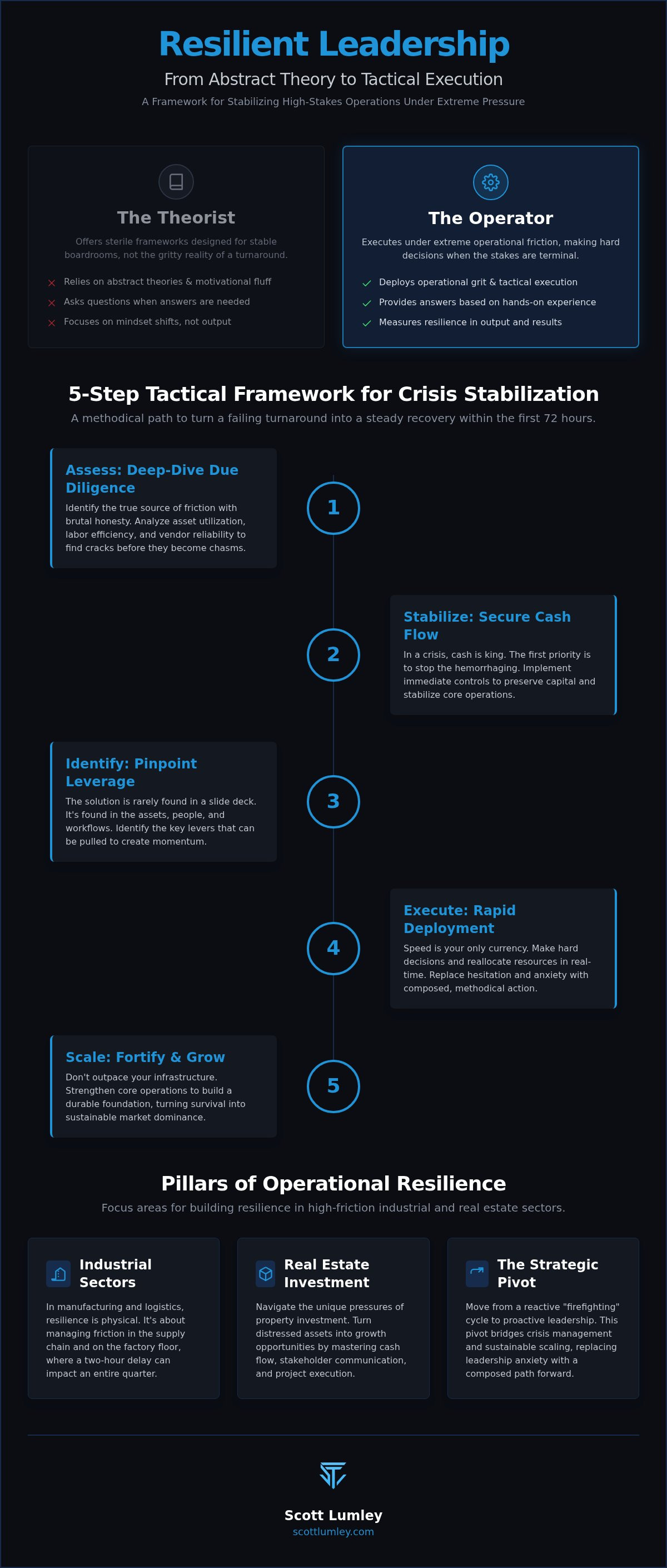
Executing the Pivot: A Tactical Framework for Crisis Stabilization
When a business is hemorrhaging capital, you don't "slow down to reflect." You execute. Stabilization is about stopping the bleed before the damage becomes terminal. Many leaders look for venture capital to bail them out, but external funding often masks internal failure. You need to fix the core operation using the assets you already have. This is the practical application of resilient leadership consulting. Real turnarounds aren't funded; they're earned through operational grit and clear-eyed decision-making.
The First 72 Hours: Critical Stabilization Moves
The first three days of a crisis determine survival. You must move with absolute clarity and zero hesitation. Follow this framework to stabilize the foundation:
- Step 1: Identify the primary bleed point. Find exactly where the cash is escaping. It is usually found in bloated payroll, broken logistics contracts, or uncollected receivables.
- Step 2: Strip away corporate fluff. If an expense doesn't contribute to immediate survival or core production, cut it immediately. This is operational essentialism.
- Step 3: Establish a no-nonsense communication rhythm. Provide daily updates to stakeholders. No spin. No false optimism. Just the facts and the next moves.
- Step 4: Prioritize cash flow over ego. Pay only what keeps the lights on and the engines turning. Everything else is secondary until stability returns.
- Step 5: Reallocate key assets. Move your best performers to the front lines where the friction is highest.
Navigating the Recovery Zone
The recovery zone is the period between stabilization and new growth. It's a dangerous phase. If you move too fast, you'll break the fragile foundation you just rebuilt. You must pivot from survival to strategic growth without losing the resilience that saved you. This requires a shift from firefighting to tactical scaling. In my book, I Survived Africa, the lessons in global operational resilience were clear: survival depends on the ability to adapt to harsh environments without losing focus on the objective. Your business is no different.
Executing this pivot alone is a high-risk gamble. Engaging a business turnaround consultant provides the outside perspective needed to identify blind spots in your recovery plan. We focus on the leverage points that move the needle. If you're ready to stop the bleed and start the build, contact us for an operational briefing. Don't wait for the market to decide your fate. Lead through it.
Why an Operator Beats a Theorist in Resilient Leadership
Certifications don't save companies. Experience does. Most consultants are academically trained coaches who have studied business from the safety of a classroom. They understand the vocabulary of leadership, but they lack the scars of operational failure. A theorist can tell you what should happen in a perfect market. An operator tells you what must happen when the market is collapsing. Resilient leadership consulting is only effective when it's delivered by someone who has navigated both extreme success and significant adversity. You don't need a coach who has read the manual; you need a strategist who has written it through four decades of work in construction, manufacturing, and logistics.
Integrity and transparency are non-negotiable in high-stakes environments. When a business is in the red zone, there is no room for sugar-coating or corporate spin. You need the brutal truth about your assets, your personnel, and your path forward. A battle-hardened advisor provides that clarity immediately. This isn't about being liked. It's about being right. Leading from the trenches is the only way to build unshakeable trust with a team that is already exhausted by operational friction.
The No-Nonsense Approach to Advisory
The Scott Lumley brand is built on rugged resilience. This isn't a personality trait; it's a professional standard. Results-driven leaders prefer direct, blunt feedback over empty cheerleading. We strip away the motivational fluff to focus on strategic planning and crisis management. If your warehouse is failing or your development project is stalled, a "mindset shift" won't fix the bottom line. You need a fractional or interim advisor who can step in, identify the leverage points, and execute. We lead from the front. We stay until the operation is stabilized. Trust is earned through results, not titles.
Next Steps: Moving Toward Sustainable Growth
The transition from friction to execution begins with a single, clear-eyed conversation. Starting a turnaround or growth strategy requires an honest assessment of your current state. What you can expect from a high-stakes leadership briefing is a tactical path forward, not a vague list of goals. We focus on operational essentialism. We identify the bleed, stabilize the core, and then build for sustainable growth. If you're ready to stop managing the anxiety and start leading the recovery, it's time to move. Don't wait for the crisis to deepen. Secure the authoritative expertise your business requires to survive and dominate. The path to resilience starts with the decision to act now.
Command Your Operational Recovery
Business survival isn't a matter of luck. It's a matter of execution. We've covered how to identify operational friction before it scales and why the first 72 hours of a turnaround are terminal for your success. You now understand that real resilience is found on the warehouse floor and in the property tax rolls, not in a textbook. Resilient leadership consulting provides the tactical path forward when the stakes are high and the room for error is zero.
With 40 years of industrial leadership and a background navigating extreme adversity detailed in I Survived Africa, I provide more than advice. I provide an operator's blueprint. Whether you're leveraging specialized Property Tax Debt Systems or stabilizing a logistics chain, the goal is sustainable growth. Stop reacting to the friction and start commanding the results your business deserves. Secure Your Operational Future with Scott Lumley Consulting today. Your recovery is waiting for a leader to take the first step. You have the tools; now lead the execution.
Frequently Asked Questions
What exactly is resilient leadership consulting?
Resilient leadership consulting is an execution-led advisory service focused on stabilizing operations under extreme pressure. Unlike traditional consulting that focuses on culture or theory, this service prioritizes tactical movement and survival. It's about bridging the gap between high-level strategy and the gritty reality of the warehouse or job site. We identify friction, stop the financial bleed, and build a durable foundation for recovery through direct, hands-on intervention.
How does operational resilience differ from executive coaching?
Coaching is often passive and focused on mindset; operational resilience is active and focused on output. A coach asks how you feel about a crisis. A resilient strategist tells you how to fix the broken logistics chain that caused the crisis. It's the difference between a cheerleader and an operator. We prioritize tangible results over reflection, ensuring your leadership commands respect through execution rather than just a title.
Can resilient leadership help a business already in financial distress?
Yes, it's specifically designed for businesses in the "red zone" of distress. Resilient leadership consulting provides the tactical framework to stabilize cash flow and strip away non-essential costs within the first 72 hours of an engagement. We don't wait for a market shift to save you. We look at existing assets and identify leverage points to stop the bleed immediately without the need for external venture capital funding.
What industries benefit most from resilient leadership consulting?
High-friction industrial sectors like manufacturing, construction, logistics, and retail see the most immediate impact. These industries face physical risks and operational complexities that theoretical advisors simply can't navigate. Real estate investment also benefits, particularly when dealing with distressed assets or complex tax liabilities. If your business depends on tangible assets and complex labor pools, you need a leadership strategy that can handle real-world friction and deliver results.
What is the 'Property Tax Debt System' in the context of leadership?
It's a strategic tool for finding opportunity in distress. This system allows leaders to extract value from real estate assets that others have abandoned due to tax liabilities. In a leadership context, it demonstrates the ability to navigate municipal hurdles and complex debt structures to secure equity. It proves that a resilient leader doesn't just manage growth. They find it where others only see a liability or a dead end.
How long does a typical business turnaround engagement take?
Stabilization happens in days, while recovery takes months. The first 72 hours are dedicated to critical stabilization moves like identifying the primary bleed point. Most full turnaround engagements last between three to six months depending on the depth of the operational friction. The goal isn't a permanent consulting contract. It's a rapid pivot to sustainable growth so your team can take the lead once the foundation is secure.
Why is industry experience more important than coaching certifications?
Certifications prove you've passed a test; experience proves you've survived a crisis. A battle-hardened operator has navigated 40 years of market cycles, supply chain collapses, and labor shortages. They lead from the trenches because they've been there. In high-stakes turnarounds, you need someone who knows the physical reality of a construction site or factory floor. Theoretical knowledge is useless when the debt collectors are at the door and production has stalled.
How do I know if my leadership team needs resilience training?
Look for signs of "firefighting" and decision paralysis. If your managers are constantly reacting to daily disasters instead of executing a long-term plan, you have a resilience problem. Leadership anxiety often manifests as operational friction and slowed growth. If your team lacks the authority to command respect through results, or if they're hiding behind corporate jargon, it's time to implement a no-nonsense, execution-led strategy to regain control of your future.


