

Your balance sheet is a crime scene. Most consultants want to hand you a polished slide deck and call it a strategy. They're wrong. A spreadsheet doesn't fix a broken culture or a failing production line. When cash is depleting and your key personnel are updating their resumes, you don't need a vision board. You need a surgical strike. You're likely feeling the suffocating pressure of mounting debt and the operational friction that turns every workday into a grind. It's exhausting.
We agree on the reality: your business is at a breaking point. This article delivers a gritty, execution-led roadmap designed for high-stakes recovery. By focusing on the hard realities of turnaround management implementation, you'll learn how to stabilize cash flow today and rebuild your foundation for tomorrow. We'll strip away the fluff to reveal a clear pivot strategy that restores confidence from your lenders and your team. This isn't about optimistic theories. It's about survival, stabilization, and the specific moves required to lead from the trenches when everything is on the line.
Key Takeaways
- Identify the operational rot hidden within your workflows by conducting a truthful pre-roadmap audit that looks past the surface of your financial statements.
- Execute an effective turnaround management implementation by prioritizing a total operational restructuring over simple financial adjustments.
- Halt the immediate cash bleed during a critical 72-hour stabilization window designed to stop all non-essential spending.
- Transition from survival to growth by executing a strategic pivot that restores stakeholder confidence and repositions your brand in the market.
- Apply battle-hardened experience to focus on gritty, real-world application rather than the theoretical fluff offered by traditional consultants.
What is a Business Turnaround Roadmap?
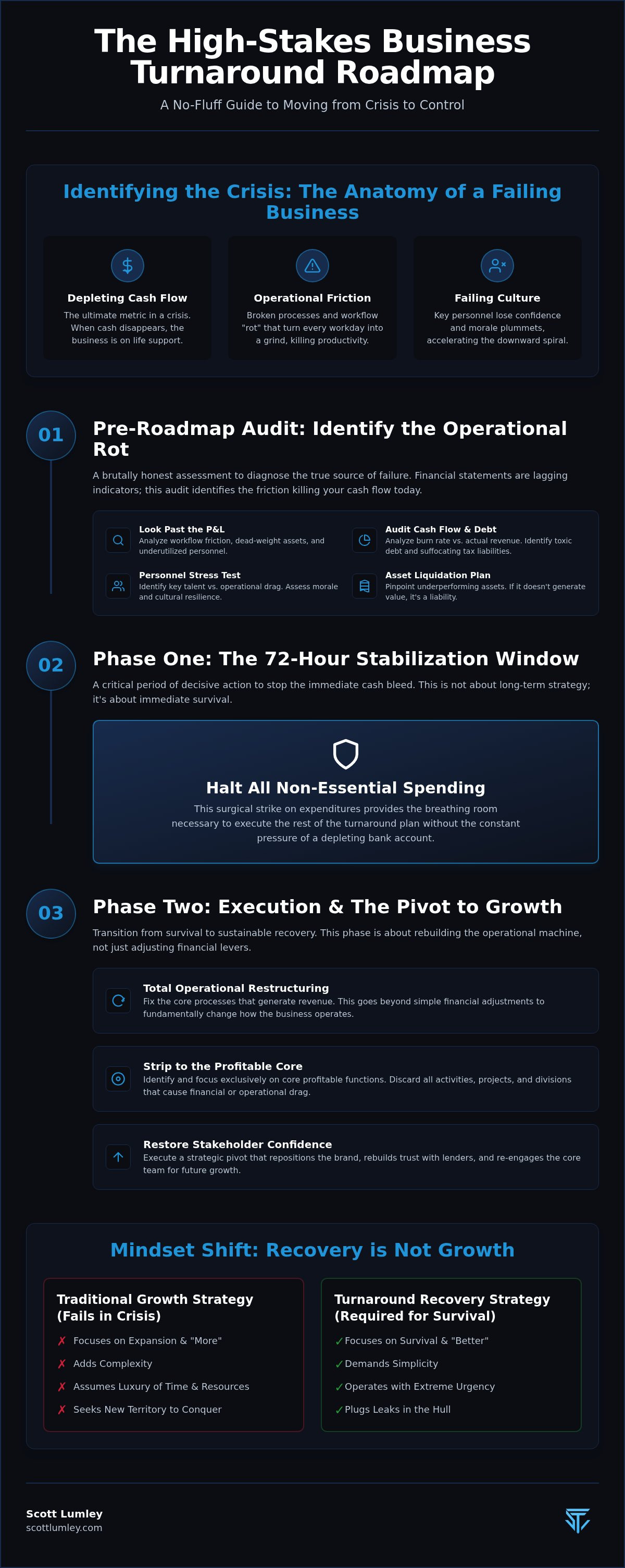
A business turnaround roadmap is a tactical guide for rapid operational recovery. It isn't a wish list or a collection of optimistic projections. It is a strategic blueprint designed to move a company from the brink of insolvency toward a state of predictable stability. When your business is failing, you don't need a vision statement; you need a sequence of high-impact moves that stop the bleeding. This roadmap acts as the sobering voice of reason during high-stakes emotional crises. It strips away the panic and replaces it with cold, hard logic.
Effective turnaround management implementation requires looking past the balance sheet. While many believe a recovery is strictly a financial exercise, it is actually a total operational restructuring. You're not just moving numbers; you're fixing the machine that generates those numbers. This process involves a deep dive into turnaround management principles to identify where the friction is killing your cash flow. It is the difference between surviving the month and building a foundation that can actually support future growth.
The Difference Between Growth Strategy and Recovery
Growth focuses on expansion, market share, and "more." Recovery focuses on survival, friction removal, and "better." Traditional growth consulting often fails in a distressed environment because it assumes you have the luxury of time and resources. You don't. In a crisis, the mindset must shift. You aren't looking for new territory to conquer; you're looking for the leaks in your own hull. Growth adds complexity. Recovery demands simplicity. It's about stripping the business down to its core profitable functions and discarding everything else that causes drag.
Why Most Business Turnarounds Fail
Failure usually starts with denial. Leadership often refuses to acknowledge the depth of the crisis until the cash is gone. By the time they act, the options are limited. Another common pitfall is chasing quick fixes. Applying a band-aid to structural operational rot won't save the company; it just delays the inevitable. Successful turnaround management implementation requires a decisive, battle-hardened leader who isn't afraid to make the hard calls. Without someone at the helm who has seen the trenches, the plan remains a theory. Turnarounds fail because of a lack of execution, not a lack of spreadsheets. You need someone who prioritizes the harsh reality of the situation over the comfort of corporate fluff.
The Pre-Roadmap Audit: Identifying Operational Rot
You can't fix a business with a blindfold on. Most leaders spend months lying to themselves about why the cash is disappearing. They blame the market, the interest rates, or "bad luck." This is a mistake. A successful turnaround management implementation begins with a brutal, honest assessment of your current state. You have to be willing to look at the operational rot that has settled into your workflows. If you don't truthfully diagnose the problem, your recovery plan is just a list of expensive guesses.
The audit must look past the P&L. Financial statements are lagging indicators; they tell you what happened last month, not why it's happening today. You need to identify the actual workflow friction slowing down production. This means identifying dead weight in your assets, personnel, and processes. Every minute of wasted movement and every underutilized machine is a leak in your boat. Transparency and integrity during this phase aren't optional. If your data is sanitized, your results will be catastrophic.
Auditing Your Cash Flow and Debt
Cash is the only metric that matters in a crisis. You need to analyze your burn rate versus your actual revenue generation with total precision. This isn't the time for "projected" earnings. We look for toxic debt and tax liabilities that are suffocating your operations. Property tax issues, in particular, can become a silent killer if left unaddressed. You must determine which assets are underperforming and ready for liquidation. If an asset isn't generating immediate value or supporting a core function, it's a liability. Sell it, scrap it, or move it. If you're struggling to prioritize these moves, a professional strategic planning session can help clarify which assets are worth saving.
The Personnel and Culture Stress Test
Your team is either your greatest asset or your biggest source of friction. You need to identify your key talent, the battle-hardened operators who will stay in the trenches when things get ugly. Contrast them with those who are simply contributing to the operational drag. Assessing morale is critical. Is the team ready for a gritty recovery, or have they already checked out? Culture isn't about office perks; it's about resilience. To bridge the gap between a failing culture and an execution-led team, you may need to leverage specialized leadership consulting services. A recovery requires a team that values transparency and is committed to the hard work of stabilization. If they aren't ready to fight, the roadmap won't matter.
Phase One: The 72-Hour Stabilization Window
The first 72 hours determine if your business survives the week. This isn't a period for reflection or deep analysis. It's a period for action. Successful turnaround management implementation requires you to move with total decisiveness. You start by stopping all non-essential spending immediately. Every dollar that leaves the bank must be tied to a function that generates immediate cash or prevents total collapse. If it doesn't move the needle today, the answer is no. You're not looking for long-term efficiency yet; you're looking for a pulse.
Once the spending is frozen, you must move through a rapid sequence of tactical moves. Step one is the immediate halt of discretionary cash outflows. Step two involves communicating directly with your major creditors. You aren't asking for permission; you're buying time. Transparency is your only leverage. Tell them the truth about the situation and the specific steps you're taking to stabilize. Step three is the triage of operations. Focus only on the products or services that yield high margins and fast cash. Finally, step four is securing the perimeter. This means protecting your intellectual property and physical assets from theft, neglect, or unauthorized access. In a crisis, value has a way of walking out the door if it isn't nailed down.
Cash Preservation and Triage
The "No-Fluff" spending rule is simple: if an expense doesn't contribute to operational recovery within the next 24 hours, cut it. This includes subscriptions, marketing campaigns without immediate ROI, and discretionary perks. When you negotiate with vendors, do it from a position of transparency. Explain the roadmap and offer a realistic payment plan. Credibility is built through honesty, not through avoiding the phone. Bringing in a seasoned business turnaround consultant is often essential here. They provide the objective distance and the "bad cop" persona needed to navigate these high-stakes negotiations without burning bridges or making empty promises.
Stabilizing the Leadership Core
Committees kill businesses in distress. During a turnaround, decision-making must be centralized. You need a command center where rapid-response decisions are made in minutes, not days. Establish a clear chain of command and eliminate the need for consensus. Your role is to communicate a clear survival message to the remaining team. They need to know the stakes are high, but they also need to see a steady hand at the wheel. Move quickly from identifying a pain point to offering a leverage point. This keeps the momentum moving forward when morale is at its lowest and the pressure is at its peak.
Phase Two: Execution and the Pivot to Growth
Survival is the baseline. Growth is the objective. Once you've stopped the bleeding, the focus of your turnaround management implementation shifts from triage to structural pivots. You can't just keep the lights on; you have to rewire the building. This phase is about repositioning the brand to regain customer trust and stripping away the logistical friction that caused the crisis. Streamlining your supply chain isn't just about saving pennies. It's about ensuring your operations move with the speed and precision required to stay alive in a high-stakes environment. You aren't just adjusting; you're transforming the core of how you do business. To map out this transition, engaging a strategic business advisor ensures your growth plan is rooted in execution, not just aspiration.
Operational Restructuring for Efficiency
Efficiency isn't a buzzword. It's a survival mechanism. In manufacturing or industrial settings, this means redesigning workflows to eliminate wasted movement and idle time. You have to be ruthless. Cut low-margin product lines that eat resources without returning profit. If a service doesn't contribute to the bottom line, it's dead weight. Every square foot of your facility must justify its cost. Before you pivot into new ventures or acquisitions, leverage due diligence consulting services. You need to identify operational friction before you commit capital to a new deal. Don't inherit someone else's mess. Focus on the assets that actually produce value and discard the rest without sentiment.
Reconnecting with the Market
Your customers aren't stupid. They know things have been rocky. Honest communication is your only path back to their good graces. Explain the changes. Show the results. This is how you rebuild a sales pipeline that actually lasts. Look for your "Blue Ocean"-the market space where you can compete without the high-stakes friction of a price war. This often means specializing in niches where your operational agility is a competitive advantage. Focus on high-margin, sustainable growth that supports your new, leaner structure. It’s about building a business that doesn’t just survive the next crisis but thrives because of its resilience. You need a pipeline that rewards your efficiency rather than taxing your resources. If you're ready to stop guessing and start executing, it's time for a direct strategic planning intervention.
The Lumley Advantage: Why Execution Trumps Theory
Scott Lumley doesn't deal in corporate fluff or optimistic theories. He brings 40 years of hands-on experience in the most demanding sectors: manufacturing, construction, and logistics. Most consultants hand you a binder and walk away. Scott leads from the trenches. This isn't about motivational speeches; it's about gritty, real-world application. When the stakes are high, you don't need a cheerleader. You need a strategist who has navigated extreme success and significant adversity. Integrity and transparency are the foundations of every engagement. The goal is simple: rapid results that stop the bleeding and rebuild the machine.
Effective turnaround management implementation requires a navigator who understands operational friction. It's about identifying exactly where the gears are grinding and applying the force necessary to fix them. Scott's approach is unapologetically direct and results-driven. He prioritizes hard-won wisdom over polished marketing promises. This commitment to transparency ensures that every move is calculated to deliver maximum impact in the shortest possible time. You get the sobering voice of reason when you need it most.
Leading from the Trenches
A permanent CEO is often too close to the problem to see the solution. They're bogged down by history and internal politics. An interim leader provides the objective distance required for a successful pivot. They make the hard calls without hesitation. This is where crisis management consulting becomes invaluable. It provides strategic stabilization when your operations are in freefall. By centralizing decision-making and removing the drag of committee-based choices, you turn survival into a long-term competitive advantage. You don't just fix the current crisis; you build a more resilient organization that knows how to fight.
Sustainable Growth Beyond the Recovery
The roadmap doesn't end when the cash flow stabilizes. It leads toward a scalable, friction-free operation. You have to ensure the structural changes you've made are durable. For asset-heavy firms, leveraging real estate leadership advisory is critical. It ensures your property operations are aligned with your overall recovery strategy. You're preparing the organization for future market shifts without the risk of breaking. We focus on building a foundation that supports expansion without reintroducing the operational rot of the past. It's about movement, strategic execution, and the relentless pursuit of a leaner, more profitable future. If you want a partner who values survival as much as growth, it's time for a direct strategic planning intervention.
Stop the Bleeding and Rebuild the Machine
Survival isn't guaranteed; it's earned through decisive action and a refusal to accept failure. You've seen the roadmap. It starts with a brutal audit of your operational rot and moves into a high-intensity stabilization phase. Successful turnaround management implementation isn't about hope. It's about execution. You must be willing to strip away the non-essential and focus entirely on what generates cash and reduces friction. This process requires a steady hand and the willingness to make the hard calls that others avoid. It is a surgical strike against the inefficiency that brought you to this point.
With 40 years of operational experience and a battle-hardened approach to crisis management, Scott Lumley provides the no-nonsense, results-driven strategy your business needs right now. Don't wait for the reserves to hit zero. Secure your business’s future with Scott Lumley’s turnaround consulting. You have the tools to recover and the path is clear. Lead from the trenches, execute the plan, and take back control of your operations today. The recovery starts with the first move.
Frequently Asked Questions
How long does a typical business turnaround take?
A full business turnaround typically takes 12 to 24 months. While the stabilization phase occurs within the first few weeks, structural changes require time to yield measurable results. You can't fix years of operational rot in a weekend. The first 90 days are critical for cash preservation. After that, the focus shifts to repositioning the brand and streamlining logistics. It's a marathon of execution, not a sprint of optimistic theories.
Can a business be saved if it has already filed for bankruptcy?
Yes, filing for bankruptcy often serves as a strategic tool for recovery rather than an end point. Chapter 11 allows for restructuring while protecting assets from creditors. It provides the breathing room needed for turnaround management implementation. You can shed toxic debt and renegotiate contracts that were previously suffocating your cash flow. Success depends on having a clear, actionable roadmap and the discipline to execute every surgical strike without hesitation.
What is the #1 mistake leaders make during a turnaround?
Denial is the most common and fatal mistake. Leaders often wait until their cash reserves are entirely depleted before admitting they need help. They blame external market factors instead of facing the internal operational friction. By the time they act, their options are limited. A successful recovery requires brutal honesty and the courage to cut non-essential spending before the bank forces your hand. Hesitation is the fastest way to insolvency.
How do I know if my business is beyond saving?
Your business is likely beyond saving when the cost of stabilization exceeds the total value of your assets and projected cash flow. If your core product is obsolete or your reputation is permanently destroyed, a pivot might be impossible. However, most businesses fail because of poor execution rather than a lack of market demand. If you still have a loyal customer base and a functional production line, there's usually a path back to stability.
Is a turnaround roadmap different for a retail business vs. manufacturing?
The fundamentals of cash preservation remain the same, but the tactical execution varies. Retail turnarounds focus heavily on inventory management and store-level profitability. In manufacturing, the focus shifts to production line efficiency and supply chain friction. You're fixing different types of machines. Manufacturing requires a deep dive into equipment utilization and labor costs. Retail requires a focus on customer foot traffic and margin protection. Both demand a total operational restructuring to survive.
What role does debt restructuring play in a turnaround roadmap?
Debt restructuring is the mechanism that buys you the time necessary to fix the operation. It's not a solution on its own; it's a bridge. By renegotiating terms with lenders or settling tax liabilities, you reduce the immediate pressure on your cash flow. This allows you to focus on turnaround management implementation without the constant threat of asset seizure. Without operational changes, however, restructured debt just delays the inevitable collapse.
How much does a professional turnaround consultant cost?
Fees for professional turnaround consulting vary based on the complexity of the crisis and the size of the operation. Most experts utilize a combination of monthly retainers and value-based success fees tied to specific recovery milestones. This aligns the consultant's incentives with your survival. While the cost may seem high, it's often a fraction of the losses incurred by continued operational friction or total insolvency. You're paying for battle-hardened experience.
What happens to employee morale during a radical pivot?
Morale typically drops during the initial stabilization phase because of the uncertainty and the necessary cuts. This is unavoidable. However, morale often rebounds once the remaining team sees a steady hand at the wheel and a clear path forward. Transparency is the key. When you communicate the survival message honestly, you build a culture of rugged resilience. The team stops worrying about the rumors and starts focusing on the next actionable move.


