

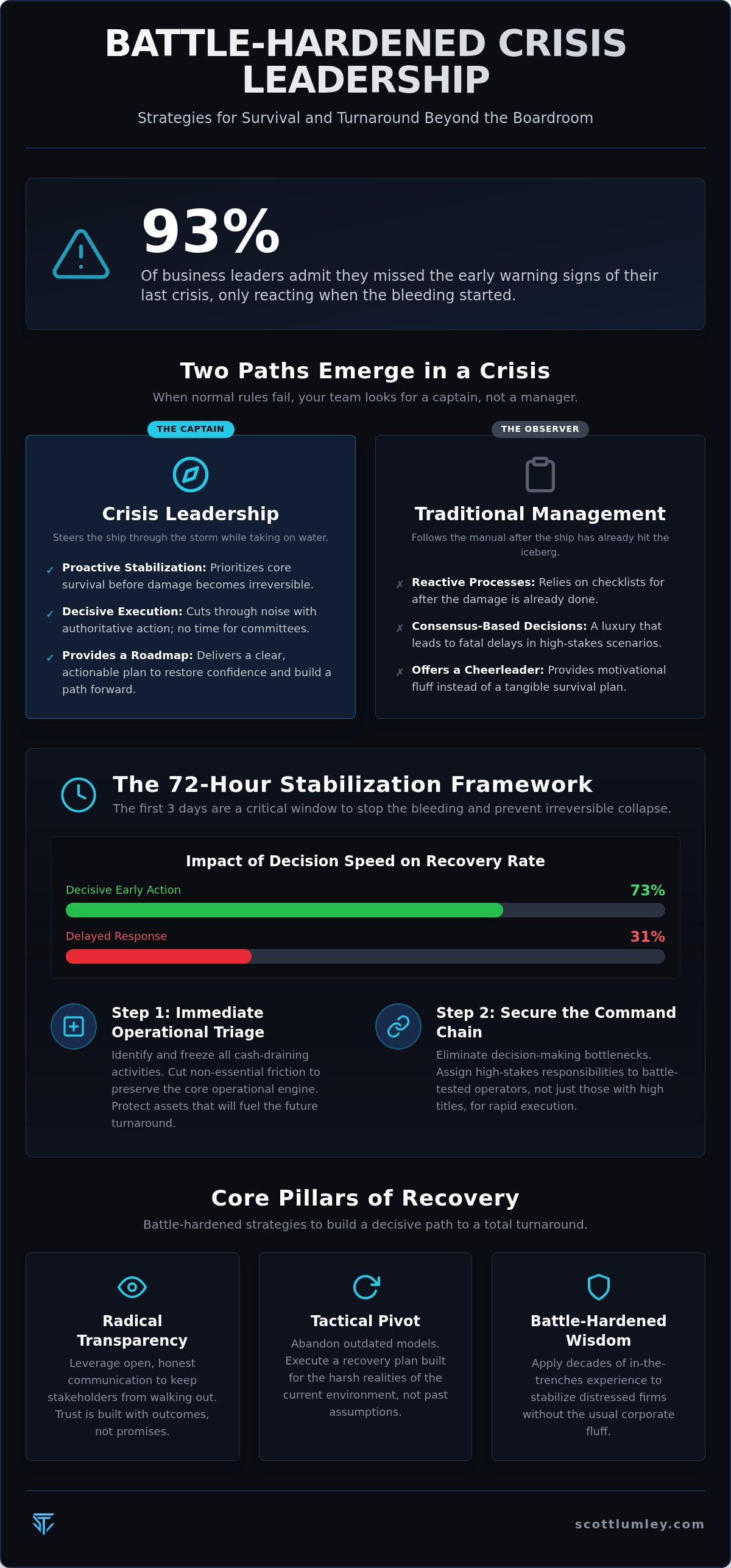
Ninety-three percent of business leaders admit they missed the early warning signs of their last crisis. Most didn't see the hit coming until the bleeding started. If you're reading this, you're likely standing in the middle of the wreckage. Stakeholders are panicking. The roadmap is gone. Operational stability feels like a fantasy. You need crisis leadership strategies that actually work in the trenches, not theoretical fluff from a boardroom.
It's exhausting to manage a firm that's hemorrhaging cash while trying to keep your team from jumping ship. You know that traditional consulting won't save you now. This guide delivers the battle-hardened strategies required to stabilize your operations, stop the financial bleeding, and confront existential threats head-on. We're stripping away the corporate jargon to focus on survival and recovery. We will break down the tactical moves needed to restore confidence and build a decisive path to a total turnaround.
Key Takeaways
- Shift from reactive management to proactive stabilization by prioritizing operational integrity under extreme pressure.
- Use a 72-hour framework to stop financial bleeding and secure liquidity when every minute counts for business survival.
- Leverage radical transparency as one of your core crisis leadership strategies to keep stakeholders from walking out the door.
- Execute a tactical pivot by abandoning outdated models and adopting a recovery plan built for the harsh realities of 2026.
- Apply 40 years of hard-won wisdom from the trenches to stabilize distressed firms without the usual corporate fluff.
Defining Crisis Leadership Strategies: Beyond Theoretical Management
Effective crisis leadership strategies aren't found in a textbook. They're built in the trenches of failing operations and systemic collapse. At its core, crisis leadership is the ability to maintain operational integrity under extreme, unyielding pressure. It's the difference between watching a ship sink and steering it into a safe harbor while the hull is taking on water. You don't need a cheerleader when the floor is on fire. You need a captain.
Most businesses confuse management with leadership. Traditional crisis management models often focus on reactive processes. They provide a checklist for after the damage is done. Crisis leadership is proactive stabilization. It prioritizes the survival of the core business before the secondary damage becomes irreversible. Standard protocols fail because they rely on predictable assumptions. In 2026, those assumptions are dead. You need battle-hardened leadership that values movement over perfection.
The Anatomy of a Business Crisis
Identifying an existential threat is the first hurdle. A market dip is a temporary loss of revenue. An existential threat is a total breakdown in liquidity or a supply chain failure that halts your ability to deliver. This is where operational friction accelerates. Every slow decision and every unreturned phone call acts as sand in the gears. During these moments, motivational fluff is dangerous. Telling a team to "stay positive" while the bank is freezing accounts is a fast way to lose your best people. They need a roadmap, not a cheerleader.
Leadership vs. Management in High-Stakes Scenarios
When the normal rules stop working, teams stop looking at the manual. They start looking at the leader. Management is about maintaining a process; leadership is about decisive execution. In high-stakes scenarios, consensus-based decision-making is a luxury you can't afford. You don't have time for a committee to debate the merits of a pivot. You need an authoritative voice that can cut through the noise and demand action.
This shift requires a gritty, transparent approach to problem-solving. It's about identifying the leverage points that stop the bleeding immediately. For many firms, crisis management consulting acts as the bridge between current chaos and future recovery. It provides the external perspective and the no-nonsense execution needed to stabilize a distressed firm before it's too late. Trust isn't built with promises. It's built with outcomes.
The 72-Hour Stabilization Framework: Stopping the Bleeding
The first 72 hours of a systemic failure are the most critical window for business survival. If you don't stop the bleeding within this timeframe, the momentum of collapse often becomes irreversible. This isn't the time for a five-year vision or cultural realignment. It's the time for tactical operational stabilization. Your immediate priority is operational liquidity and asset protection. You need a no-nonsense audit of every liability, every contract, and every outgoing dollar.
Stakeholder panic is a contagion. The only way to neutralize it is through visible, decisive action. People don't follow hope; they follow a plan that produces immediate results. Research from the Harvard Business Review shows that leaders who make decisive calls within the early stages of a crisis see a 73% recovery rate. Those who delay see that number drop to 31%. Effective crisis leadership strategies focus on the immediate 72-hour horizon to secure the ground before attempting to build on it.
Step 1: Immediate Operational Triage
Start by identifying the bleeding points in your logistics, manufacturing, or retail operations. Operational triage is the tactical prioritization of survival-critical functions. You must cut non-essential friction to preserve the core. If a product line is draining cash without immediate return, freeze it. If a logistics route is unreliable and costly, reroute or drop it. You are stripping the business down to its durable engine. A strategic planning approach during this phase ensures that you aren't just cutting costs, but protecting the assets that will fuel the eventual turnaround.
Step 2: Securing the Command Chain
Decision-making bottlenecks are terminal during a crisis. You must eliminate the layers of bureaucracy that slow down execution. Rapid deployment of leadership is mandatory. Assign high-stakes responsibilities to battle-tested operators who have lived through friction, not just those with the highest titles. Crisis response research indicates that decentralized execution with centralized intent is the most effective way to handle rapidly shifting threats. Establish a 24-hour feedback loop where information from the trenches reaches the command level in real-time, allowing for instant adjustments. These crisis leadership strategies turn a panicked organization into a focused unit.
Radical Transparency: Communication Strategies for Crisis Leaders
Corporate PR is designed to polish a reputation during the good times. It's a death sentence during a turnaround. When your operations are bleeding, stakeholders don't want a "messaging strategy." They want the truth. Radical transparency is one of the most effective crisis leadership strategies because it kills the rumors that drive panic. If you hide the reality of a liquidity crunch or a supply chain failure, your best people will fill the silence with their own worst-case scenarios. They'll leave because they've lost trust, not because the situation is difficult.
The myth that telling the truth triggers an exodus is a lie told by weak managers. People leave when they sense a cover-up. They stay for a leader who treats them like adults. You must deliver hard truths to employees and investors without a filter. Define the threat. Outline the fix. Then execute. This approach aligns with essential crisis leadership behaviors, specifically the need to decide with speed and communicate reliably. People can handle a hard reality if they see a leader who isn't flinching.
Communication as Tactical Leverage
Speculation is the enemy of stability. It's driven by emotion. You stop it with data. Use short, punchy sentences. Be direct. "The cash is low. The debt is high. Here is the cut." This clarity provides a sense of finality. It signals that someone is in control. You aren't asking for permission to survive. You're stating the requirements for recovery. This communication style creates a vacuum where panic used to live, replacing it with a sobering voice of reason that stakeholders actually trust.
Stakeholder Management Under Fire
Managing banks, vendors, and partners requires constant contact. Silence is interpreted as insolvency. You must over-communicate to prevent destructive rumors from taking hold. This is especially critical when managing physical assets and complex portfolios. Utilizing real estate leadership advisory services helps protect your footprint while you stabilize the core operations. Whether you're dealing with property investment partners or logistics vendors, your word must be iron. Follow the "One Voice" rule. Ensure every piece of communication is punchy, declarative, and unified across the entire organization. No contradictions. No excuses.
Operational Pivot: Executing the Crisis Recovery Plan
Survival mode is a temporary state. You can't live in triage forever without the business eventually starving to death. Transitioning to recovery mode requires a shift in focus from stopping the bleeding to rebuilding the engine. This is where crisis leadership strategies move from the defensive to the offensive. You must identify the specific pivot point where old, broken models are abandoned for a gritty new reality. This isn't about hope; it's about strategic execution.
In high-stakes industries like manufacturing and logistics, recovery doesn't happen in the boardroom. It's a floor-up process. You need to look at the friction points in production lines and delivery routes that were ignored during the good times. Engaging a business turnaround consultant helps identify these hidden leverage points. They provide the external perspective needed to see where the machine is grinding itself down. You don't need a theoretical advisor. You need someone who has fixed broken systems before.
Restructuring for Sustainable Growth
Growth often hides deep-seated operational friction. When revenue is high, waste is ignored. In a crisis, that waste becomes a terminal illness. Trimming the fat means identifying every process that doesn't directly contribute to the bottom line. You must redefine your core value proposition for a market that has fundamentally changed. A strategic pivot is the realignment of resources toward high-margin, low-friction activities. If a product or service isn't profitable and scalable in the current environment, it has no place in your recovery plan.
Building Long-Term Operational Resilience
Resilience isn't a buzzword; it's a survival trait. You must implement strategic safeguards to ensure the crisis doesn't repeat itself. This involves more than just a better bank balance. It requires a cultural shift that values recovery and survival as much as expansion. Utilizing due diligence consulting services allows you to future-proof the business by identifying operational friction before the next deal is signed. You build a company that is durable, not just profitable. If you are ready to stop reacting and start leading, contact Scott Lumley to stabilize your operations today.
The Scott Lumley Method: Battle-Hardened Crisis Leadership
Success in a turnaround isn't about having the loudest voice in the room. It's about having the most experience in the trenches. The Scott Lumley Method is built on 40 years of lived experience across construction, manufacturing, retail, and logistics. This isn't a theoretical framework designed in a sterile boardroom. It's a no-nonsense approach to high-stakes business advisory that prioritizes movement over perfection. When your firm is hemorrhaging cash, you don't need a consultant who studies crisis leadership strategies; you need an operator who has executed them.
Execution is the only metric that matters when your business is on the line. Sterile theory fails because it doesn't account for the friction of real-world operations. It doesn't account for the human element of stakeholder panic or the mechanical reality of a broken supply chain. Scott Lumley positions himself as a strategic business advisor who leads from the front. This is about gritty, transparent recovery. It's about stripping away the fluff to find the leverage points that actually stop the bleeding.
Execution Over Sterile Theory
Cheerleading doesn't save businesses. Strategic planning does. There's a fundamental difference between a fractional advisor and a battle-hardened operator. One offers advice; the other offers outcomes. The Lumley Method focuses on tangible results and operational recovery. We don't care about superficial appearances or corporate jargon. We care about liquidity, asset protection, and the restoration of stakeholder confidence. If a process doesn't contribute to one of those three goals, it's a distraction. We cut the distractions so you can focus on survival.
Next Steps: Stabilizing Your Operation
Identifying your specific needs is the first step toward recovery. Do you need an interim leader to take the wheel, or a full-scale turnaround strategy to overhaul the machine? The answer depends on the depth of the crisis and the speed of the collapse. Rapid deployment is the cornerstone of effective leadership consulting services. You can't afford to wait for a three-month audit. You need a briefing that identifies the immediate threats and the tactical moves required to neutralize them.
Your business is either moving toward recovery or toward collapse. There is no middle ground in a crisis. If you're ready to stop the bleeding and restore operational integrity, you need a strategist who values execution over theory. Contact us today for a high-level briefing. Let's look at the facts, identify the friction, and build a path back to stability. The time for talk is over. The time for execution is now.
Stop the Bleeding and Take Control
Stabilization isn't a passive process. It's a tactical hunt for leverage. We've covered the necessity of the first 72-hour window and why radical transparency is your best weapon against stakeholder panic. These crisis leadership strategies are designed for one purpose: to keep your business alive when the floor starts to give way. You've seen the difference between managing a process and leading a recovery.
Success in a turnaround requires a battle-hardened strategy that produces direct, execution-led results. With 40 years of operational experience in the trenches of manufacturing and retail, we know that sterile theory won't save a failing firm. Only decisive action will. You don't need a cheerleader. You need a captain who has navigated these waters before.
The path to recovery is narrow, but it's open. You have the tools to stabilize your operations and restore confidence. It's time to stop reacting to the chaos and start dictating the terms of your turnaround. Secure Your Operation with a High-Stakes Strategic Briefing today. You can still win this fight.
Frequently Asked Questions
What is the first step in effective crisis leadership?
The first step is immediate operational triage to identify bleeding points and secure liquidity. You don't start with a vision statement or a culture audit. You look at the cash. You look at the assets. Identify what is draining resources without return and freeze it immediately. This creates the breathing room needed to execute a recovery plan. Survival requires a brutal, honest assessment of your current liabilities and outgoing capital.
How do crisis leadership strategies differ from standard management?
Standard management is built for predictable environments and incremental growth. Crisis leadership strategies are built for systemic friction and existential threats. Management relies on consensus and established protocols. Leadership demands authoritative execution and rapid decision-making. In a crisis, the luxury of a committee is gone. You aren't maintaining a system; you are rebuilding one while it's under fire. It's the difference between driving a car and fixing the engine at speed.
Can a business recover from an operational crisis without VC funding?
Recovery without outside capital is not only possible but often more sustainable. You achieve this by stripping away operational waste and focusing on high-margin core functions. It requires a floor-up restructuring that prioritizes cash flow over expansion. VC funding often masks deep-seated friction rather than fixing it. True recovery comes from fixing the machine, not just throwing more fuel into a leaking tank. It's about grit and strategic execution.
How do I maintain employee morale during a business turnaround?
You maintain morale by delivering the hard truth and securing small, visible wins. Don't use motivational fluff or empty promises. Employees aren't stupid; they can smell a cover-up. Give them a clear roadmap and show them that the plan is working. When they see a leader who isn't flinching and an operation that is stabilizing, their confidence returns. Trust is the byproduct of competent execution, not a pep talk in the breakroom.
Is it possible to lead a crisis recovery while managing daily operations?
Leading a recovery while managing daily operations is a recipe for burnout and failure. The mental bandwidth required to fight a fire is different from the bandwidth needed to run a factory. Most successful turnarounds involve an interim leader or a strategic advisor who focuses solely on stabilization. This allows the existing team to maintain what works while the advisor fixes what is broken. You can't be the captain and the engineer simultaneously.
What role does transparency play in crisis leadership strategies?
Transparency is a tactical tool used to neutralize panic and restore stakeholder confidence. Effective crisis leadership strategies utilize radical honesty to align everyone with the reality of the situation. When you hide facts, you create a vacuum that gets filled with speculation and fear. By providing a sobering voice of reason, you kill rumors before they destroy the organization. Truth is the foundation of any recovery plan that actually sticks.
How long does a typical business stabilization process take?
Initial stabilization should happen within the first 72 hours. This is the triage phase where you stop the bleeding and secure liquidity. A full operational recovery typically takes anywhere from six to eighteen months depending on the depth of the friction. You aren't looking for a quick fix; you're looking for a durable turnaround. The goal is to move from survival mode to a gritty new reality where the business is resilient.


