

Buying an industrial asset based on a clean balance sheet is the fastest way to inherit someone else’s operational nightmare. If you’re only looking at the paperwork, you aren’t doing real due diligence for industrial property; you’re just checking boxes while the real risks stay buried under the concrete. A pretty P&L doesn't tell you if the floor slab is failing or if the local grid can actually handle your automation. You’re not just buying a building. You’re buying its history, its friction, and every hidden liability the seller is hoping you won't find.
You already know the stakes are high. One overlooked environmental liability or a miscalculation in floor load capacity can turn a strategic acquisition into a financial anchor. This guide isn't a theoretical exercise. It's a gritty, execution-led framework designed to identify operational friction and hidden infrastructure costs before the deal closes. We're going to conduct an operational autopsy. You'll walk away with a clear risk assessment, validated capacity metrics, and the strategic leverage you need to win at the negotiating table.
Key Takeaways
- Stop treating this as a clerical task. Effective due diligence for industrial property requires an operational autopsy to identify friction before capital is committed.
- Learn why the physical state of the floor and the soil dictates your output capacity. Environmental liabilities can quickly outstrip the asset's total value if ignored.
- Analyze the local infrastructure and labor pool as part of your strategic audit. A building is only as valuable as the power grid and workforce that fuel it.
- Use a focused checklist to navigate legal hurdles and zoning compliance. This prevents analysis paralysis and ensures you focus on the variables that actually move the needle.
- Leverage battle-hardened experience to spot the operational rot that traditional advisors miss. Move from a paper-based review to a high-stakes, boots-on-the-ground reality check.
Beyond the Closing Table: Defining Industrial Property Due Diligence
If you treat due diligence as a formality to satisfy a lender, you’ve already lost. In the industrial sector, this process is an operational autopsy. It’s the systematic audit of physical, legal, and operational assets designed to uncover the "deal-killers" before your capital is irrevocably committed. Standard commercial due diligence often fails industrial buyers because it ignores specialized infrastructure. You aren't just buying four walls and a roof. You’re buying power grids, floor load capacities, and environmental histories. Effective due diligence for industrial property provides the hard data needed for aggressive price renegotiation or the courage to walk away from a bad deal. It’s the only window you have to see the asset for what it truly is, rather than what the broker’s brochure claims it to be.
The High Stakes of Industrial Acquisitions
Industrial assets carry risks that don't exist in retail or office space. Environmental contamination can exceed the total value of the land. Specialized zoning can restrict your operations overnight. Surface-level inspections are a liability. If you don't look at the soil or the structural integrity of the slab, you're gambling with your margins. Operational friction in a warehouse destroys profits faster than high interest rates. You need to know exactly what the asset can do before you sign. A warehouse with a failing roof or a factory with insufficient power isn't an investment. It's a debt trap. You must identify these points of failure while you still have the power to say no.
Due Diligence as a Strategic Leverage Point
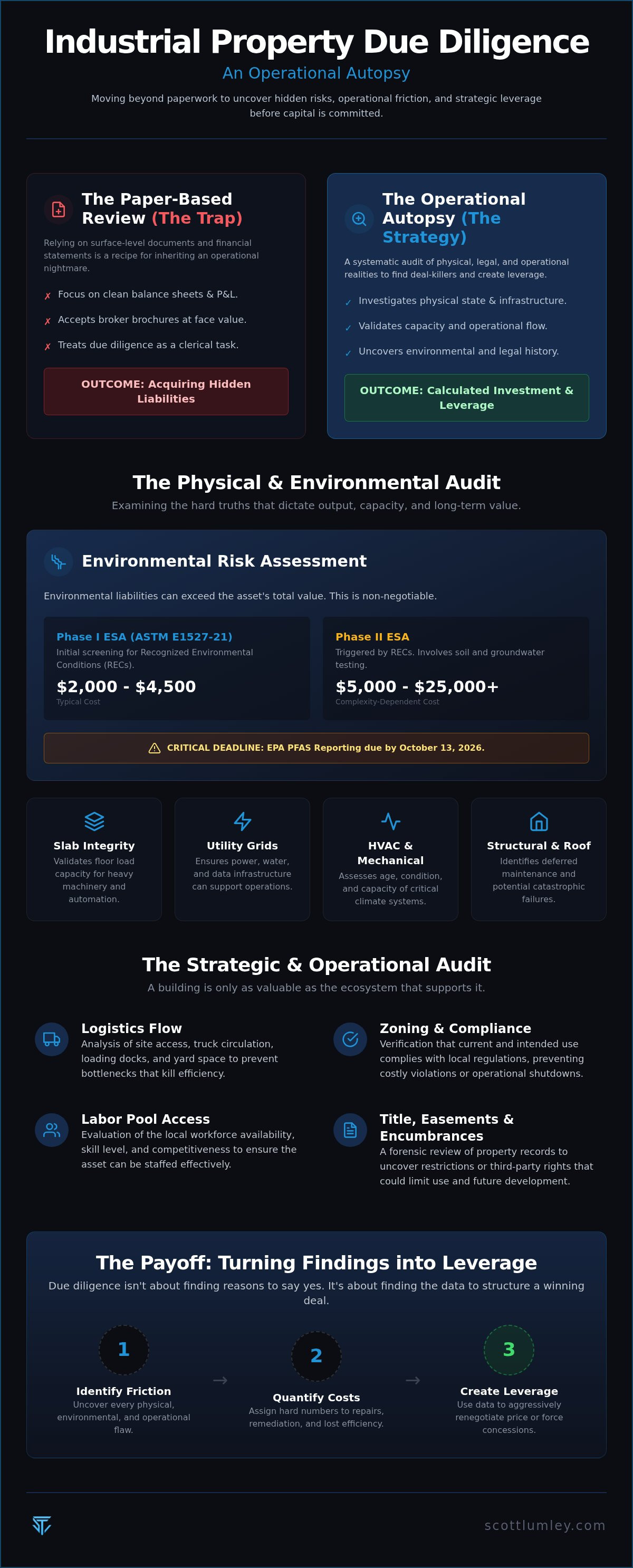
Findings aren't just risks; they’re leverage. When you uncover a failing HVAC system or a non-compliant drainage system, you have the data to restructure the deal or adjust the cap rate. This isn't about checking boxes. It’s about identifying leverage points that the seller hoped you’d miss. You use these facts to squeeze the price or force repairs. Most buyers look for reasons to say yes. You should be looking for reasons to say no. If the deal survives that level of scrutiny, then it’s worth the capital. Due diligence is the process of stripping away marketing fluff to achieve absolute operational clarity.
- Physical Assets: Roof, slab, HVAC, and electrical capacity.
- Legal Assets: Zoning, easements, and title encumbrances.
- Operational Assets: Logistics flow, labor access, and utility reliability.
Due diligence is the tool that transforms a speculative purchase into a calculated strategic move.
The Physical and Environmental Audit: Hard Truths on the Factory Floor
Industrial properties aren't just buildings. They're productive assets. The physical state of the facility directly dictates its output capacity and operational efficiency. If the floor slab can’t support your heavy machinery or the local grid can’t fuel your automation, the asset is a liability. You aren't just buying real estate; you’re buying an engine. If that engine is seized, your investment is dead on arrival. Thorough due diligence for industrial property requires looking beneath the surface to find the friction that stops production. Integrating a comprehensive due diligence checklist ensures that no detail, from soil samples to slab thickness, is overlooked during this phase.
Environmental Risk and Remediation
Environmental liabilities can quickly exceed the total value of the land. Every industrial acquisition must start with a Phase I Environmental Site Assessment (ESA) compliant with the ASTM E1527-21 standard. In 2026, a standard Phase I ESA costs between $2,000 and $4,500. If that report identifies Recognized Environmental Conditions (RECs), you must trigger a Phase II. This involves soil and groundwater testing, typically costing between $5,000 and $25,000 depending on the complexity. You also need to watch for the October 13, 2026, EPA PFAS reporting deadline. Legacy chemical footprints and underground storage tanks (USTs) aren't just historical footnotes. They're financial landmines that stay with the property long after the previous owner is gone.
Specialized Infrastructure and Utility Grids
Utility infrastructure is the lifeblood of industrial operations. You can’t assume the building’s power capacity is sufficient for modern manufacturing automation. Auditing the electrical grid is mandatory. You must also evaluate specialized ventilation systems and HVAC units. As of January 1, 2026, new EPA regulations require automatic leak detection for large refrigeration systems. If the property doesn't comply, that's an immediate capital expenditure you need to factor into your offer.
- Floor Load Capacity: Assess the slab for specific heavy machinery loads, not general occupancy.
- Ceiling Heights: Modern logistics require clear heights that support high-density racking.
- Water and Gas: Verify that local supply lines can handle peak operational demand without surging costs.
For those who need a battle-hardened perspective on these risks, a real estate advisory partner can identify the operational rot that paper reports often miss. Don't rely on the seller's disclosures. Verify the infrastructure yourself or prepare to pay for it later.
Operational Due Diligence: Analyzing the Engine, Not Just the Shell
A warehouse is not just four walls and a roof. It is a cog in a massive, moving machine. While traditional commercial real estate due diligence focuses on lease terms and property taxes, it often ignores the reality of the floor. If the property doesn't function as a high-speed node in your supply chain, it’s a failed asset. Proper due diligence for industrial property requires you to analyze the engine, not just the shell. You must identify operational friction before it eats your margins. You aren't just buying a building. You're buying its ability to move goods and people with total efficiency.
Logistics and Supply Chain Connectivity
Logistics efficiency lives or dies in the yard. You need to scrutinize the site layout for throughput speed. Are there enough dock doors to prevent bottlenecks during peak hours? Is the turning radius sufficient for modern 53-foot trailers? Ingress and egress efficiency can make or break a last-mile distribution facility. If a truck spends twenty minutes maneuvering because of a cramped site layout, you aren't just losing time; you're losing money. Proximity to major transport hubs is a baseline requirement, but the site's internal flow is what dictates its true capacity. A building with a great location but a broken layout is a bottleneck you can't afford. You need to walk the yard and see the friction yourself.
Labor Markets and Operational Sustainability
A building is useless if you can't staff it. Labor access is a critical component of due diligence for industrial property that most investors overlook. You need to assess the local demographics and the availability of a skilled workforce within a thirty-minute commute. Labor scarcity is a hidden cost that manifests as high turnover and rising wages. It can destroy the viability of an acquisition faster than a leaking roof. You aren't just buying a facility; you're entering a labor market. Integrating real estate leadership advisory allows you to look past the physical specs and assess the long-term sustainability of the operation. If the people aren't there, the asset won't perform. You need to know if the local talent pool is deep enough to support your expansion or if you're buying into a talent desert.
The Industrial Acquisition Checklist: Cutting Through the Noise
Most buyers drown in documentation. They collect thousands of files but miss the signal. Documentation is only useful if it leads to an actionable decision. If a report doesn't tell you to buy, walk, or renegotiate, it’s just noise. You need a prioritized framework to navigate the due diligence window without falling into analysis paralysis. Effective due diligence for industrial property requires you to separate the clerical check-boxes from the high-stakes variables that actually dictate your return on investment. You aren't a clerk. You're an operator making a high-stakes bet on an asset’s future performance.
Legal and Regulatory Documentation
Start with the ALTA survey. Don't just look at the property lines. Look for encroachments or easement issues that could restrict future expansion. If a utility easement cuts through the center of your primary yard, your throughput is capped before you even start. Confirm zoning compliance for your specific use. There is a massive operational difference between heavy and light industrial zoning. A building that looks perfect for manufacturing might be legally restricted to light assembly. You need to verify these details against current municipal codes, not just the seller’s word. For a deeper audit that uncovers these hidden legal traps, leverage professional due diligence consulting services to ensure the paperwork matches the reality on the ground.
Financial and Tenant Analysis
Rent rolls are the surface level. You need to dig into the CAM reconciliations and tenant creditworthiness. If your anchor tenant is struggling, your cash flow is at risk regardless of the lease term. Analyze the lease expiration schedule to avoid a "dark" building scenario. You also need to scrutinize the property tax debt history. Effective real estate tax rates vary significantly across the country, and a sudden reassessment can turn a profitable asset into a liability overnight. Audit historical maintenance costs to predict future CapEx requirements. If the previous owner deferred roof repairs for a decade, that cost is coming out of your pocket in year one.
- ALTA Surveys: Identify restrictive easements or encroachments.
- Zoning Verification: Ensure heavy industrial uses are permitted.
- Tax Debt Audit: Uncover hidden liens or pending reassessments.
- CapEx Projections: Forecast the next five years of structural maintenance.
If you want to cut through the noise and identify the operational rot before the deal closes, secure a due diligence advisory partner who has spent forty years in the trenches. Don't let a clean paper trail blind you to a failing asset.
Strategic Advisory: Executing the Deal with Absolute Clarity
Due diligence is a leadership function. It isn't a clerical task for junior analysts to handle. If you treat it like a paper exercise, you'll miss the operational rot that sinks deals. Real due diligence for industrial property requires a "boots on the ground" perspective. You need someone who has seen the floor fail and the grid collapse. Scott Lumley brings forty years of lived experience to the table. He identifies the friction that traditional advisors miss because he’s been in the trenches of construction, logistics, and turnaround management. This isn't about polished marketing promises. It’s about the harsh realities of high-stakes business.
Identifying Turnaround Potential in Industrial Assets
Not every flaw is a reason to walk away. Some are opportunities for massive growth. Identifying turnaround potential is where real value is created. A distressed property might look like a failure on paper, but with the right leadership consulting services, it can be salvaged. This is where the role of a business turnaround consultant becomes vital. You aren't just buying an asset; you're buying a recovery project. You must evaluate the "turnaround ROI" against the "stabilized asset ROI." A stabilized asset offers predictable, lower returns. A turnaround project offers high-stakes recovery with significant upside. If the friction is fixable through better operational execution, the discount you negotiate during diligence becomes your profit margin. This is how seasoned operators build wealth in the industrial sector.
Finalizing the Acquisition Strategy
The end of discovery is the beginning of execution. You need a "Go/No-Go" decision matrix that consolidates your findings into hard truths. Does the slab hold the load? Is the power grid sufficient? Is the labor pool deep enough? If the answers aren't a resounding yes, you renegotiate or you walk. Preparing for operational takeover starts before the ink is dry. You need a plan for day one that addresses the hidden liabilities you’ve uncovered. Industrial property is a long-term play. It requires a foundation of hard-won wisdom, not optimistic theories. You need to move from discovery to absolute clarity with speed and decisiveness. Don't let a clean paper trail blind you to a failing asset.
Stop guessing and start executing with total transparency. Contact Scott Lumley for high-stakes due diligence advisory and ensure your next acquisition is built on reality, not a broker’s promise. Secure the leverage you need to win at the closing table and beyond.
Master the Operational Autopsy
Industrial property is a high-stakes arena where the margin for error is razor-thin. You can't afford to rely on a clean paper trail when the physical asset or the local labor pool is failing. Effective due diligence for industrial property means performing a total operational autopsy. You've seen how to audit the factory floor, evaluate logistics flow, and cut through the noise of standard checklists. These aren't just technical steps. They're strategic maneuvers that provide the leverage you need to win or the courage to walk away from a liability.
Success in this sector requires more than software or legal templates. It requires the grit of someone who has managed manufacturing and logistics from the trenches. Scott Lumley brings 40 years of operational experience and expertise in manufacturing and logistics to your deal. He specializes in high-stakes turnarounds and identifying the operational rot that traditional advisors miss. Don't leave your capital to chance. Secure Your Industrial Investment with Scott Lumley’s Advisory and move forward with absolute clarity. You have the framework. Now it's time to execute with confidence.
Frequently Asked Questions
How long does due diligence for industrial property usually take?
It typically takes between 30 and 90 days to complete. The timeline depends heavily on the complexity of the asset and the speed of third-party reports. A Phase I ESA alone takes about two to three weeks. If you trigger a Phase II, add another four weeks. Lenders often dictate this window. Don't rush it. Moving too fast leads to overlooked structural flaws or environmental liabilities that sink your long-term margins.
What is the difference between Phase I and Phase II environmental reports?
A Phase I ESA is a non-invasive review of historical records and a visual site inspection. It identifies potential contamination risks without breaking ground. A Phase II ESA is the next step if the Phase I finds red flags. It involves actual soil, air, or groundwater sampling to confirm the presence of toxins. You need the samples to know the real remediation costs. This process ensures you don't inherit a multi-million dollar cleanup.
What are the most common red flags in an industrial property inspection?
Structural slab failure is the biggest deal-killer. If the floor can't handle heavy machinery, the building is useless for manufacturing. Other red flags include aging roof systems, inadequate electrical capacity for automation, and poor site drainage. Look for signs of underground storage tanks or legacy chemical stains. If the utility grid can't scale with your operation, you're buying into a bottleneck. These physical issues represent immediate capital expenditures that you must negotiate out of the price.
Why is zoning so critical for industrial real estate acquisitions?
Zoning dictates what you can actually do inside the building. A property zoned for light assembly won't legally support heavy manufacturing or chemical processing. If you ignore these restrictions, you risk municipal fines or total operational shutdown. You must verify that your specific use is permitted by right. Don't rely on the current tenant's use. Local codes change. Confirming zoning is a non-negotiable part of due diligence for industrial property.
How can operational due diligence impact the final purchase price?
Operational findings provide the leverage needed for aggressive price renegotiation. If you discover the truck turning radii are insufficient or the dock doors are failing, those are operational friction points. You calculate the cost to fix these bottlenecks and subtract it from the offer. You aren't just buying a shell; you're buying throughput. If the building restricts your speed, it’s worth less. Use these hard facts to squeeze the seller before the deal closes.
What documents should be included in a standard industrial due diligence checklist?
Your checklist must include the ALTA survey, Phase I ESA, and at least three years of maintenance records. You also need updated rent rolls, CAM reconciliations, and property tax debt history. Don't forget the certificate of occupancy and any active equipment warranties. These documents prove the asset's health. If the seller can't provide them, it's a major red flag. Every document should lead to a clear go or no-go decision for the acquisition.
How does an ALTA survey differ from a standard property survey?
A standard survey only shows property boundaries and basic improvements. An ALTA survey is much more rigorous. It follows national standards and reveals easements, encroachments, and zoning setbacks that a basic survey misses. It’s the gold standard for title insurance companies. In the industrial sector, knowing exactly where a utility easement sits is vital. It prevents you from planning an expansion over land you don't actually control. This ensures your operational footprint is secure.
Can due diligence identify potential for a business turnaround?
Yes, it identifies the specific friction points that a turnaround strategy can solve. You look for assets with "good bones" but poor management or deferred maintenance. If the building's problems are operational rather than structural or environmental, there is massive upside. You use due diligence for industrial property to find the rot you can cut out. This allows you to buy at a discount and create value through better leadership and execution.


