

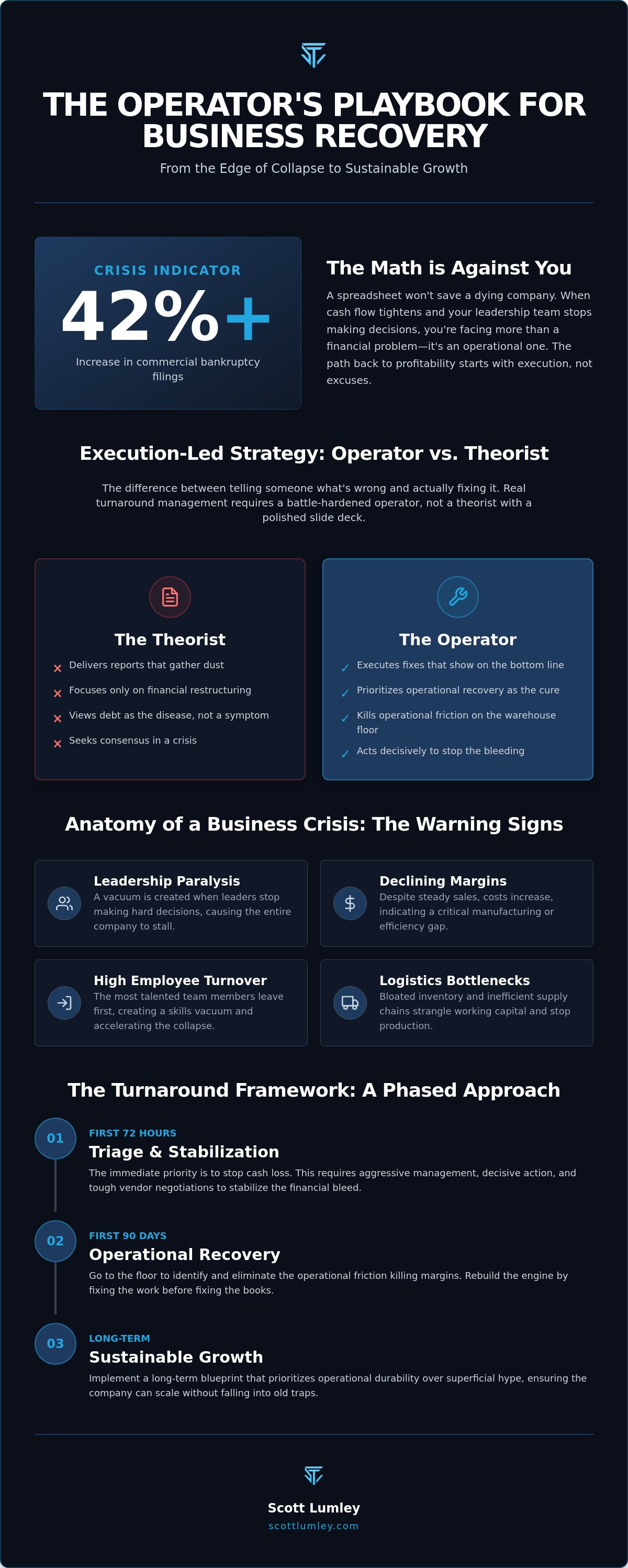
A spreadsheet won't save a dying company. When cash flow tightens and your leadership team stops making decisions, the math is already against you. You are likely feeling the weight of the 42% increase in commercial bankruptcy filings recorded in early 2026. This is the exact point where a business turnaround consultant steps in to stop the bleeding. It isn't about optimistic theories or polished slide decks. It is about identifying the friction killing your margins and executing a recovery plan before the clock runs out.
You already know that your current trajectory is unsustainable. The pressure of operational failure feels permanent. This article pulls back the curtain on the gritty reality of business recovery. You will learn how a battle-hardened operator moves a firm from the edge of collapse back to sustainable growth. We will cover the immediate steps for operational stabilization, a clear roadmap to profitability, and the strategy for scaling without falling back into the same traps that caused the initial crisis. The path back to the black starts with execution, not excuses.
Key Takeaways
- Learn why a business turnaround consultant serves as an interim leader focused on removing operational friction rather than just financial restructuring.
- Identify the hidden root causes of distress, from stagnant growth to leadership paralysis, before they become terminal.
- Master the triage framework to stop immediate cash loss through aggressive management and vendor negotiations in the first 72 hours.
- Differentiate between theoretical advice and the execution-led strategies of a battle-hardened operator with real-world experience in the trenches.
- Implement a long-term blueprint for sustainable growth that prioritizes operational durability over superficial marketing hype.
Defining the Business Turnaround Consultant: Beyond Financial Restructuring
A business turnaround consultant is not a financial analyst with a calculator. They are an interim leader. They enter high-stakes environments to identify and kill operational friction. Most firms hire a consultant to fix their debt, but that is a fundamental mistake. Debt is a symptom. The disease is usually found on the warehouse floor, in the logistics chain, or within a paralyzed leadership team. Hiring a business turnaround consultant is about finding an operator who can stabilize the ship while simultaneously rebuilding the engine.
Real turnaround management requires more than a spreadsheet. It requires an "Execution-Led Strategy." This is the difference between telling someone what is wrong and actually fixing it. Theorists provide reports that gather dust on a desk. Battle-hardened operators provide results that show up on the bottom line. They understand the gritty reality of manufacturing and logistics because they have lived it. They don't just advise; they execute.
Operational vs. Financial Turnaround
Fixing the balance sheet fails if the warehouse floor is still broken. You can refinance debt or negotiate with creditors all day. If your manufacturing process is bleeding cash, you are just delaying the inevitable. Financial restructuring is a temporary band-aid. Operational recovery is the cure. This involves identifying specific friction points in manufacturing and retail supply chains that slow down production and eat margins.
A strategic business advisor looks at these systemic issues first. They look for the leverage points where a small change in process leads to a massive shift in profitability. If the logistics are inefficient, no amount of financial wizardry will save the firm. You have to fix the work before you can fix the books.
The Mentality of a Turnaround Specialist
Consensus is a luxury you cannot afford in a crisis. A specialist prioritizes decisiveness over agreement. They don't look for a committee's approval. They look for the move that stops the bleed. This requires a total lack of interest in superficial appearances and a deep commitment to transparency. They deliver the blunt truth to stakeholders, even when it is painful to hear.
Scott Lumley’s four decades of experience in construction, manufacturing, and logistics matters more than an MBA. A degree teaches you how to manage a healthy company. Survival requires the hard-won wisdom of someone who has navigated extreme adversity. Integrity in this field means being honest about the risk. It means leading from the trenches rather than from a boardroom. You need a pragmatic strategist, not a cheerleader.
The Anatomy of a Business Crisis: Identifying Operational Friction
Crisis is rarely a sudden event. It is the result of operational friction that has been allowed to accumulate over years. For a mid-size firm, this friction acts like sand in the gears of a machine. It slows down production, eats away at margins, and eventually leads to total paralysis. A business turnaround consultant doesn't start by looking at the profit and loss statement. They look at the floor. They look at the loading docks. They look for where the work is getting stuck.
Poor leadership and inefficient logistics are the most common root causes of distress. In high-stakes environments, a leadership vacuum is toxic. When the people at the top stop making hard decisions, the rest of the company follows suit. This is why due diligence consulting services are vital during acquisitions; they spot these systemic failures before you sign the check. If you're already in the thick of it, you have to identify these friction points in real-time while the stakes are at their highest.
The Warning Signs of a Failing Operation
The most dangerous warning sign is declining margins despite steady sales. This usually points to a manufacturing efficiency gap. You're working just as hard, but it's costing you more to deliver the same result. High employee turnover is another red flag. In a crisis, your best people are the first to leave because they have options. This leaves a leadership vacuum that accelerates the collapse. Finally, look at your inventory. Bloated warehouses and logistics bottlenecks strangle your working capital. If your cash is tied up in stagnant stock, you can't pivot when the market shifts.
Sector-Specific Distress Factors
Different industries fail in different ways. In construction, project delays and cost overruns are the primary death knell. A single mismanaged contract can wipe out years of profit. Retail firms often face friction between brick-and-mortar overhead and the necessary digital transition. They're stuck with expensive leases while their customers move online. Manufacturing firms often suffer from outdated strategic planning. Their plans look good on paper but fail to account for the reality of the factory floor. Effective leadership in corporate turnarounds requires recognizing these sector-specific traps immediately.
If your firm is showing these signs, the window for a DIY fix is closing. You need an operator who can cut through the noise and implement a recovery plan. You can request a direct operational assessment to see exactly where your leverage points are before the situation becomes terminal.
The Turnaround Framework: First 72 Hours to the First 90 Days
Speed is the only currency that matters when a firm is failing. A business turnaround consultant doesn't have the luxury of a six-month discovery phase. The first 72 hours are about triage. This means stopping the bleed through aggressive cash management and immediate vendor negotiations. It isn't just about managing liquidity; it's about securing the perimeter so you can actually perform the surgery. You have to communicate with key creditors before they pull the plug. You have to find the quick wins that generate immediate revenue to fund the rest of the journey.
Once the bleeding stops, the audit begins. This is a no-nonsense assessment of assets, people, and processes. It's about looking at the floor and seeing who is actually working and what is actually moving. During this phase, implementing leadership consulting services is critical. You aren't just changing a plan; you're changing organizational behavior. If the team doesn't shift from a mentality of survival to one of execution, the recovery will fail. Stabilization ensures the lights stay on while the recovery blueprint is built.
Immediate Crisis Management Tactics
The first 72 hours are high-stakes. You must secure liquidity by identifying every possible source of cash within the operation. This involves cutting discretionary spending that doesn't serve core operational capacity. If it doesn't help you deliver a product or keep a critical vendor happy, it's gone. Communication is the other pillar of triage. You don't hide from creditors; you lead the conversation. This builds the transparency required to buy the time needed for a full recovery.
The First 90 Days: Building the Recovery Blueprint
The first 90 days are where the real work of restructuring happens. Hierarchy is irrelevant during a turnaround; execution is everything. The management team must be restructured to prioritize movement over meetings. This often involves optimizing the supply chain to remove the friction points identified in the initial audit. You have to establish operational excellence metrics that actually matter to the people on the floor. If a metric doesn't provide clarity on the next move, it's noise. By the end of this period, the firm should move from reactive chaos to a methodical, strategic rhythm. This is the foundation for sustainable growth.
Evaluating a Turnaround Partner: Lived Experience vs. Sterile Theory
Consulting is often a game of polished slide decks and theoretical models. In a high-stakes recovery, those tools are useless. You don't need a cheerleader or a passive coach. You need a pragmatic strategist who understands the weight of a failing operation. A business turnaround consultant with lived experience knows how to navigate the chaos because they have survived it before. They don't just offer advice; they lead from the trenches. This is the difference between an academic advisor and a battle-hardened operator.
Experience matters. Scott Lumley brings four decades of hands-on work in construction, manufacturing, and retail. This isn't theoretical knowledge gained in a classroom. It is hard-won wisdom from 40 years of navigating both extreme success and significant adversity. When a consultant has "Survived Africa" and managed high-stakes global operations, they aren't easily rattled by a domestic cash flow crisis. They provide a sobering voice of reason when your leadership team is paralyzed by the stakes. They prioritize hard realities over optimistic theories every time.
The Operator’s Checklist for Hiring
Before you sign a contract, you must vet the person who will be holding the wheel. Use this checklist to separate the operators from the theorists:
- Sector-Specific Experience: Does the consultant have a track record in construction, manufacturing, or logistics? If they don't understand the floor, they can't fix the books.
- Interim Leadership: Are they willing to step into an interim role to execute the plan? You need someone who does the work, not just someone who "advises" from a distance.
- Strategic Growth Planning: Does their plan include a path to sustainable scaling, or is it just a slash-and-burn cost-cutting exercise? Recovery requires a blueprint for growth.
Red Flags in Turnaround Consulting
Avoid consultants who rely on corporate jargon and motivational fluff. If they can't explain a solution without using "synergy" or "alignment," they don't have a solution. A lack of interest in the gritty details of your logistics or floor operations is another major red flag. If they won't walk the warehouse, they won't find the friction. Finally, watch out for a "one-size-fits-all" approach. Every firm has unique assets and risks. A strategy that ignores the nuances of real estate leadership advisory or specific industry debt structures is destined to fail.
Stop looking for a coach and start looking for an operator. You can hire an execution-led strategist who has navigated the exact crisis you are currently facing.
From Survival to Sustainable Growth: The Long-Term Blueprint
Survival is the first step. It is not the destination. Once a business turnaround consultant has stabilized the operation, the focus shifts to durability. You cannot stay in crisis mode forever. It burns out your best people and ignores market opportunities. The transition to "Growth Mode" must be methodical. It requires a "Strategic Planning" blueprint that prioritizes long-term stability over short-term hype. This isn't about rapid expansion at any cost. It's about scaling in a way that doesn't re-introduce the friction that nearly killed the firm.
Sustainable scaling requires a total commitment to risk mitigation. You have to identify the points where growth will strain your logistics or your cash flow before you pull the trigger. This is where ongoing advisory becomes a leverage point. It ensures the organization remains friction-free as it adds complexity. You don't just want a bigger version of the broken company you started with. You want a lean, high-performing machine built on hard-won wisdom. The goal is to move from a state of constant reaction to a state of calculated movement.
Sustainable Scaling Without Operational Friction
Expanding the top line is easy. Doing it without exploding your overhead is the real challenge. Many firms fail because they scale their problems along with their revenue. You must build a resilient culture that values execution and transparency above all else. This means keeping the trench-level visibility established during the recovery phase. If you lose sight of the floor operations as you grow, the friction will return.
Leveraging your assets is a key part of this stability. For firms with significant holdings, "Real Estate Advisory" can provide the liquidity needed to fund growth without taking on toxic debt. You use what you already have to build what you need next. It's a pragmatic approach to expansion that relies on tangible assets rather than speculative projections. This ensures that the growth is rooted in reality, not just optimistic spreadsheets.
The Exit Strategy: When the Consultant Leaves
A successful turnaround ends when the consultant is no longer the primary driver of decision-making. The goal is to equip the leadership team to maintain "Operational Excellence" on their own. This requires setting up permanent "Due Diligence" systems. These systems act as an early warning network to prevent future crises. They track the metrics that actually matter on the factory floor and in the supply chain. If a margin slips, you should know why before the weekend.
The exit of a business turnaround consultant should not feel like a vacuum. It should feel like a handoff. You've spent months stripping away the corporate fluff and focusing on the gritty reality of your operations. Now, you have the roadmap. A turnaround is not just the end of a crisis. It is the beginning of a more disciplined, profitable era for your company. The work doesn't stop; it just changes focus from recovery to expansion.
Stop the Bleed and Rebuild for Durability
Business recovery is a test of operational will. It is not a theoretical exercise. You have seen how identifying friction and executing a 90-day blueprint can move a firm from the edge of collapse back to sustainable growth. A business turnaround consultant provides the decisive leadership required when your team is paralyzed by crisis. It requires looking at the warehouse floor and the supply chain with total transparency. You cannot fix what you refuse to see. Speed is your only ally when the margins are thin.
Don't wait for the situation to become terminal. Scott Lumley brings 40 years of battle-hardened experience and an execution-led strategy to every engagement. With national reach and deep industry expertise in manufacturing and construction, he helps you navigate the gritty reality of recovery. You don't need a cheerleader; you need an operator who has lived through the trenches. Secure your business’s future; connect with Scott Lumley for a direct operational assessment. The path back to profitability is open for those willing to execute. Your best days are still ahead.
Frequently Asked Questions
What is the first thing a business turnaround consultant does?
Triage is the immediate priority. The consultant secures liquidity and stops the bleed through aggressive cash management. They identify every source of friction that's draining capital in real-time. This isn't about long-term strategy yet. It's about ensuring the company survives the next 72 hours. Communication with key creditors starts here to buy the necessary time for a full assessment of the operation.
How much does a turnaround consultant cost for a mid-size firm?
Industry rates vary based on the expert's seniority and the project's complexity. Many senior experts in 2026 utilize hourly rates or daily fees that reflect their niche experience. Some firms prefer value-based structures, often ranging from 10% to 20% of the quantified value the project creates. These fees are an investment in survival. They're designed to be offset by immediate operational savings and recovered margins.
What is the difference between a turnaround consultant and a liquidator?
A consultant builds; a liquidator burns. The consultant's goal is to identify operational friction and restore sustainable growth. They want to keep the lights on and the staff employed. A liquidator is brought in when recovery is no longer an option. Their job is to sell off assets and close the doors to satisfy creditors. One focuses on life; the other manages the end of the entity.
Can a turnaround consultant help if my business is already in bankruptcy?
Yes, a consultant is vital during a Chapter 11 reorganization. The automatic stay provides a window of time, but you need an execution-led strategy to use it effectively. They help develop the reorganization plan required by the court. With commercial bankruptcy filings rising 21% year-over-year in early 2026, many firms use consultants to navigate the new Bankruptcy Administration Improvement Act requirements while restructuring their core operations.
How long does a typical business turnaround process take?
The process moves in distinct phases. Triage happens in the first 72 hours to secure liquidity. The blueprint for recovery is usually established within the first 90 days. A full transition from crisis mode to sustainable growth typically takes 12 to 24 months. It depends on the depth of the operational friction and the leadership team's willingness to execute the new strategy without reverting to old, failing habits.
Do I need a turnaround consultant if I only have a cash flow problem?
Cash flow problems are almost never just about cash. They're symptoms of deeper operational friction. If you only fix the cash, the underlying issues in manufacturing or logistics will eventually drain the coffers again. A business turnaround consultant looks past the symptom to find the disease. They fix the processes that are killing your margins so the cash flow remains healthy for the long haul.
What industries does Scott Lumley specialize in for turnarounds?
Scott Lumley focuses on high-stakes environments in construction, manufacturing, and logistics. His four decades of experience are grounded in these gritty, asset-heavy industries. He understands the specific friction points in retail supply chains and the project-delay risks in construction. This specialized focus allows him to lead from the trenches rather than offering the generic, sterile advice of a theoretical advisor.
What is the success rate of operational turnarounds for manufacturing firms?
Success depends on the speed of the intervention and the commitment to operational performance. Industry trends in 2026 show that firms prioritizing underlying operational issues alongside financial restructuring have a much higher survival rate. Manufacturing turnarounds succeed when they bridge the efficiency gap on the factory floor. It requires a total lack of interest in superficial fixes and a deep commitment to transparency.


