

A distressed asset is not a death sentence. It's a management failure. Most property owners wait until the bank is at the door before they admit the strategy is broken. By then, the cost of recovery is astronomical. If you're facing operational friction, looming debt defaults, or a leadership gap that's stalling growth, professional real estate turnaround services are your only viable path forward. No fluff. No cheerleading. Just a strategy that prioritizes survival over superficial appearances.
You'll learn how to identify operational friction, evaluate expert advisors, and execute a high-stakes recovery plan. In a 2026 market where commercial mortgage rates sit between 5.41% and 8.75%, there's no room for amateur mistakes or "hope" as a business plan. Precision matters. This guide provides a briefing on stabilizing your asset and restoring profitability. We're stripping away the corporate jargon to focus on the grit required to turn a failing property into a performing asset with a clear growth strategy.
Key Takeaways
- Stop waiting for a miracle. Learn to identify the deep operational friction that signals your asset is failing before the bank takes notice.
- Technical knowledge isn't enough. Evaluate advisors based on "multi-sector scars" in construction and logistics to ensure they can lead from the trenches.
- Legal filings won't save your equity. Professional real estate turnaround services provide an active, operator-led recovery that prioritizes cash flow over litigation.
- Execute the 72-hour triage. Stabilize immediate cash flow leaks and use deep-dive due diligence to map a definitive exit or long-term growth strategy.
Defining the Distress Zone: When to Deploy Real Estate Turnaround Services
Real estate turnaround isn't a cosmetic renovation. It's a surgical strike on a failing asset. Many investors mistake surface-level symptoms, like a tenant dispute or a deferred maintenance list, for the root cause. They're wrong. True distress is systemic. It's the silent erosion of value caused by operational friction. Real estate turnaround services focus on the strategic recovery of underperforming assets by rebuilding the foundation of the business model from the ground up.
The "Point of No Return" isn't when the bank forecloses. It's the moment when current management can no longer see the solution because they're too close to the problem. Standard management excels at maintaining the status quo. It fails when the business model requires a complete overhaul. Waiting for the crisis to hit the front page is a tactical blunder that costs equity and time. If you can't identify the friction, you're already in the zone.
Signs of Operational Friction in Property Portfolios
High occupancy should mean healthy profits. If your rent roll is full but cash flow is stagnant, you have a friction problem. This often shows up as persistent cash flow leaks that standard accounting can't explain, such as excessive maintenance costs that could be mitigated by low-maintenance landscape solutions from Nu Scape Designs. In industrial or retail assets, a flat ROI usually indicates the property is no longer aligned with modern logistics or consumer behavior. Leadership gaps are also glaring during development phases. If construction projects are consistently over budget or behind schedule, the friction isn't just the contractor. It's the lack of decisive leadership at the top.
The Cost of Inaction: Asset Degradation vs. Strategic Pivot
The Distress Zone is the gap between potential value and current operational reality.
The Property Investment Strategy Consultant: Evaluation Framework
Technical knowledge is a baseline. It isn't a strategy. Knowing how to read a balance sheet won't stop a construction project from hemorrhaging cash or fix a broken supply chain. For a full recovery, you need an advisor who understands the physical realities of the asset. This is where most real estate turnaround services fail. They focus on the numbers while the operations rot. You need "multi-sector scars." An advisor who has navigated the complexities of manufacturing and logistics brings a level of grit that a boardroom consultant simply lacks.
Evaluating an advisor means looking past the suit. Can they lead from the trenches? If they haven't faced the harsh realities of a job site or a failing industrial plant, they won't survive the pressure of a distressed recovery. This process begins with exhaustive due diligence. It's about uncovering the hidden friction points that others miss. Global firms often highlight the need for Real Estate Turnaround & Restructuring frameworks to maintain stakeholder confidence. Those frameworks are only as good as the operator executing them. A comprehensive approach to real estate turnaround services requires more than just financial restructuring; it requires operational dominance.
Execution Over Sterile Theory
Avoid career consultants. If they've never owned an asset or felt the weight of a personal guarantee, they're speaking from theory. Theory doesn't save equity. You need a battle-hardened perspective. High-stakes environments require decisions made in real-time, based on lived experience. In a market where 10-year Treasury yields hit 4.48% in May 2026, the cost of capital is too high for "trial and error." This is why Leadership Consulting Services focus on execution-led strategy rather than polished presentations. If you want a cheerleader, hire a coach. If you want results, hire an operator who has survived the fire.
Critical Criteria for Your Strategy Advisor
Choosing the wrong advisor is a second disaster you can't afford. Use this framework to vet your next move:
- Proven Crisis Management: Look for a track record of rapid stabilization. Ask for examples of assets they saved when everyone else walked away.
- Debt and Tax Mastery: They must navigate complex structures, including the Property Tax Debt System, to preserve capital.
- Brutal Transparency: You don't need a "yes man." You need someone who will report operational harsh realities without sugar-coating the truth.
Success in recovery requires a partner who values integrity over appearances. If you're ready to stop the bleeding, a Real Estate Advisory session can provide the clarity you're missing. Don't wait for the bank to make the decision for you.
Receivership vs. Strategic Turnaround: Navigating the Recovery Path
Receivership is a legal maneuver. Strategic turnaround is an operational offensive. One stops the bleeding. The other heals the patient. Understanding the difference determines whether you retain your equity or merely satisfy a creditor's balance sheet. Real estate turnaround services prioritize the latter, focusing on active recovery rather than passive liquidation. If you're still in control of the asset, you have a choice. Once the court steps in, that choice vanishes.
A receiver is a caretaker. They safeguard the asset's "going-concern" status under court supervision. Their priority is the creditor's interest, not the owner's long-term ROI. In contrast, an operator-led turnaround targets the root causes of failure. It rebuilds the business model to ensure the asset can thrive in a 2026 market where total investment volume is projected to reach $562 billion. You don't want to be a bystander in your own recovery. You want an engine, not a cage.
The Legal Shield: Receivership Basics
Receivership acts as a legal shield. It provides a structured environment to stabilize operations under legal duress or debt default. Receivers safeguard assets for creditors by ensuring compliance and preventing further waste. However, a court-appointed receiver rarely has the incentive to drive growth. They follow court orders. They don't take calculated risks to reposition an asset. This approach protects the property from immediate degradation, but it often caps the potential for value restoration. It is a defensive posture for those who have already lost the lead.
The Operational Pivot: Strategic Turnaround Leadership
Strategic turnaround leadership is about the pivot. It requires restoring profitability through aggressive cost management and direct leadership intervention. You don't just "manage" the distress; you gut the inefficiencies that caused it. This involves fixing broken management structures and realigning the asset with current market demands. It's a high-stakes move that requires a Strategic Business Advisor who understands execution-led growth. This is where real estate turnaround services provide the most leverage. You aren't just surviving legal duress. You're executing a plan to restore the asset's value and secure a clear exit strategy or a long-term growth path. The goal is a restored "going-concern" status that actually generates profit, not just one that satisfies a legal requirement.
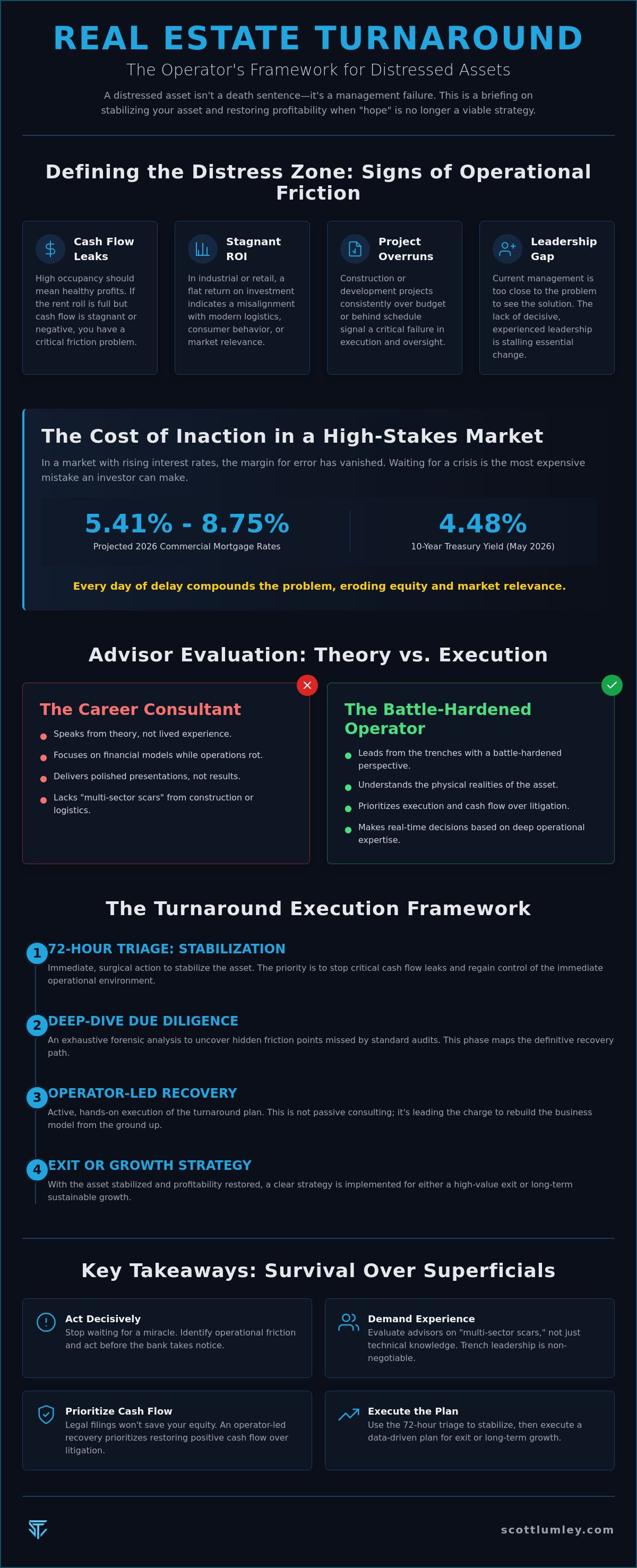
The Turnaround Execution Framework: From Stabilization to Growth
Execution is where theory goes to die. A recovery plan that stays on a whiteboard is a liability, not an asset. When a property enters the distress zone, you don't have months to deliberate. You have days. Professional real estate turnaround services provide the scaffolding for this recovery, moving from immediate triage to long-term expansion. This isn't about incremental gains. It's about a total operational overhaul that replaces friction with flow.
The framework is a sequence of high-stakes moves. You stabilize the cash, identify the rot, and then rebuild the core. If you skip a step, the foundation remains fractured. In a market where commercial real estate investment volume is climbing back toward $562 billion, the difference between a total loss and a profitable exit is the speed of your execution. You need an operator who knows how to stop the bleed and restart the engine.
Phase 1: Stabilization and Triage
The first 72 hours determine the asset's survival. You must secure the property and halt immediate value loss by locking down cash flow and controlling the narrative with stakeholders. Managing creditor and vendor relationships during the pivot is a delicate balance of transparency and firm leadership. Triage is the immediate cessation of non-essential capital expenditure. Every dollar must be diverted to stabilization. If it doesn't keep the lights on or the asset secure, it doesn't get spent. You stop the outward flow of capital so you can assess the damage without the pressure of a collapsing treasury.
Phase 2: Deep Due Diligence and Identification
Once the bleeding stops, you go deep. This isn't a standard audit; it's a forensic investigation into why the asset failed. You must analyze the property tax debt and financial liabilities that are choking the balance sheet. Inefficiency often hides in construction or maintenance contracts that were signed during better times and never revisited. This is the stage where you uncover the hidden friction points that are dragging down your ROI. Utilizing Due Diligence Consulting Services ensures you aren't just looking at the numbers, but at the operational reality on the ground.
Phase 3: Execution and Sustainable Growth
Executing real estate turnaround services requires a total rejection of the status quo. You implement recovery tools like the Property Tax Debt System to clear the path for profitability. Leadership consulting ensures the new strategy "sticks" at the floor level, where the actual work happens. Success isn't just a better balance sheet. It's a healthy operation where management is proactive, not reactive. You measure health by the reduction of friction and the clarity of the exit path. If you're ready to move from survival to strategy, engage a Real Estate Advisory session to map your recovery. Don't wait for the next quarter to see if things improve on their own. They won't.
Scott Lumley: Execution-Led Real Estate Turnaround and Strategy
Scott Lumley isn't a consultant. He's an operator. While others provide polished reports and optimistic forecasts, Scott focuses on the harsh realities of a distressed asset. Real estate turnaround services are not about hoping for market shifts. They are about forcing a recovery through strategic grit and four decades of lived experience. If your project is stalling, you don't need a cheerleader. You need a veteran who leads from the trenches.
Scott's approach is unapologetically direct. He strips away the corporate fluff to reveal the operational friction that others ignore. This isn't theoretical. It's hard-won wisdom from navigating both extreme success and significant adversity across construction, manufacturing, and logistics. When the stakes are high, you need a steady, composed leader who values survival and recovery as much as expansion. He provides the sobering voice of reason that is often missing in high-pressure environments.
The Battle-Hardened Operator Advantage
Scott brings an advantage that career advisors lack: cross-sector perspective. His experience in construction and manufacturing translates directly to solving complex real estate problems. He understands how a delay on the floor impacts the balance sheet. Every advisory role is built on a foundation of transparency and integrity. There are no "yes men" here. If the asset is failing, he tells you why and how to fix it. Composed leadership in the middle of an operational storm isn't a skill you learn in a boardroom. You earn it through years of high-stakes decision-making and real-world application.
Your Next Move: Strategic Clarity
Moving from a state of crisis to a state of execution requires a total shift in mindset. You stop reacting to the latest fire and start following a methodical recovery plan. For many firms, a full-time hire isn't the immediate answer. Fractional or interim leadership provides the veteran presence needed to stabilize the asset without the long-term overhead. This is about deploying real estate turnaround services exactly where they provide the most leverage. It's about movement and strategic execution.
Turnaround is not a promise. It is a process of grit. It requires the courage to cut the rot and the discipline to rebuild the core. If you're ready for a no-nonsense evaluation of your portfolio, Real Estate Advisory can provide the clarity you need to move forward. Strategic Planning and Crisis Management aren't just terms on a website; they are the tools of survival in a volatile market. The next move is yours. Make it a decisive one.
Secure Your Equity Through Decisive Operational Recovery
Distress is a signal to pivot, not a reason to surrender. You've seen that successful recovery requires more than just high-level consulting; it demands the grit to gut inefficiencies and rebuild the core. Effective real estate turnaround services bridge the gap between a failing balance sheet and a performing asset by replacing friction with operational flow. Whether you're navigating debt defaults or leadership gaps, the solution lies in execution, not theory. It's about moving fast and moving with purpose.
Scott Lumley brings 40 years of hands-on operational experience across construction, manufacturing, and logistics to every engagement. He doesn't just offer advice. He provides a definitive roadmap for survival using specialized tools like the Property Tax Debt System. This is strategic leadership for firms that need a veteran in the trenches to stabilize high-stakes projects. You don't have to navigate the storm alone.
The window to save your equity is closing. Stop reacting to the crisis and start leading the recovery. Contact Scott Lumley for a No-Nonsense Strategic Briefing and gain the clarity needed to stabilize your portfolio. You have the power to turn the tide.
Frequently Asked Questions
What exactly are real estate turnaround services?
Real estate turnaround services are the strategic recovery of underperforming or distressed property assets. This isn't standard property management. It is operational surgery designed to identify deep-seated friction, stabilize hemorrhaging cash flow, and rebuild the asset's business model from the ground up. The goal is to restore profitability and secure a clear exit or growth strategy before the asset is lost to foreclosure.
How is a property investment strategy consultant different from a real estate agent?
An agent facilitates a transaction; a consultant fixes the business behind the asset. Agents focus on the immediate sale price and commission. A strategy consultant focuses on operational health, risk mitigation, and the structural changes required to make an asset viable. They lead from the trenches to resolve the management failures that an agent simply isn't equipped to handle.
When is it too late to start a business turnaround?
It's too late when you've lost total control to the court or a lender. If a receiver is already appointed or a foreclosure is finalized, your window for an operator-led recovery has closed. The most effective turnarounds begin the moment you identify persistent cash flow leaks or leadership gaps. Waiting for the bank to knock makes the recovery exponentially more expensive and less likely to succeed.
Can turnaround services help with property tax debt?
Yes. Specialized real estate turnaround services utilize tools like the Property Tax Debt System to navigate complex liabilities. This process involves identifying the most efficient path to clear tax burdens while preserving capital for operational recovery. It is a vital part of the initial financial triage phase, ensuring that tax debt doesn't derail the entire stabilization plan.
Do turnaround consultants provide legal representation?
No. Turnaround consultants are operators and strategists, not attorneys. While they understand the mechanics of receivership and debt structures, they do not provide legal representation or CPA services. They work alongside your legal and tax professionals to lead the execution of a recovery plan. Their role is to drive the operation while ensuring the strategy aligns with legal requirements.
How long does a typical property turnaround take?
Immediate triage happens in the first 72 hours, but a full operational pivot usually takes several months. The timeline depends on the severity of the distress and the complexity of the asset's debt. Real estate turnaround services require enough time to not only stop the bleed but to implement new management structures that stick at the floor level. It's a process of grit, not a quick fix.
What is the role of due diligence in real estate recovery?
Due diligence is the diagnostic phase that prevents you from flying blind. It's a forensic investigation into the operational reality of the asset, looking far beyond the balance sheet. You must uncover hidden friction points, inefficient contracts, and physical maintenance gaps. Without this deep dive, any recovery plan is based on guesswork rather than hard data.
Why is operational experience more important than a consulting degree?
Degrees teach theory, but operations teach survival. In high-stakes turnarounds, you need an advisor with "multi-sector scars" from construction, manufacturing, and logistics. Theory won't help when a project is over budget or a supply chain is broken. You need someone who has owned assets and made decisive moves in the trenches to navigate the harsh realities of a failing property.


