

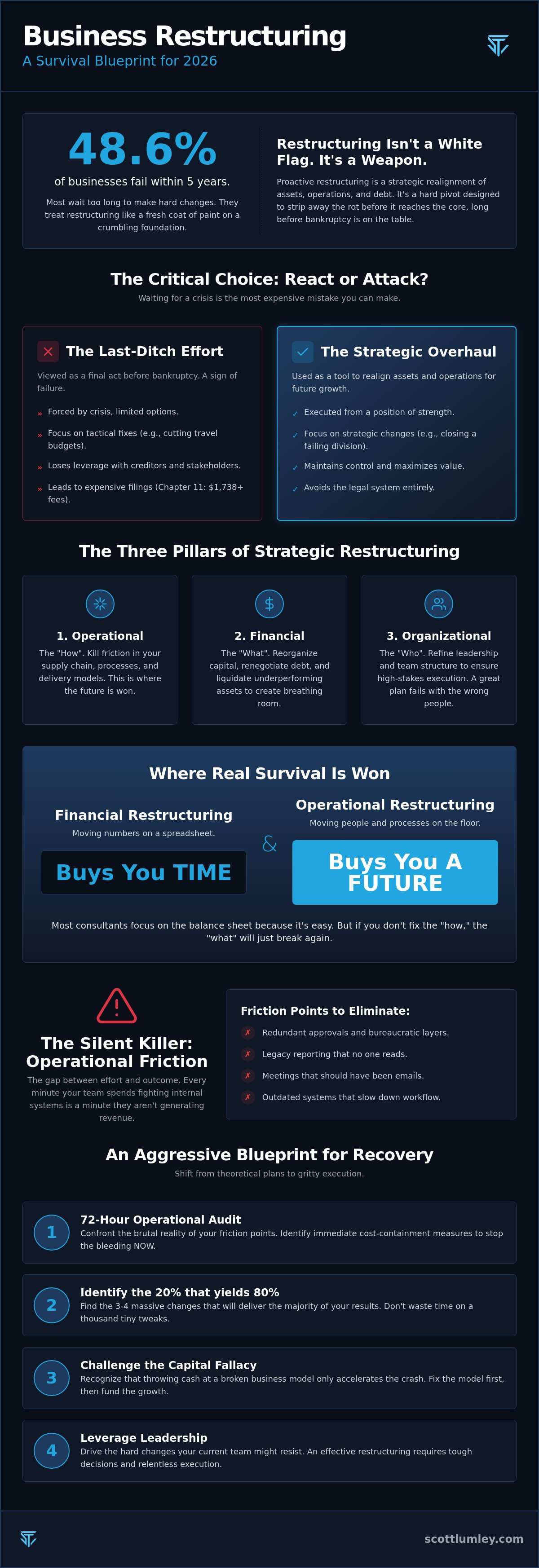
Most business owners treat a restructuring like a fresh coat of paint on a crumbling foundation. It's a fatal mistake. Data shows that 48.6 percent of businesses fail within their first five years. If you're feeling the squeeze in 2026, you don't need a new mission statement or a team-building retreat. You need aggressive business restructuring strategies that prioritize survival and cash flow over corporate ego.
It's a heavy burden when revenue stays flat while operational friction grinds your daily progress to a halt. You see the tightening margins and the team's resistance to change. You know the current path is a dead end. This guide shows you how to strip away that friction and execute a restructuring that saves the actual business, not just the titles on your door. We'll break down how to leverage the permanent tax benefits of the One Big Beautiful Bill Act and navigate the shift toward private credit to keep your company alive, lean, and profitable.
Key Takeaways
- Stop viewing business restructuring strategies as a last-ditch effort before bankruptcy and start using them as a proactive tool to realign your assets and operations.
- Understand that while financial restructuring manages your debt and buys you time, only operational changes to your processes and supply chain will buy you a future.
- Recognize that throwing fresh capital at a fundamental business model failure doesn't solve the problem; it only accelerates the eventual crash.
- Implement a 72-hour operational audit to confront the brutal reality of your friction points and execute immediate cost-containment measures to stop the bleeding.
- Shift your focus from theoretical plans to gritty execution by leveraging leadership consulting to drive the hard changes your current team structure might resist.
Business Restructuring Strategies: Moving Beyond the Bankruptcy Myth
Restructuring isn't a white flag. It's a weapon. Too many owners think of a restructure as the final act before the lights go out, but that's a failure of perspective. In reality, the broad scope of corporate restructuring is a strategic realignment of your assets, your operations, and your debt. It's a hard pivot designed to strip away the rot before it reaches the core. If you wait until you're forced to file for Chapter 11, you've already lost the leverage. In 2026, filing for Chapter 11 costs $1,738 in fees alone; that's before the lawyers start their clocks. True business restructuring strategies are about avoiding that room entirely.
There's a massive difference between a tactical fix and a strategic overhaul. A tactical fix is cutting the travel budget or switching to a cheaper CRM. It's a band-aid on a gunshot wound. A strategic overhaul is an aggressive reassessment of why the business exists. It's the guts to close a legacy division that's bleeding cash even if it's the one your father started. Waiting for a crisis to force your hand is the most expensive mistake you can make. By then, your options are limited, your cash is gone, and your competitors are circling.
The Three Pillars of Strategic Restructuring
Effective business restructuring strategies rest on three specific pillars. First is operational restructuring. This is the "how" of your business. It's about killing the friction in your supply chain and delivery models. Second is financial restructuring. This is the "what." You're reorganizing capital, renegotiating debt, and liquidating underperforming assets to find air. Third is organizational restructuring. This is the "who." It involves refining your leadership to ensure high-stakes execution. If you have the right plan but the wrong people, the plan is just paper.
Identifying the Tipping Point for Recovery
You need to know when a temporary slump has turned into a broken business model. Data shows that 48.6 percent of businesses fail within five years. Often, these failures happen because leadership chose to "try harder" at a flawed strategy rather than admitting the model was dead. You've hit the tipping point when operational friction becomes a structural threat. If your revenue is stagnant but your team is drowning in work, your processes are broken. If you're running out of cash despite consistent sales, your margins are a lie. At this stage, grit isn't enough; you need a total realignment of how you generate value.
Financial vs. Operational Restructuring: Where Real Survival is Won
Financial restructuring is the spreadsheet. It's about moving numbers to stop the bleeding. Operational restructuring is the floor. It's about moving people and processes to start the healing. Most consultants focus on the balance sheet because it's easy to track. They're wrong. Financial restructuring buys you time. Operational restructuring buys you a future. If you don't fix the "how," the "what" will just break again in six months.
You need to find the leverage point. In any recovery, 20 percent of your changes will yield 80 percent of your results. This isn't about a thousand tiny tweaks. It's about identifying the three or four massive friction points that are killing your margins. Avoid "sterile" restructuring. This is the plan that looks perfect in a boardroom but falls apart the second it hits the warehouse floor. If your strategy doesn't change how work actually gets done, it's not a strategy. It's a fantasy.
Operational Friction: The Silent Killer of Mid-Size Firms
Audit your workflow. Look for the "clutter." These are the redundant approvals, the legacy reporting requirements, and the meetings that could be emails. Operational friction is the gap between effort and outcome. Every minute your team spends fighting your own internal systems is a minute they aren't generating revenue. Keeping legacy systems that no longer serve your growth is a sunken cost fallacy. It's expensive. It's slow. It's deadly. Utilizing aggressive operational restructuring strategies is the only way to clear the path for real growth.
Financial Re-engineering Without Losing Control
With the prime rate at 6.75 percent in July 2026, the cost of capital is high. You can't afford to be sloppy with debt. Look at debt restructuring tactics that protect your equity. You don't always have to trade ownership for liquidity. Implementing effective business restructuring strategies requires you to manage liquidity during the pivot phase. Sometimes, you have to cut a limb to save the body. This is asset divestiture. Sell the underperforming warehouse. Liquidate the equipment that's collecting dust. During the pivot, cash is your only metric that matters. If you're struggling to see the path forward, professional strategic planning can help you identify which assets are worth keeping and which are liabilities in disguise.
The Capital Fallacy: Why More Cash Won’t Fix a Broken Business Model
"I just need a loan." It's the most common lie told in boardrooms when the walls start closing in. Most owners believe that a fresh injection of venture capital or a bank loan will solve their problems. They're wrong. If your business model is fundamentally broken, more cash is just high-octane fuel for a fire. It doesn't fix the leak; it just lets you bleed faster. Throwing capital at a struggling company before executing business restructuring strategies is a recipe for a more expensive funeral.
You must differentiate between growth capital and survival capital. Growth capital is meant to scale a proven, profitable machine. Survival capital is an expensive band-aid used to mask operational failure. Real recovery comes from finding "found" money through internal efficiency. This isn't about hope. It's about leverage. Internal efficiency is the only capital that doesn't come with interest rates or equity loss. It requires grit, not a pitch deck.
How to Fix a Struggling Business Using Internal Leverage
Stop looking at the bank and start looking at your floor. Aggressive cost-cutting is a defensive move, but strategic cost-reallocation is an offensive one. You need to identify "zombie" projects. These are the initiatives that drain your staff's time and your company's resources without providing a clear ROI. Kill them immediately. Redirect those resources into the 20 percent of your business that actually generates cash. For a step-by-step breakdown of these moves, consult the business survival strategy checklist to begin your operational recovery.
The "Survival First" Mindset: Cash Flow is King
Forget about profitability. Profit is a long-term goal. Right now, your only metric is liquidity. During the initial phase of a turnaround, you operate with a survival-first mindset. This means shortening your cash conversion cycle by any means necessary. You need to move cash through the business faster than the friction can slow it down.
Be ruthless with your accounts receivable. If clients aren't paying, they aren't clients; they're liabilities. Negotiate with vendors from a position of transparency and strength. Most would rather have a long-term partner who pays slowly than a bankrupt one who doesn't pay at all. This no-nonsense approach to business restructuring strategies ensures that every dollar you have is working toward your survival, not sitting in someone else's bank account. You don't need a miracle. You need a better handle on your own numbers.
A 5-Step Strategic Blueprint for Fixing a Struggling Business
Survival isn't a theory. It's a sequence of high-stakes moves. When you deploy business restructuring strategies, you aren't just rearranging chairs. You're stripping the engine while the car is moving. Most owners fail because they move too slowly. They wait for consensus. They hope for a market shift. In 2026, with prime rates at 6.75 percent and competition at an all-time high, hope is a liability. You need a blueprint that prioritizes speed and clarity over comfort.
The process starts with confronting the brutal reality. You perform a 72-hour operational audit to identify every leak. Once the leaks are found, you stop the bleeding with immediate cost-containment. Next, you define your core. You strip away the distractions until only your primary value proposition remains. Then, you execute the pivot by realigning your team and resources. Finally, you build for scale using a strategic business advisor framework to ensure the growth is sustainable and friction-free.
The First 72 Hours: Operational Triage
The first three days are about triage. You aren't looking for perfection. You're looking for survival. Look for the "clutter" mentioned earlier and apply the Keep, Kill, or Change framework. If a business unit isn't generating cash or supporting the core, kill it. If it's vital but broken, change it. If it's working, keep it. Be blunt with your stakeholders. Investors and employees don't want sugar-coated lies. They want a plan. Clear, decisive communication reduces the panic that kills productivity during high-stakes transitions.
Executing the Pivot Without Breaking the Culture
Culture doesn't break because of hard decisions. It breaks because of uncertainty. Manage resistance through radical transparency. Explain the "why" behind the pivot, then act. In a crisis, staccato decision-making is your best friend. Make the call. Move to the next one. Winding consensus is a luxury you can't afford when cash flow is tightening. For a battle-hardened template that guides your moves without the fluff, follow the business crisis recovery plan.
If your company is drowning in friction and the team is resisting necessary change, you need crisis management that leads from the trenches to secure your recovery.
Execution Over Theory: Implementing Restructuring with Grit
A perfect plan is worthless if it stays in a binder. Most business restructuring strategies fail because they never leave the boardroom. It's easy to draw a new org chart. It's hard to cut a legacy department that's been part of your identity for a decade. Execution requires the guts to make those calls. If you treat your restructuring plan as "shelf-ware," you're just documenting your own decline. Real change happens on the floor, in the warehouse, and at the negotiation table. It requires a total lack of interest in superficial appearances.
This is where leadership consulting services become the differentiator. You don't need a passive coach or a cheerleader. You need an operator who understands execution led strategy for high-stakes operations. A battle-hardened leader leads from the trenches, not the dashboard. They understand the friction of the supply chain and the reality of tightening cash flow. They know that restructuring isn't a one-time event to "fix" a problem. It's a continuous process of refining your business for growth. You're either getting leaner or you're getting slower. There is no middle ground.
The Difference Between an Advisor and an Operator
Theoretical consultants fail in distressed environments. They offer polished slide decks and "best practices" that don't survive the first day of a liquidity crisis. An operator brings 40 years of hands-on experience in manufacturing, retail, and logistics. They've seen the 22.1 percent of businesses that fail in year one and the 48.6 percent that don't make it to year five. You identify a real advisor by their scars, not their certificates. They've survived the storm. They know how to find the leverage point that buys you a future while others are still arguing over the past.
Next Steps: From Strategy to Sustainable Growth
Transitioning from survival mode to high-stakes growth requires a fundamental shift in how you view every deal. You must implement a due diligence consulting mindset in every operation. This isn't just for acquisitions. It's for every vendor contract, every new hire, and every capital expenditure. You're building a foundation of durability. Don't wait for the crash to start the fix. The most effective business restructuring strategies are deployed while you still have the leverage to move. Start the audit. Stop the bleeding. Secure the core. The window for recovery is always smaller than you think.
Secure Your Future Through Aggressive Execution
Your business doesn't need a miracle. It needs a realignment. Real survival is won on the floor, not in a legal filing. By now, you know that business restructuring strategies are about more than just managing debt. They're about stripping away operational friction and having the guts to pivot when the market shifts. You've seen the data. You know the costs of hesitation in 2026. Now, it's time to act.
Don't let your plan become shelf-ware. You need an operator who has navigated the trenches. With 40 years of hands-on leadership across manufacturing, retail, and real estate, I've managed the high-stakes turnarounds others only theorize about. I don't offer polished marketing promises; I offer hard-won wisdom that saves businesses. Stop the bleeding and start the pivot—Consult with Scott Lumley today.
The path to recovery is difficult, but it's clear. Take the first step toward durability. You've survived this far; now it's time to win again.
Frequently Asked Questions
What is the primary goal of business restructuring?
The primary goal of business restructuring is to realign a company's assets, operations, and debt to restore financial health. It isn't just about survival. It's about stripping away the operational friction that prevents a company from being profitable. You're rebuilding the foundation so the business can handle high-stakes growth without collapsing under its own weight. It turns a fragile entity into a durable machine.
Once you have established a stable foundation, check out Phoenix Design to help transform your SME into a market leader.
How do I know if my business needs a turnaround or just a better marketing plan?
You need a turnaround when your core business model is leaking cash despite consistent sales. A better marketing plan can increase your reach, but it won't fix a broken delivery system or stagnant revenue. If your team is "busy" but you're still drowning in debt, the problem is your machine, not your message. Restructuring addresses the structural rot that marketing often masks.
Can I restructure my business without filing for bankruptcy?
Yes, you can and should restructure without filing for bankruptcy whenever possible. Out-of-court business restructuring strategies are increasingly common in 2026 because they avoid the high costs and public stigma of a Chapter 11 filing. By renegotiating with vendors and realigning your internal processes early, you preserve your leverage. You keep control of the company's future instead of handing it to a court.
What is the biggest mistake leaders make during a corporate restructuring?
The biggest mistake is waiting too long to act and prioritizing consensus over decisiveness. Hesitation is expensive in a crisis. Many executives treat restructuring as a theoretical exercise rather than an aggressive operational pivot. By the time they stop looking for a "painless" solution, the company's liquidity has usually vanished. This leaves them with no options but liquidation or a forced sale.
How long does a typical business restructuring process take to show results?
Initial results from cost-containment and liquidity measures should appear within the first 30 to 90 days. However, a full operational overhaul typically takes six to 18 months to stabilize. You'll see the bleeding stop almost immediately if you follow a 72-hour audit and triage. Building a durable, scalable machine requires sustained execution and a total commitment to the new strategic direction.
Is it possible to fix a struggling business with zero outside funding?
It is absolutely possible to fix a business using internal leverage. This involves identifying "found money" by killing zombie projects and shortening your cash conversion cycle. Throwing new capital at a broken model often accelerates the crash. Focusing on business restructuring strategies that improve operational efficiency allows you to generate the liquidity needed for recovery without surrendering equity or taking on high-interest debt.
What is the difference between organizational and operational restructuring?
Organizational restructuring focuses on the "who," such as refining your leadership and team structure to ensure high-stakes execution. Operational restructuring focuses on the "how," including your supply chain, delivery models, and daily workflows. While organizational changes set the stage, operational restructuring is what actually removes the friction that drains your margins. You need both to ensure the pivot actually sticks.
When should I hire a turnaround management consultant?
You should hire a consultant when your current team structure is resisting necessary change or you've hit a plateau in your recovery. If you're too close to the problem to make objective, brutal decisions, you need an outside operator. An expert provides the gritty, battle-hardened perspective required to identify friction points that internal staff might overlook or protect out of habit.


