

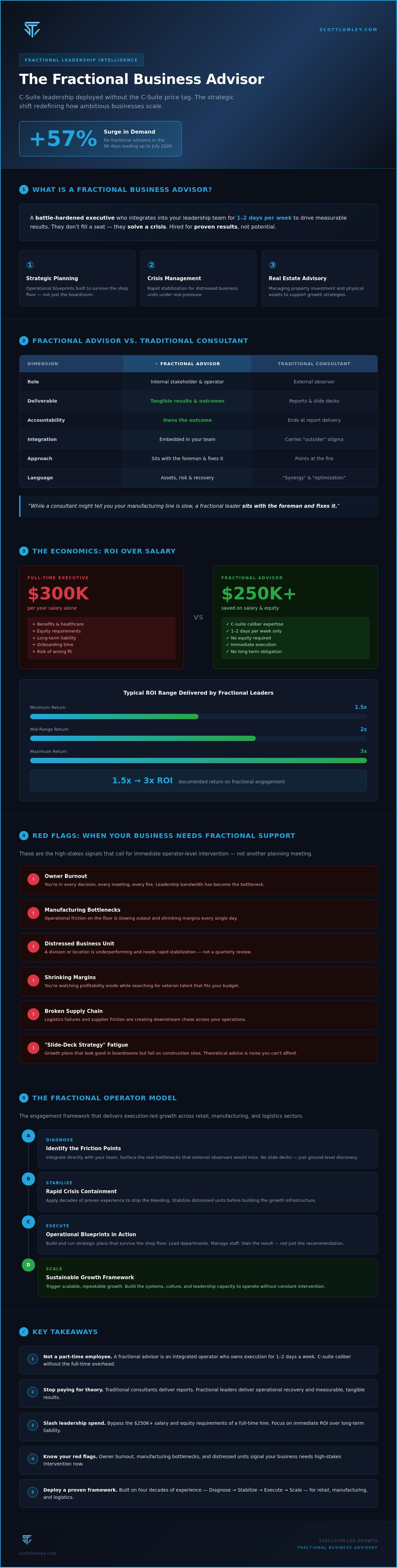
A $300,000 executive salary is a heavy price to pay for a leader who might not survive your company's current friction. You don't need a permanent fixture in a corner office to fix a broken supply chain or a distressed business unit. You need an operator. Hiring a fractional business advisor isn't about filling a seat; it's about deploying high-stakes leadership exactly where it's needed. Demand for these roles has increased by 57 percent in the 90 days leading up to July 2026. This shift proves that savvy owners are now prioritizing hard-won wisdom over traditional hiring models.
You likely feel the weight of operational bottlenecks slowing your growth every single day. It's frustrating to watch your margins shrink while you search for veteran talent that fits your budget. This guide will show you how to leverage specialized leadership to fix friction and scale your business without the cost of a full-time executive. We'll explore the mechanics of fractional engagement, the typical 1.5x to 3x ROI these experts deliver, and how to build a sustainable scaling framework that actually works.
Key Takeaways
- A fractional business advisor isn't a consultant; they're an integrated operator who owns execution for 1-2 days a week. You get C-suite caliber without the full-time overhead.
- Stop paying for theory and start paying for outcomes. While traditional consultants deliver reports, fractional leaders deliver tangible operational recovery and measurable results.
- Slash leadership spend by bypassing the $250k+ salary and equity requirements of a full-time hire. Focus on immediate ROI rather than long-term liability.
- Identify the specific red flags, like owner burnout or manufacturing bottlenecks, that signal your business is ready for high-stakes intervention.
- Deploy a no-nonsense framework built on four decades of experience to stabilize operations and trigger sustainable scaling in retail, manufacturing, or logistics.
What is a Fractional Business Advisor? (The Operational Reality)
A fractional business advisor is not a part-time employee. They are a battle-hardened executive who plugs into your leadership team for one or two days a week to drive results. They don't fill a seat; they solve a crisis. You are buying the caliber of a C-suite veteran without the full-time clock or the $300,000 price tag. This isn't about human resources filling a gap. It's a tactical hunt for the specific experience your business lacks.
The reality of the role is execution. Many leaders get caught in the trap of hiring for potential. A fractional advisor is hired for proven results. They've already seen your problems at multiple other companies. They know where the friction is. To understand the broader context of this role, it helps to look at the foundational definition of What is a Fractional Executive? and how they operate as strategic partners.
The Difference Between a Consultant and a Fractional Leader
Consultants are external observers. They look at your data, build a slide deck, and hand you a bill. Their job ends when the report is delivered. A fractional business advisor is an internal stakeholder. They integrate with your team. They manage your departments. They own the outcome. While a consultant might tell you your manufacturing line is slow, a fractional leader sits with the foreman and fixes it. A fractional leader’s reputation is built on the survival and scaling of your business, not the polish of a PDF.
Core Responsibilities in High-Stakes Environments
In high-pressure industrial or retail sectors, the advisor takes on specific, high-leverage tasks:
- Strategic Planning: Creating operational blueprints that survive the shop floor.
- Crisis Management: Providing rapid stabilization for distressed business units.
- Real Estate Advisory: Managing property investment and physical assets to support growth.
This is leadership from the trenches. It is focused entirely on the next actionable move to ensure recovery and expansion.
Fractional vs. Traditional Consulting: Why Execution Matters
Traditional consulting ends with a PDF. It is sterile. It is safe. A fractional business advisor ends with a result. They don't just point at the fire; they grab the extinguisher. This is the "Operator" mindset in action. It favors lived experience in manufacturing and retail over MBA theory. It strips away the fluff and corporate jargon that usually clogs up high-level decision making. When the stakes are high, you don't need a cheerleader. You need a strategist who knows how to move the needle on a balance sheet.
Corporate jargon is often a shield for people who don't know how to do the work. You've seen it before. High-priced consultants walk in, use words like "synergy" and "optimization," then leave you with a 50-page deck you'll never open. A fractional leader operates differently. They speak the language of assets, risk, and recovery. They cut through the nonsense because they don't have time for it. There is a palpable sense of urgency here. Every hour spent on theory is an hour lost on execution.
The Problem with "Slide-Deck Strategy"
Owners are exhausted by growth plans that look good in a boardroom but fail on a construction site. If an advisor hasn't managed a logistics hub or a distressed retail unit, their advice is just noise. Theoretical growth is a luxury you can't afford when operations are stalling. We prioritize strategic business advisor pillar strategies because execution-led growth is the only metric that matters. It's about movement. It's about fixing the friction in real-time, not planning to fix it next quarter.
Integration into the Company Culture
A fractional business advisor doesn't carry the "outsider" stigma. They lead your existing staff from the trenches. They build trust through transparency and shared goals. They value resilience over superficial appearances. This integration allows them to identify internal friction that a standard consultant would miss. They aren't there to make friends; they're there to stabilize the ship. If your operations need this level of grit, you might consider how strategic planning can stabilize your specific environment and prepare it for sustainable scaling.
The transition from "outsider" to "stakeholder" happens quickly. It's driven by a total lack of interest in corporate politics. The focus remains entirely on the next actionable move. This steady, composed leadership style provides clarity at high speed. It ensures that your team isn't just working harder, but working on the right levers to drive recovery.
The Economics of Fractional Leadership (ROI over Salary)
Hiring a full-time executive is a massive financial gamble. A $250,000 base salary is just the starting point. When you factor in healthcare, retirement matches, bonuses, and equity, that single hire can easily cost your business north of $400,000 annually. For a mid-sized firm facing operational friction, that's a lot of capital tied up in a single person who might not deliver. A fractional business advisor flips this equation. You gain the same veteran caliber for a fraction of the overhead. You aren't paying for a corner office presence; you're paying for a specific set of outcomes.
The "Speed to Value" factor is where the real money is made. A traditional C-suite hire usually requires a 90-day onboarding period to "learn the culture" and assess the landscape. You don't have 90 days when your margins are shrinking or your supply chain is failing. A fractional leader arrives with a mandate for immediate execution. Research shows that most fractional engagements deliver a 1.5x to 3x return on investment within the first year. They don't spend months observing; they spend weeks stabilizing.
Cost-Benefit Analysis: Full-Time vs. Fractional
Think of a full-time hire as a long-term mortgage and a fractional leader as a high-yield investment. One is a fixed liability; the other is agile leverage. By shifting to a fractional model, you free up significant capital. This liquidity can be redirected into core assets or specialized recovery tools like a Property Tax Debt System to clean up your balance sheet. A fractional advisor acts as a force multiplier for your budget by concentrating high-level strategic impact into a condensed, high-intensity schedule.
Reducing the Risk of Executive Turnover
The hidden costs of a bad executive hire are staggering. Beyond the lost salary, you face recruitment fees, disrupted team morale, and the opportunity cost of three to six months of failed strategy. The fractional model offers a "try before you buy" approach to C-suite talent. It allows you to test the leader’s grit and cultural fit in the trenches before making a permanent commitment. You maintain the flexibility to scale the advisor’s hours up or down based on the current level of operational friction. This isn't just about saving money; it's about protecting your business from the volatility of traditional hiring.
Measuring the success of this partnership is straightforward. You look at operational efficiency, debt reduction, and margin expansion. If the numbers don't move, the engagement ends. It's a results-only environment that prioritizes survival and recovery over corporate tenure. This level of accountability is rarely found in the world of full-time employment, where mediocrity can often hide behind a long-term contract.
Identifying the Friction: When Your Business Needs Fractional Support
Most business owners wait too long to ask for help. They wait until the smoke becomes a fire. By then, the cost of recovery has doubled. Identifying the need for a fractional business advisor requires a sober look at your current operations. If you are honest with yourself, the red flags are already there. They show up in your bank balance, your warehouse floor, and your stress levels. You don't need a consultant to tell you things are wrong; you need an operator to tell you how to fix them.
There are four primary indicators that your business is hitting a wall. First, growth has plateaued because you are bogged down in the daily grind. Second, operational friction is causing missed deadlines in manufacturing or logistics. Third, your real estate portfolios are underperforming due to a lack of strategic oversight. Finally, a crisis is imminent, and your current team lacks the grit to navigate it. These aren't just inconveniences. They are systemic failures that require high-stakes leadership to resolve.
The "Founder Trap" and How to Escape It
Founders are often the biggest bottleneck in their own companies. You started the business by doing everything yourself. That grit got you to the first million, but it will stop you from reaching the next ten. You become the single point of failure. A fractional business advisor helps you build the systems that allow you to lead again. This is about transitioning from "doing the work" to "owning the strategy." It requires a methodical approach to delegation and process design that most founders simply don't have the time to implement themselves.
Turnaround Situations and Distressed Assets
In a crisis, the first 72 hours are non-negotiable. Whether it is a supply chain collapse or a sudden liquidity crunch, rapid deployment leadership is the only way to stabilize the ship. We often use due diligence consulting services to identify these operational deal-breakers before they sink a deal or a company. During a recovery, the focus shifts to stabilizing cash flow and managing specialized liabilities, such as the Property Tax Debt System. If your business units are distressed, you need a strategist who can execute a crisis management plan immediately to ensure survival.
Recovery isn't about optimistic theories. It's about hard-won wisdom applied to gritty realities. You need someone who has navigated adversity before. Someone who lead from the trenches. If your current leadership team is paralyzed by the stakes, it is time to bring in a fractional expert who thrives in the friction.
Strategic Execution: The Scott Lumley Fractional Model
Success in high-stakes environments isn't accidental. It's the result of four decades of hands-on experience across retail, manufacturing, and logistics. This model isn't built on academic theory. It's built on lived experience. A fractional business advisor from this background doesn't just offer advice; they take ownership of the execution. We prioritize survival and recovery as much as expansion. You can't scale a business that is currently leaking capital or suffering from deep operational friction. We fix the foundation first.
The difference between a coach and a battle-hardened operator is simple. A coach tells you what to do. An operator shows you how to do it while standing next to you in the heat of the moment. This "no-nonsense" approach strips away the fluff. It focuses entirely on the next actionable move. Whether it's through strategic planning or a deep dive into due diligence, the goal is always a tangible outcome. We don't deal in possibilities. We deal in results.
Leadership Forged in Adversity
Resilience isn't a buzzword. It's a requirement for global operations. The principles found in I Survived Africa serve as a blueprint for navigating complex, high-risk environments. This isn't just a book title. It's a testament to the grit required to manage construction projects and property investment portfolios with steady composure. When you hire a strategist who has navigated both extreme success and significant adversity, you get hard-won wisdom that can't be taught in a classroom. You get a leader who knows how to survive the storm and lead the recovery.
Your Next Actionable Move
Stop settling for theoretical growth. Assess your current leadership team. Do they have the grit required for the next level of scaling? If the answer is no, the integration of a fractional expert is your leverage point. The process begins with a sober assessment of your industrial or real estate firm's current friction. From there, we deploy a methodical framework to stabilize operations and drive ROI. It is time to stop guessing and start executing. Get the direct, results-driven leadership your business requires.
The path to sustainable scaling isn't through more meetings. It's through better leadership. By deploying a fractional business advisor, you gain the clarity needed to make high-stakes decisions with confidence. We move quickly from identifying a pain point to offering a leverage point. There is no wasted space in this narrative. Every move is calculated to ensure your business survives, recovers, and eventually dominates its sector.
Deploy High-Stakes Leadership Today
High-stakes leadership is no longer a luxury reserved for massive corporations. It's a tactical requirement for any firm facing operational friction or a growth plateau. You've analyzed the economics. You've identified the red flags. Now you must decide if you want another theoretical report or a tangible result. A fractional business advisor provides the grit and strategic oversight necessary to stabilize distressed units and trigger sustainable scaling. This isn't about optimistic theory; it's about movement.
Leverage 40 years of hands-on experience in manufacturing, logistics, and real estate. The Scott Lumley model delivers a battle-hardened approach to crisis management and turnarounds. We don't deal in corporate jargon or sterile promises. We deal in hard-won wisdom. Your next move determines whether you continue to fight the same bottlenecks or finally break through them. Don't let operational friction dictate your future. Secure the strategic leadership your business needs to scale or recover.
The path to recovery is open. It requires a leader who has navigated the trenches. It's time to build a business that lasts.
Frequently Asked Questions
What exactly does a fractional business advisor do on a daily basis?
A fractional business advisor integrates into your leadership team to own the execution of your strategy. They don't just attend meetings; they manage departments, fix operational friction, and oversee high-stakes projects from the trenches. Their day is spent on movement and results rather than corporate posturing. They identify bottlenecks in manufacturing or logistics and deploy immediate solutions to keep the business scaling.
Is a fractional business advisor the same as an interim CEO?
No. An interim CEO is a full-time placeholder working until a permanent hire is found. A fractional advisor is a long-term strategic partner who provides C-suite caliber leadership on a part-time basis. You get the expertise without the $300,000 overhead. It's about buying the leader’s wisdom and execution capability, not their entire week.
How many hours a week does a fractional advisor typically work?
Most engagements require one to two days per week, though the schedule is flexible based on your operational needs. Verified industry trends show that fractional professionals often balance two to three clients at a time. The focus remains on leverage and impact. You don't pay for a presence in a corner office; you pay for the specific hours required to stabilize and scale the firm.
Can a fractional advisor help with real estate development and property tax debt?
Yes, if they possess specific Real Estate Advisory expertise. They manage property assets and can deploy specialized tools like a Property Tax Debt System to clean up a distressed balance sheet. This isn't just administrative work. It is high-level strategic management of physical assets to ensure they support, rather than drain, your company’s growth.
What industries benefit most from fractional leadership?
Industrial sectors like manufacturing, logistics, and construction see the most immediate impact. These environments often face complex operational friction that requires veteran Strategic Planning. Retail and distressed business units also benefit from this model. Any industry where the stakes are high and the margins are tight requires the grit that a fractional business advisor brings to the table.
How do you measure the success of a fractional business advisory engagement?
Success is measured by tangible ROI and the removal of growth bottlenecks. Look at your margin expansion, debt reduction, and operational stability. Most fractional engagements deliver a 1.5x to 3x return on investment within the first year. If the advisor isn't moving the needle on your balance sheet, the engagement isn't working. It is a results-only environment.
Is it possible to transition a fractional role into a full-time position later?
It's possible, but the fractional model is designed for agile leadership. It allows for a "try before you buy" approach to C-suite talent. You can test a leader’s grit and cultural fit in the heat of a crisis before committing to a permanent salary and equity package. This flexibility protects the business from the high cost of executive turnover.
How much does it cost to hire a fractional business advisor?
Costs depend entirely on the scope of the engagement and the level of crisis or strategy required. The real metric isn't the fee, but the capital saved by avoiding a full-time executive’s salary, benefits, and equity. You are redirecting those savings into core assets while gaining veteran leadership. It's a shift from a fixed liability to a high-leverage investment.


