

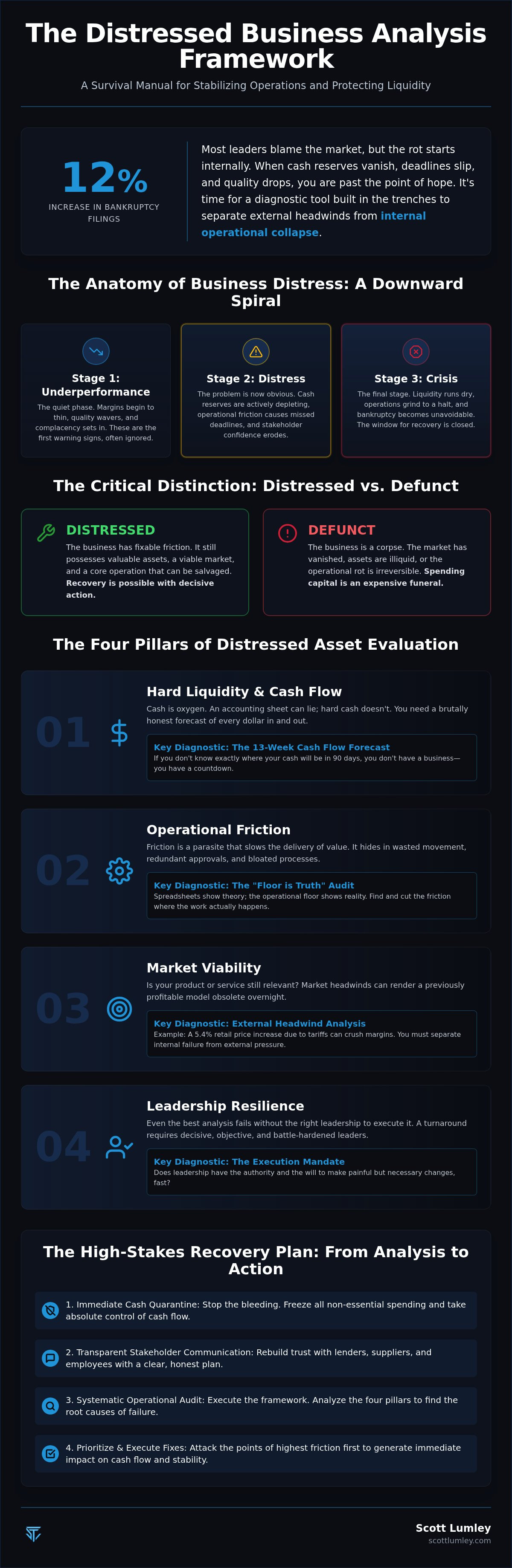
Your spreadsheet isn't failing you; your operations are. With total bankruptcy filings rising nearly 12% in the last year, the margin for error has effectively vanished. Most leaders stare at declining margins and blame the market, but the rot usually starts much closer to home. If you're watching cash reserves vanish while deadlines slip and quality drops, you're past the point of hoping for a turnaround. You need a battle-hardened distressed business analysis framework that strips away the fluff and identifies the exact friction points killing your liquidity. This isn't about theoretical consulting models. It's about a diagnostic tool built in the trenches to separate external market trends from internal operational collapse.
It's exhausting to lead a company when every decision feels like a gamble against a ticking clock. You know something is broken. However, the confusion between bad luck and bad systems is paralyzing. This guide changes that. You'll learn how to execute a systematic audit of your business failure, prioritize the operational fixes that actually move the needle, and build a turnaround strategy with total confidence. We're going to look at the harsh realities of your current state and map out the specific moves required to stabilize before the window of opportunity slams shut.
Key Takeaways
- Learn to distinguish between "distressed" operations that can be salvaged and "defunct" businesses that are already past the point of recovery.
- Implement a battle-tested distressed business analysis framework to expose internal operational friction before your cash reserves hit zero.
- Stop blaming the economy and use a diagnostic checklist to separate external market headwinds from internal mismanagement.
- Execute a high-stakes recovery plan starting with immediate cash quarantine and transparent stakeholder communication.
- Understand why even the best strategic analysis fails without the decisive, trench-led leadership required to drive rapid operational stabilization.
What is a Distressed Business Analysis Framework?
A distressed business analysis framework isn't a generic consulting deck. It's a survival manual. It functions as a systematic diagnostic tool designed to evaluate both operational and financial health under extreme pressure. Most leaders wait too long to use one. They mistake terminal failure for a temporary rough patch. You must distinguish between "distressed" and "defunct" immediately. A distressed business has fixable friction. It has assets, a market, and a core that still functions. A defunct business is a corpse. Spending capital on a defunct entity isn't a turnaround; it's an expensive funeral.
This framework removes the emotional bias that clouds a founder's judgment. It's hard to be objective when it's your name on the building. Scott Lumley's approach strips away the ego. With 40 years of experience in manufacturing and logistics, he knows that analysis is worthless without immediate execution. If your diagnostic doesn't lead to a tactical move, you're just documenting your own decline. Every minute spent on theory is a minute of liquidity you'll never get back.
The Anatomy of Business Distress
Failure happens in stages. It starts with underperformance. This is the quiet phase where margins thin and quality begins to waver. If ignored, it matures into distress. Now, cash reserves are depleting and operational friction causes missed deadlines. The final stage is a full-blown crisis. This is where liquidity runs dry and the doors start to close. Complacency is the primary driver here. Leaders get comfortable and ignore the "silent killers" like hidden friction in the supply chain or bloated overhead. A distressed business analysis framework serves as the definitive roadmap for rapid stabilization before you hit the crisis cliff.
Why Spreadsheets Only Tell Half the Story
Spreadsheets provide a sterile theory of how a business should work. They rarely reflect the grounded reality of a failing operation. A balance sheet can mask deep-seated rot by showing book values that don't match market liquidity. It doesn't show the friction on the manufacturing floor or the breakdown in logistics. The "operational floor" is the only source of truth that matters. If the work isn't flowing, the numbers won't follow. You don't fix a business by moving cells in Excel. You fix it by removing the friction where the actual work happens. The numbers are just the scoreboard; the floor is where the game is won or lost.
The Four Pillars of Distressed Asset Evaluation
A distressed business analysis framework relies on four structural supports. If one fails, the entire turnaround collapses. These pillars aren't academic concepts. They are the pressure points where a business either stabilizes or bleeds out. We evaluate hard liquidity, operational friction, market viability, and leadership resilience. This is a cold, calculated look at what's actually left in the tank. You aren't looking for excuses here. You're looking for leverage.
Pillar 1: Hard Liquidity and the 13-Week Forecast
Cash is oxygen. In a distressed environment, your accounting software is likely lying to you. You need a 13-week cash flow forecast that tracks every dollar with brutal honesty. This isn't about accruals; it's about hard cash on hand. With the Prime Rate sitting at 6.75% as of August 2026, the cost of capital is too high to tolerate "liquidity leaks" in your supply chain. These leaks often hide in bloated inventory or inefficient logistics routes. If you don't know where your cash will be in 90 days, you don't have a business. You have a countdown.
Pillar 2: Operational Friction Diagnostic
Operational friction is any process that slows the delivery of value to your customer. It's a parasite. In manufacturing or retail, this looks like wasted movement on the floor or redundant approvals that bottleneck production. You must audit the operational floor to find these inefficiencies. This level of scrutiny mirrors the process used in due diligence consulting services. You're looking for the gap between how the work is supposed to happen and how it's actually getting done. Cut the friction, or the friction will cut your margins.
Pillar 3: Market Viability and "The Pivot"
Is your product still relevant in 2026? Market headwinds, like the 5.4% increase in retail prices due to 2025 tariffs, can render a previously profitable model obsolete. You need to analyze competitor moves in this high-stakes environment. Sometimes, the analysis reveals that the core product is sound but the delivery model is broken. This leads to a strategic pivot. Other times, the market has moved on entirely. In those cases, a hard restructuring is the only path forward. You can't out-manage a product that nobody wants to buy. A clear strategic planning session can help determine if your value proposition is still viable.
Pillar 4: Leadership and Human Capital Resilience
Turnarounds are won by people, not spreadsheets. You must evaluate if your current leadership has the stomach for the decisions ahead. Crisis management requires a different psychological profile than steady-state growth. If your team is paralyzed by the 12% rise in total bankruptcy filings, they won't execute the framework. You need operators who can maintain composure while the stakes are at their highest. Resilience isn't a "soft skill" here. It's a survival requirement. If the leadership lacks the grit to execute, the best analysis in the world is just paperwork.
Identifying Operational Friction vs. Market Headwinds
Blaming "the economy" is the easiest way to avoid looking in the mirror. While interest rates and tariffs are real pressures, they are often used to mask internal rot. A distressed business analysis framework forces you to separate market headwinds from operational friction. Headwinds are external forces that slow everyone in your sector down. Friction is the internal drag that only slows you down. If your competitors are navigating the same high-interest environment but maintaining their delivery schedules, your problem isn't the Fed. It's your floor.
To stop the bleeding, you must categorize your failures with total transparency. Use this diagnostic checklist to determine where your energy belongs:
- Headwind: Industry-wide demand drops by 15% due to consumer spending shifts.
- Friction: Your customer churn is 30% higher than the industry average because of poor quality control.
- Headwind: Raw material costs rose by 5.4% across the board due to global trade dynamics.
- Friction: Your internal procurement process is so slow that you miss early-payment discounts and volume rebates.
Identifying these gaps is the core objective of crisis management consulting. You can't control the market, but you can control the friction. Fixing the floor yields immediate results that hit the bottom line faster than any market recovery ever will. Waiting for the economy to turn is a strategy for the hopeful; fixing the friction is a strategy for the battle-hardened.
The Friction Audit: From Logistics to Leadership
The friction audit starts in the warehouse but usually ends in the boardroom. Communication silos are the most common bottlenecks. When your sales team promises delivery dates that your logistics team can't physically meet, friction spikes and cash burns. You must also confront toxic complacency within your leadership. If your managers are more concerned with protecting their departments than reducing the company-wide burn rate, they are part of the friction. Decisive leadership means removing anyone who prioritizes their comfort over the company's survival.
Surviving Market Headwinds: Strategic Safeguards
Surviving headwinds requires a gritty business model that assumes volatility is the new baseline. This means reducing risk through diversified asset management and maintaining extreme strategic flexibility. Don't get locked into rigid, long-term contracts that prevent you from pivoting when the market shifts. Resilience is built by assuming the market will stay difficult and optimizing your internal engine to outrun the competition anyway. A lean, friction-free operation can remain profitable in a down market while bloated competitors are filing for Chapter 11.
How to Execute a Distressed Business Analysis
Execution is the graveyard of theory. A distressed business analysis framework only works if it's applied with speed and surgical precision. You don't have months to deliberate. You have weeks, or perhaps only days, before liquidity runs dry. The process starts with a total shutdown of non-essential spending and ends with a restructured operation capable of sustainable growth. This isn't a gentle transition. It's a high-stakes intervention designed to save the core of the business while cutting away the rot.
To execute this framework effectively, you must follow a disciplined sequence of moves:
- Immediate Cash Quarantine: Freeze all non-essential outflows. Every dollar must be justified against survival.
- Stakeholder Communication: Manage the narrative. Talk to creditors and investors before they hear rumors from the market.
- Rapid Operational Audit: Perform "The Floor Walk." This is a physical inspection of where the work happens to identify the friction points discussed in the previous sections.
- Priority-Based Restructuring: Identify the 20% of operations causing 80% of the bleed. Cut them immediately to preserve the remaining assets.
- Deployment of Interim Leadership: Replace paralyzed or complacent managers with operators who can execute under fire without emotional attachment to past failures.
The 72-Hour Stabilization Protocol
The first three days of a recognized crisis are the most critical. You must stop the bleed immediately. This involves cancelling all discretionary subscriptions, freezing all hiring, and deferring non-critical maintenance. Establish a "War Room" where high-stakes decisions are made in real-time. This isn't a committee; it's a command center. If you can't stabilize the cash position in 72 hours, your turnaround options shrink by the hour. Speed is your only friend when the bank is watching your every move.
Communicating with Creditors and Investors
Transparency is your only currency when you're out of cash. Creditors and investors can tell when you're hiding the truth, and they'll pull the plug the moment they smell dishonesty. Present a turnaround plan that is grounded in the reality of your operational audit. Build trust by showing them the math and the decisive moves you've already made. This is where engaging a business turnaround consultant becomes a strategic asset. An outside expert brings the credibility and "battle-hardened" perspective that internal teams often lack. To secure your company's future, you need to consult with an execution-led operator who understands the stakes.
Turnaround Leadership: Moving from Action to Analysis
Analysis is just the map. Leadership is the driver. A distressed business analysis framework provides the diagnostic data you need, but it won't make the hard calls for you. You need a leader who isn't afraid to cut deep and move fast. Most turnarounds fail because owners get sentimental. They hesitate. In a crisis, hesitation is a death sentence. You can't lead a recovery from a comfortable office; you have to lead it from the trenches where the friction actually lives.
Scott Lumley’s philosophy is grounded in this reality. With four decades of experience across manufacturing, construction, and logistics, he knows that "boardroom strategy" often crumbles when it hits the warehouse floor. True leadership in a distressed state means being an operator first and a strategist second. It means identifying the rot, acknowledging it without ego, and executing the stabilization protocol before the clock runs out.
Execution Over Sterile Theory
Analysis paralysis is a luxury you don't have. If you spend months perfecting a diagnostic, you'll be documenting a bankruptcy instead of a recovery. A 70% perfect plan executed today beats a 100% perfect plan delivered next month when your accounts are empty. This is the core of the distressed business analysis framework: it's designed for speed. You identify the primary leverage points, stop the immediate bleed, and move to the next move. Lessons from forty years in high-stakes operations show that decisive action creates its own momentum. You don't need consensus; you need results.
Building a Resilient Future
Stabilization is only the first win. Once you've stopped the slide, the focus must shift toward sustainable growth. This is where you transition from survival mode to building a durable engine. Bringing in an interim business consultant provides the objective distance needed to make these transitions without the baggage of past failures. They don't just offer advice; they drive the change required to ensure the friction doesn't return.
Implementing strategic business advisor frameworks ensures your business is rugged enough to handle future market volatility. Recovery isn't about getting back to "normal." Normal is what got you into distress. Recovery is about becoming more efficient, more transparent, and more profitable than you were before the crisis began. Stop watching your margins disappear and start executing a plan that works. Contact Scott Lumley for a no-nonsense operational diagnostic and take control of your company's future today.
Stop the Bleed and Execute Your Recovery
Business distress isn't a life sentence. It's a diagnostic challenge. You've seen how to separate external market headwinds from the internal friction that's actually draining your accounts. You now have the pillars to evaluate your assets and the protocol to stabilize your cash flow within 72 hours. Applying this distressed business analysis framework is the difference between a controlled recovery and a total collapse.
Theory won't save your company. Only execution can. Scott Lumley brings 40 years of operational experience in manufacturing and real estate to the table, delivering execution-led turnaround results that traditional consultants can't match. Don't wait for the market to shift or for liquidity to vanish entirely. Take the decisive step required to stabilize your floor and rebuild your margins. You have the map; now you need the driver.
Secure Your Business’s Future with Scott Lumley’s Strategic Advisory. Your business can still be salvaged if you have the grit to lead it through the recovery.
Frequently Asked Questions
What is the first step in a distressed business analysis?
The first step is an immediate cash quarantine. You must freeze all non-essential spending to preserve every dollar of remaining liquidity. This isn't a suggestion; it's a survival requirement. You can't accurately assess the damage while cash is still bleeding out of the back door. Once the outflows are controlled, you can begin the deep-dive diagnostic into your operational floor to find where the friction is killing your margins.
How do you differentiate between a temporary slump and a distressed state?
A temporary slump is a market-driven dip in demand, while distress is a systemic failure of your internal operations. In a slump, your systems still work, but the customers are quiet. In a distressed state, you might still have sales, but your cash reserves are vanishing anyway. Missed deadlines, declining quality, and chronic liquidity shortages are the hallmarks of a business that has moved from a slump into a crisis.
Can a business be saved if it is already in a liquidity crisis?
Survival is possible if your core product or service still has market value. A liquidity crisis is a timing problem, not necessarily a terminal one. By applying a distressed business analysis framework, you can identify the assets to protect and the rot to cut. Success requires aggressive cost-containment and transparent communication with creditors. If you can stabilize the cash flow before the window closes, you can rebuild the operation.
What are the most common signs of operational friction?
Operational friction shows up as bottlenecks and communication silos that slow down delivery. Look for redundant approval processes, wasted movement on the manufacturing floor, or a sales team that doesn't talk to logistics. Toxic complacency is another major sign. When managers prioritize their own comfort or department over the company's survival, friction has won. You fix this by auditing the floor and removing every step that doesn't add direct value.
How long does a typical business turnaround analysis take?
Initial stabilization happens in the first 72 hours, but a comprehensive audit takes longer. A typical distressed business analysis framework deployment requires ten to fourteen days to yield a prioritized list of operational fixes. This isn't a months-long consulting project. It's a high-speed diagnostic designed to produce a tactical plan before your next major payroll or creditor deadline. Speed is the only priority when liquidity is at stake.
What is a 13-week cash flow forecast and why is it critical?
A 13-week cash flow forecast is a granular look at every dollar entering and leaving the business over the next quarter. It's critical because it removes the "sterile theory" of accrual accounting. In a turnaround, you don't care about paper profits; you care about hard cash. This forecast tells you exactly when you'll hit a wall, allowing you to make decisive moves to extend your runway before it's too late.
Why do I need an outside advisor for a distressed business analysis?
You need an outside advisor because internal teams are often blinded by their own history. Emotional attachment to failed strategies or "toxic complacency" prevents leaders from making the hard cuts required for survival. An advisor brings a battle-hardened perspective from the trenches. They don't have a department to protect or an ego to feed. Their only goal is operational recovery and rapid stabilization.
How do I manage employee morale during a turnaround analysis?
You manage morale with total transparency and decisive action. Employees aren't stupid; they know when the business is failing. Lying to them or providing "cheerleader" talk only destroys trust. Instead, show them a clear, no-nonsense plan for recovery. When they see leadership in the trenches and making the same sacrifices they are, they'll rally. Resilience is built on honesty, not polished marketing promises or false optimism.


