

High yields in property tax debt investing aren't won at the auction block. They're won in the trenches of due diligence. Most amateurs treat these certificates like lottery tickets. They hope the underlying asset is worth the paper it's printed on. It's a dangerous game. You aren't just buying debt. You're inheriting operational friction, environmental liabilities, and structural nightmares. These can turn a guaranteed return into a financial sinkhole.
You know the frustration of opaque auction processes and the fear of uncovering a toxic asset after the check has cleared. It's a valid concern. This article strips away the polished marketing promises. It delivers the gritty reality of strategic execution. I'll provide a repeatable due diligence framework built on forty years of operational experience. You'll learn how to identify hidden risks, manage the recovery of tax-distressed assets, and build a property tax debt system designed for scale. We're moving past the theory. We're moving into the hard-won wisdom of real-world recovery.
Key Takeaways
- Move beyond sterile investment theories to understand property tax debt as a high-stakes asset requiring hands-on operational recovery.
- Differentiate between the interest-based returns of tax liens and the direct asset acquisition strategies found in tax deed auctions.
- Protect your capital by identifying operational friction, such as environmental liabilities and structural neglect, before bidding on property tax debt investing opportunities.
- Transition from manual, emotional bidding to a scalable Property Tax Debt System that prioritizes data-driven research and systemic analysis.
- Apply battle-hardened leadership and risk management principles to navigate the gritty realities of distressed real estate and secure long-term yields.
Understanding Property Tax Debt: High-Stakes Assets vs. Sterile Theory
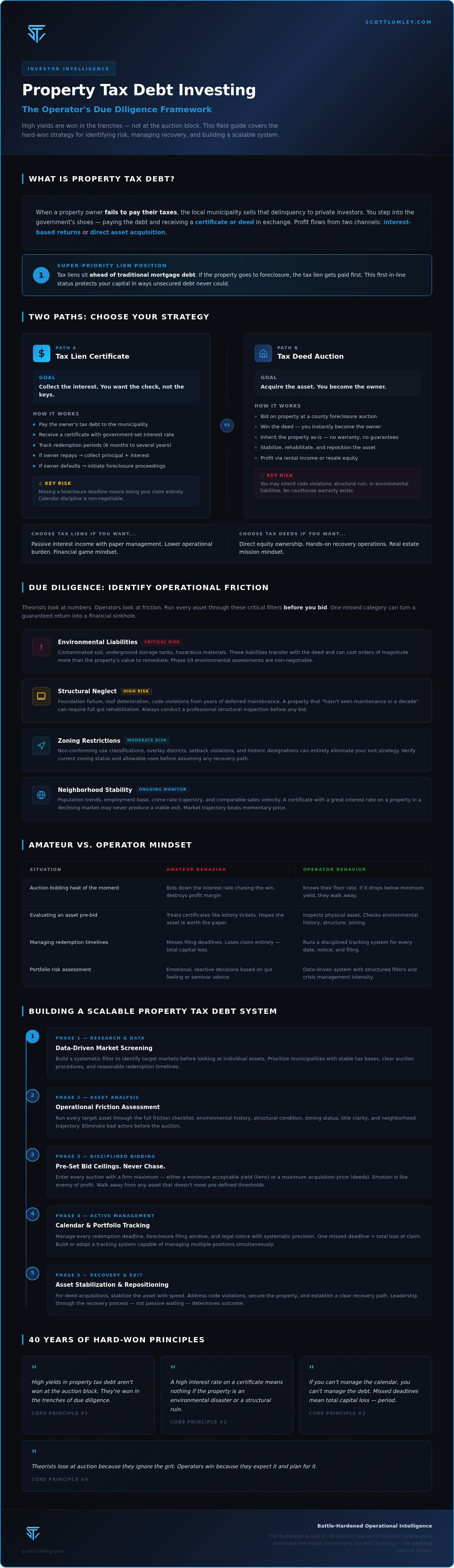
Property tax debt is a government-backed claim on real estate. When a property owner fails to pay their dues, the local municipality doesn't just wait. They monetize that delinquency. For the investor, property tax debt investing is the act of stepping into the shoes of the government. You pay the debt. You receive a certificate or a deed in exchange. It sounds simple on paper. It's anything but simple in the field.
Profit in this sector flows from two channels: aggressive interest rates or the eventual acquisition of the asset itself. Don't be fooled by the high yields promised in weekend seminars. This is not a passive investment. It's a high-stakes operational recovery play. You aren't just buying a paper yield; you're buying a seat at the table of a distressed asset's future. If you don't understand the operational reality of the building, you don't understand the investment.
The Mechanism of the Tax Lien Certificate
Local governments rely on property taxes to fund schools, roads, and emergency services. When that cash flow stops, their budgets stall. To fix this, they sell tax lien certificates to private investors. This process allows the municipality to receive immediate cash while the investor takes on the right to collect the debt plus interest. It's a necessary tool for municipal stability.
The real power lies in the priority position. A tax lien is a super-priority lien. It sits ahead of traditional mortgage debt. If the property goes to foreclosure, the tax lien gets paid first. This "first-in-line" status is the ultimate leverage point. It protects your capital in ways that unsecured debt never could. However, leverage is only useful if you know how to pull the handle. Without a clear strategy, that priority position is just a faster way to lose money on a bad asset.
Real Estate Leadership in Distressed Debt
Success in this arena requires moving beyond the spreadsheet. You have to understand the physical asset. A high interest rate on a certificate means nothing if the property is an environmental disaster or a structural ruin. Theoretical advisors look at the numbers; battle-hardened operators look at the friction. They look at zoning, structural integrity, and neighborhood stability.
Strategic planning is essential here. You need to assess portfolio risk with the same intensity you'd use in a crisis management situation. The difference between a win and a total loss often comes down to your ability to lead through the recovery process. Theorists lose at auction because they ignore the grit. Operators win because they expect it. They use a Property Tax Debt System to filter out the noise and focus on assets with a clear path to recovery. It's about leadership in the trenches, not just bidding from a desk.
Tax Liens vs. Tax Deeds: Navigating the Recovery Zone
In property tax debt investing, you either want the check or the keys. There's no middle ground. Tax liens are a play for interest. You buy the debt, wait for the owner to pay, and collect the yield. Tax deeds are a play for the asset. You buy the property outright at a foreclosure auction. Each path demands a specific operational mindset. One is a financial game. The other is a real estate recovery mission. Your choice depends entirely on your risk appetite and whether you want cash flow or equity.
Investing in Tax Lien Certificates
This is the lien-to-yield strategy. You aren't looking to own the building. You're looking for the interest. Local laws set interest rate caps, but competitive auctions often involve bidding down those rates. Amateurs bid themselves out of a profit in the heat of the moment. Professionals know their floor and stick to it. If the rate drops too low, they walk away. They don't chase bad deals for the sake of winning.
Managing the paper is where the friction lives. You have to track redemption periods, which can last from six months to several years. If the owner doesn't pay, you must know when your right to foreclose expires. Missing a deadline means losing your claim entirely. It requires a disciplined system to manage the dates, the notices, and the legal filings. If you can't manage the calendar, you can't manage the debt.
Executing the Tax Deed Strategy
Tax deeds are the heavy-lifting side of property tax debt investing. When you win a deed auction, you aren't a lender anymore. You're the owner. This transition brings immediate operational challenges. You might inherit a building with major code violations or a structure that hasn't seen maintenance in a decade. You're buying the property as-is, which often means buying someone else's neglect. There's no warranty at the county courthouse steps.
Stabilization must happen fast. You need to secure the perimeter, assess the structural integrity, and deal with any existing occupants. This is where strategic real estate advisory becomes the difference between a successful turnaround and a stagnant liability. You need a plan for the physical recovery of the asset before you ever raise your hand at the auction. If you wait until you have the deed to figure out the repairs, you've already lost. Success here isn't about the bid. It's about the execution that follows.
Due Diligence: Identifying Operational Friction Before the Auction
Yield isn't something you find after the gavel falls. It's something you protect before you ever step into the room. In property tax debt investing, the most dangerous move is assuming the asset matches the tax roll description. Most "bargains" you see at auction are actually operational liabilities in disguise. They are properties that professional operators have already passed on. If you don't have a rigorous process, you're just catching their falling knives.
Operational friction isn't a buzzword. It's the reality of distressed real estate. It's the zoning hurdle that prevents you from flipping a lot or the structural neglect that makes a renovation impossible. You aren't buying a financial instrument. You're buying a physical liability that happens to have a tax bill attached. Yield is earned through aggressive due diligence, not just high bidding.
Physical Asset Inspection and Risk Mitigation
You have to separate the "dirt" from the "structure." The land might have value, but a crumbling building can cost more to demolish than the lot is worth. Look for the "un-fixable" problems. Environmental contamination is the ultimate deal-killer. One leaking underground storage tank can wipe out a decade of gains. Legal encumbrances, like federal tax liens or undisclosed easements, are equally toxic. Use your due diligence to find these friction points. They aren't just risks; they are the data points that determine your maximum walk-away bid. If the friction is too high, walk.
Navigating Legal and Operational Hurdles
The physical building is only half the battle. You also have to navigate the legal friction. A sudden bankruptcy filing by the property owner can freeze the tax foreclosure process for months or years. Your capital stays locked while the asset deteriorates. Then there is the cost of clearing the title. Most tax deeds come with "clouds" that prevent you from getting title insurance. You'll need to factor in the hidden costs of "quiet title" actions. This isn't a job for a spreadsheet. It requires Due Diligence Consulting Services to identify these hurdles before the deal is signed. Real estate leadership means knowing exactly what you're stepping into before the first dollar leaves your account.
Building a Scalable Property Tax Debt System
Scale is not a product of luck. It's a product of discipline. In property tax debt investing, the biggest threat to your capital is your own emotion. Bidding wars at auctions are designed to trigger a "must-win" response. A systemic approach kills that response. It replaces gut feelings with hard data. When you build a system, you aren't just buying certificates. You're executing a repeatable business model that functions regardless of market noise.
Scaling requires moving from manual, localized research to systemic data analysis. You can't rely on walking into one courthouse. You need to diversify across multiple tax jurisdictions. This hedges your risk against local legislative shifts or economic downturns. The Scott Lumley Property Tax Debt System is built on this exact foundation. It's an execution-led framework designed for investors who want to move beyond the "hobbyist" phase and into professional asset management.
Operationalizing the Acquisition Flow
Your acquisition flow must be a machine. This starts with a repeatable framework for auction research. You need to know which assets to ignore before the auction even starts. Managing your capital stack is equally critical. In the "recovery zone," speed is a competitive advantage. You must have funds ready for rapid deployment. High-stakes tax sales don't wait for you to move money around. You either have the liquidity to strike, or you lose the opportunity to someone who does. Rapid decision-making isn't about being reckless; it's about having enough data to be decisive.
Turnaround Strategies for Acquired Assets
Winning the deed is the beginning of the friction, not the end. Once the asset is yours, you must apply business turnaround principles to stabilize it. Distressed property is a crisis management exercise. You need a clear plan for the exit before you ever bid. Are you flipping for immediate liquidity? Are you renting for cash flow? Or are you holding for long-term appreciation? Strategic planning for asset stabilization must happen in the first 30 days post-foreclosure. Secure the property. Clear the title. Execute the plan. If you're ready to stop guessing and start building a professional portfolio, it's time to leverage the Property Tax Debt System for your next move.
Strategic Execution: Why Real Estate Leadership Matters
Investing in debt is a leadership exercise in risk management. It isn't a passive sideline. In property tax debt investing, your success depends on your ability to lead through friction. You're entering a high-stakes environment where the assets are distressed and the rules are rigid. Leadership here means having the stomach to make hard calls when a deal goes sideways. It's about moving from "buying debt" to executing a comprehensive property strategy. You aren't just a collector; you're an operator.
Industry experience in construction and manufacturing translates directly to better real estate deals. If you've managed a job site or a production line, you understand how things break. You know how to spot the difference between a cosmetic fix and a structural failure. This grounded perspective allows you to see the reality of an asset while others are blinded by the potential yield. The value of a real estate leadership advisor lies in this exact ability to navigate complex, high-friction deals with a steady hand.
Leadership from the Trenches
Theoretical advisors fail in the gritty world of tax deeds. They haven't stood on a site with a code enforcement officer or managed a rapid turnaround in a declining neighborhood. They offer polished theories; you need hard-won wisdom. Leveraging four decades of operational experience is how you avoid deal-killing friction. It's about knowing which legal hurdles are routine and which are terminal. For many firms, a fractional advisor provides the necessary leadership to scale without the overhead of a full-time executive. You get the battle-hardened perspective required to survive the recovery zone.
Next Moves: Executing Your Debt Strategy
Don't enter the next auction cycle without a plan. You need a final checklist to ensure your capital is protected. High-stakes property tax debt investing requires absolute clarity before the bidding begins. Professional due diligence is your only shield against worthless assets. If you're ready to stop gambling on tax rolls and start executing a professional system, you need an operator's perspective. Your next move should be to consult with Scott Lumley on your Property Tax Debt System. Build your framework now. Execute with precision later. The auction clock is already ticking.
Mastering the Recovery Zone
Property tax debt investing isn't a game of chance. It's a game of execution. You've seen that yield isn't won at the auction; it's protected through aggressive due diligence and systemic research. Success requires moving past the sterile theories of traditional consulting. You need the grit to handle operational friction and the leadership to stabilize distressed assets. Most investors fail because they lack a repeatable framework. They let emotion drive their bids and neglect the physical reality of the building. You don't have to be one of them.
By focusing on risk mitigation and strategic planning, you turn a high-stakes liability into a scalable asset. Stop guessing on courthouse steps. Leverage four decades of operational leadership and expertise in distressed asset recovery to build a portfolio that lasts. It's time to move from theory to the trenches. Execute your strategy with Scott Lumley’s Property Tax Debt System and take control of your next acquisition. You have the tools. Now, go do the work.
Frequently Asked Questions
Is property tax debt investing safe for beginners?
Property tax debt investing isn't inherently safe for beginners who treat it like a passive hobby. It's a high-stakes environment where one bad asset can wipe out your capital. You're dealing with structural neglect and environmental risks. Without a repeatable framework, you're just gambling on tax rolls. Beginners should focus on building an operational system before bidding on their first certificate. Hard-won experience is the only real protection in this market.
What happens to the mortgage if I buy a tax lien?
The tax lien typically takes a super-priority position over the existing mortgage. This means the government’s claim for unpaid taxes sits first in line. If the lien isn't redeemed and you foreclose, the mortgage is usually extinguished. Banks often pay the delinquent taxes themselves to prevent this from happening. You must understand the priority of liens in your specific jurisdiction to manage the risk of bank intervention.
Can I lose my entire investment in property tax debt?
You can absolutely lose your entire investment if you skip the due diligence phase. If you buy a lien on a property with environmental contamination or a structure slated for demolition, your money is effectively gone. The certificate might promise a high yield, but if the underlying asset has no value, there's nothing to recover. This is why a professional system prioritizes the physical asset over the spreadsheet.
How much capital is required to start a property tax debt system?
Capital requirements depend on the scale of your operation and the jurisdiction you're targeting. You can find liens for as little as a few hundred dollars, but professional property tax debt investing requires more. You need liquidity for the bid, the research fees, and the potential costs of stabilizing the asset if you take ownership. A scalable system isn't about the minimum entry price; it's about having the capital stack to strike quickly.
How long is the typical redemption period for tax liens?
Redemption periods vary by location, typically lasting between six months and three years. During this window, the property owner has the right to pay the delinquent taxes plus interest to clear the lien. If they pay, you get your capital back with the accrued interest. If they don't, you may earn the right to foreclose. You must track these expiration dates with total precision to protect your claim.
What is the difference between a tax lien and a tax deed auction?
A tax lien auction sells the right to collect the debt and interest. You're acting as the lender. A tax deed auction sells the actual property. In a deed state, the government has already foreclosed, and you're bidding on the ownership of the asset. Liens are a play for interest-based yield; deeds are a play for real estate equity. Each requires a different level of operational due diligence.
Do I own the property immediately after paying the back taxes?
You don't own the property immediately after paying back taxes in most jurisdictions. In lien states, you hold a certificate that represents a claim against the property. Ownership only happens after the redemption period ends and you finish the foreclosure process. Even in deed states, you might have to wait for a secondary redemption period or deal with existing occupants before you can truly take possession of the asset.
How do I clear the title after a tax deed foreclosure?
Clearing the title usually requires a quiet title action. Title companies often view tax deeds as "clouded" because the original owner might claim they didn't receive proper notice. This legal process proves that the foreclosure was handled correctly. It's a necessary step if you plan to sell the property or get title insurance. Don't assume the deed is "clean" just because the county sold it to you.


