

Most retail strategies fail not because the vision is weak, but because the store floor can't hold the weight of the boardroom's expectations. Growth without execution is just an expensive hallucination. A polished slide deck might promise a seamless "phygital" experience, yet the actual rollout usually ends in a mess of manual workarounds. Currently, only 17% of retailers rate their unified commerce capabilities as mature. Developing a resilient strategic vision for retail executives in 2026 requires more than just a forecast of the NRF's projected $5.6 trillion in sales. It demands a blueprint that accounts for the hard reality of daily operations.
You've felt the disconnect between high-level planning and the friction of digital-to-physical transitions. It's a common pain point that leads to operational collapse during rapid scaling. This article provides an execution-led framework to build a vision that survives the friction of high-stakes environments. You'll learn how to bridge the gap between the boardroom and the loading dock. We'll break down the pillars of a resilient operational blueprint and show you how to stabilize your business while others are still guessing.
Key Takeaways
- Define your strategy as a tactical blueprint rather than a collection of sterile corporate buzzwords.
- Pinpoint the "Friction Zone" where your vision hits the warehouse floor to stop operational failure before it starts.
- Build a strategic vision for retail executives that prioritizes grit and tangible results over polished boardroom theories.
- Use high-stakes due diligence to audit your operational foundation and strip away the jargon that masks real risk.
- Recognize when to bring in a battle-hardened advisor to bridge the gap between rapid scaling and long-term stability.
Redefining Strategic Vision for Retail Executives in 2026
Strategic vision is often sold as a high-level aspiration. It's usually a collection of buzzwords about "synergy" and "innovation" that collapses the moment it hits the loading dock. In 2026, a strategic vision for retail executives is either an operational blueprint or it's a liability. Real strategy isn't about where you want to be; it's about the specific, gritty steps required to get there without breaking your logistics chain. You must move past sterile theory. High-stakes retail doesn't care about your five-year plan if your current assets are bleeding cash. Success requires an execution-led approach that bridges the gap between the boardroom and the warehouse floor.
Effective strategic management in this sector isn't about chasing every new trend. It's about identifying the friction points in your current model and ruthlessly eliminating them. The cost of a vision-execution gap is staggering. Retailers with unified commerce strategies can reduce fulfillment costs by up to 27%, yet most fail to implement them correctly. If your vision doesn't account for the reality of your workforce and your physical assets, it's just an expensive hallucination.
Why Traditional Retail Vision Fails in High-Stakes Markets
Traditional leadership often falls into the trap of over-relying on technology. While 70% of retail leaders plan to implement AI-powered programs by the end of 2026, many lack the floor-level readiness to make them work. Corporate jargon frequently masks underlying operational friction. It's easier to talk about "digital transformation" than it is to fix a broken supply chain. In a low-margin, high-competition environment, motivational fluff is dangerous. It creates a false sense of security while assets are mismanaged. You don't need a cheerleader; you need a strategy that survives the harsh realities of the retail floor.
The 2026 Retail Landscape: Volatility as a Constant
The current market doesn't offer clear skies. With a U.S. inflation rate of 3.53% and a prime interest rate of 6.75%, the margin for error has vanished. Executives must plan for operational storms rather than assuming steady growth. While the NRF forecasts retail sales to reach $5.6 trillion in 2026, capturing that revenue requires logistical precision. Only 17% of retailers currently rate their unified commerce capabilities as mature. This gap represents a massive risk. Resilience-first thinking means building a system that can pivot when regulations change or consumer spending dips. It takes grit to stay the course when the market shifts, and that grit must be baked into your strategic vision for retail executives from day one.
The Operational Reality: Why Vision Fails Without Tactical Execution
Strategy often dies in the Friction Zone. This is the space where the boardroom's intent collides with the warehouse floor's capability. Many retail strategy challenges stem from this fundamental disconnect. Executives see a growth graph; managers see a broken conveyor belt and a labor shortage. A successful strategic vision for retail executives must prioritize asset optimization as its silent engine. If your physical assets and logistics chains aren't tuned for the pivot, your vision is a liability. It's not enough to have a destination. You need to know if the vehicle can actually make the trip.
Due diligence isn't just a tool for buying companies. It's a method for auditing your own roadmap. You must apply the same scrutiny to your internal operations that you would to a distressed acquisition. This rigor identifies why strategy feels like a fantasy to the people actually moving the freight. When the vision is disconnected from daily reality, execution becomes impossible and friction becomes the status quo.
Identifying Operational Friction Before It Breaks the Strategy
Smart leaders use due diligence consulting services to look at their vision through a tactical lens. You need to spot the red flags in logistics and supply chain that visionaries often miss. Is your current infrastructure ready for the projected 4.4% growth in 2026 retail sales? Operational friction is the resistance between boardroom intent and floor execution. If you don't find these friction points early, they'll manifest as operational collapse during your next rapid scaling phase.
Bridging the Gap Between the Boardroom and the Warehouse
You can't lead a high-stakes turnaround from a spreadsheet. You have to lead from the trenches. Retail executives need to identify tactical leverage points. These are small, precise operational shifts that yield massive strategic results. Aligning middle management is the hardest part of any strategic vision for retail executives. They don't need "inspiration" or motivational fluff. They need clear, actionable directives that solve floor-level problems. If you're preparing for a high-stakes pivot, a professional strategic planning audit can reveal the leverage points you're currently missing. Middle management will follow a plan that works, but they'll ignore a vision that ignores their reality. Execution is the only thing that builds leadership credibility.
Strategic Vision vs. Operational Performance: Bridging the Leadership Gap
Visionary leadership is easy. It happens in climate-controlled boardrooms with polished slide decks. Operational leadership is hard. It happens in the trenches where labor shortages, rising interest rates, and supply chain bottlenecks reside. For a strategic vision for retail executives to deliver, it must be anchored in tangible results rather than optimistic theories. The gap between what leadership says and what the operation does is where profit vanishes. Bridging this gap requires more than just better communication. It requires a fundamental shift in how leadership is defined and executed.
Building a team capable of surviving high-stakes environments isn't about finding the most charismatic speaker. It's about developing gritty, execution-led managers. Professional leadership consulting services focus on this exact transition. They move the needle from "what if" to "how to," ensuring that every strategic move is backed by the operational muscle to sustain it. You don't need another visionary; you need a strategist who understands the weight of the warehouse floor.
The Battle-Hardened Operator: A New Standard for Retail Excellence
In 2026, the most valuable asset in any retail organization is the battle-hardened operator. These are leaders who have navigated extreme success and significant adversity. They don't rely on polished marketing promises or sterile MBA-style theoretical frameworks. Instead, they prioritize rugged resilience. They know that a 3.53% inflation rate isn't just a number on a report; it's a direct pressure on their margin that requires immediate tactical adjustment. Lived experience provides a sobering voice of reason that theory simply cannot match. When the market turns, these are the individuals who maintain composure and find the leverage points to keep the business moving forward.
Turning Strategy into Sustainable Growth Without Breaking the System
Expansion is a drug. It feels excellent until the operational system overdoses. Many retail firms suffer from "growth-induced collapse," where the speed of scaling outpaces the stability of the foundation. A strategic business advisor identifies these breaking points before they become catastrophic. They implement strategic safeguards that allow for expansion without compromising the core business. This involves balancing the NRF's projected 4.4% sales growth with the reality of a 6.75% prime interest rate. You must stabilize before you scale. Sustainable growth is not about moving as fast as possible; it's about moving as fast as your logistics and leadership can reliably handle.
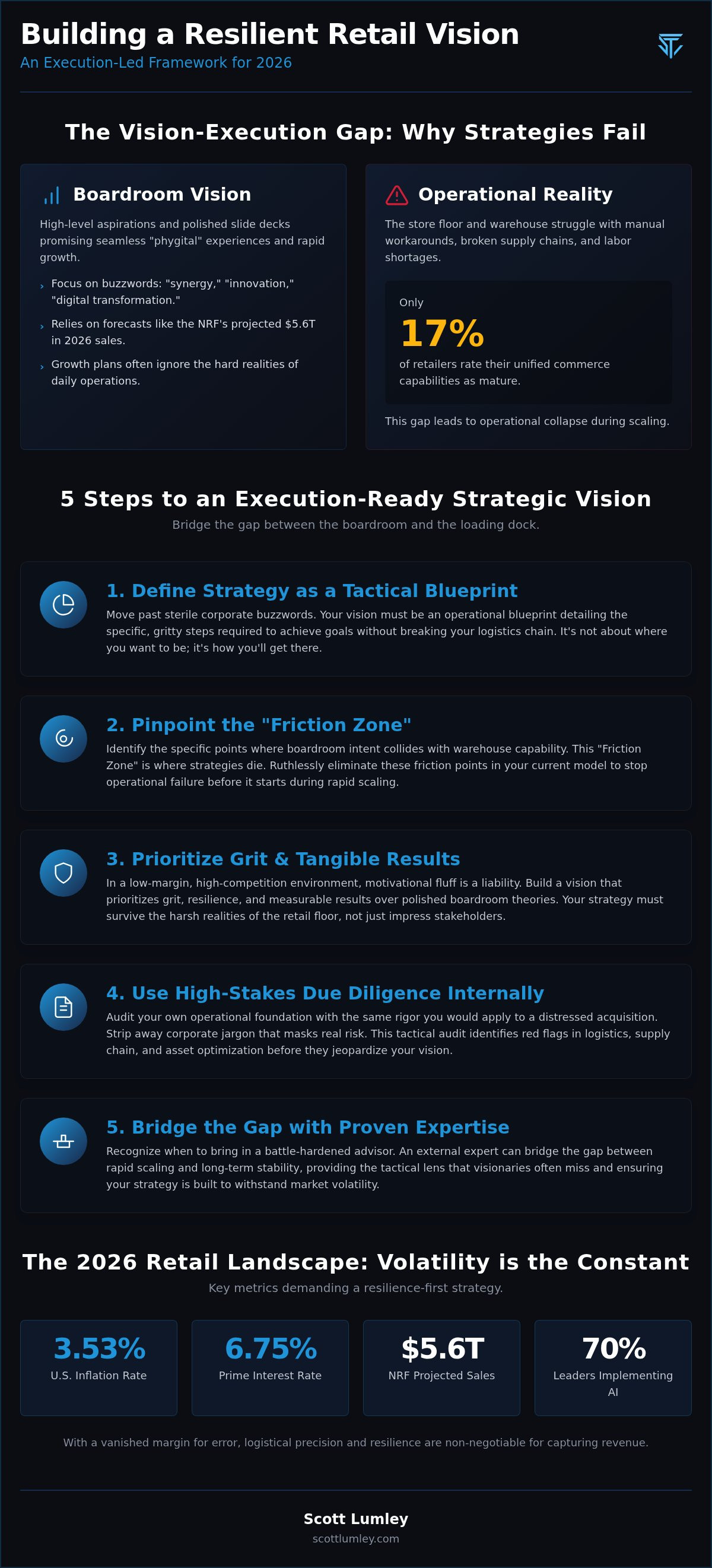
5 Steps to Building an Execution-Ready Strategic Vision
Stop building dreams. Start building blueprints. A strategic vision for retail executives in 2026 must be built on the hard ground of operational reality, not the shifting sands of corporate optimism. If your plan doesn't account for the current 6.75% prime interest rate or the logistical friction of evolving regulatory frameworks, such as new environmental compliance mandates, it's already obsolete. Execution-ready strategy requires a methodical approach to identifying and eliminating failure points before they manifest on the balance sheet.
- Step 1: Audit the operational foundation. Use high-stakes due diligence to look past the marketing reports. You need to know the true state of your warehouse efficiency and asset health.
- Step 2: Strip away corporate jargon. Identify the core tactical mission. If a shift supervisor can't explain the strategy in two sentences, the strategy is too complex to execute.
- Step 3: Stress-test the vision. Run scenarios against supply chain disruptions and labor friction. Test how your roadmap handles the average retail wage rising to $17.15 or sudden regulatory shifts.
- Step 4: Align leadership with the floor. Executive goals must match trench-level operational realities. A vision that doesn't solve floor-level problems will never be fully adopted.
- Step 5: Adopt a recovery mindset. Establish the habits of a business turnaround consultant. Treat growth as a series of continuous recoveries and tactical adjustments.
Stress-Testing Your Strategy Against Market Friction
You need to conduct a pre-mortem on your strategic vision for retail executives. This isn't a pessimistic exercise; it's a survival tactic. Identify the single points of failure in your 2026 roadmap. Is it a single supplier? Is it a lack of "phygital" maturity? A vision that can't survive a supply chain crisis isn't a vision, it's a wish. By finding the breaking points now, you can build the redundancies required to maintain momentum when the market turns volatile.
Building the 'Gritty' Retail Roadmap
Move from high-level goals to granular, actionable execution points. Your KPIs must measure operational health, such as dock-to-shelf speed and fulfillment accuracy, rather than just top-line revenue. This is where crisis management consulting becomes a tool for pre-emptive planning. It allows you to stabilize your operations before the next market pivot forces your hand. If you're ready to bridge the gap between vision and execution, secure a direct strategic planning audit to find your leverage points. Results don't come from the vision; they come from the grit to see it through.
Leveraging External Expertise to Stabilize and Scale Retail Operations
High-stakes environments don't tolerate passive advice. A strategic vision for retail executives is only as strong as its weakest operational link. When floor execution lags or margins shrink, you don't need a coach to tell you to "think bigger." You need a pragmatic strategist who has navigated the trenches. Passive coaching is for clear skies. Pragmatic strategic advisory is for when the storm is already here. It provides a sobering voice of reason that replaces optimistic theory with the hard reality of what works in the warehouse and on the storefront.
When to Bring in a Turnaround Specialist
Identify the signs early. If your current strategy isn't landing on the floor, it's failing. You might see stagnant growth even in a healthy market, or perhaps your digital-to-physical transitions are creating more friction than revenue. These are red flags. An interim business consultant provides rapid deployment leadership when your internal team is stretched thin. Turnaround strategies aren't just for dying firms. They are essential for any company that needs to revitalize stagnant operations or stabilize during a rapid scaling phase. It's about fixing the underlying machinery, not just repainting the sign. If you're seeing these cracks, it's time for a professional strategic planning audit to stop the bleed.
The Scott Lumley Approach: Execution Over Fluff
Scott Lumley's 40 years of experience isn't based on textbooks. It's built on four decades of hands-on operations in retail, logistics, and industrial sectors. This is a no-nonsense advisory process designed for executives who are tired of superficial promises. We strip away the corporate jargon to find the tactical mission. We engage in a partnership that prioritizes survival first, then recovery, and finally, aggressive expansion. This isn't a passive relationship. It's a high-intensity collaboration focused on tangible outcomes.
Engaging a battle-hardened operator allows you to leverage lived experience that identifies risks before they become catastrophes. In 2026, operational grit is the only thing that separates market leaders from corporate casualties. Stop managing by hope. Move from a theoretical strategic vision for retail executives to execution-led growth that actually delivers. If you're ready to stabilize your operations and build a resilient blueprint for the future, contact Scott Lumley today. Results are the only metric that matters.
Securing Your Operational Future
A strategic vision for retail executives must be built on the warehouse floor, not in the boardroom. Theory fails where friction begins. True resilience comes from auditing your operational foundation and stripping away the jargon that masks real risk. You need a blueprint that survives supply chain shocks and labor shifts while maintaining a clear path to growth. This isn't about optimistic forecasts; it's about the grit to execute when the stakes are highest.
Scott Lumley brings 40 years of lived experience to your organization. As a specialist in distressed business turnarounds, he provides the direct, results-driven strategic leadership required to bridge the gap between vision and reality. Don't let your strategy become another casualty of operational collapse. Stop settling for theoretical vision and start executing with Scott Lumley.
The market in 2026 will be volatile. Your business can be the exception. Build a system that doesn't just survive the storm but masters it. You have the tools to turn your vision into a durable, profitable reality.
Frequently Asked Questions
What is the difference between a retail vision and a retail operation?
Vision is the intent; operation is the engine. Vision defines the destination. Operations manage the assets, labor, and logistics required to reach it. A vision without an operational blueprint is just a hope. Successful execution requires aligning high-level goals with the gritty reality of the warehouse floor and the storefront. You don't need more theory; you need an engine that can handle the load.
How do I know if my retail strategic vision is too theoretical?
Your vision is too theoretical if it can't be explained to a shift manager in two sentences. If the plan relies on buzzwords like "synergy" or "innovation" without addressing labor friction or supply chain constraints, it's a fantasy. A grounded strategic vision for retail executives must account for real-world resistance and asset limitations. If it doesn't solve a floor-level problem, it isn't ready for execution.
Can a business turnaround consultant help a profitable retail company?
Turnaround specialists identify inefficiencies that hide behind top-line revenue. Profitability often masks operational rot that leads to collapse during rapid scaling. A consultant uses tactical audits to stabilize your foundation. This ensures your growth doesn't outpace your logistical capability. It's about optimizing for durability before you chase the next expansion. Even healthy firms need a sobering voice of reason to avoid growth-induced collapse.
What are the biggest risks to retail strategic execution in 2026?
The primary risks are persistent inflation, rising interest rates, and regulatory volatility. With U.S. inflation at 3.53% and the prime rate at 6.75%, the margin for error has vanished. Retailers also face a patchwork of state laws, such as new food labeling requirements in California. These create massive operational friction for multi-state operators. Your execution must be flexible enough to handle these shifts without breaking the logistics chain.
How does due diligence apply to retail strategic planning?
Due diligence is the tool for stress-testing your own roadmap. It involves a high-stakes audit of your physical assets, logistics chains, and labor readiness before you commit to a pivot. By applying the same scrutiny to your internal operations that you would to a distressed acquisition, you identify single points of failure. This process strips away corporate jargon to find the core tactical mission and identify friction before it starts.
Why is operational grit more important than digital transformation?
Digital tools are useless if your floor-level execution is broken. While many leaders plan to implement AI by late 2026, many lack the infrastructure to support it. Operational grit is the ability to maintain tactical precision during a crisis. It ensures that your strategic vision for retail executives survives the digital-to-physical transitions where most theoretical models fail. Grit delivers results; transformation just delivers a bill.
How do I align my C-suite with a new strategic vision?
Alignment happens through transparency and shared tactical goals. You must move the C-suite away from sterile reports and toward trench-level operational realities. When every executive understands the friction points on the floor, they stop chasing polished marketing promises. They start focusing on the leverage points that deliver tangible growth. Real alignment is built on a shared commitment to operational recovery and long-term stability.
What role does crisis management play in a long-term retail strategy?
Crisis management is the insurance policy for your strategic roadmap. It involves building redundancies and tactical safeguards that allow the business to pivot when market conditions turn. A long-term strategy that ignores potential operational storms isn't a plan; it's a wish. Crisis readiness ensures you maintain direction when others are panicking. It's the difference between a controlled strategic pivot and a total operational collapse.


