

Most growth strategies are nothing more than expensive hallucinations written on whiteboards by people who've never stepped foot on a factory floor. True business performance optimization isn't found in a software update or a motivational seminar. It's found in the aggressive removal of friction within your daily operations. You've likely felt the weight of hidden inefficiencies slowing your progress. You see the gaps in your supply chain. You feel the fear of a business stalling just when it should be accelerating.
It's a common struggle for leaders who value reality over theory. You're right to be skeptical of polished marketing promises that don't translate to the bottom line. This guide will show you how to eliminate operational friction and drive sustainable profitability using battle-tested leadership strategies that prioritize execution. We'll examine the specific tactical moves needed to navigate recovery and execute growth in 2026, stripping away the jargon to focus on what actually works when the stakes are high.
Key Takeaways
- Redefine optimization as the aggressive removal of friction between your strategy and your actual results.
- Identify the four critical levers in supply chain and manufacturing where your margins are currently bleeding out.
- Understand the tactical shift required to move from crisis management and stabilization into high-stakes growth.
- Implement business performance optimization by favoring operational grit and execution over sterile, software-based theories.
- Build a blueprint for sustainable scaling that prevents your performance from collapsing under the weight of expansion.
What is Business Performance Optimization? (The Operator’s Definition)
Business performance optimization isn't a theoretical exercise or a line item on a polished slide deck. It's the aggressive removal of friction between your high-level strategy and your daily execution. Many consultants treat this like a math problem. They're wrong. True organizational performance improvement is a leadership challenge, not just a data exercise. In the 2026 economic landscape, the stakes are too high for half-measures. Survival depends on moving faster than your competition. You don't do that by adding more layers of management. You do it by stripping them away.
There's a massive difference between sterile efficiency and operational grit. Sterile efficiency is what you see in a software demo. It assumes everything goes according to plan. Operational grit is what happens when a shipment is stuck at a port and your production line is hours away from a total shutdown. Most optimization efforts fail because they ignore the human bottleneck. If your team is stuck in a culture of "good enough," no amount of data will save your margins. You need a system that functions when things go wrong, not just when the sun is shining.
The Myth of the Quick Tech Fix
Buying another SaaS platform is often a distraction. It adds a layer of digital friction to an already clogged system. Automating a broken process just makes you fail faster. It's expensive; it's lazy. Real business performance optimization is the alignment of assets with aggressive growth goals. You need your equipment, your capital, and your people moving in a single direction. If they aren't, the most advanced software in the world is just a high-tech paperweight. Fix the process first. Only then should you look for a tool to scale it. Tech should be a multiplier, not a crutch.
Friction vs. Flow: Identifying Your True Bottlenecks
Invisible friction lives in your organizational chart. It hides in redundant approval chains and "standard" procedures that no longer serve a purpose. You must distinguish between busy work and high-impact performance. One keeps people occupied; the other moves the needle on profitability. A strategic business advisor looks at the floor, not just the spreadsheet. They see the physical delays in manufacturing. They hear the hesitation in the supply chain manager's voice. They find the truth where the work actually happens. Identifying these bottlenecks requires a total lack of interest in superficial appearances. It requires a commitment to transparency that most corporate environments find uncomfortable.
Identifying the 4 Levers of Operational Friction
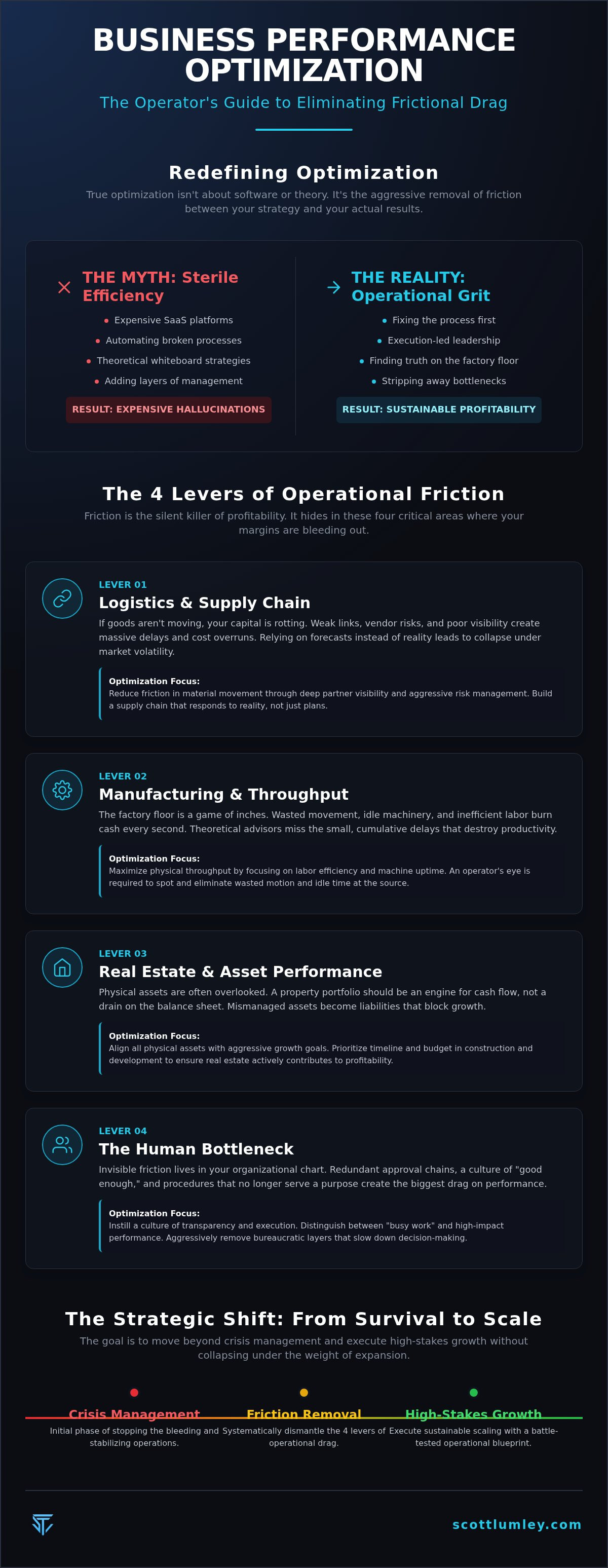
Friction is the silent killer of profitability. It hides in plain sight within your daily operations. In high-stakes industries like construction and logistics, friction is the difference between a successful exit and a total collapse. You don't find it on a spreadsheet. You find it on the floor where the work happens. To achieve true business performance optimization, you must identify and dismantle the four primary levers of operational drag.
Logistics and Supply Chain Optimization
Supply chains are where your margins go to die. If your goods aren't moving, your capital is rotting. You need to reduce friction in the movement of materials from the origin to the destination. This requires more than just a tracking number. It requires deep visibility into your partners. Utilizing due diligence consulting services allows you to identify vendor risks before they become your liabilities. You can't stabilize industrial operations during market volatility if you're relying on weak links. You need a supply chain that responds to reality, not just forecasts.
The manufacturing floor is another critical lever. Optimizing physical throughput is about labor efficiency and machine uptime. If a worker has to walk fifty feet for a tool, you're losing money. If a machine sits idle while waiting for a part, you're losing money. Business performance optimization at this level is a game of inches. It requires an operator’s eye to spot the wasted movement that theoretical advisors miss.
Real Estate and Asset Performance
Strategic planning for property portfolios is often overlooked. Your real estate should be an engine for cash flow, not a drain on your balance sheet. Leadership strategies for complex construction and development projects must prioritize timeline and budget over aesthetic fluff. Leverage specialized knowledge like the Property Tax Debt System to recover lost capital and clear the path for growth. If you don't manage your physical assets, they will manage you. This is why many organizations benefit from professional strategic planning to align their physical footprint with their financial goals.
Finally, you must address leadership gaps. Sometimes the executive team is the bottleneck. When decision-making stalls at the top, the entire organization freezes. Execution-led growth requires leaders who lead from the trenches. If the C-suite is disconnected from the reality of the manufacturing floor or the logistics hub, friction is inevitable. Real-world experience matters more than a degree when you're navigating a turnaround or an aggressive expansion. Leadership is about making the hard calls that clear the way for everyone else to perform.
The Turnaround Mindset: Optimization in High-Stakes Scenarios
Optimization during growth is a luxury. Optimization during a turnaround is a necessity for survival. When your business is stalling or losing altitude, the rules of business performance optimization change completely. You aren't looking for incremental gains or long-term brand building. You're looking for the leak that's sinking the ship. Crisis management requires you to stabilize the vessel before you even think about adjusting the sails. This is the stage where most theoretical advisors fail. They want to talk about culture and vision. An operator wants to talk about cash flow and asset utilization.
Even healthy companies often harbor distressed assets. These are departments, product lines, or physical properties that have become a drain on resources. Identifying these pockets of rot is the first step in a no-nonsense recovery. You must be willing to cut waste with total detachment. Recovering capital from underperforming assets isn't an admission of failure. It's a tactical move to fund your next victory. If an asset isn't generating a return or serving a critical operational purpose, it's dead weight. Cut it loose.
Rapid Deployment Leadership
Consensus is a luxury for stable times. In a high-stakes pivot, consensus is a death sentence. You need decisive action that lands with immediate impact. An interim business consultant focuses on stabilizing operations within the first 72 hours. This isn't about making everyone feel comfortable. It's about identifying the primary leverage points and exerting pressure. A turnaround is a tactical hunt for lost value, not a tourist ride through the P&L. You stop the bleeding first. You ask questions about the long-term roadmap later.
Risk Mitigation and Recovery
Industrial and manufacturing firms face unique risks that service-based businesses don't understand. A single equipment failure or a vendor collapse can trigger a catastrophic spiral. De-risking these operations requires a gritty, hands-on approach to business performance optimization. You need to map every failure point in your production line. Once you've identified the risks, you move into the "Recovery Zone." This is the period where you rebuild the systems that failed, but with more durability. Lessons in resilience aren't learned in a boardroom. They're learned in the trenches of global operations where the stakes are real and the consequences of failure are final. You don't just recover; you harden the business against the next crisis.
Strategic Execution: Scaling Performance Without Breaking
Scaling is the point where most businesses commit suicide. They mistake revenue growth for organizational health. This is the "Growth Trap." As you add volume, you add layers of complexity that your current systems weren't built to handle. Without business performance optimization, that complexity turns into a drag that eventually stops your momentum. You need a blueprint that anticipates the friction of a larger workforce and a more volatile supply chain. Scaling isn't just about doing more. It's about doing more with the same level of intensity and precision you had on day one.
Blueprints for High-Stakes Operations
High-stakes operations like construction or manufacturing cannot be scaled on the fly. You need a strategic growth plan that accounts for the reality of the floor, not just the optimism of the sales department. This is where leadership consulting services provide the necessary leverage. You aren't just scaling a firm; you're scaling a standard of execution. Execution-led strategy beats sterile theory every time. It's grounded in what can actually be achieved by the people in the trenches. If your strategy doesn't survive contact with the manufacturing floor, it isn't a strategy. It's a fantasy.
Asset and Portfolio Optimization
Scaling real estate investments or industrial portfolios requires a sober look at your current holdings. Use real estate leadership advisory to ensure your property operations are optimized for cash flow before you add more assets. Due diligence is a growth strategy. It allows you to identify operational friction before you sign the deal. You must balance organic growth with aggressive expansion. If your expansion outpaces your infrastructure, you'll break the very systems that made you successful. Don't acquire new problems. Acquire assets that you have the capacity to manage at peak performance.
Resource capacity planning in construction and manufacturing is a logistical puzzle. It isn't just about having enough machines. It's about the labor, the materials, and the physical throughput of your facilities. If your sales team is hitting targets but your logistics hub is redlining at 98% capacity, you're one minor delay away from a total system failure. Business performance optimization demands that you identify these bottlenecks months before they become crises. You must align your organizational culture with these high-performance standards. Every new hire needs to understand that in high-stakes operations, there is no room for "good enough." You're building a machine designed for durability. Scaling without breaking requires a strategic plan that prioritizes execution over optimism.
Implementing Optimization: The Scott Lumley Approach
Scott Lumley doesn't offer theories. He offers four decades of scars. True business performance optimization isn't learned in a classroom; it's forged on manufacturing floors, logistics hubs, and construction sites. Most advisors are cheerleaders. They'll tell you what you want to hear while your margins bleed out. Scott is a pragmatic strategist who leads from the trenches. He has navigated both extreme success and significant adversity across 40 years of operations. This lived experience allows him to see the friction points that a theoretical advisor will always miss. He isn't interested in polished marketing promises. He's interested in what works when the stakes are high.
The process is linear and uncompromising. It starts with a brutal Assessment. We find the truth, no matter how uncomfortable it is for the C-suite. Next comes Stabilization. We stop the bleeding, secure the assets, and clear the path. Only then do we move to Execution and Growth. You can't scale a broken machine. You fix it first, then you push it to the limit. This isn't about making people feel good. It's about ensuring the business survives and thrives in a high-stakes environment. It's about moving from a culture of "good enough" to a standard of excellence that drives profitability.
Custom Advisory for Industrial and Real Estate Sectors
Manufacturing, retail, and logistics firms face unique operational transitions. These aren't just administrative changes. They are physical, logistical, and financial pivots that carry immense risk. Scott provides strategic leadership for organizations that can't afford a mistake. Whether you're dealing with a supply chain collapse or a complex real estate development, a battle-hardened perspective is your most valuable asset. Crisis management isn't a drill. It's a high-stakes reality that requires a leader who has navigated the same trenches you're in now.
Taking the Next Decisive Move
Your business is either growing or it's dying. There is no middle ground. You must identify if your operation needs a total turnaround or a blueprint for aggressive growth. An operational deep dive is the first step toward clarity. We look at the throughput, the labor efficiency, and the capital allocation. We find the friction. We remove it. This is the difference between a business that stalls and one that dominates its sector. It requires a total lack of interest in superficial appearances and a deep commitment to transparency.
If you're tired of theoretical advice and ready for execution-led results, it's time to act. Secure your operational future with a direct strategy briefing. This isn't a sales pitch. It's a high-level briefing for leaders who value their time and their capital. Your next move determines your trajectory for 2026. Make it a decisive one.
Securing Operational Dominance in 2026
Optimization isn't a project you finish; it's a standard you maintain. We've stripped away the corporate fluff to reveal that true business performance optimization is about the aggressive removal of friction. You've seen how supply chain gaps, manufacturing delays, and leadership hesitation can stall even the strongest firms. Whether you're navigating a high-stakes turnaround or scaling for 2026, the strategy remains the same: prioritize execution over theory. Every move must be calculated. Every asset must be aligned.
You don't need a cheerleader. You need a strategist with 40 years of industrial leadership who leads from the trenches. Scott Lumley provides the perspective of a battle-tested crisis management expert. He's an execution-led growth strategist who values transparency over superficial promises. Stop guessing. Start executing. Book a Strategic Briefing with Scott Lumley to define your path forward. Your business has the potential for extreme success. It's time to clear the way.
Frequently Asked Questions
What is the first step in a business performance optimization plan?
The first step is a brutal, honest assessment of your current operational reality. You can't fix what you haven't identified as broken. This involves auditing your supply chain, labor efficiency, and capital allocation to find where the strategy is failing to reach the floor. We ignore the spreadsheets and look at the physical friction slowing down your throughput. You need the truth before you can build a plan.
How long does it take to see results from operational optimization?
You should see stabilization within the first 72 hours of a professional intervention. Tangible financial results typically appear within 30 to 90 days as waste is cut and assets are realigned. High-stakes business performance optimization isn't a slow burn. It's a series of decisive moves designed to stop the bleeding and recover capital quickly. If you don't see movement in the first quarter, your strategist is focusing on theory rather than execution.
Can optimization be done without hiring new staff or buying software?
Yes. Most optimization efforts fail because they try to buy their way out of a problem with new software or more headcount. True optimization is about the aggressive removal of existing friction. Often, this means simplifying your organizational chart or fixing a broken process on the manufacturing floor. You don't need more tools; you need your current assets moving in the same direction. Software is a multiplier, not a fix for a broken system.
What is the difference between business growth and business optimization?
Business growth is an increase in volume, while optimization is an increase in the efficiency of that volume. You can grow your way into bankruptcy if your margins are rotting. Optimization ensures that as you scale, your profitability remains sustainable. Growth adds weight; optimization ensures your infrastructure can carry it. You want a business that gets stronger as it gets bigger, not one that becomes more fragile under the pressure of expansion.
How do you identify hidden friction in a manufacturing or construction business?
You find hidden friction by walking the floor, not by reading reports. In construction or manufacturing, friction looks like idle machines, redundant approval chains, and workers waiting for materials. It's the "invisible" drag in your logistics hub that delays a shipment by four hours. You identify it by observing the work as it actually happens. If you only look at the P&L, you're seeing the symptoms, not the disease.
Is business performance optimization only for failing companies?
Optimization is a tool for both recovery and expansion. While it's critical for failing companies to stabilize, it's equally important for healthy firms that want to scale without breaking. Every business accumulates operational rot over time. Whether you're navigating a turnaround or preparing for aggressive growth in 2026, business performance optimization is the only way to protect your margins. It's about durability, not just survival.
What role does leadership play in operational recovery?
Leadership is the primary lever in any operational recovery. If the executive team is the bottleneck, the entire organization will stall. Recovery requires a shift from consensus-based management to decisive, execution-led strategy. Leaders must be willing to make hard calls regarding assets and personnel with total detachment. Without strong, battle-hardened leadership at the top, even the best optimization plan will fail to gain traction in the trenches.
How much does a business performance optimization consultant cost?
The cost of a consultant varies based on the complexity of the operation and the level of intervention required. Instead of focusing on the fee, leaders should focus on the ROI of recovered capital and removed friction. A professional strategist pays for themselves by identifying leaks in your supply chain or manufacturing process that are currently bleeding your margins. The real cost is the money you're losing every day by allowing inefficiencies to persist.


