

Most leaders don't see the end coming until the bank locks the doors. They mistake a slow bleed for a rough patch. Business decay isn't a sudden explosion. It's a series of ignored friction points that eventually hit critical mass. With business bankruptcy filings up 11.4 percent as of March 2026, the margin for error has vanished. If you're staring at unpredictable cash flow gaps or watching your best talent walk out the door, you aren't just having a bad month. You're seeing the primary signs of a distressed business.
It's exhausting to wake up every morning wondering which fire to put out first. You feel the weight of mounting debt and the paralysis that comes with it. You know something is wrong, but you're too close to the trenches to see the pattern. This briefing changes that. We will identify the five critical operational and financial red flags that signal your company is in trouble before the damage becomes terminal. You'll get clear diagnostic criteria to validate your concerns and a roadmap to begin stabilization. Let's stop the guessing and start the recovery.
Key Takeaways
- Distinguish between a temporary market dip and systemic decay to know when your business model is fundamentally failing.
- Learn to spot the primary signs of a distressed business, from chronic cash flow gaps to the sudden exit of high-performing talent.
- Avoid the "one big deal" fallacy and other cognitive biases that prevent seasoned leaders from taking decisive action.
- Implement a 13-week cash flow forecast to gain immediate clarity on your actual runway and asset leverage.
- Master the first 72 hours of crisis management to stop the bleeding and begin a strategic restructuring for long-term durability.
Beyond the Balance Sheet: What Business Distress Actually Looks Like
Business distress isn't a line item. It's a state of operational instability that eats away at your foundation long before the bank calls. Most owners wait for the numbers to turn red before they admit there's a problem. That's a mistake. By the time the balance sheet reflects the damage, the rot is usually deep. Real signs of a distressed business appear in the daily friction of your operations. It’s the missed deadline, the frustrated vendor, and the employee who stops caring. This is a diagnosis. It's not a death sentence, but you have to be honest about what you're seeing.
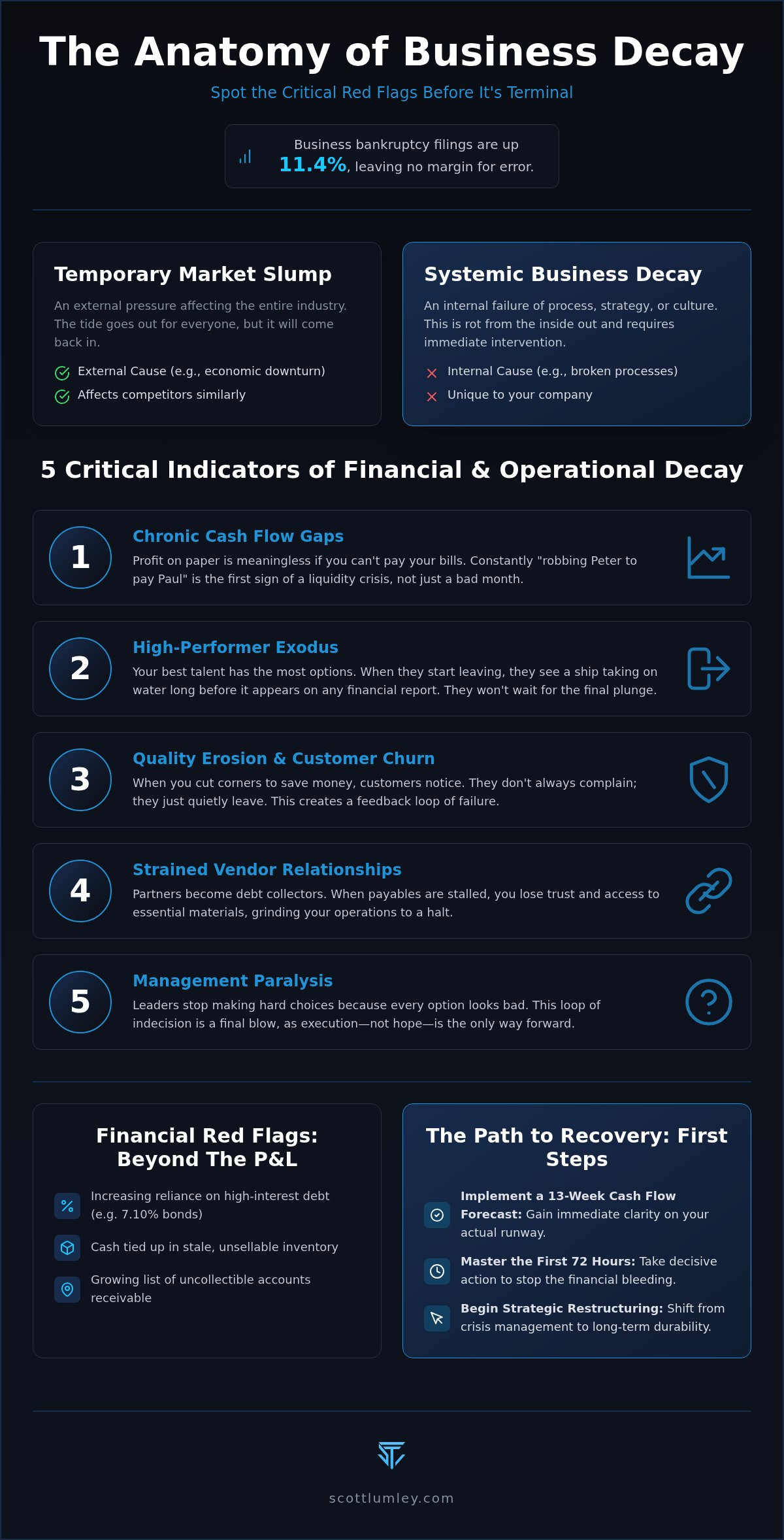
Distinguishing between a temporary market slump and systemic decay is vital. A slump is external. It's a tide that goes out for everyone. Systemic decay is an internal failure. With business bankruptcy filings up 11.4 percent as of March 2026, the margin for ignoring these failures has vanished. You can't work your way out of a broken process by just putting in more hours. Your gut feeling is often your most accurate diagnostic tool. If the office feels heavy or every decision feels like a battle, trust that instinct. It's the first indicator that a spreadsheet will never catch.
Distress vs. Insolvency: Knowing the Difference
There's a sharp line between being in financial distress and being legally insolvent. Technical insolvency happens when your liabilities exceed your assets. At that point, your options are gone. Operational distress is the friction that precedes the collapse. It's the stage where you still have choices. If you wait until you're technically insolvent to seek help, you've already lost your leverage. Acting during the distress phase is the difference between a successful turnaround and a total liquidation.
The Velocity of Decay
Decay moves at different speeds. In manufacturing or logistics, it starts with small inefficiencies. A late shipment here. A quality control issue there. These feel like isolated incidents, but they're symptoms of a systemic breakdown. This is the "boiling frog" syndrome. The temperature rises so slowly that you don't realize you're being cooked until it's too late. Rapid growth often masks these issues. If your revenue is climbing but your margins are shrinking, you aren't winning. You're outrunning a collapse that will eventually catch up. Spotting the signs of a distressed business early is the only way to slow the velocity of that decay.
5 Critical Indicators of Financial and Operational Decay
Business survival isn't about your revenue. It's about your liquidity. When you start robbing Peter to pay Paul, you've moved past a bad quarter. You're now managing a crisis. Identifying the signs of a distressed business requires looking at the movement of money and people, not just a static spreadsheet. High-performers are the first to leave. They have options. If your best talent is hitting the exits, they see a ship taking on water even if you don't. They won't wait for the final plunge.
Customer churn and quality erosion follow. When you cut corners to save a buck, your clients notice. They don't complain; they just leave. This creates a feedback loop of failure. You have less cash, so you cut more quality, which drives away more customers. Eventually, your vendors stop being partners and start being debt collectors. Stalled payables destroy your reputation in the market. When you can't get raw materials because you owe the supplier, your operation is terminal. This loss of trust is nearly impossible to rebuild without professional Crisis Management.
Management paralysis is the final blow. Leaders stop making hard choices because every option looks bad. They wait for a miracle. Miracles don't happen in logistics or manufacturing. Execution does. If you're stuck in a loop of indecision, you're already losing. You need a strategy, not a wish.
Financial Red Flags: Beyond the P&L
Profit on paper is a lie if you can't pay your bills. You might see a positive P&L, but if your cash is tied up in stale inventory or uncollectible receivables, you're in trouble. Watch for an increasing reliance on high-interest bridge loans. With high-yield corporate bonds at 7.10 percent as of August 2026, debt is expensive. Relying on these to cover payroll is a massive red flag. Working capital is the lifeblood of operations. You should monitor early warning signals of financial distress like debt-to-equity ratios to stay ahead of the curve.
Operational Friction: The Silent Killer
Decay shows up on the floor before it shows up in the books. Look for decreasing maintenance standards. When you stop servicing machines to save cash, you're trading future viability for a few days of survival. It's a losing trade. Logistics chains start to fray. Shipments arrive late. Errors increase. This operational friction is a silent killer. It's driven by leadership fatigue. When the boss is too tired to enforce standards, the whole organization slides into mediocrity. These are the internal signs of a distressed business that define your future.
The Denial Trap: Why Seasoned Leaders Miss Early Warnings
Denial is the most dangerous stage of business decay. It's a survival mechanism that turns into a suicide pact. Seasoned leaders often fall into the "One Big Deal" fallacy. They believe a single massive contract or a sudden market shift will save them. It won't. Miracles aren't a management strategy. Relying on them is just gambling with your employees' livelihoods. When you're looking for signs of a distressed business, the first place to look is your own calendar. If you're spending more time chasing "hail mary" plays than fixing operational friction, you're in the trap.
Past success is a double-edged sword. It builds confidence, but it also creates cognitive bias. You think because you navigated a crisis a decade ago, your current intuition is infallible. It isn't. The current environment is different. High-yield corporate bonds are at 7.10 percent as of August 2026. Debt is no longer cheap. If you're waiting for interest rates to drop or the market to return to some imagined normal, you're burning your most expensive asset: time. In a turnaround, time is the only currency that matters. Once it's gone, your options vanish.
The Psychology of a Failing CEO
Isolation is the hallmark of a failing leader. As the pressure mounts, many CEOs stop communicating. They stop holding town halls. They stop looking at the raw data. Defensiveness becomes the default response to any critical feedback. To break this cycle, you must pivot to objective metrics. You need to look at both financial and non-financial signs of distress to see the reality of your situation. If the data says you're bleeding, stop arguing with the data. Transparency is the only way to regain the trust of your board and your team.
Externalizing Blame: The Market, The Bank, The Staff
It’s easy to blame the economy. It’s easy to blame the bank for tightening credit or the staff for low morale. These are excuses, not reasons. Externalizing blame prevents internal restructuring. If the problem is always "out there," you don't have to change anything "in here." That's a path to liquidation. Taking ownership of the turnaround process from day one is the only way forward. You have to distinguish between the factors you can't control and the operations you can. If you can't own the failure, you can't lead the recovery. This shift in mindset is the first step in identifying the signs of a distressed business before they become terminal. Stop looking for someone to blame and start looking for a leverage point.
The Survival Audit: Assessing Your Company’s Viability in Real-Time
Data doesn't care about your feelings. When you're identifying the signs of a distressed business, you have to stop looking at your profit and loss statement. The P&L is historical fiction. It tells you what happened last month, not what's happening tomorrow. To survive, you need a real-time audit of your vitals. This isn't a theoretical exercise. It's a triage process designed to find out if the heart of the company is still beating or if you're just ventilating a corpse.
Your audit must follow a ruthless sequence. Start with these five steps:
- The 13-Week Cash Flow Forecast: This is the only document that matters in a crisis. It tracks every cent coming in and going out on a weekly basis. If you can't see your cash position three months out, you're flying blind.
- Asset Inventory: Identify what you actually own. Can that warehouse be sold? Can that equipment be leveraged? With corporate bond yields at 5.39 percent as of August 2026, traditional borrowing is expensive. You need to know your internal liquidity.
- Core Competency Review: Strip away the ego projects. What do you do that actually generates margin? If a product line isn't profitable today, it's dead weight.
- Stakeholder Sentiment: Call your top three vendors. If they're tightening your credit terms, they've already smelled the smoke.
- Operational Triage: Cut the "dead wood" immediately. This includes redundant staff, underperforming locations, and expensive software you don't use.
Performing a 'Cold-Eye' Review
You cannot audit your own failing business effectively. You're too close to the problems and too invested in the excuses. Bias is a silent killer in a turnaround. Professional due diligence consulting services are essential for finding the operational friction you've learned to ignore. This includes identifying toxic clients. If a customer demands 20 percent of your time but only provides 5 percent of your margin, they aren't a client. They're an anchor. Cut them loose before they pull you under.
The Go/No-Go Decision
The hardest part of the audit is deciding if the business is salvageable. As of April 2025, the debt limit for a small business debtor increased to $3,424,000. You need to know if your liabilities have outpaced your ability to recover. If the business model is fundamentally broken, a turnaround won't help. You're just delaying an orderly exit. Acting while you still have leverage is the difference between a controlled restructuring and a chaotic collapse. If you're ready to stop the bleeding, it's time for professional Strategic Planning to map your next move.
Executing the Turnaround: From Crisis Detection to Strategic Recovery
Identifying the signs of a distressed business is a diagnostic success. It isn't a victory. The real work begins when you stop analyzing and start cutting. A turnaround is a high-stakes operation where every hour counts. You don't need a cheerleader. You need a strategist who can navigate the friction of a collapsing foundation. The goal isn't just to keep the lights on. It's to rebuild an organization that can actually withstand the next market shift without folding under pressure.
Managing the narrative is just as important as managing the cash. Your banks, staff, and customers are looking for a reason to leave. If you go silent, they'll assume the worst. Transparent execution is the only way to hold onto your credibility. An interim business consultant provides the objective perspective needed to handle these high-stakes negotiations while you focus on the floor. They see the leverage points you've missed because you're too busy putting out fires in the trenches.
Stopping the Bleeding: Immediate Crisis Management
The first 72 hours are about one thing: cash control. You must centralize every single disbursement. No one spends a cent without the lead decision-maker's approval. This isn't about micromanagement. It's about triage. You prioritize mission-critical payments like payroll and key vendors while stalling everything else. This is where crisis management consulting adds value. It provides the necessary distance to make cold, calculated decisions without the emotional baggage of long-term relationships getting in the way of survival.
Rebuilding for the Long Haul
Once the bleeding stops, the focus shifts from survival back to strategic growth planning. You can't stay in crisis mode forever. You have to implement new operational controls that prevent a relapse. This means better inventory management, tighter credit terms, and rigorous financial reporting. As of March 2026, the Small Business Default Index sat at 3.31 percent. You don't want to be part of that statistic. Restoring your leadership credibility requires hitting the milestones you set. Don't over-promise. Execute. When the team sees the plan working, the morale issues often solve themselves. Durability is the ultimate goal. If you've seen the signs of a distressed business and acted, you've already beaten the odds. Now, finish the job.
Stop the Bleeding and Rebuild Your Foundation
Recognizing the signs of a distressed business is a diagnostic win, but it isn't the end of the road. You've moved past the denial trap and performed a ruthless audit of your cash flow. Now, you must execute. Survival depends on your ability to make hard choices about assets, core competencies, and operational friction. You don't have time for sterile theories or corporate jargon. You need a direct, execution-led strategy that stops the financial bleed before it becomes terminal. Recovery is a fight, and it's one you can win with the right perspective.
Scott Lumley brings 40 years of operational experience to the trenches. He's a specialist in manufacturing and logistics turnarounds who prioritizes real-world results over polished marketing promises. If you're ready to move from crisis detection to strategic recovery, you need a battle-hardened operator in your corner. Secure your business's future with Scott Lumley’s turnaround advisory today. Your company's best days don't have to be behind you. Let's get to work and build something durable.
Frequently Asked Questions
What is the very first sign of a distressed business?
The very first sign is usually a shift in employee morale and the departure of your top-tier talent. These individuals have the best market value and the keenest sense of a sinking ship. They won't wait for a formal announcement. If your high-performers are hitting the exits while your middle management becomes defensive, you are seeing the early signs of a distressed business. Trust your intuition over your monthly reports.
Can a business in distress be saved without filing for bankruptcy?
Yes, provided you act while you still have operational leverage and liquid assets. Turnarounds happen through aggressive cost-cutting, debt restructuring, and centralizing cash control. The goal is to stabilize the operation before insolvency becomes a legal reality. If you wait until the bank initiates foreclosure or your creditors file a petition, your options for a private recovery vanish. Speed is your only ally here.
How do I tell my employees that the company is struggling?
You tell them the truth, but you lead with the solution. Transparency prevents the rumor mill from destroying what's left of your culture. Be direct about the challenges and clear about the steps you're taking to fix them. People can handle bad news; they can't handle uncertainty. If you don't provide a narrative, they'll invent one that involves them updating their resumes immediately.
Is a temporary cash flow gap always a sign of business distress?
A single gap isn't always terminal, but it's a symptom you can't ignore. If the gap is caused by a specific, one-time event like a delayed shipment, it's a slump. If you're consistently robbing Peter to pay Paul to meet payroll, it's systemic decay. You need to distinguish between a seasonal dip and a fundamental failure in your working capital management. One is a hurdle; the other is a trap.
Should I use my personal savings to keep my failing business afloat?
Almost never. Injecting personal capital into a failing business model without a restructuring plan is just a slow-motion disaster. You're burning your safety net to buy a few weeks of time. Unless the capital is tied to a specific, execution-led turnaround strategy that fixes the underlying rot, you're just throwing good money after bad. Protect your personal assets until the business model is proven viable again.
When is the right time to hire a turnaround consultant?
The right time is the moment you realize your internal team is too close to the problem to see the solution. If you're stuck in management paralysis or your creditors are no longer taking your calls, you've waited too long. A consultant provides the "cold-eye" review needed to identify the signs of a distressed business that you've grown blind to. Don't wait for the bank to force the decision.
What is the difference between a business slump and a distressed state?
A slump is an external market condition that affects your entire industry. A distressed state is an internal operational failure. In a slump, your margins might tighten, but your processes remain sound. In distress, your foundation is crumbling regardless of what the market is doing. If your competitors are growing while you're struggling to pay vendors, you aren't in a slump. You're in a crisis.
How much does a business turnaround usually cost?
Costs vary based on the complexity of your debt, the size of your workforce, and the depth of the operational rot. It's not a flat fee. You should view it as an investment in asset protection rather than an expense. The real question is the cost of inaction. If the alternative is total liquidation and the loss of decades of equity, the price of a professional turnaround is negligible compared to the alternative.


