

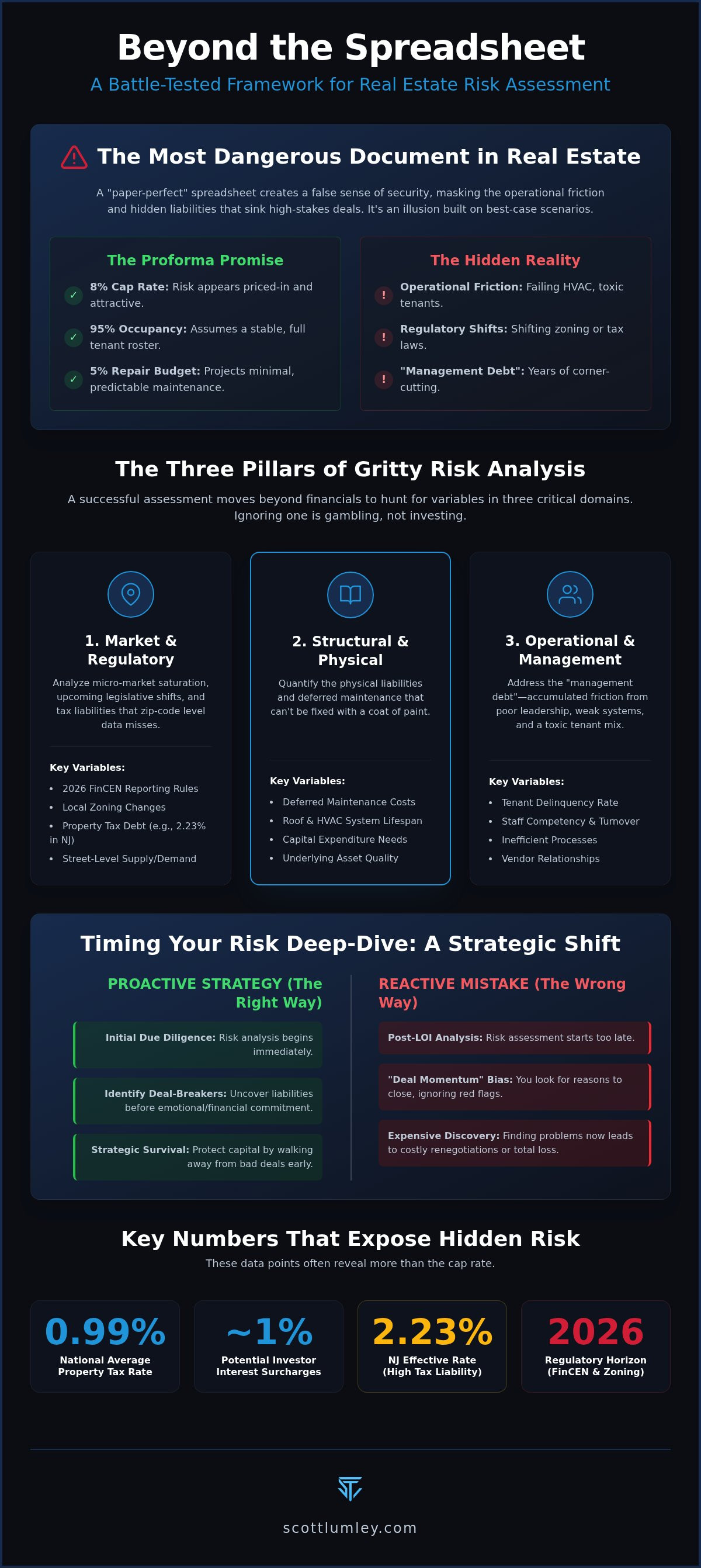
A perfect spreadsheet is the most dangerous document in real estate. It creates a false sense of security while masking the operational friction that actually sinks high-stakes deals. You’ve seen the "paper-perfect" acquisition fail because no one accounted for the grit of execution or the hidden liabilities lurking in the fine print. Effective risk assessment for property investment isn't about staring at a cap rate until it looks attractive; it's a field-led hunt for the variables that don't fit into a cell.
You know the frustration of watching a deal bleed out through unforeseen regulatory shifts, like the 2026 FinCEN reporting rules for non-financed transfers or shifting tax liabilities. This isn't theoretical. It's about survival in a volatile market where the national average property tax rate sits near 0.99% and interest rate surcharges for investors can hit 1%. This article moves beyond surface-level data to provide a battle-tested framework for identifying deal-breakers before they cost you your capital. We'll strip away the fluff to reveal a strategic approach for lowering operational friction and securing your assets against the harsh realities of the current market.
Key Takeaways
- Move beyond the "Cap Rate Trap" by identifying the hidden operational friction that polished spreadsheets often ignore.
- Implement a three-pillar framework for risk assessment for property investment to uncover structural and regulatory liabilities before signing.
- Transition from desktop analysis to a boots-on-the-ground operator perspective to quantify "operational debt" and hidden asset friction.
- Set firm stop-loss triggers and execution-focused strategies to protect your capital in volatile markets and high-stakes deals.
Why Standard Risk Assessments for Property Investment Fail
Standard risk assessment for property investment usually looks like a clean Excel file. It's a collection of formulas and assumptions that look great in a boardroom but crumble on the job site. Most investors fall into the "Cap Rate Trap." They see an 8% cap rate and assume the risk is priced in. It isn't. A cap rate is a snapshot. It doesn't account for a failing HVAC system, a toxic tenant mix, or shifting local zoning laws. Understanding real estate investing fundamentals requires recognizing that financial risk is inseparable from operational reality. Volatility in the market is just a price adjustment. A structural deal-breaker, however, is a total loss of capital. Most assessments fail because they confuse the two.
The Illusion of the Perfect Proforma
Proformas are sales documents. They are built on "best-case scenarios" where occupancy stays at 95% and repairs never exceed a conservative 5% of gross income. This is fiction. Polished spreadsheets hide operational friction. They ignore the reality of a building's "manufacturing" process. If the logistics of managing the asset are broken, the numbers won't save you. You must identify the "fluff" in projected rental income. Are those rates achievable in the current micro-market, or are they based on outdated 2024 data? Sterile data ignores the real-world friction of human behavior, physical decay, and local regulatory shifts that can turn a "paper-perfect" deal into a cash-flow nightmare.
Timing Your Risk Deep-Dive
Most risk analysis happens after the Letter of Intent is signed. That's a mistake. By then, you've already committed time, legal fees, and emotional energy. You're looking for reasons to close, not reasons to walk away. This bias leads to "deal momentum," where red flags are explained away as "manageable issues." Integrating risk assessment into the initial due diligence consulting services phase is the only way to protect your capital. It's about moving from a reactive stance to a proactive one. You need to identify the liabilities that sink deals before you become too invested to say no. Late-stage discovery is expensive. Early discovery is strategic survival.
Execution is where most property investments fail. You can't manage what you haven't identified. A no-nonsense framework prioritizes the hard truths over the polished marketing promises of a broker's deck. It requires a willingness to look past the projected ROI and see the operational debt you're actually inheriting.
The Three Pillars of Gritty Real Estate Risk Analysis
A comprehensive risk assessment for property investment requires more than a cursory glance at market trends. It demands a deep dive into three distinct pillars: Market, Structural, and Operational risk. If you ignore any of these, you aren't investing; you're gambling. Market risk is about more than just interest rates. It's about micro-market saturation at the street level. Structural risk covers the physical and regulatory liabilities that can't be fixed with a fresh coat of paint. Finally, operational risk addresses the friction caused by poor management and weak leadership. Success in high-stakes real estate hinges on identifying these leverage points before they become liabilities.
Market and Regulatory Volatility
Regulatory shifts taking effect in 2026, such as the new FinCEN reporting requirements for non-financed residential transfers, are already changing how legal entities hold title. You must also assess the impact of 2026 zoning changes and local legislative shifts that can overnight alter a property's highest and best use. You can't rely on zip-code-level data when supply-demand imbalances vary from one block to the next. High-stakes investors look for the hidden variables. One of the most overlooked risks is property tax debt. In states like New Jersey, where the effective rate is 2.23%, tax liabilities can snowball quickly. A battle-hardened operator sees this as an opportunity. By utilizing a proven Property Tax Debt System, you can turn a distressed liability into a systemized acquisition strategy.
Operational Friction and Asset Quality
Spreadsheets conveniently ignore deferred maintenance and management debt. Management debt is the accumulated friction caused by years of cutting corners. It's the tenant who hasn't paid in three months and the roof that's five years past its prime. This is why construction experience is non-negotiable. You need to see the manufacturing of the building. In real estate leadership advisory, we focus on the execution of the turnaround. If the leadership is weak, the asset will fail regardless of the market conditions. Identifying these physical and operational gaps is the core of a gritty risk assessment for property investment.
Financial risk remains the final weight. With investment property mortgage rates typically sitting 0.5% to 1% higher than primary residences, your margin for error is thin. You need a strategy that accounts for liquidity and the long-term weight of debt. If you're navigating a complex recovery or a high-stakes acquisition, professional strategic planning can provide the clarity needed to move forward with confidence.
Desktop Analysis vs. Boots-on-the-Ground Reality
You cannot accurately perform a risk assessment for property investment from a high-rise office in another state. Financial models are clean; properties are messy. A proforma doesn't smell the mold in a basement or hear the tension in a tenant's voice. You're looking for friction in the manufacturing and logistics of the building. Think of the property as a machine. If the gears are grinding, the output will fail. Verifying "paper assets" against the physical reality is the only way to spot red flags that a standard inspector, focused only on code compliance, will likely miss. You need to see the flow of the asset. How do people move through it? How does waste leave it? If the logistics are broken, the profit is an illusion.
The Limits of Financial Modeling
Internal Rate of Return (IRR) and Net Present Value (NPV) are academic metrics. They are secondary to cash flow resilience. Your model needs to be stress-tested against "worst-case" operational failures, not just market fluctuations. What happens if a major tenant leaves or a structural failure occurs? A strategic business advisor prioritizes execution over theory because the math only works if the operator can handle the heat. If the plan relies on perfection, it's a bad plan. You need margins that allow for human error and mechanical failure. High-stakes deals don't die because of a 0.25% interest rate hike; they die because the roof collapsed and there was no contingency fund.
The Field-Led Audit
A real audit happens in the trenches. It involves a checklist that reveals operational truth. You must go beyond the mechanical room.
- Walk every square foot, including the dark corners of the parking garage and the utility closets.
- Interview the maintenance staff to find out what's actually broken and what's being "patched" to save costs.
- Talk to tenants to gauge the real quality of on-site management and the likelihood of renewals.
On-site management is the heartbeat of the asset. If the property manager is checked out, the investment is already in trouble. Utilizing leadership consulting services helps you assess the quality of the team on the ground. You aren't just buying brick and mortar; you're buying a business operation. If the leadership lacks the grit to manage friction, the asset will underperform. This field-led approach exposes the management debt mentioned earlier. It turns "paper assets" into tangible, manageable risks.
Building an Operational Risk Mitigation Framework
Mitigation is not a passive exercise. It's a series of tactical maneuvers designed to protect capital when the reality of the asset shifts. A generic "diversification" strategy won't save you when a specific property is hemorrhaging cash. You need a framework that prioritizes execution over theory. This process turns a theoretical risk assessment for property investment into a functional shield for your portfolio. It's about moving from identifying the problem to neutralizing the threat.
- Step 1: Quantify Operational Debt. Assign a hard dollar value to every deferred repair and every broken management process. Don't just list the issues; price them into your immediate capital requirements.
- Step 2: Establish Stop-Loss Triggers. Define the exact moment a deal becomes a liability. If the capital injection required exceeds 20% of the acquisition price or occupancy drops below a specific floor, you trigger a pre-planned exit or pivot.
- Step 3: Implement a 72-Hour Stabilization Plan. Secure the site immediately. Change the locks; audit the utility meters; and verify all rent rolls against actual bank deposits. Take control of the asset's "manufacturing" floor within three days.
- Step 4: Align Leadership Strategy. A value-add retail project requires different grit than a stabilized industrial site. Match the operator's specific experience to the asset's unique friction points.
Crisis Pre-emption and Stabilization
The first 90 days determine the trajectory of a distressed asset. You don't have time for a "discovery phase." You need a Gritty Recovery Plan that targets immediate cash flow leaks. Applying crisis management consulting principles allows you to stabilize the operation while others are still reading the inspector's report. It's about aggressive triage. Stop the bleeding first; then fix the wound. This isn't about optimistic growth; it's about securing the foundation of the investment before attempting to scale.
Strategic Safeguards for Mid-Size Portfolios
Mid-size firms are often the first to fail during market corrections. They lack the massive reserves of institutional players but carry more overhead than small shops. They get stuck in the middle with bloated bureaucracy and slow decision-making. You need controls that scale without adding friction. An experienced business consultant helps you implement these safeguards during high-stakes pivots. If you're currently facing operational friction that threatens your capital, request a strategic briefing to secure your position and stabilize your assets.
Execution is the only thing that separates a successful turnaround from a total loss. Your mitigation framework must be as gritty as the asset itself. Don't rely on polished promises. Rely on a battle-tested system that prioritizes survival and recovery as much as expansion.
Real Estate Leadership: Executing the Risk-Adjusted Strategy
Risk is a constant. Leadership is the variable. A thorough risk assessment for property investment is a dead document if you lack the grit to execute the findings. You can identify every leak, every zoning hurdle, and every management failure. If you don't have the stomach for the recovery, the asset will still fail. Transitioning from a passive investor to a strategic operator is the only way to survive high-stakes deals. It requires the mindset of a business turnaround consultant. You aren't just collecting rent checks. You're managing a complex logistics and manufacturing operation that happens to be made of brick and mortar.
Execution Over Sterile Theory
Sterile theory doesn't survive contact with reality. Polished advisory reports look great in a pitch deck but offer little value when a project hits a wall. Battle-hardened leadership is the ultimate risk mitigation tool. It's the difference between identifying a problem and neutralizing it. You need a veteran who has navigated both extreme success and significant adversity. This means moving beyond passive "advisory" roles to hands-on strategic execution. Experience in the trenches allows you to see the operational friction that a junior analyst will miss every time. A veteran doesn't just predict the storm; they know how to steer the ship through it.
Securing Your Next High-Stakes Deal
Integrate these frameworks into your 2026 investment strategy immediately. The market is shifting. With the implementation of the NAR settlement rules and updated FHFA loan-level price adjustments, the cost of entry and operation is rising. You cannot afford to ignore the risk assessment for property investment variables that don't fit into a spreadsheet. Reducing operational friction is the only way to protect your returns in a volatile environment. This isn't about being optimistic. It's about being prepared for the harsh realities of the current market. You need a strategy that prioritizes survival and recovery as much as expansion.
Don't walk into your next deal with a blindfold. Leverage 40 years of construction and investment grit to see the liabilities that others miss. Whether you're dealing with property tax debt or a failing management team, you need a pragmatic strategist who leads from the trenches. Get a direct, no-nonsense assessment of your real estate strategy from Scott Lumley. Secure your capital. Protect your upside. Move with absolute clarity.
Master the Execution
Real estate isn't a game of math. It's a game of execution. You've seen how polished proformas hide management debt and structural liabilities. Moving from a passive investor to a strategic operator is the only way to protect your capital in this environment. A rigorous risk assessment for property investment is your only defense against market volatility and operational friction. It requires a field-led audit and a hard-nosed mitigation framework that prioritizes survival over optimistic theories. Stop looking at the cap rate and start looking at the logistics of the asset.
You don't have to navigate these high-stakes deals alone. Leverage 40 years of hands-on leadership in construction and property investment to see the liabilities that others miss. Scott Lumley provides the grit and strategic foresight needed for distressed turnarounds and complex property operations. Don't let operational friction eat your returns before you've even broken ground. Secure your next deal with a no-nonsense Real Estate Advisory from Scott Lumley. The market is volatile, but your strategy doesn't have to be. You have the tools to win; now go execute.
Frequently Asked Questions
What is the most overlooked risk in commercial property investment?
Operational friction is the most overlooked risk in commercial property. Investors often obsess over the cap rate but ignore the "management debt" accumulated by previous owners. This includes deferred maintenance, toxic tenant relationships, and broken logistics. If the building’s manufacturing process is flawed, the proforma numbers are irrelevant. You aren't just buying an asset; you're buying a business operation that requires grit to manage effectively.
How do I assess risk for a distressed property acquisition?
You assess risk for distressed assets by performing a field-led audit that goes beyond the mechanical room. Quantify the "operational debt" by pricing out every deferred repair and management failure. Establish hard stop-loss triggers before you sign the LOI. If the capital required for stabilization exceeds your contingency by 20%, walk away. Distressed deals require a turnaround mindset, not just a spreadsheet and a prayer.
Can I perform a rigorous risk assessment without a large corporate team?
You don't need a corporate team to perform a rigorous risk assessment for property investment. You need a battle-hardened operator who knows where the bodies are buried. One veteran with 40 years of construction experience is more valuable than ten junior analysts with MBAs. Focus on high-impact variables like structural integrity, local zoning shifts, and tax liabilities. Experience replaces headcount every time in high-stakes environments.
What is the difference between financial risk and operational risk in real estate?
Financial risk covers the capital stack, interest rates, and liquidity. It’s about the money. Operational risk is about the friction of execution. It’s the broken HVAC, the non-paying tenant, and the weak property manager. A deal can have perfect financing and still fail because the operator lacks the leadership to manage the site. Financial risk is a math problem; operational risk is a grit problem.
How often should I update the risk assessment for my existing portfolio?
Update your risk assessment quarterly at a minimum. However, you must trigger an immediate review when major market or regulatory shifts occur, such as the 2026 FinCEN reporting changes. Don't wait for an annual report to discover your asset is underperforming. Volatile markets require constant vigilance. A stagnant assessment is a liability. Stay proactive to ensure your capital remains protected against shifting local legislation and micro-market saturation.
What are the red flags to look for during a physical property inspection?
Look for "patched" repairs that mask deeper structural issues. Fresh paint in one corner of a basement often hides a moisture problem. Observe the tension between tenants and on-site staff. If the communication is broken, the management debt is high. Check utility meters for irregularities that suggest illegal sub-metering or leaks. These red flags indicate operational friction that a standard code inspector will usually overlook during a routine walk-through.
How does a property tax debt system impact my overall risk profile?
A Property Tax Debt System reduces your risk profile by turning a hidden liability into a systemized acquisition opportunity. High property taxes, like the 2.23% rate in New Jersey, can sink a deal if unmanaged. By identifying properties with tax liens, you can acquire assets at a discount and stabilize them through strategic recovery. It transforms a financial threat into a calculated leverage point for growth and capital protection.
Is a high cap rate always indicative of high investment risk?
A high cap rate is often a warning sign of mispriced risk. It usually indicates that the market perceives a threat that hasn't been fully quantified, such as micro-market saturation or structural decay. However, a high cap rate can also represent an opportunity for a strategic operator who can neutralize the friction. Don't chase the yield without performing a deep-dive risk assessment for property investment to find the catch.


