

Industry analysts at JLL and CBRE report that most companies lose 15% to 20% of their potential savings because they treat square footage as a fixed cost rather than a variable weapon. You're likely asking how to stop your portfolio from draining capital and start making it work for your growth strategy. This lack of aggressive real estate portfolio optimization means you feel the weight of high occupancy costs while utilization stays low. It's a common frustration. You know the space isn't working, but the friction of fixing it feels like a secondary battle. You're paying for square footage that serves your history, not your future.
It's time to stop playing defense. This isn't a data entry exercise. It's an operational offensive to strip away friction and reclaim capital. This article will show you how to transform your portfolio from a passive cost center into a lean, strategic growth lever. You'll learn how to reduce occupancy costs by 15% or more and align every square foot with your core business goals. We'll look at the hard realities of site alignment and the specific steps required to eliminate the operational drag that's killing your agility.
Key Takeaways
- Stop managing leases and start deploying assets. Learn why optimization is an offensive move to reclaim capital and strip away operational friction.
- Consolidate fragmented data to drive real estate portfolio optimization and eliminate the hidden costs of site misalignment.
- Conduct a hard audit to identify "Ghost Space" and stop paying for square footage that does not contribute to your bottom line.
- Map your physical footprint to your 24-month growth plan to ensure every location serves a current business purpose rather than a historical one.
- Pivot from tracking occupancy costs to measuring Return on Asset (ROA) to turn your portfolio into a strategic weapon for growth.
Beyond Maintenance: Why Real Estate Portfolio Optimization is an Operational Offensive
Real estate is usually a company's second-largest expense. Most executives treat it as a static line item. They're wrong. Real estate portfolio optimization isn't about property management. It's an operational offensive. It's the aggressive removal of capital leakage. You don't manage a portfolio; you deploy it. While Modern Portfolio Theory focuses on balancing risk and return through diversification, operational optimization focuses on stripping away the friction that kills your margins. It's about tactical realignment. Every square foot must justify its existence today, not based on a decision made five years ago.
Passive property management is a slow death. It waits for things to break. It waits for leases to expire. That's a losing strategy in a high-stakes market. Active strategic leadership hunts for inefficiencies before they become crises. If you're waiting for a ten-year lease to end before questioning a site's value, you've already lost the capital. Optimization is the process of forcing your physical assets to match your business goals in real time. It's gritty work. It requires looking at the harsh realities of your footprint and making the hard calls that traditional managers avoid.
The High Cost of Under-Optimized Portfolios
Utilization is the only metric that matters. Many businesses pay for "Ghost Space" they don't use. This is a hidden tax on your growth. Industry data suggests businesses lose 15% to 20% of potential savings through simple neglect. In a national supply chain, one poorly aligned site creates a bottleneck. Decentralized decision-making leads to fragmented data. You can't fix what you can't see. Operational drag at a single location can cripple your entire distribution network. It creates friction. It slows down delivery. It drains cash that should be used for expansion.
Portfolio Optimization as a Turnaround Maneuver
When a business is struggling, real estate is the first place to look for recovery. It's often where the most capital is trapped. Asset realignment moves a company from distressed to stabilized. This requires a business turnaround consultant who understands how to extract value from physical assets. You don't just cut costs. You restructure the footprint to support the next 24 months of survival and growth. This isn't about aesthetics or corporate prestige. It's about survival. It's about turning a passive cost center into a lean, strategic growth lever. You're not just saving money; you're reclaiming your agility.
The Core Pillars of Asset Optimization: Data, Alignment, and Friction
Optimization fails when it's built on a shaky foundation. You cannot fix what you cannot see. Effective real estate portfolio optimization requires three pillars: clean data, strategic alignment, and the total removal of operational friction. If one pillar is missing, you aren't optimizing; you're just moving furniture. You need to know why every asset exists in your portfolio today. Historical reasons are irrelevant. If a site was perfect five years ago but hinders your current supply chain, it's a liability, not an asset. Every square foot must justify its place on the balance sheet right now.
Establishing a Single Source of Truth
Spreadsheet-based management is a recipe for disaster. It leads to missed dates, overpaid taxes, and fragmented decision-making. You need one view of every lease obligation and critical date. This isn't just about administrative ease. It's about reclaiming leverage in negotiations. Standard real estate portfolio management often focuses on square footage costs. That's a white-collar metric. For high-stakes operations, you must track occupancy cost per unit of output. If your rent is low but your floor plan slows down production, that "cheap" space is costing you a fortune in lost revenue. Centralizing this data allows you to see the capital leaks before they become catastrophic.
Eliminating Industrial and Retail Friction
Legacy locations are often the biggest bottlenecks in modern logistics. A warehouse built for outdated distribution patterns cannot handle the speed of today's manufacturing. We look for friction. This means evaluating site layouts for operational flow, not just the monthly check you write to a landlord. Narrow bays, low ceilings, and poor dock access are operational drags that kill agility. Identifying these bottlenecks requires a specialized real estate leadership advisory approach that prioritizes the "gritty" realities of the shop floor over the aesthetics of the boardroom.
Strategic alignment means anticipating market shifts before they devalue your footprint. Don't wait for a site to become obsolete. If you see a logistics corridor shifting or a retail district dying, move first. This level of foresight is what separates battle-hardened operators from passive managers. To get ahead of these shifts, you may need to engage in strategic planning that treats your physical footprint as a fluid resource rather than a static burden. Risk mitigation is about movement. If you stay still too long, the market will move for you, and it won't be in your favor.
Auditing the Portfolio: Identifying Hidden Operational Drag and Capital Leaks
The audit is the reckoning. It's where you find the rot in your footprint. Most managers fear the audit because it exposes their passivity. Real estate portfolio optimization demands a no-nonsense look at what stays, what goes, and what gets restructured. You're looking for "Ghost Space." This is square footage you pay for that contributes zero to your revenue. If a warehouse bay is empty or a retail corner is dead, you're hemorrhaging capital. Every square foot is a soldier. If it isn't fighting for your bottom line, discharge it. We categorize assets into three buckets: those that drive growth, those that can be salvaged through restructuring, and those that are terminal drains on your cash flow.
Optimized vs. Unoptimized Portfolios
The difference between a lean portfolio and a bloated one shows up in your agility and your risk profile. Here is how they compare:
- Optimized Portfolio: Centralized data with one source of truth. Utilization rates exceed 90%. Every site is aligned with a 3-year growth plan. Operational friction is minimal.
- Unoptimized Portfolio: Information is siloed in local spreadsheets. Utilization sits below 70%. The footprint consists of legacy sites with high maintenance drag and zero strategic purpose.
Optimization isn't just about space. It's about every dollar attached to that space. We use the Property Tax Debt System as a strategic tool to reclaim leverage. Taxes aren't fixed. They're negotiable if you have the data and the grit to challenge them. If you treat property tax as an inevitable bill, you're leaving money on the table. This is capital that should be fueling your next acquisition or operational upgrade.
Leveraging Due Diligence for Capital Recovery
Due diligence shouldn't be a one-time event during a deal. It's a recurring process. Using due diligence consulting services for your existing portfolio reveals leaks that corporate accountants miss. They see numbers. We see operational friction. We look at maintenance contracts that have bloated over time and utility inefficiencies that drain your margins. It's gritty work. It requires an operator's eye to find the friction points that a spreadsheet hides.
Capital recovery starts with seeing the reality of your assets, not the polished version in the annual report. If you aren't hunting for these leaks quarterly, you're losing a significant portion of your potential savings to simple neglect. We find the leaks in property tax, maintenance, and utilities that others ignore. This isn't theoretical consulting. It's a battle-hardened search for the capital you've already earned but haven't collected.
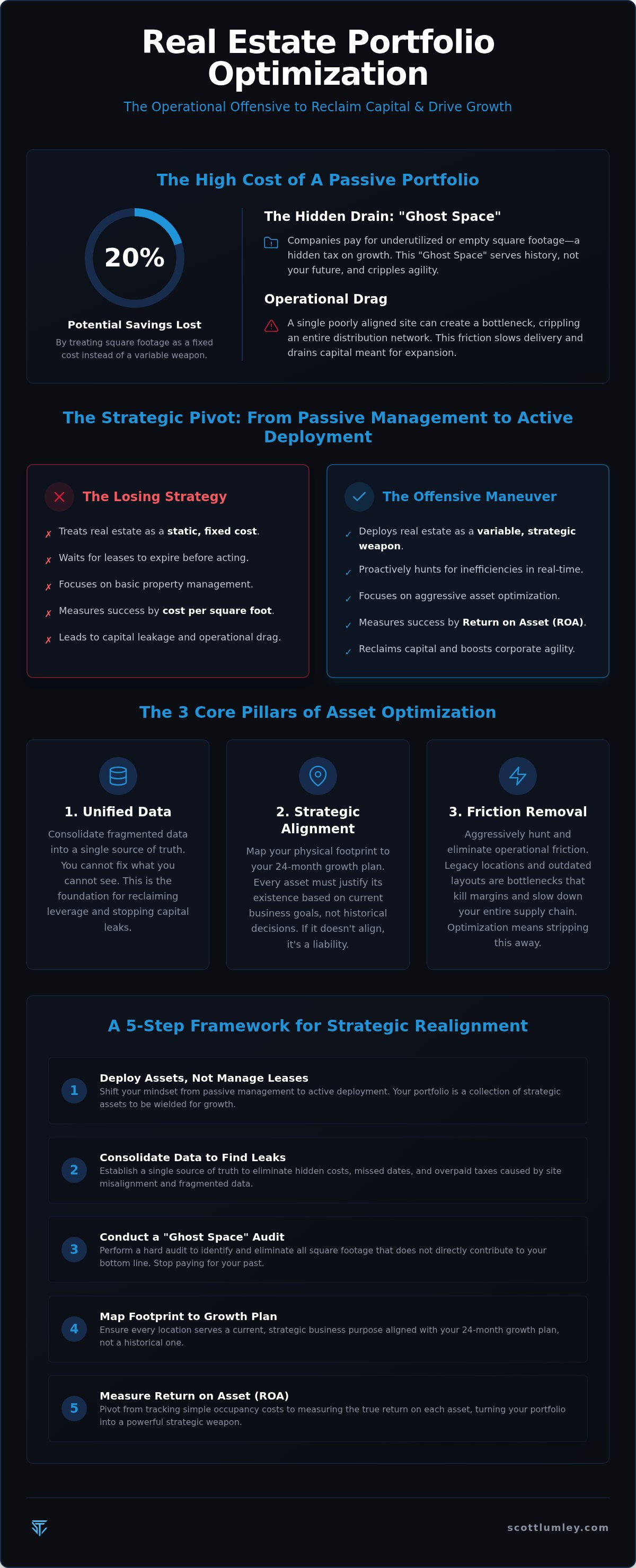
Executing the Pivot: A 5-Step Framework for Strategic Asset Realignment
Real estate strategy is useless without a path to execution. Many competitors focus on "culture" and "employee sentiment." We focus on capital and throughput. Effective real estate portfolio optimization requires a disciplined framework to move from a bloated footprint to a high-performance offensive. The pivot isn't a suggestion. It's a requirement for survival in a tightening market. If your physical assets aren't supporting your 24-month growth plan, they're actively hindering it. You need a process that turns data into movement.
- Step 1: The Hard Audit. Identify every friction point and capital leak in the current footprint.
- Step 2: Strategic Goal Mapping. Align every asset to the specific operational requirements of the next 24 months.
- Step 3: Tactical Restructuring. Execute lease renegotiations or divest underperforming assets to reclaim capital.
- Step 4: Operational Streamlining. Modify the physical layout of remaining spaces to improve speed and flow.
- Step 5: Continuous Monitoring. Establish a permanent feedback loop between real estate and operations.
Tactical Asset Restructuring
Restructuring is about leverage. Landlords want stability; you want flexibility. Use your occupancy data to force renegotiations that gain you the agility you need. We use a "Keep, Sell, or Repurpose" decision matrix for industrial assets. If a site doesn't fit the 24-month map, divest it immediately. Rapid divestment of non-core assets provides the cash injection needed to fund turnaround efforts. Stop holding onto "legacy" sites out of habit. Every asset must earn its place on the balance sheet daily.
Integrating Leadership for Execution
Silos kill execution. The "Real Estate Department" often operates in a vacuum, disconnected from the daily friction of the manufacturing floor or the logistics hub. Breaking these silos requires leadership consulting services that prioritize execution led strategy over corporate theory. An interim or fractional advisor provides the objective distance needed to make the hard calls that internal teams avoid. Leadership is about protecting the business, not the status quo. You need operators who have navigated high-stakes environments and know how to drive change through an organization.
If your portfolio is dragging down your operations, you need a strategy built in the trenches. Contact us for strategic planning that turns your real estate from a static burden into a weapon for growth.
Strategic Leadership: Turning Real Estate from a Line Item into a Growth Lever
Real estate is a weapon for growth. It's not a static burden. Most companies treat their physical footprint as a necessary evil. They're wrong. True real estate portfolio optimization shifts the focus from simple occupancy cost to Return on Asset (ROA). You don't just want a lower rent check. You want a footprint that accelerates your throughput and supports your market position. A battle-hardened perspective is mandatory here. Property investment firms often lack the dirt under the fingernails experience to see how a physical layout impacts the daily bottom line. You need leaders who've been in the trenches of manufacturing and logistics, not just the boardroom. If your assets aren't actively contributing to your expansion, they're dead weight.
The Value of an External Strategic Advisor
Internal teams often suffer from operational blindness. They've lived with the same friction for so long they don't even see it anymore. They work around the bottlenecks. They ignore the capital leaks. They mistake familiarity for efficiency. A strategic business advisor brings a cross-industry view that breaks this cycle. Whether it's manufacturing, retail, or logistics, the principles of execution remain the same. These services bridge the gap between the concrete on the ground and the capital on the balance sheet. You need someone who sees the reality of the asset, not the story told in the lease file. This external perspective is what identifies the 15% to 20% in savings that internal audits consistently miss.
Building Operational Resilience
Preparing for the operational storms of the next decade requires resilience. Market volatility is the new constant. In this environment, flexibility is your ultimate asset. If your portfolio is locked in rigid, long-term commitments that no longer serve your goals, you're vulnerable. Developing a gritty, results-driven culture around real estate performance means every site is always on trial. It either performs or it's restructured. This isn't about being comfortable. It's about being durable. You need the ability to pivot your footprint as fast as the market shifts. That agility is only possible when you stop viewing real estate as a fixed cost and start treating it as a variable resource.
Leading a portfolio is different from managing it. Management is about maintenance and keeping the status quo. Leadership is about deployment and strategic movement. Stop managing your footprint and start leading it. Reclaim your capital. Strip away the friction. Turn your physical assets into a strategic lever that drives your business forward. Every square foot must justify its existence today. If it doesn't, it's time for an operational offensive to fix it.
Reclaiming Your Capital: The Operational Offensive Starts Now
Your real estate footprint is either a strategic weapon or a terminal drain on your capital. Most businesses leave 15% to 20% of their potential savings on the table because they fear the hard audit. Effective real estate portfolio optimization requires you to stop managing leases and start leading assets. It's about stripping away "Ghost Space" and forcing every square foot to justify its existence against your 24-month growth goals. You've seen the framework. You know the pillars. Now, you must execute.
Don't let operational blindness kill your agility. Scott Lumley provides a turnaround specialist perspective forged through 40 years of hands-on experience in the industrial and manufacturing trenches. He strips away the corporate fluff to deliver gritty, actionable results that transform your footprint from a cost center into a growth lever. It's time to stop the leakage and reclaim your leverage. Lead your portfolio to growth with Scott Lumley today. Your next move determines your durability.
Frequently Asked Questions
What is real estate portfolio optimization?
Real estate portfolio optimization is the aggressive realignment of physical assets to meet current business objectives. It isn't passive property management. It's an operational offensive designed to identify and remove capital leaks while stripping away friction. By treating square footage as a variable resource rather than a fixed cost, you ensure every location supports your 24-month growth plan. This process turns a bloated footprint into a lean, strategic growth lever for the organization.
How much can I save through CRE portfolio optimization?
You can typically reduce occupancy costs by 15% to 20% through aggressive real estate portfolio optimization. Industry analysts at JLL and CBRE frequently cite these figures for companies that move beyond simple lease administration. These savings come from identifying Ghost Space, renegotiating lease terms using hard utilization data, and challenging property tax assessments. It's about reclaiming capital that is currently trapped in underutilized or misaligned assets. These recovered funds can then be redeployed into core operations.
What are the signs of an under-optimized real estate portfolio?
The most common signs include high occupancy costs paired with low site utilization. If your data is fragmented across various local spreadsheets, you're likely losing money. Other red flags include Ghost Space where you pay for square footage that contributes nothing to revenue. Operational friction, such as legacy layouts that slow down manufacturing or logistics, is another clear indicator. If your real estate footprint hasn't changed despite shifts in your business strategy, it's under-optimized and draining capital.
How do you align real estate with business strategy?
Alignment starts by mapping every physical asset to your 24-month operational roadmap. You must evaluate each site based on its current contribution to throughput and revenue, not its historical purpose. This requires breaking down silos between the real estate department and the operations floor. Every location must justify its place on the balance sheet daily. If a site doesn't support your next two years of growth, it needs to be restructured, repurposed, or divested immediately to maintain agility.
What is the role of a real estate portfolio advisor?
A real estate portfolio advisor provides the objective distance and battle-hardened perspective needed to make hard calls. They bridge the gap between concrete assets and corporate capital. Unlike internal teams, an external advisor isn't blind to existing operational friction. They use cross-industry experience in manufacturing and logistics to identify bottlenecks that traditional managers miss. Their role is to lead the offensive, ensuring that real estate remains a strategic weapon for growth rather than a static burden on margins.
Can portfolio optimization help a distressed business?
Portfolio optimization is a critical turnaround maneuver for distressed businesses. Real estate is often the second-largest expense and the first place where significant capital can be recovered quickly. By identifying non-core assets for rapid divestment and restructuring debt through property tax systems, a business can stabilize its cash flow. It moves the company from a state of crisis to a position of operational resilience. Realigning the footprint provides the liquidity needed to fund broader recovery efforts and survival.
What is operational friction in real estate?
Operational friction refers to any physical layout or location that slows down manufacturing speed or logistics throughput. Examples include narrow warehouse bays, low ceilings, or poor dock access that hinders modern distribution patterns. It's not just about what you pay in rent; it's about the hidden costs of inefficiency. Friction drains margins by increasing the time and labor required to move goods. Optimization identifies these bottlenecks and modifies the space to improve total operational flow and delivery speed.
How often should a real estate portfolio be audited?
A high-stakes real estate portfolio should undergo a hard audit at least annually, though quarterly reviews of utilization data are better. Market conditions and operational needs shift faster than most lease cycles. Due diligence must be a recurring process, not a one-time event during an acquisition. Regular audits ensure you catch capital leaks, like utility inefficiencies or property tax errors, before they compound. Constant monitoring allows you to maintain the agility required for real estate portfolio optimization.


