

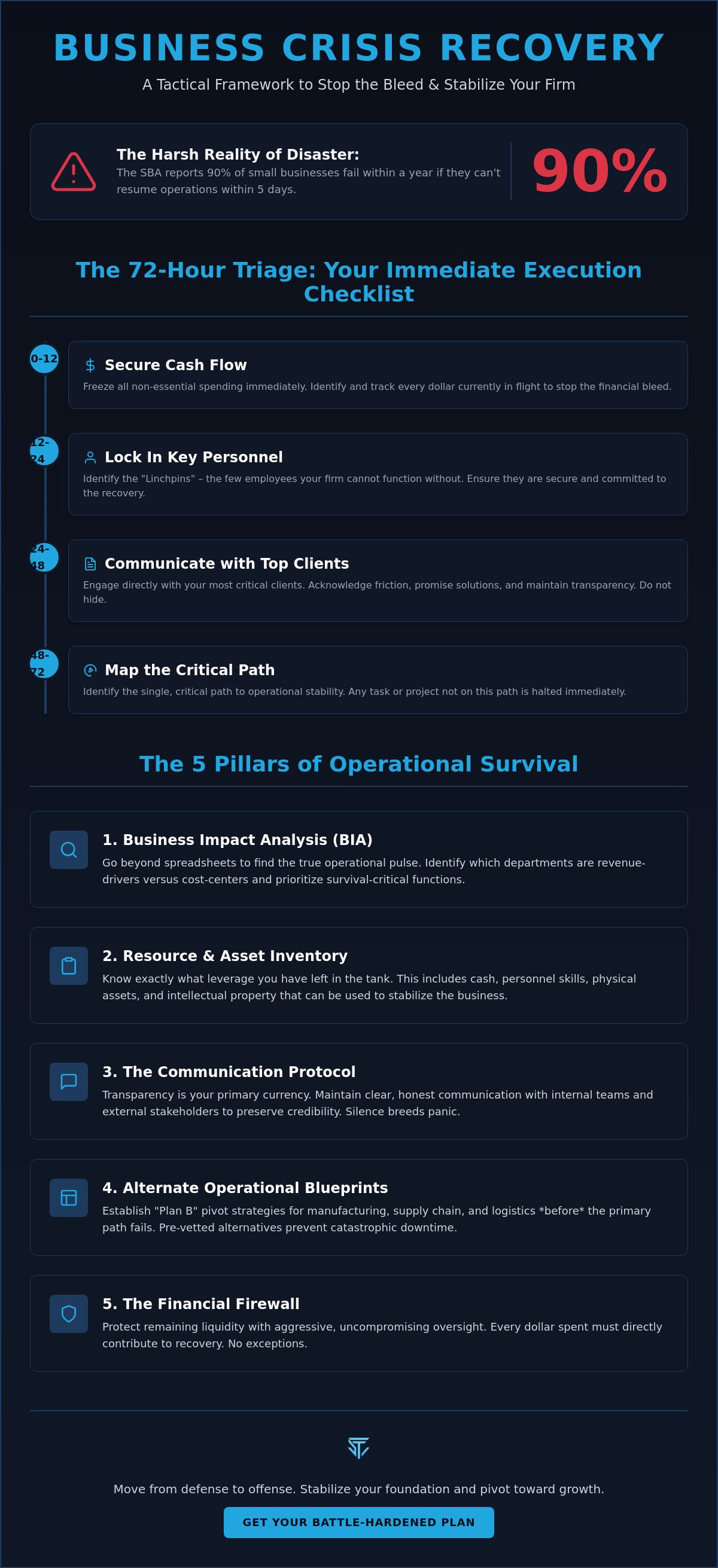
The SBA reports that 90% of small businesses fail within a year if they cannot resume operations within five days of a disaster. It's a cold reality that most leaders ignore until the walls start closing in. If you're currently watching your cash reserves deplete while operational friction turns every missed deadline into a fresh crisis, you need a business crisis recovery plan that actually works. You're losing stakeholder trust and your margin for error has vanished. You need a way out, and you need it now.
We understand that a standard corporate manual is a useless paperweight when the stakes are this high. You need a triage system for immediate execution, not a collection of polished marketing promises. This guide is built to stop the operational bleed and stabilize your firm within 90 days. We're providing a gritty, battle-hardened framework that strips away the fluff to deliver a clear triage list, moving your company from survival mode back toward sustainable growth.
Key Takeaways
- Execute a 72-hour triage to identify and seal immediate bleed points in cash, personnel, and critical contracts.
- Build a business crisis recovery plan that functions as a tactical execution framework rather than a static, theoretical document.
- Stabilize your foundation by prioritizing immediate liquidity over long-term profit and negotiating for the time needed to breathe.
- Establish clear Recovery Time Objectives for core units to determine exactly when to stop defensive cuts and pivot toward growth.
- Bridge the gap between strategy and survival with hands-on leadership that values operational grit over polished consulting theories.
The 72-Hour Triage: Why Your Crisis Plan Starts with Execution
A business crisis recovery plan is not a theoretical document designed to satisfy an auditor. It is a tactical execution framework built for survival. When the ship is taking on water, you don't need a 50-page case study; you need a bucket and a plug. Most leaders confuse Business continuity planning with recovery. Continuity is about keeping the lights on. Recovery is about fixing the break that caused them to flicker in the first place.
The first 72 hours are the most dangerous. According to the SBA, 90% of small businesses fail within a year if they cannot resume operations within five days of a disaster. You don't have time for a committee. You need a command center led by a single, decisive leader who can identify "bleed" points with surgical precision. These points are almost always centered on three things: rapidly depleting cash, the sudden exit of key personnel, or the imminent loss of critical client contracts. If you don't secure these three pillars immediately, the rest of your strategy is irrelevant.
Your "Stop the Bleed" checklist for the first three days must be absolute:
- Hour 0-12: Freeze all non-essential spending and identify every dollar currently in flight.
- Hour 12-24: Secure your "Linchpins." Identify the three employees your firm cannot function without and ensure they are locked in.
- Hour 24-48: Direct communication with your top three clients. Acknowledge the friction. Promise a solution. Do not hide.
- Hour 48-72: Map the critical path to operational stability. If it doesn't contribute to survival, it stops.
Defining the Recovery Zone
Recovery is distinct from the day to day. It requires a different mindset and a different set of rules. During this phase, your only objective is to reach a state of operational stability where you are no longer losing ground. Operational triage is the prioritization of survival-critical functions over routine tasks. You must be willing to let secondary projects fail so the core business can live.
Assembling the Response Team
In a crisis, your existing org chart is often a liability. You need a response team that blends internal operators who know where the bodies are buried with external advisors, such as a turnaround consultant, who can provide an unbiased perspective. The "Strategist" looks at the 90-day horizon, while the "Executor" focuses on the next 60 minutes. Avoid analysis paralysis by limiting your team to five people. Large groups create noise; small teams create movement. Every hour spent in a meeting is an hour not spent executing your business crisis recovery plan.
The Crisis Recovery Template: 5 Pillars of Operational Survival
Stabilizing a failing firm requires more than a bucket. It requires a blueprint. A gritty business crisis recovery plan rests on five non-negotiable pillars. These aren't suggestions. They are the structural supports that keep your company from collapsing under the weight of operational friction. While many competitors focus strictly on IT recovery times, a battle-hardened operator looks at the entire ecosystem. You can find basic business preparedness resources to get started, but survival in the trenches requires a deeper dive into your specific leverage points.
- Pillar 1: Business Impact Analysis (BIA) beyond the balance sheet. Move past the spreadsheets to find the operational pulse.
- Pillar 2: Resource and Asset Inventory. Know exactly what leverage you have left in the tank.
- Pillar 3: The Communication Protocol. Maintain internal and external transparency to preserve your remaining credibility.
- Pillar 4: Alternate Operational Blueprints. Establish pivot strategies for manufacturing and logistics before the primary path fails.
- Pillar 5: The Financial Firewall. Protect your remaining liquidity with aggressive, uncompromising oversight.
Transparency is your primary currency during a turnaround. The Communication Protocol ensures that both internal teams and external stakeholders get the truth. Silence breeds panic. Alternate Operational Blueprints are your "Plan B" for logistics. If your primary supplier fails, you need a pre-vetted pivot. Finally, the Financial Firewall protects your remaining liquidity at all costs. You don't spend a dime that doesn't directly contribute to the recovery.
Conducting a Gritty Business Impact Analysis
Most BIAs are sterile. They miss the human and operational friction that actually grinds a recovery to a halt. You must identify which departments are true revenue-drivers and which are merely overhead that can be shed. Assess the friction points that triggered the crisis. Was it a supply chain failure or a leadership vacuum? Determine the "Point of No Return" for each unit. If a division can't be stabilized within 60 days, it's time to cut it loose.
Inventorying Your Strategic Leverage
Inventory everything. Don't just look at the equipment. Look at your IP, your data, and your deep-seated relationships. These are the intangible assets that provide the most leverage when cash is tight. Evaluate the liquidity of every asset on the books. If it can't be converted to cash or used to secure a lifeline, it's dead weight. Sell the surplus. Liquidate underperforming assets to fuel the recovery of the core business. If you're unsure how to separate your core assets from the noise, a seasoned crisis management strategist can help you identify the leverage you didn't know you had.
Cash Flow and Credibility: Stabilizing the Foundation
Profit is a vanity metric during a turnaround. Liquidity is the only reality that matters. If your business crisis recovery plan focuses on long-term margins while your bank account hits zero, you've already lost. Cash is oxygen. Without it, even the most brilliant strategic pivot will suffocate. You must shift your mindset from "growing the business" to "preserving the fuel." This means prioritizing liquidity over every other metric on the balance sheet.
Stabilizing the foundation requires a brutal assessment of your creditors. Most leaders make the mistake of hiding when the money runs dry. This is a fatal error. Creditors aren't just names on a ledger; they're stakeholders in your survival. Negotiating for time requires proactive communication. If you tell a vendor you'll be late before the deadline hits, you're a partner. If you tell them after, you're a risk. Buy the time you need by offering transparency and a realistic repayment schedule. Don't burn bridges you'll need to cross once the recovery takes hold.
You must also identify and eliminate "phantom costs." These are the invisible drains on your recovery fund. Think recurring software subscriptions for 500 users when you only have 300 left. Think unused warehouse space or inefficient logistics routes that haven't been audited in years. Every dollar saved from a phantom cost is a dollar that funds your operational survival.
Aggressive Cash Flow Management
In a crisis, a weekly cash report is useless. You need a daily cash-in and cash-out tracking system. No exceptions. This level of granularity allows you to see the cliff before you drive over it. Prioritize your payments with total ruthlessness. Payroll and critical "keep the lights on" vendors come first. Everything else stays in the queue until the foundation is firm. Accelerate your accounts receivable by offering small, immediate-pay discounts. It's better to have 95% of the cash today than 100% in 60 days when your doors might be closed.
The Transparency Doctrine for Stakeholders
Your employees know when the ship is listing. Trying to hide the truth only fuels the mass exodus of your best talent. Draft a "Crisis Memo" that is direct and grounded. Acknowledge the stakes. Outline the plan. Tell them exactly what is required to survive. This isn't about being a cheerleader; it's about being a leader who respects their intelligence. Radical transparency is the only viable currency during financial restructuring. When communicating with lenders, provide the hard data before they ask for it. Honesty builds the credibility you need to secure the concessions that will save the firm.
Executing the Pivot: Moving from Defense to Offense
Defense doesn't win the market. It only buys you the right to stay in the game. A business crisis recovery plan that ends with mere stabilization is a job half-done. Once the bleed has stopped, you must transition from survival to strategic execution. This shift requires identifying the "Pivot Point." This is the precise moment when further cost-cutting begins to kill the engine rather than preserve the fuel. If you stay in defensive mode too long, you'll find yourself with a stable company that has no momentum to move forward.
Executing the pivot starts with setting a Recovery Time Objective (RTO) for every core operational unit. This isn't just for IT systems. It applies to your supply chain, your sales team, and your fulfillment centers. If your manufacturing line is running at 50% capacity, what is the hard date for 100%? You must rebuild your sales pipeline while the brand is still in recovery. Don't wait for perfection. Sell the new, lean, battle-hardened version of your firm to clients who value resilience. To ensure you don't slide back into chaos, implement "Operational Guardrails." These are hard limits on debt-to-equity ratios and overhead growth that act as tripwires for future leadership.
If you're ready to stop reacting to the chaos and start leading your firm toward a measurable turnaround, it's time to engage with execution-focused leadership consulting to bridge the gap between triage and growth.
Defining New Operational Milestones
Success in recovery is measured by the reduction of "Operational Friction." If it's getting easier to fulfill orders and meet deadlines, you're winning. Set hard 30, 60, and 90-day targets. The 30-day goal is stability. The 60-day goal is efficiency. The 90-day goal is scalability. For companies looking to turn this newfound efficiency into long-term market dominance, partnering with a strategic business advisor ensures your execution-led growth stays on track through 2026 and beyond.
Sustainable Scaling After the Storm
The "lean" habits you learned during the crisis are your most valuable assets. Don't discard them the moment the cash flow turns positive. Maintain the discipline. Vet every new opportunity through a lens of risk reduction rather than blind expansion. Scaling isn't about getting bigger; it's about getting better. Train your next generation of leadership in the trenches. They need to know how to handle an operational storm before the next one hits. Sustainable growth is built on the hard-won wisdom of survival.
Why Theoretical Plans Fail Without Hands-On Leadership
A binder is not a strategy. Most companies have a business crisis recovery plan gathering dust on a shelf. It's filled with optimistic charts and vague next steps written by people who have never stood on a failing manufacturing floor. In a crisis, the distance between theory and execution is where businesses die. You don't need a consultant to tell you that you're in trouble. You need an operator to show you the way out.
The difference is fundamental. A consultant observes and reports. An operator engages and executes. Grit isn't a line item on a spreadsheet; it's the willingness to make the hard calls when the stakes are highest. Scott Lumley’s approach is forged from four decades of turnarounds across retail, logistics, and manufacturing. It's built on the understanding that a plan is only as good as the leader driving it. Without hands-on leadership, your recovery is just a series of expensive meetings.
The Value of the Battle-Hardened Advisor
Internal teams are often too close to the fire to see the exit. They're often blinded by loyalty, tradition, or fear. An external perspective identifies the blind spots that lead to operational collapse. This requires rigorous due diligence even when time is short. You must verify every asset and audit every process. In manufacturing, for example, saving a floor from collapse often means ignoring the official reports and looking at the actual output friction on the line. Real-world recovery happens in the trenches, not the boardroom.
An advisor who has lived through extreme success and significant adversity provides more than just a map. They provide the composure needed to lead through the noise. They focus on the harsh realities of the business rather than optimistic theories. This is about moving from a state of constant reaction to a state of strategic movement.
Next Steps: Securing Your Business Future
Once the immediate threat has passed, the real work begins. You must conduct a brutal post-mortem. What did the crisis teach you about your business model? Where did the communication break down? Use these lessons to transition from "Crisis Management" to permanent "Leadership Consulting" and strategic growth. The habits that saved your firm during the storm are the same ones that will make it dominant in the market. Don't wait for the next disaster to audit your resilience. It's time to move from defense to a permanent state of operational excellence.
If you're tired of theoretical advice and need a strategy that lands with impact, get a direct, no-nonsense assessment of your operational health today. Your business crisis recovery plan only works if you have the grit to see it through.
Execution Over Theory: Your Next Operational Move
Theoretical advice won't save your manufacturing line or your retail footprint. You need an operator who has spent four decades in the trenches of turnaround management. Scott Lumley brings 40 years of hands-on experience across manufacturing, retail, and logistics to your specific situation. This is results-driven strategy centered on execution, not consulting fluff. It's time to stop the operational bleed with a strategy built for the real world.
Secure your business future with a direct advisory session from Scott Lumley and get the clarity you need to move forward. Your firm has the potential to survive this storm. You just need the right strategist to lead from the trenches. You can do this.
Frequently Asked Questions
What is the first step in a business crisis recovery plan?
The first step is immediate operational triage to stop the financial and talent bleed. You must freeze all non-essential spending and identify the "linchpin" employees and clients who are critical to your survival. Without securing these three pillars, any long-term strategy will collapse before it begins.
How is a business recovery plan different from a business continuity plan?
Business continuity is about keeping the lights on during a disruption; recovery is about fixing the fundamental break. While continuity focuses on maintaining a baseline of service, a business crisis recovery plan is a tactical framework designed to return the company to stability and growth. One is defensive; the other is corrective.
How long does a typical business recovery take?
Stabilization generally requires a 90-day execution window. The first 72 hours are for triage, the first 30 days are for stopping the bleed, and the remaining 60 days are for establishing operational efficiency. While a full return to peak health may take longer, the most critical "danger zone" is typically navigated within this three-month period.
Can a business recover from a crisis without outside consulting?
It's possible, but internal teams often suffer from "tunnel vision" and emotional bias. An external operator identifies the blind spots that leaders on the inside are often too close to see. While you can execute the steps yourself, having a battle-hardened advisor ensures that you're prioritizing the right fires and not just the loudest ones.
What are the most common reasons business recovery plans fail?
Failure usually stems from analysis paralysis or a lack of leadership grit. Plans fail when leaders spend too much time in committee meetings and not enough time on the floor executing hard decisions. If you prioritize corporate optics or theoretical margins over immediate liquidity and operational friction, the plan will likely stall.
How do you prioritize which business functions to recover first?
Prioritize revenue-generating units and critical client fulfillment over administrative overhead. You must identify which departments are the engine of the firm and which are merely the passengers. If a function doesn't directly contribute to cash flow or the fulfillment of core promises, it stays at the bottom of the list until the foundation is secure.
What role does communication play in a recovery strategy?
Communication is the currency that preserves your remaining credibility. Radical transparency with employees prevents a mass exodus of talent, while proactive honesty with creditors buys you the time needed to restructure. Silence is not a strategy; it's a signal to stakeholders that the situation is out of control.
How much does it cost to implement a business recovery plan?
Costs are entirely relative to the scale of the crisis and the complexity of your operations. Instead of focusing on the implementation fee, leaders should calculate the cost of downtime, which can exceed $9,000 per minute for mid-sized firms. The real expense isn't the plan; it's the cost of doing nothing while the business hemorrhages value.


