

Most businesses don't collapse because they lack a viable product; they fail because their leadership loses its nerve when the cash starts to bleed. When reserves are depleting and operational friction is grinding progress to a halt, you don't need a motivational speech. You need a cold, calculated business survival strategy that prioritizes execution over optics. You're likely feeling the weight of every decision right now, watching focus slip while the stakes continue to climb. It's a brutal position, but it's where resilient companies are forged.
This article provides a battle-hardened checklist to stabilize your operations and protect your remaining capital. We're stripping away the corporate jargon to focus on the gritty tactics of operational recovery. You'll gain a clear triage plan for the next 72 hours, proven methods to stabilize your cash flow, and a roadmap to move from survival back to recovery. The goal isn't just to stay afloat. It's to restructure your operations so aggressively that you emerge stronger than before the crisis hit.
Key Takeaways
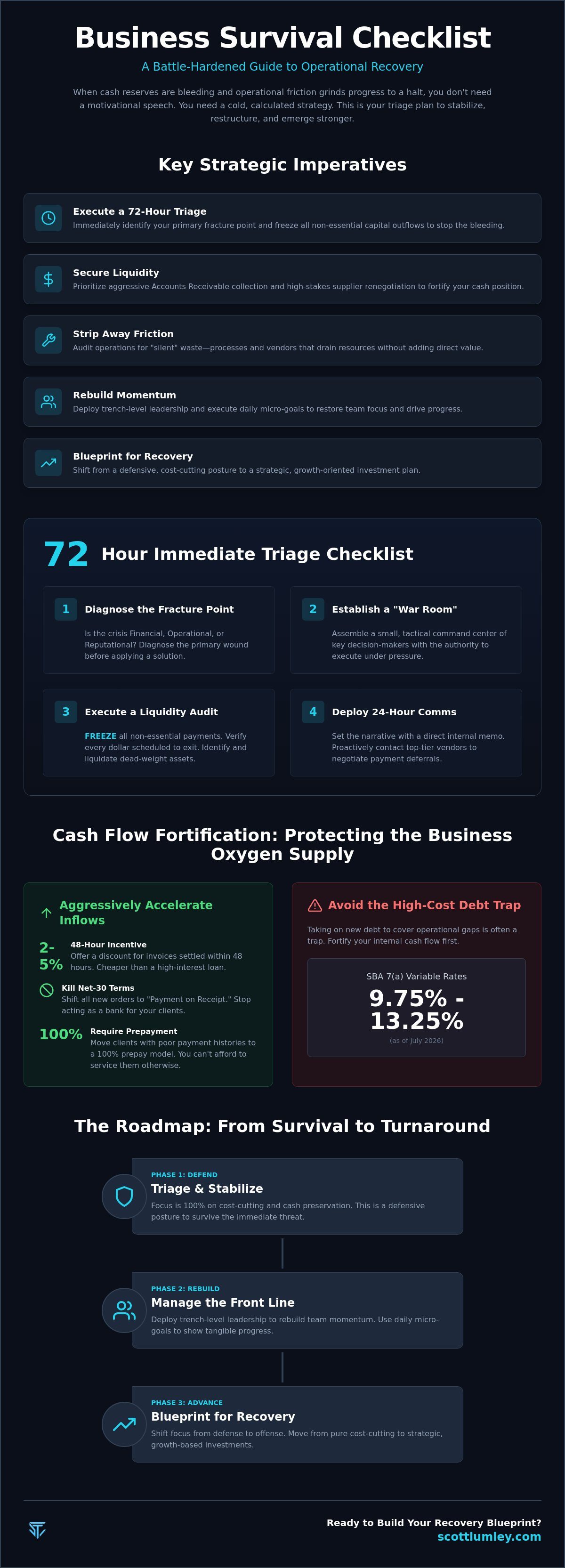
- Execute an immediate 72-hour triage by identifying your primary fracture point and freezing all non-essential capital outflows.
- Secure your liquidity with a business survival strategy that prioritizes aggressive AR collection and high-stakes supplier renegotiation.
- Strip away operational friction by auditing for "silent" waste and purging unreliable vendors from your supply chain.
- Rebuild team momentum through trench-level leadership and the execution of daily micro-goals.
- Move beyond defensive posture to build a recovery blueprint that shifts focus from cost-cutting to strategic, growth-based investment.
The First 72 Hours: Immediate Operational Triage Checklist
The moment a crisis hits, the clock starts. You don't have weeks to deliberate. You have hours to act. A successful business survival strategy begins with a brutal assessment of reality. You must identify the primary fracture point immediately. Is the crisis financial, driven by a sudden loss of capital? Is it operational, where a supply chain collapse has halted production? Or is it reputational, where a loss of trust is draining your client base? Diagnose the wound before you try to stitch it. If you treat an operational failure with a financial band-aid, the business will still bleed out.
Establish a War Room mentality. This is not a board meeting. It is a tactical command center. Keep the group small. Only include the key decision-makers who have the authority to execute and the grit to handle high-stakes pressure. Everyone else is a distraction. Once the room is set, audit your current inventory and work-in-progress (WIP). Look for immediate leverage. Find the projects that are 90% complete and can be billed by Friday. Identify the inventory that can be moved at a discount to generate instant liquidity. In a crisis, finished goods are better than potential orders.
Stopping the Bleeding: The Liquidity Audit
Liquidity is your oxygen. Without it, the business dies. You must verify every single dollar scheduled to exit the bank account in the next 72 hours. If a payment isn't for essential payroll or a utility that keeps the machines running, freeze it. There are no "automatic" payments in a triage environment. Identify dead weight assets immediately. If you have equipment sitting idle or real estate that isn't producing, it is just frozen cash. You may need to utilize due diligence consulting services to uncover hidden liabilities that are quietly draining your reserves. This level of scrutiny is the bedrock of effective turnaround management. You aren't looking for perfection; you're looking for survival.
The 24-Hour Communication Protocol
Panic thrives in a vacuum of information. You have 24 hours to set the narrative before the rumors do it for you. Draft a direct, honest internal memo. Don't offer false hope. Tell the core team what the situation is and what the plan for the next three days looks like. This stabilizes the people you need most. Next, get on the phone with your top-tier vendors. Don't wait for a missed payment to start the conversation. Contact them proactively to negotiate immediate deferrals. Offer transparency in exchange for flexibility. By providing a single, authoritative voice, you prevent the rumor-driven panic that causes key staff and suppliers to jump ship when you need them in the trenches.
Cash Flow Fortification: Protecting the Business Oxygen Supply
Cash is the only metric that matters when you're in the trenches. Profit is a theory; cash is a fact. If your business survival strategy doesn't prioritize the immediate fortification of your bank balance, you're just managing a slow-motion collapse. You've already frozen non-essential outflows. Now, you must aggressively accelerate inflows. This isn't about polite reminders. It's about securing the capital required to keep the doors open for another week.
Traditional credit is currently a high-cost burden. With SBA 7(a) variable rates sitting between 9.75% and 13.25% as of July 2026, taking on new debt to cover operational gaps is often a trap. Instead of looking to banks, look to your own ledger. Your accounts receivable (AR) is a dormant gold mine. You need that capital in your account, not sitting on a client's balance sheet. At the same time, you must perform a brutal audit of your costs. Anything that doesn't directly contribute to the 20% of products or services generating 80% of your cash must be sidelined. Use market research and competitive analysis to ensure your leanest offerings are still positioned to win against better-capitalized rivals.
Incentivizing Rapid Receivables
- The 48-Hour Incentive: Offer a 2% to 5% discount for any invoice settled within 48 hours. It's cheaper than a high-interest bridge loan.
- Kill Net-30: Shift all new orders to "Payment on Receipt" immediately. You aren't a bank; don't act like one.
- Prepay Requirements: Identify clients with poor payment histories and move them to a 100% prepay model. If they can't pay upfront, you can't afford to service them.
The Lean Cost-Cutting Framework
Operational recovery requires a "survival-only" lens. Start by purging technology bloat. Cancel every SaaS subscription or software seat that isn't vital to the production floor or service delivery. Next, consolidate your logistics. If you're running half-empty trucks or fragmented delivery routes, you're burning fuel and labor for zero return. Focus your remaining energy on your high-margin core. If a product line is struggling to break even, kill it. You don't have the luxury of supporting "potential" growth right now. You need certain outcomes. For many operators, this is the time to engage in strategic planning to ensure every remaining dollar is deployed with maximum leverage.
Renegotiate with your suppliers based on your long-term survival. Be transparent. Tell them that a short-term deferral ensures you'll be a customer for the next decade. Most vendors would rather have a slow-paying client than a bankrupt one. This isn't about avoiding debt; it's about managing your oxygen supply until the environment stabilizes.
Removing Operational Friction: Lean Execution in Distressed Environments
Survival isn't just about having cash; it's about what you do with the time that cash buys you. If your operations are riddled with friction, you're burning your oxygen on wasted effort. You need a business survival strategy that looks at the floor, not just the spreadsheet. Operational friction is the delay between a customer's need and your ability to bill for it. Every hour an order sits in a bottleneck is an hour of lost liquidity. In a distressed environment, you don't have the luxury of "business as usual." You must strip the machine down to its core components and ensure every movement serves a specific, revenue-generating purpose.
Operational recovery requires you to repurpose your existing labor. Don't let your team sit idle while orders slow down. Move them to high-impact recovery tasks like auditing inventory, cleaning up the CRM, or assisting with aggressive collections. This maintains momentum and prevents the stagnation that kills morale. Research into small business survival strategies shows that the ability to pivot internal resources quickly is a primary differentiator between firms that fold and those that endure. You aren't just cutting costs; you're reallocating energy. For many, the most effective move is to implement a strategic business advisor framework to ensure your operations are perfectly aligned with your immediate survival goals.
Identifying the Friction Points
Start by locating the bottlenecks that delay invoicing. If your manufacturing process has a three-day lag between completion and shipping, that's three days of dead capital. Simplify your product line immediately. Carrying inventory for twenty different SKUs is a drain when five of them drive all your revenue. Eliminate corporate theater. If a meeting doesn't result in a decision that moves cash or clears a bottleneck, cancel it. Reports that no one reads are friction. Meetings that don't end in action are waste. Focus on the work that moves the needle and ignore the rest.
Logistics and Supply Chain Survival
Supply chains in 2026 remain fragile. You must verify the stability of your Tier 1 and Tier 2 suppliers today. Don't wait for a "delayed" notification to find out your vendor is in trouble. Identify local alternatives for critical components to reduce international shipping delays and the associated labor friction. Optimize your warehouse layout. If your team is walking three miles a day to pick orders, you're paying for movement, not results. Reorganize the floor so that your highest-velocity items are the easiest to reach. Every second saved in the warehouse is a second closer to a paid invoice.
Crisis Leadership: Managing the Front Line Under Pressure
Crisis leadership isn't about polished speeches or corporate retreats. It's about presence. A business survival strategy only works if the people on the front line trust the person at the top. You build that trust by adopting a "Lead from the Trenches" posture. Don't hide in your office reviewing spreadsheets while the floor is in chaos. Be where the work is happening. Show your team that you're sharing the friction and the risk. When leadership is visible, panic recedes. When leadership is absent, rumors fill the void and destroy productivity.
Momentum is the only antidote to despair in a distressed environment. When the big picture looks bleak, your team will freeze. Break the paralysis by setting daily micro-goals. Give your staff a win they can achieve by the end of the shift. This keeps the engine turning and maintains a sense of agency. Identify and empower "Crisis Captains" within the organization. These are the two or three individuals who remain composed when things go sideways. Give them the authority to make tactical calls without waiting for a committee. Centralize your command, but decentralize your execution.
The Decisive Leadership Mindset
Stop seeking consensus. In a crisis, consensus is a luxury you can't afford. It's too slow and often results in watered-down compromises. Move to high-speed, authoritative decision-making. You must accept that 80% accuracy right now is infinitely better than 100% accuracy when it's too late. Focus on execution over sterile theory in every leadership huddle. If a plan doesn't result in a tangible move within 24 hours, it's a distraction. Your job is to make the hard calls quickly and live with the results.
Maintaining Core Team Resilience
You can't save everyone, and you shouldn't try. Identify the 5% to 10% of your staff who are absolutely essential for the recovery. These are your high-performers who carry the weight of the operation. Protect them from burnout by stripping away every non-essential task. Be honest about the stakes. Uncertainty breeds more fear than the truth ever will. If the business is at risk, say so. Then, tell them exactly what the plan is to fix it. Honesty builds a resilient core; fluff builds a fragile one.
Managing this level of operational pressure requires a specific set of skills that many executives haven't had to use in years. If you're struggling to maintain focus while the walls are closing in, professional leadership consulting can provide the external perspective needed to keep your command steady. You need a strategist who has been through the fire before.
Brutal transparency is your most powerful tool for eliminating uncertainty. When people have the facts, they can act. When they're guessing, they're panicking. Your role is to be the sobering voice of reason that keeps the front line moving forward. Keep your communication short, frequent, and entirely centered on the next actionable move. Steady leadership is the bedrock of any successful recovery.
From Survival to Turnaround: Building a Blueprint for Recovery
Survival is a temporary state. If you stay in a defensive posture for too long, your business will eventually starve. Once the bleeding is stopped and the cash flow is stabilized, your business survival strategy must evolve into a blueprint for recovery. This transition is not about returning to the way things were. It's about defining a "New Normal" that is leaner, faster, and more resilient. The friction you've stripped away over the last few days should stay gone. You've proven the business can operate without the bloat; don't let it crawl back in.
Shift your focus from survival-based cost-cutting to growth-based investment. With the 100% bonus depreciation for qualifying property reinstated and made permanent as of June 2026, the current tax environment favors those who reinvest in their operational infrastructure. Use your early recovery cash to double down on your highest-margin service lines. This is also the time to look at unconventional asset plays to diversify your risk. Reviewing the Property Tax Debt System can reveal opportunities to secure assets or resolve liabilities that provide long-term stability rather than just short-term relief. You're no longer just trying to exist. You're positioning to win.
The Pivot to Sustainable Growth
Formalizing the Turnaround Strategy
- The 90-Day Roadmap: Develop a plan with clear financial milestones. Focus on debt reduction and cash reserve rebuilding first.
- Interim Leadership: If your current team is battle-fatigued, hire an interim leader to drive the recovery. Fresh eyes see opportunities that exhausted ones miss.
- The Red Team: Establish a permanent "Red Team" whose only job is to identify future operational risks before they peak.
Document every lesson learned during the crisis. This record is your most valuable asset for preventing a return to pre-crisis friction. A turnaround isn't a one-time event; it's a permanent shift in how you lead and execute. By formalizing these tactics, you move from merely staying alive to dominating a market that is still reeling from the same volatility you just navigated. The goal is a business that is not just recovered, but transformed.
Take Command of Your Operational Recovery
The first 72 hours of a crisis determine if you survive. The next 90 days determine if you thrive. By executing a brutal triage and stripping away operational friction, you've already done more than most. You've secured your liquidity and stabilized your front line. These aren't just defensive maneuvers. They are the foundation of a leaner, more aggressive company that is ready to dominate a volatile market. It's time to stop reacting to the fire and start directing the recovery.
A successful business survival strategy requires more than just technical knowledge. It requires the grit to make hard calls when the stakes are highest. Scott Lumley brings 4 decades of hands-on operational experience in construction, manufacturing, and logistics to your war room. He provides a no-nonsense approach to business recovery that prioritizes tangible outcomes over sterile consulting theories. Don't navigate the turnaround alone when you can leverage a veteran's perspective.
Take the first step toward a permanent turnaround today. Book a Strategic Advisory Session with Scott Lumley and secure your company's future. You've endured the worst of the storm. Now, lead your team into the recovery they've earned.
Frequently Asked Questions
What is the first step in a business survival strategy?
The first step is an immediate triage to identify the primary fracture point of the crisis. You must determine if your failure is financial, operational, or reputational before taking action. Once identified, you immediately freeze all non-essential capital outflows to preserve remaining liquidity. This isn't about long-term planning; it's about stopping the bleeding within the first few hours of a tailspin to ensure you have a floor to stand on.
How can a small business survive an economic recession in 2026?
Small businesses in 2026 must focus on lean execution and managing high-interest debt, as SBA 7(a) variable rates currently reach up to 13.25%. Survival requires purging technology bloat and renegotiating supplier terms based on long-term viability. You should also leverage permanent tax provisions, such as the 21% corporate rate and 100% bonus depreciation, to protect your remaining cash flow while less disciplined competitors continue to overspend on non-essentials.
Is cost-cutting enough to save a failing company?
Cost-cutting is a defensive necessity, but it is rarely enough to save a failing company on its own. You also need an aggressive business survival strategy that focuses on revenue acceleration and operational restructuring. Cutting expenses buys you time, but only fixing the underlying friction points in your production or service delivery will lead to a permanent recovery. You can't simply shrink your way back to a successful, scaling operation.
Can a business survive without a cash reserve?
A business can survive without a cash reserve only if it can aggressively accelerate its accounts receivable and move to prepay models immediately. You must essentially turn your customers into your bank. This requires offering discounts for 48-hour payments and cutting any client who doesn't pay on receipt. It's a high-friction path that leaves zero room for error in your daily execution and requires a total focus on cash inflows.
How do you tell employees the business is in trouble?
You tell employees the truth through brutal transparency to eliminate rumor-driven panic. Draft a direct internal memo that outlines the current stakes and the specific tactical plan for the next few days. Don't offer false hope or vague optimism. When people know the hard facts, they can focus on their specific micro-goals instead of wasting energy wondering if the company will exist by the end of the week.
What is the difference between survival and turnaround management?
Survival management is the immediate triage required to keep the lights on during an active crisis. Turnaround management is the subsequent phase of permanent operational restructuring and growth. While survival focuses on stopping the bleed and securing liquidity, turnaround focuses on building a new, leaner value proposition that can scale. One buys you the time to breathe; the other builds a sustainable future that avoids repeating past mistakes.
How much debt is too much for a business to survive?
Debt becomes too much when the cost of servicing it exceeds your projected free cash flow during a crisis. In 2026, with bank term loans reaching up to 17.25%, high-interest debt can quickly become a terminal liability. If you're borrowing just to cover payroll without a clear path to operational recovery, you've already crossed the line into insolvency. You shouldn't take on new debt to fund a broken model.
When should I hire a business turnaround consultant?
You should hire a business turnaround consultant when your internal leadership is too battle-fatigued to make objective, high-stakes decisions. External advisors provide the sobering voice of reason needed to identify friction points that insiders often ignore. If your business survival strategy has stalled and the cash is still depleting, you need an operator who has successfully navigated these trenches before and can lead from the front.


