

Most business consultants are paid to talk. They aren't paid to do. They deliver polished presentations while your margins evaporate and your operations stall. You've likely already spent thousands on a so-called hands-on business consultant who provided nothing but a binder of suggestions. It's frustrating to buy a map from someone who has never actually driven the route. You don't need more theories. You need a partner who values survival and recovery as much as expansion.
You're here because you know that a slide deck won't fix a broken supply chain or a leadership vacuum. In this article, you'll discover why operational execution is the only thing that actually saves a company in crisis. We'll show you how to identify a strategist who works in the trenches and takes real accountability for results. We will break down the red flags of binder-heavy consulting and provide a clear path to stabilizing your operations for sustainable growth. It's time to stop paying for suggestions and start investing in a partner who delivers a stabilized, clear path forward.
Key Takeaways
- Stop paying for binders that collect dust; prioritize operational deployment over advisory reports that never leave the shelf.
- A true hands-on business consultant stabilizes the foundation first, focusing on removing friction before attempting to scale.
- Lived experience beats generalist theory every time when navigating high-stakes operational risks and supply chain bottlenecks.
- Avoid the "Junior Associate" trap by ensuring the expert you hire is the one actually working in the trenches of your business.
- Shift your focus from survival to sustainable growth by implementing accountability-driven leadership that delivers measurable results.
The Plan vs. Execution Myth: Why Most Consulting Fails
Most consultants sell you a map. They don't care if your car has an engine or if the road is washed out. They deliver a deck, collect a check, and leave you to figure out the rest. This is why the traditional consulting model is broken. A true hands-on business consultant is defined by operational deployment, not just advisory reports. If the consultant isn't willing to get their hands dirty, they aren't solving your problems. They're just describing them.
There's a reason the "Binder on the Shelf" syndrome exists. Industry research consistently shows that approximately 70% of strategic plans are never fully implemented. It's a staggering failure rate. These plans die because they lack a bridge to reality. They're built on optimistic theories instead of the harsh friction of the warehouse floor or the construction site. Execution-led consulting focuses on moving the needle in real-time. It doesn't wait for a quarterly review to tell you that you're bleeding cash. It identifies the leak and plugs it immediately.
The traditional framework of Management consulting focuses on identifying problems and suggesting solutions. It's a passive approach. Real-world success requires being in the trenches. You need to see where the bottlenecks actually happen. You need to feel the friction in the supply chain. You need to hear the hesitation in the leadership team. Only then can you deploy tactics that actually work.
The "Advisor" vs. The "Operator"
Advisors tell you what is wrong. They use corporate jargon to mask a lack of real-world operational understanding. They talk about "synergy" and "optimization" because they've never actually managed a P&L under pressure. Operators are different. They show you how to fix the problem while doing the work alongside you. The shift from consultant-led projects to execution-led partnerships is the difference between surviving and thriving. It's about rugged resilience. It's about hard-won wisdom over polished marketing promises.
Execution as a Service
Bridging the gap between a visionary goal and a marketable operational reality is a violent process. It requires cutting through layers of inefficiency and ego. Hands-on leadership stabilizes a team during these high-stakes transitions. It provides a steady hand when the stakes are highest. Hands-on consulting is the direct application of industry-tested tactics to solve immediate operational friction. It isn't about long-term "suggestions." It's about immediate, decisive action that secures the future of the company.
Theory vs. Industry Scars: Busting the Generalist Illusion
Generalists are a liability. They walk into a construction site or a manufacturing plant and try to apply the same "quick wins" they used for a retail chain. It doesn't work. Business is not just business. Manufacturing is not retail. Logistics is not software. Each sector has its own friction, its own risks, and its own language. A hands-on business consultant doesn't rely on generic frameworks. They rely on industry scars. They know that what works in a climate-controlled office fails on a job site where the mud is knee-deep and the supply chain is collapsing.
Lived experience is the only true hedge against operational risk. 40 years of navigating high-stakes environments builds a level of intuition that no textbook can replicate. It's the difference between an advisor who reads the weather report and an operator who has survived the storm. You need someone who knows what failure looks like so they can help you avoid it. These scars aren't just for show. They represent the hard-won wisdom of managing P&Ls through recessions, political instability, and operational storms in places like Africa and the US.
Why Academic Models Fail Real Operations
MBA case studies are sterile. They assume perfect conditions and rational actors. Real operations are messy. A bottleneck on a manufacturing floor isn't a math problem; it's a physical reality involving broken machinery, labor disputes, or supply chain disruptions. Standard audits miss these details. Comprehensive due diligence consulting services go beyond the spreadsheet. They identify asset risks by looking at the actual equipment and the people running it. They find the friction before it kills the deal.
The Value of Cross-Sector Expertise
True expertise isn't siloed. It's adaptable. The principles of timing and labor management found in construction apply directly to logistics efficiency. Deep knowledge in real estate advisory allows for securing corporate assets with a level of precision a generalist can't match. A strategic business advisor must understand the concrete as well as the contracts. They need to know how the physical world impacts the financial one. If your operations are stalling, you don't need a cheerleader. You need an operator to review your growth strategy and find the leverage points that actually matter.
The Growth Hacking Myth: Why You Cannot Scale Friction
Growth hacking is a lie sold to founders who want a shortcut. It suggests that if you just throw enough leads at a business, the internal chaos will eventually sort itself out. It won't. Scaling a business with broken internal processes is a fatal mistake. It's an accelerated collapse. If your logistics are leaking cash and your manufacturing floor is a bottleneck, doubling your orders just doubles your losses. You cannot scale friction. You only magnify it. A hands-on business consultant understands that revenue is not a substitute for efficiency. They look past the top-line numbers to find the operational rot that is waiting to swallow your margins.
Many executives fear business failure during a turnaround, but the real danger is the refusal to stop and fix the foundation. Chasing more revenue to solve a structural problem is like pouring water into a bucket full of holes. It's exhausting and expensive. You don't need more water; you need to fix the bucket. This requires a partner who leads from the trenches rather than a theoretical advisor who only watches the dashboard. It takes a sobering voice of reason to tell a CEO that they aren't ready to grow. It takes a battle-hardened operator to show them why.
Scaling Inefficiency is a Death Sentence
In high-stakes sectors like manufacturing and logistics, rapid expansion acts as a pressure test. It exposes every hidden weakness in your chain. If your floor managers can't handle ten units, they will fail at fifty. The role of a partner in the trenches is to "clean the house" before the expansion begins. This means identifying operational rot in every corner, from stagnant real estate portfolios to mismanaged property tax liabilities. You don't build an addition on a house with a crumbling foundation. You stabilize the basement first. This gritty work isn't flashy, but it's the difference between a sustainable empire and a temporary success that burns out under its own weight.
Stabilisation as the First Step to Growth
Turnaround management is the sobering reality of saving a distressed firm. It's about survival. The first 90 days of a turnaround are about cutting friction, not adding leads. If the ship is taking on water, you don't buy a bigger engine; you plug the holes. Crisis management requires keeping the lights on when the "growth hacks" fail. You fix a struggling business by recovering lost margins and tightening processes. You don't need venture capital or external debt to save a company that has sound fundamentals but poor execution. You need discipline. True growth is the byproduct of an efficient, friction-free operation.
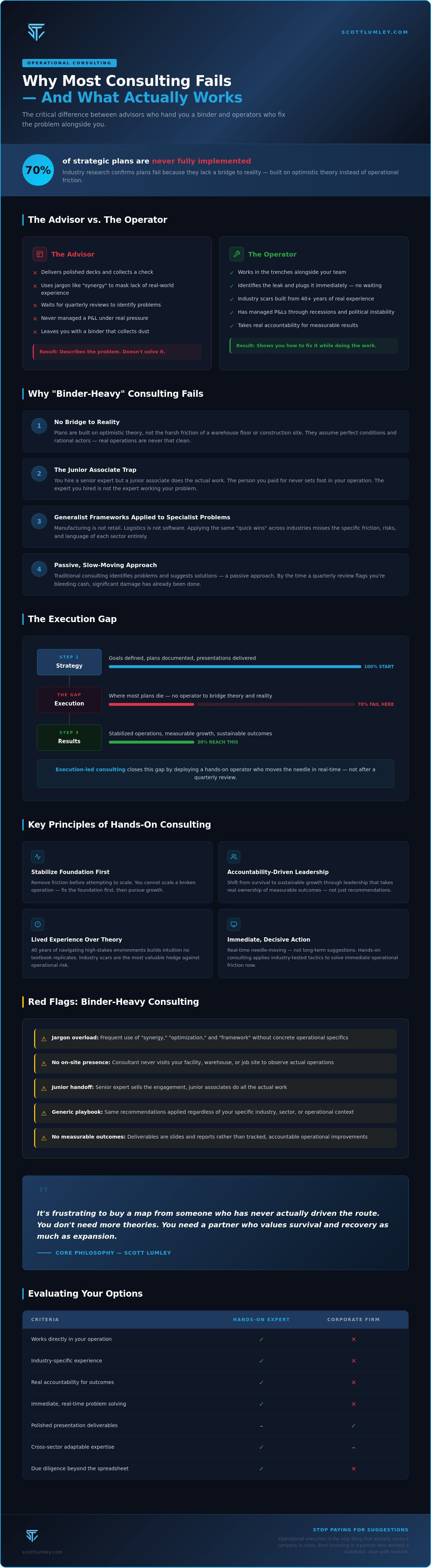
Evaluating Your Options: Hands-on Expert vs. Corporate Firm
Big consulting firms are built on a bait-and-switch. They send a senior partner to win your trust and sign the contract. Then, they hand the keys to a junior associate who has never seen a factory floor or managed a P&L under pressure. This is the "Junior Associate" trap. It's a waste of capital for any business facing operational bottlenecks or high-stakes transitions. A hands-on business consultant doesn't hide behind a team of interns. They are the ones doing the work. They are the ones identifying the friction where it actually happens. Direct access isn't a luxury; it's a requirement for survival.
When you hire a massive firm, you're paying for their brand and their high-rise office rent. When you hire an interim business consultant, you're paying for results. The ROI is immediate. You get veteran leadership without the bloated overhead of a full-time executive salary and benefits package. In 2026, the consulting market has shifted toward this model of transparency. Recent industry data shows that 73% of clients now prefer value-based or outcome-driven pricing over traditional hourly rates. They want a partner with skin in the game, not a billable hour machine.
Principal Access and Direct Leadership
High-stakes operations require a veteran, not a researcher. You don't want someone who has to "study" your industry; you want someone who has already survived its worst-case scenarios. A fractional business advisor acts as a temporary co-founder. They take direct ownership of the problem. This level of access is impossible at a large firm where the principals are too busy selling the next project to manage yours. You need a leader who can make a call on the floor, not someone who needs to check with a committee.
Accountability in the Recovery Zone
Accountability is rare in traditional consulting. Most advisors provide suggestions and then vanish before the consequences arrive. They take the credit for success and blame the "implementation" for failure. A hands-on consultant stays until the pivot is executed. Success isn't measured by the number of pages in a slide deck. It's measured by operational stability, debt reduction, and recovered margins. You need blunt truths, not polished promises. If a strategy fails to meet the real world, the operator is there to adjust the course immediately. If you are tired of paying for binders and ready for execution, partner with an operator who takes accountability for your results.
Beyond Advice: Implementing High-Stakes Leadership
Transitioning from a state of crisis to a blueprint for sustainable growth is a violent shift. It requires a leader who understands that survival is the prerequisite for expansion. A true hands-on business consultant doesn't just hand you a map; they take the wheel during the storm. This is the Scott Lumley approach. It is built on 40 years of lived experience in construction, manufacturing, and real estate advisory. These aren't just industries. They are the battlegrounds where margins are won or lost. Navigating these complex operational storms requires a steady, battle-hardened hand that knows how to find leverage when everyone else sees only risk.
Whether it's deploying the Property Tax Debt System to recover capital or applying hard-won lessons from global operations in I Survived Africa, the focus remains on the harsh realities of business. You don't need optimistic theories or polished marketing promises. You need a partner who has navigated political instability, supply chain collapses, and high-stakes turnarounds. This is not a cheerleader role. It is a pragmatic, strategically intense commitment to your company's durability. It is about prioritizing hard-won wisdom over corporate jargon.
Navigating Complex Operational Storms
Crisis management isn't just for failing firms. It is a growth strategy. You apply the same urgency and precision to expansion that you do to a turnaround. Building a resilient organization that thrives under friction requires total transparency. It requires a commitment to integrity that many corporate firms lack. Turnaround leadership is about finding the blunt truths and acting on them immediately. When the stakes are high, you need a strategist who values survival as much as success. You need someone who leads from the trenches rather than a theoretical advisor.
Your Next Actionable Move
Stop planning and start executing. Engaging a hands-on business consultant means shifting your focus from the binder to the floor. In the first 72 hours of a turnaround, an operator doesn't conduct a survey. They identify the immediate cash leaks. They stabilize the leadership. They secure the assets. Every hour spent on a slide deck is an hour lost to the friction that is killing your growth. There is no wasted space in this process. Every move is designed to provide clarity at high speed. Your next move is simple. Schedule a direct consultation with Scott Lumley to stabilise your operations today.
Secure Your Operational Future
You've seen why slide decks fail. They are static maps for dynamic crises. True recovery isn't found in a binder; it's found on the factory floor, the construction site, and the retail front lines. A hands-on business consultant doesn't just offer advice. They provide the grit and the leadership required to stabilize a sinking ship and chart a course for sustainable growth. Theory won't save your margins. Only execution will.
Scott Lumley brings 40 years of hands-on operational experience to your business. This isn't theoretical knowledge. It's a proven track record forged in manufacturing, retail, and construction. As a veteran of high-stakes global operations, he knows that survival requires immediate, decisive action. You don't need a researcher. You need an operator who takes accountability for the outcome. Stop paying for suggestions. Start investing in results that stabilize your foundation and secure your assets.
Get the execution-led leadership your business needs. Contact Scott Lumley.
Your business is too valuable to leave to chance. Take the first step toward a friction-free future today.
Frequently Asked Questions
What is the difference between a business coach and a hands-on consultant?
A business coach focuses on your personal development and asks questions to help you find your own way. A hands-on business consultant takes the wheel. They don't ask how you feel about a bottleneck; they identify the root cause and deploy a tactical fix. Coaches deal in potential, while consultants deal in operational reality. You hire a coach to think better. You hire a consultant to perform better.
How long does a typical hands-on consulting engagement last?
Engagement length is dictated by the complexity of the friction, not a standard contract template. A crisis management pivot might require 90 days of intense stabilization to stop the bleed. A long term strategic growth project could last several months as new systems are integrated. The focus is always on achieving a specific operational milestone rather than hitting a specific number of billable hours. It ends when the result is secured.
Can a hands-on consultant help with a business turnaround if we are in debt?
Debt is usually the final symptom of a deeper operational failure. A consultant identifies the leaks in your cash flow and implements recovery systems to stabilize the business. Whether it's utilizing a specialized Property Tax Debt System or renegotiating supply chain contracts, the goal is to find capital hidden within your own inefficiencies. You don't always need more funding; you often just need better execution to clear the path.
Does a hands-on consultant actually manage my employees?
They lead through action rather than just giving orders from a boardroom. A consultant works alongside your team to implement new processes and stabilize leadership. This isn't about micromanaging daily tasks; it's about setting a high standard for execution and ensuring your staff has the tools to meet it. They act as a temporary force multiplier for your existing workforce, providing a veteran perspective in the trenches.
What industries do hands-on consultants typically specialise in?
These experts thrive in high stakes sectors where physical assets and complex logistics are the primary drivers of value. You'll typically find them in construction, manufacturing, and real estate advisory. These industries involve significant operational risk and tangible friction that a generalist advisor cannot navigate. They specialize in environments where a single mistake in the supply chain or on the job site can evaporate your entire margin overnight.
How do I know if my business needs an advisor or an operator?
Look at your current results. If you have a stack of strategic plans but your operations are still stalling, you need an operator. Advisors provide the "what" and the "why," but they leave the "how" to you. If your team is overwhelmed and your growth has hit a ceiling, you need someone to step into the trenches and drive the execution. Stop buying maps and start hiring a driver.
What is the ROI of hiring a hands-on business consultant?
ROI is measured by the tangible recovery of your business. It shows up as stabilized cash flow, reduced operational friction, and a clear path to sustainable growth. You aren't paying for a document; you're paying for the elimination of the bottlenecks that are costing you money every day. The return is the difference between a business that is merely surviving and one that is built to endure the harshest market conditions.
Is hands-on consulting suitable for small businesses or just large firms?
Size doesn't matter when your foundation is crumbling. Small businesses often have less room for error than large firms, making the precision of a hands-on business consultant even more critical. Whether you are managing a single construction site or a multi state manufacturing operation, the need for direct, accountable leadership remains the same. If there is friction in your process, it needs to be removed regardless of your headcount.


