

Why is your construction business stalling despite having a full pipeline of projects? It’s the central question driving the need for construction business consulting in a year where copper prices have climbed 24.2% and the industry faces a 349,000 worker shortage. A packed schedule is no longer a guarantee of profit. In 2026, it's often just a faster way to find yourself insolvent.
You know the reality of the dirt. You see the friction between your field crews and the back office every day. You aren't looking for a cheerleader or a thick binder of suggestions. You need to stop the bleeding. I will show you how to strip away the operational drag that's killing your cash flow and replace it with a roadmap for sustainable scaling. We are moving beyond theory to focus on battle-hardened execution.
We'll examine the specific moves required to stabilize your operations against 2026 market volatility. This includes navigating the new 5% retention caps in California and the mandatory wildfire safety codes that are now the baseline for survival. It's time to move past advising and start executing.
Key Takeaways
- Identify the "Growth Trap" where increasing your project volume actually drains your liquidity and stalls your operations.
- Understand why effective construction business consulting prioritizes immediate operational intervention over theoretical long-term blueprints.
- Learn the mechanics of turnaround management to save a distressed firm and stabilize cash flow in a volatile 2026 market.
- Plug the "Change Order Leak" by identifying the specific points where profit margins erode between the field and the back office.
- Implement a 90-day stabilization roadmap designed to fix a broken operational model before you attempt to scale it.
The High Stakes of Construction: Why Most Firms Hit an Operational Ceiling
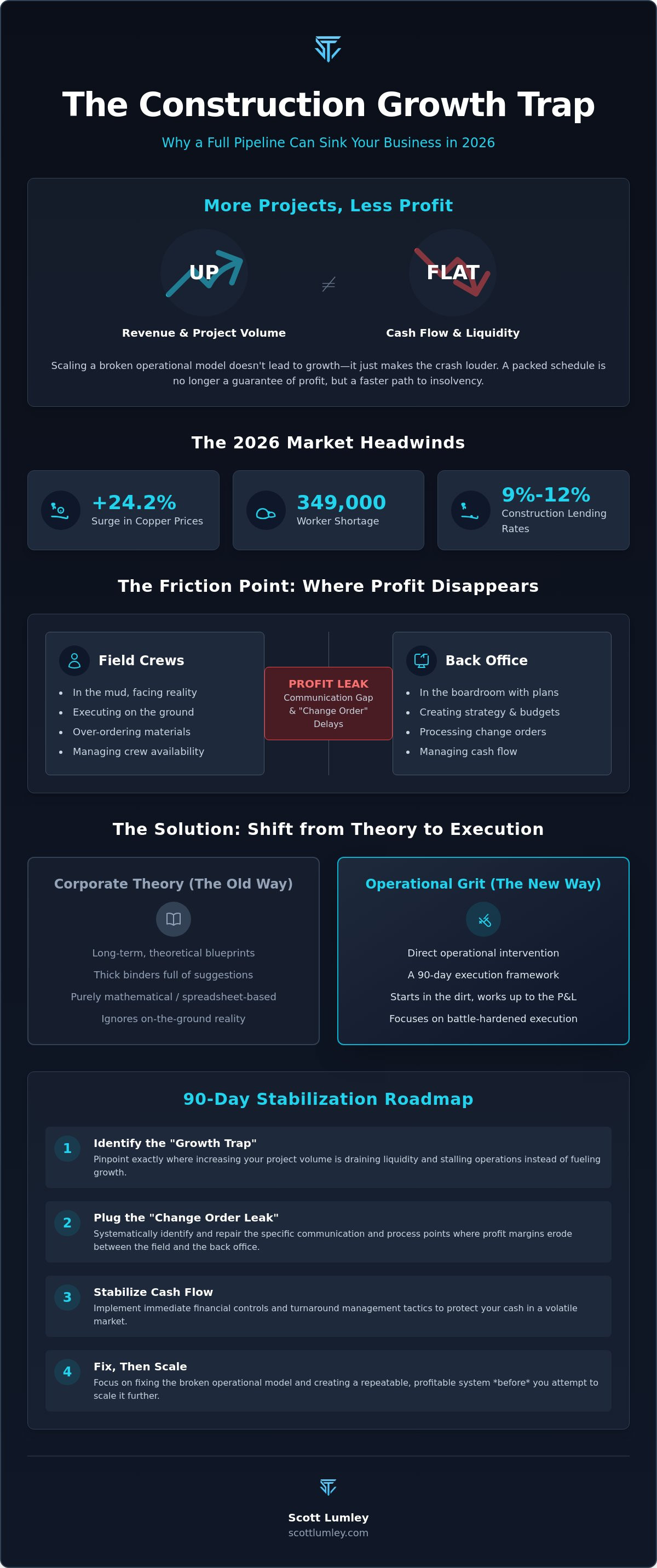
Most construction firms don't fail for lack of work. They fail because they can't handle the volume they've already secured. In 2026, the "Growth Trap" is more lethal than ever. You win a massive contract, hire more crews, and suddenly your liquidity vanishes. Revenue goes up, but your bank account stays flat. This is where most leaders hit the ceiling. They think more volume equals more stability. They're wrong. Scaling a broken model only makes the crash louder.
Effective construction business consulting isn't about providing a binder full of suggestions. It is a direct operational intervention. It's the process of identifying why your margins are thinning even as your backlog grows. While a professional construction management service handles the technical oversight of a build, consulting fixes the broken machine behind the builder. It's the difference between managing a project and managing a business that can survive a 9.7% rise in nonresidential input prices. You don't need more advice. You need a better engine.
The 2026 market dynamics demand leaner, more agile leadership. With interest rates for construction lending hovering between 9% and 12%, there is no room for bloat. High-volume environments often mask deep inefficiencies until the first market dip occurs. By then, it's usually too late to pivot. Real strategy in this climate means cutting the weight before the storm hits.
The Friction Point: Where Strategy Meets the Job Site
Your project managers are in the mud. Your executives are in the boardroom. If they aren't speaking the same language, you're losing money every hour. "Hope-based" management is the silent killer of the job site. You hope the change order gets signed. You hope the crew shows up. You hope the margin holds. Operational friction is the hidden tax on every billable hour. Without a tight feedback loop between the field and the office, your strategy is just a list of wishes.
The 2026 Construction Landscape: New Risks and Realities
The current environment is unforgiving. Labor scarcity isn't a temporary hurdle; it's a permanent reality. With the industry needing 349,000 new workers this year, you can't just throw bodies at a problem. You have to lead the people you have more effectively. Supply chain volatility has moved from a nuisance to a core strategic risk. Steel is up 6.7% and copper has surged 24.2%. Getting the work is easy. Executing that work profitably is the only thing that matters now. Construction business consulting provides the framework to make that execution possible.
Core Disciplines of Construction Business Consulting: Beyond the Blueprints
Construction isn't a spreadsheet exercise. It's a logistical war. Construction business consulting must reflect that reality. Traditional firms often treat restructuring as a purely mathematical problem. They're wrong. You can't fix a cash flow crisis if you don't understand why your site supervisors are over-ordering material. True advisory starts in the dirt and works its way up to the balance sheet. It identifies the rot in your operations before it hollows out your bank account.
Strategic Planning for High-Stakes Operations
Your five-year plan is a fantasy. In a market where material costs shift weekly, a long-term projection is just a guess. You need a 90-day execution framework that survives contact with reality. This means aligning your capital allocation with your actual project capacity. Don't over-leverage your assets on a pipeline your labor force can't support. Working with a strategic business advisor ensures that growth is dictated by operational capability, not just market opportunity. It is about execution-led growth that keeps the lights on when the market tightens.
Risk Mitigation and Due Diligence
Identifying operational rot before it becomes a legal liability is the difference between expansion and extinction. Many firms face significant and pressing challenges ranging from labor shortages to "poison pill" contracts that drain margins. You must vet every deal for hidden friction. Utilizing due diligence consulting services allows you to see the red flags in a potential acquisition or a major build before you're legally bound. This includes managing property tax debt systems and asset exposure in a fluctuating environment. Don't sign until you know exactly where the money is leaking.
Effective construction business consulting also covers these critical areas:
- Turnaround Management: The mechanics of saving a distressed firm. This isn't about cutting costs; it's about restoring operational flow and stabilizing the cash cycle.
- Leadership Advisory: Developing a "trenches-first" mentality. Your management needs to be as comfortable on the site as they are in the office to ensure directives actually land.
- Crisis Intervention: Moving fast to stabilize cash flow when a project goes sideways or a subcontractor defaults.
If your current trajectory feels unsustainable, it's time to look at the mechanics of your business. You can review your operational strategy to find where the friction is slowing you down and fix it before the next quarter begins.
Operational Grit vs. Corporate Theory: Choosing the Right Advisory Path
You don't need a consultant who brings a 50-page slide deck to a job site. You need an operator who knows why your equipment is sitting idle and your crews are frustrated. Many corporate firms try to sell you on "Analytical Sciences" or "AI-driven strategy." They're selling theories while your margins are under attack by a 9.7% rise in nonresidential input prices. Real construction business consulting is an exercise in grit. It's about identifying project-level inefficiencies that a data model will always miss. If your advisor hasn't stood in the mud during a turnaround, they aren't an advisor. They're a spectator.
The Fallacy of Theoretical Consulting
Textbooks don't account for the chaos of a 2026 build site. When "best practices" meet a labor shortage of 349,000 workers, the theory breaks. Over-complicating simple operational fixes leads to analysis paralysis in the field. Your site supervisors don't need more meetings or complex software. They need clear directives and a stabilized supply chain. Sterile theory often ignores the human element of construction. It fails to address the friction between the back office and the foreman. You can't solve an operational crisis with a spreadsheet if you don't understand the logistics of the trade.
The Value of Lived Experience
Experience is the only currency that matters when a project starts hemorrhaging cash. Navigating complex operational storms requires more than a fresh degree; it requires a history of survival across manufacturing, logistics, and property investment. Organizations like the Construction Industry Institute provide research-backed frameworks for the sector, but those frameworks still need a veteran hand to implement them. This is why hands-on leadership consulting services outperform passive coaching every time. You need a strategist who leads from the trenches.
Spotting a "slide-deck consultant" is simple. Ask them how they handled a subcontractor walk-off during a period of high interest rates. If they talk about "synergy" instead of "cash cycle stabilization," they've never actually navigated a turnaround. Construction business consulting should be about immediate, actionable moves. It's the difference between a four-decade veteran who knows where the rot hides and a fresh MBA who is still learning the vocabulary of the job site. Choose the path that prioritizes execution over appearances.
Identifying the Friction: Red Flags in Your Construction Operations
Most construction owners don't realize they're in trouble until the bank stops answering their calls. By then, the rot has already hollowed out the business. You need to identify the red flags before the liquidity dries up. Effective construction business consulting isn't just about spotting problems; it's about building a diagnostic system you can use every day. If you can't self-diagnose, you can't survive. Use this checklist to find the friction points killing your margins.
- Step 1: Analyze the "Change Order Leak." Track every hour spent on work that wasn't in the original scope. If it's not billed, it's a gift to the client.
- Step 2: Evaluate the "Communication Lag." If your back office doesn't know about a site delay within four hours, your reporting is broken.
- Step 3: Audit "Asset Utilization." Idle machinery and crews waiting for materials are pure overhead. If talent is sitting, profit is bleeding.
- Step 4: Check for "Leadership Fatigue." When mid-level managers stop solving problems and start merely reporting them, your execution is at risk.
- Step 5: Review "Crisis Readiness." You need a recovery plan for the next 72 hours. If a key subcontractor walks off tomorrow, do you have a move?
The Change Order Crisis
Disputed change orders are more than a nuisance; they're a path to technical default with your lenders. Many firms treat site adjustments as handshake deals to keep the project moving. This is a mistake. A change order is a contract amendment, not a favor. You must implement systems that capture and bill every scope change in real-time. If the paperwork isn't signed before the work starts, you're essentially financing the client's project for free. In a year where labor costs are up 4%, you can't afford to be a bank.
Liquidity and Cash Flow Management
There's a dangerous difference between being profitable on paper and having cash in the bank. If your "profitable" project is constantly requiring cash injections to cover payroll, you have a structural failure in your cash cycle. This often happens when vendor payments aren't aligned with client milestones. For asset-heavy firms, navigating these waters requires specialized real estate turnaround services to stabilize the balance sheet. You have to manage your vendor relationships with total transparency when the budget gets tight to keep the supply chain open.
Don't wait for a crisis to reveal the cracks in your foundation. You can schedule an operational audit today to find the friction points and stop the bleeding before it impacts your 2026 growth targets.
Strategic Leadership: Navigating Construction Turnarounds and Growth
You cannot scale a broken operational model. If your current systems are leaking cash at ten million in revenue, they'll cause a total collapse at fifty million. Many firms chase market expansion as a cure for internal friction. This is a fatal mistake. Growth doesn't fix dysfunction; it amplifies it. True construction business consulting focuses on repairing the foundation before adding more weight. You must stabilize the machine before you try to run it faster.
The first 90 days of a turnaround are about survival and clarity. You have to move from reactive fire-fighting to methodical execution. This begins with a simple mandate: stabilize, then optimize. You can't worry about long-term efficiency if your weekly payroll is in jeopardy. Once the bleeding stops, you can begin the work of stripping away the layers of waste that have accumulated over years of "growth at any cost" management.
Executing the Pivot in Distressed Firms
In a distressed firm, speed is your only ally. You need a rapid deployment of crisis management strategies to regain control of your cash cycle. This often requires cutting the "dead wood" from your project portfolio. Not every contract is worth finishing. If a project is a permanent drain on your resources with no path to profitability, you need the grit to exit. Communicating this turnaround plan to skeptical stakeholders requires total transparency. Don't offer optimistic theories. Provide a blunt assessment of the reality and a clear roadmap for recovery.
Building for the Future: Real Estate Leadership
Survival is the baseline, but the goal is the transition to sustainable, organic growth. This is where you move beyond the role of a "contractor" and become a strategic property partner. Your deep understanding of the build process is a massive competitive advantage in the investment market. By utilizing real estate leadership advisory, you can leverage your construction expertise for superior property investment due diligence. You know where the structural risks hide because you've seen them on the job site.
Positioning your firm for long-term success means moving up the value chain. Construction business consulting helps you bridge the gap between being a service provider and being a strategic asset manager. When you control the operations and the strategy, you control your destiny. The market in 2026 is volatile, but it's full of opportunity for those who have the operational grit to execute when others are just advising.
Securing Your Operational Foundation for 2026
Success in this market isn't about the size of your backlog. It's about the efficiency of your execution. You've seen how scaling a broken model leads to collapse and why operational friction acts as a silent tax on every project. Moving from survival to sustainable growth requires a shift in leadership. You must stop acting as a passive observer of your own business and start operating with total transparency and grit. The machine must be fixed before it can be pushed.
Effective construction business consulting provides the leverage you need to repair the machine. Scott Lumley brings 40 years of hands-on experience in construction, logistics, and manufacturing to every engagement. Whether you're navigating a distressed turnaround or positioning your firm for strategic property investment, you need an advisor who leads from the trenches. His expertise in retail and industrial operations ensures your strategy is built on reality, not theory. It's about hard-won wisdom, not polished promises.
The stakes are high, but the path forward is clear. Fix the friction. Stabilize the cash. Execute the growth. Get the no-nonsense advisory your construction business needs to scale or recover. Contact Scott Lumley today.
Your business can thrive in 2026. You just need the right roadmap and the courage to follow it.
Frequently Asked Questions
What exactly does a construction business consultant do?
A consultant acts as an operational mechanic for your firm. They identify where the friction between your field crews and your back office is draining your liquidity. This includes implementing strategic planning that actually works on a job site and providing crisis management when projects go sideways.
How do I know if my firm needs a turnaround consultant or just better software?
If your pipeline is full but your bank account is empty, you don't need a new app. You need an intervention. Software merely automates your existing processes. If those processes are broken, software just helps you fail faster. A turnaround consultant fixes the engine; software just polishes the dashboard.
Can a consultant help with disputed change orders and lender defaults?
Yes, they provide the framework to stop the bleeding. Consultants help you implement real-time billing systems so that change orders are treated as contract amendments rather than favors. They also assist in navigating technical defaults by providing lenders with a credible, execution-led recovery plan that restores confidence.
What is the difference between construction consulting and project management?
Project management is about the build, but construction business consulting is about the business. A project manager ensures the drywall goes up on time. A consultant ensures the firm stays liquid enough to pay the crew. One manages the site; the other manages the risk, assets, and strategic growth of the entire organization.
How long does a typical construction business turnaround take?
Stabilization typically happens in the first 90 days. During this window, the focus is on stopping the cash drain and securing the supply chain. A full transition from survival mode to sustainable, organic growth typically takes six to twelve months of consistent operational discipline and leadership adjustment.
Is construction consulting worth the investment for mid-sized firms?
It is often the only way to break through an operational ceiling. Mid-sized firms frequently fall into the "growth trap" where more projects lead to less liquidity. Professional construction business consulting plugs the profit leaks that mid-sized firms often overlook, making the investment a necessity for survival in a volatile 2026 market.
How does Scott Lumley’s approach differ from large corporate consulting firms?
The difference is lived experience versus corporate theory. Scott Lumley doesn't use slide decks to explain a turnaround; he uses 40 years of experience in the dirt. Large firms offer passive coaching and academic "best practices." Scott provides direct, trenches-first leadership that focuses on immediate execution and tangible recovery.
What are the most common operational red flags in a construction business?
Look for leadership fatigue and a disconnect between the site and the office. If your change orders are unmanaged or your equipment is sitting idle, you have a friction problem. High turnover in mid-management and a lack of a 72-hour crisis plan are also critical indicators that your operations are stalling.


