

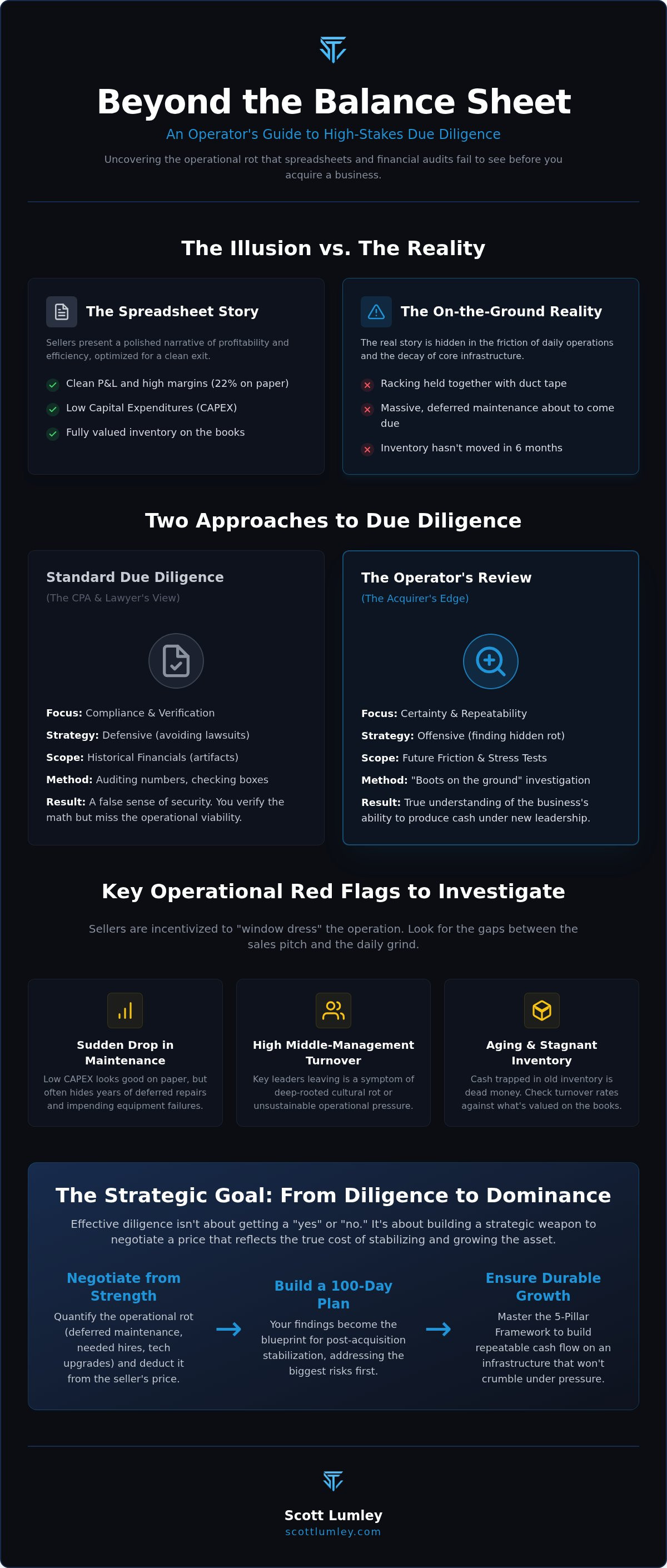
The spreadsheet says the margins are 22 percent, but the warehouse floor tells a different story. You are looking at a clean P&L while ignoring the fact that the forklift drivers are using duct tape to keep the racking together. Most business acquisition due diligence processes focus on the numbers because numbers are easy to audit. Operational reality is harder. It is messy. It is hidden in the way a manager avoids eye contact or how the inventory hasn't moved in six months despite what the software claims.
You're right to be skeptical of the polished slide decks provided by theoretical consultants who have never actually run a business. You need to know if you're buying a high-performance machine or a lemon wrapped in a fresh coat of paint. This guide strips away the corporate jargon to show you how to identify the operational rot that spreadsheets hide before you sign the deal. We will move past the theoretical and look at the real-world friction that determines whether a company thrives or dies under new ownership. You will learn how to spot the hidden debt that eats profit and gain the confidence to walk away from a bad deal.
Key Takeaways
- Stop relying on historical financial statements. They are artifacts that fail to predict the future friction of a live operation.
- Effective business acquisition due diligence identifies maintenance traps where low CAPEX on paper hides a massive, upcoming equipment failure.
- Move beyond the CPA's audit. An operator's review tests how the business handles stress and volume, not just how the books look at rest.
- Use your diligence findings as a strategic weapon. Negotiate a deal price that reflects the real cost of stabilizing the target's operational rot.
- Master the 5-pillar framework to ensure the cash flow is repeatable and the infrastructure is durable enough to support your growth plans.
Beyond the Balance Sheet: Why Standard Due Diligence Fails
Standard due diligence is a defensive play. It is built by lawyers to avoid lawsuits and CPAs to verify math. While necessary, it's an exercise in compliance that rarely touches the operational reality of the business. You're looking at historical artifacts. A P&L tells you what happened last year, but it won't tell you that the plant manager is planning to quit the day after the wire hits. The spreadsheet is a lie of omission. It doesn't show the friction; it shows the result of that friction, delayed and distorted by accounting rules.
Effective business acquisition due diligence must be an offensive strategy. It's the process of tearing apart the seller's narrative to find the cold, hard evidence underneath. Most buyers fall into the "clean audit" trap. They see a profitable bottom line and assume the engine is healthy. In reality, a business can look highly profitable while its core infrastructure is rotting. High margins often hide deferred maintenance, burnt-out staff, and obsolete technology. If you only look at the spreadsheets, you're flying blind.
The Difference Between Compliance and Certainty
Compliance asks if the boxes are ticked. Certainty asks if the business can survive the transition. Legal safety is not the same as operational viability. You can buy a company with perfectly filed permits and zero litigation history that still fails within six months because the workflow is broken. Checking the box is easy. Hunting for the truth requires getting your boots on the ground. You aren't just verifying assets; you're verifying the ability of those assets to produce cash under your leadership. Certainty comes from seeing the friction, not ignoring it.
Why Sellers Hide the Friction
Sellers are incentivized to optimize for the exit. This often means "window dressing" the operation. They suppress labor costs by running skeleton crews. They defer expensive equipment repairs to keep CAPEX low and EBITDA high. In manufacturing or retail, this looks like a clean floor and a full warehouse. You have to look for the gaps. During business acquisition due diligence, pay attention to these red flags:
- Recent, unexplained drops in maintenance spending compared to historical averages.
- High turnover in key middle-management roles over the last 12 months.
- Inventory that hasn't moved in two quarters but is still valued at full cost on the books.
The gap between the sales pitch and the daily grind is where the real price of the acquisition is hidden. If you don't find the rot now, you'll pay for it later at a much higher rate.
Operational Friction: The Hidden Killer of Business Acquisitions
Operational friction is the drag that stops growth. It's the invisible weight that turns a healthy margin into a deficit once the honeymoon phase ends. While a financial audit counts the cash, business acquisition due diligence must measure the resistance. If every process requires a "workaround," you're buying a headache, not a business. Friction is the gap between how a business should run and how it actually survives the day. It eats your time, kills your morale, and eventually, it destroys your bottom line.
Asset Decay in Manufacturing and Logistics
Asset decay is the silent thief of acquisition ROI. In manufacturing, don't trust a clean factory floor. Sellers paint machines; they rarely catch up on three years of skipped oil changes. You need to scrutinize the maintenance logs. If the logs are missing or look like they were written in the same pen on the same day, you're looking at a maintenance trap. The true cost of deferred maintenance includes the emergency repair bill and the lost revenue from a week of total shutdown. Identifying these operational risks early is the only way to avoid buying a lemon.
The Retail and Supply Chain Stress Test
Retail and logistics businesses often hide fragility in their vendor lists. If 70 percent of the product comes from one supplier, you don't own a business; you own a distribution arm for that supplier. Analyze inventory turnover against aging stock. Cash trapped in three-year-old inventory is dead money. Logistics bottlenecks also hide in plain sight. A warehouse that works at 500 orders a day might catch fire at 700. You need to know where the breaking point is before you try to scale. Business acquisition due diligence should include a stress test of the supply chain to see where it snaps under pressure.
Culture rot is the intangible friction that kills post-acquisition momentum. It's the resentment built from years of poor leadership or broken promises. When high-performing teams see a new owner, they often see an exit ramp. If the staff is checked out, your integration plan is dead on arrival. You can't fix a broken culture with a memo. You have to identify the rot during the diligence phase or prepare for a mass exodus the day you take the keys. This is the friction that no spreadsheet can ever capture, but every operator feels on day one.
Financial Audit vs. Operator Review: Identifying Asset Decay
A CPA audits the past. An operator audits the future. Financial statements show you what was spent; they don't show you what was ignored. During business acquisition due diligence, you will frequently encounter the "Maintenance Trap." This occurs when a seller slashes CAPEX to inflate cash flow. On paper, the business looks like a high-margin machine. In reality, you're buying a fleet of trucks or a manufacturing line that is one month away from a catastrophic failure. Accountants see a low expense line. Operators see a massive, looming bill.
Labor costs are another area where the books mislead. A low payroll is often hailed as "lean." It's frequently a red flag. It might mean the owner is doing the work of three people, or the staff is so underpaid they're already looking for the exit. Efficiency is what matters. If a warehouse needs 20 people to do the work of 10 because the layout is broken, that's friction. You don't want a low payroll; you want a productive one. Low costs without efficiency are just a ticking time bomb for the new owner.
Revenue quality is the final piece of the puzzle. Look for spikes in the last six months. Sellers often "prime the pump" by offering unsustainable discounts or pulling forward future sales to make the exit look more attractive. If the growth isn't repeatable, it isn't real. You're buying the future cash flow, not the seller's curated history.
Hunting for Operational Debt
Operational debt is the cumulative cost of every shortcut taken by the previous owner. It's the "band-aid" fix on the roof or the manual spreadsheet that replaces a broken ERP module. In real estate and construction portfolios, this debt is often buried deep in the physical assets or the project management workflow. You need due diligence consulting services to uncover these liabilities before they become your problem. If you don't account for operational debt in your offer price, you're paying a premium for someone else's negligence.
The 'Boots on the Ground' Audit
You can't do business acquisition due diligence from a conference room. You have to walk the floor. Do it without the owner. Their "tour guide" narrative is designed to distract you from the cracks. Watch the rhythm of the work. See how many times a worker has to walk across the building to get a tool. Spot the piles of scrap. Compare the "official" process manual to what is actually happening. If the software says inventory is tracked by RFID but the workers are using sticky notes, the software is useless. The truth is in the movement, not the manual. Spotting these inefficiencies now gives you the leverage to negotiate or the clarity to walk away.
The 5-Pillar Framework for High-Stakes Due Diligence
Generic 20-point checklists treat a missing fire permit with the same weight as a failing supply chain. That is a mistake. In high-stakes business acquisition due diligence, you must prioritize the risks that can actually kill the deal or bankrupt you post-closing. You need a framework that separates the noise from the signal. This operator-led approach focuses on five core pillars: Financial Integrity, Operational Resilience, Asset Viability, Human Capital, and Strategic Fit.
- Financial Integrity: Verifying that the cash flow is not just present, but real and repeatable.
- Operational Resilience: Determining if the systems can survive growth or a sudden market shift.
- Asset Viability: Auditing physical and intellectual property for hidden decay or obsolescence.
- Human Capital: Identifying who actually keeps the lights on and why they stay.
- Strategic Fit: Ensuring the new entity doesn't create more friction than the growth it promises.
Most buyers spend too much time on Pillar 1 and completely ignore the others. They verify the bank statements but fail to realize the business is one key employee away from a total shutdown. If you want to survive the first 90 days, you have to look at the infrastructure that supports the numbers.
Testing for Operational Resilience
Most businesses work fine at their current pace. The friction appears when you try to accelerate. You must stress-test the current systems by asking a simple question: what happens if volume doubles tomorrow? If the answer involves a total system collapse or a 400 percent increase in overtime, the business isn't scalable. It's brittle. Operational resilience is the ability to absorb shock without breaking. You are looking for single points of failure, whether it is a legacy server from 2012 or a single vendor who holds all the leverage. If you want to identify these vulnerabilities before you sign, you need expert due diligence support.
Auditing Human Capital and Key Man Risk
Who actually runs the business? Hint: it's rarely just the owner. Every successful operation has a "key man" who holds the institutional knowledge. It might be the shop foreman who knows how to coax a temperamental machine into working, or the lead salesperson who has the personal cell numbers of every major client. If these people leave the day you take over, the value of the acquisition evaporates. Business acquisition due diligence requires you to identify these drivers of value early. You need a retention strategy that goes beyond a standard employment contract. You're buying their loyalty and their expertise, not just their time. If the culture is already rotting, no amount of money will keep the top talent from walking out the door during the transition.
Strategic Alignment: Converting Diligence into Growth
Diligence is not a binary choice. It is not just about saying "yes" or "no" to a deal. It is about defining the "how" of the integration. If you treat business acquisition due diligence as a hurdle to clear, you have already lost. You must treat it as the blueprint for your first year of ownership. Every friction point you find is a line item in your turnaround plan. You aren't just looking for reasons to walk away; you're looking for the leverage points that will allow the business to actually scale once the seller is gone. The goal is to move from a defensive posture to an offensive strategy the moment the keys change hands.
From Risk Discovery to Deal Negotiation
Operational red flags are currency. If you find $200,000 in deferred maintenance, that is $200,000 that should come off the purchase price. Do not let the seller hand-wave these issues as "minor." If it's minor, they should have fixed it. Use the findings from your business acquisition due diligence to structure the deal in your favor. This often means using earn-outs tied to the resolution of specific friction points. If the inventory is a mess, tie a portion of the payment to a successful audit 90 days post-close. This protects your cash and forces the seller to be honest about the rot. Sometimes, the friction is too high. If the culture is toxic and the assets are dead, the best move is the art of walking away. No price is low enough for a business that cannot be stabilized.
The First 90 Days: Stabilization and Growth
The day you sign is the day the real work begins. Use your diligence report as the Day 1 stabilization plan. You don't have time to "learn the business" for three months. You should already know where the bodies are buried. Prioritize quick wins that reduce friction immediately. If the warehouse layout is killing efficiency, change it on week one. If the middle management is the bottleneck, address it. This builds momentum and shows the team that the new regime values execution over talk. Transitioning from a battle-hardened auditor to a strategic leader requires a shift in focus from finding problems to implementing solutions. This is where partnering with a business turnaround consultant becomes a force multiplier. You need someone who has lived through the recovery phase to ensure your growth plan doesn't stall in the mud of old habits. Growth only happens after you stop the bleeding and clear the path for repeatable results.
Stop Buying Spreadsheets; Start Buying Operations
The deal doesn't end when the wire hits. That is just when the real friction begins. You have learned that standard business acquisition due diligence is often a defensive box-ticking exercise that ignores the operational rot beneath the surface. Success requires moving beyond the balance sheet to identify asset decay, supply chain fragility, and culture rot before they become your debt. You now have a 5-pillar framework to stress-test your target and a strategy to turn those findings into deal leverage.
Don't fly blind into a high-stakes acquisition. Scott Lumley brings 40 years of operational experience as a turnaround specialist in manufacturing and logistics to your corner. He provides a no-nonsense, execution-led strategy that identifies the friction before it stops your growth. You deserve the clarity that only a battle-hardened operator can provide. Identify the friction before you sign; consult with Scott Lumley today. Your future margins depend on the truth you find today. Take the next step with confidence.
Frequently Asked Questions
What is the most common mistake in business acquisition due diligence?
The most common mistake is focusing exclusively on financial statements while ignoring physical operations. Buyers get mesmerized by a clean P&L and miss the fact that the actual equipment is failing or the workflow is fundamentally broken. This spreadsheet blindness leads to overpaying for assets that require immediate, heavy capital injection. You have to look at how the work gets done, not just how the profit is recorded on paper.
How long should a thorough due diligence process take for a mid-size firm?
A comprehensive review typically requires 60 to 90 days. While some try to rush the process in 30 days to close quickly, this speed usually results in missing deep-seated operational friction. You need enough time to observe the business through a full billing cycle and perform unannounced site visits. If the seller is pushing for a faster timeline, it is often a sign they are hiding a major structural failure.
Can I perform due diligence myself, or do I need a consultant?
You can handle basic financial verification, but you need an operator for technical and structural audits. Most buyers aren't equipped to spot asset decay in heavy machinery or identify key man risk in a logistics hub. An experienced consultant sees the friction that you miss because they've lived through the failures. It is the difference between checking a box and ensuring the business is actually viable for the long term.
What are the biggest red flags in a target company's operational logs?
Inconsistent maintenance records and sudden drops in repair spending are massive red flags. If the equipment logs look too clean or were clearly filled out all at once, the seller is likely window dressing for the exit. Other warning signs include high middle-management turnover and inventory that hasn't moved in over six months. These signals indicate a business that is being starved to inflate short-term cash flow at your expense.
How does due diligence change for distressed or turnaround businesses?
The focus shifts from verifying growth to identifying the exact point of failure. In business acquisition due diligence for distressed assets, you are hunting for the leverage point that will stop the bleeding. You must prioritize debt obligations, lien searches, and employee morale. You aren't buying a stable machine; you're buying a salvage project. You need to know if the core engine is still worth the effort and capital of the repair.
What documents should I prioritize during the initial financial review?
Prioritize the Quality of Earnings report and detailed accounts receivable aging. You need to see if the revenue is concentrated in one or two clients or if the cash is actually trapped in uncollectible debts. Look at the last three years of tax returns to ensure they match the internal books. If there is a discrepancy between what they tell the government and what they tell you, walk away from the deal immediately.
How do I assess company culture during a confidential acquisition process?
Observe the interactions between staff and middle management during site tours. Look for signs of checked out employees or a general lack of urgency on the factory floor. You can also review LinkedIn turnover data to see if people are fleeing the ship. Confidentiality is difficult, but the way a manager speaks about their team when they think you aren't listening tells the whole story. Culture is the engine of your future profit.
What happens if I discover major issues after the due diligence period ends?
This is why your purchase agreement must include strong representations, warranties, and an escrow holdback. If a major issue surfaces post-close, you may have legal recourse to claw back a portion of the purchase price. However, litigation is expensive and slow. The goal of business acquisition due diligence is to find these problems early so you can adjust the price or kill the deal before the money ever leaves your hand.


