

Most struggling companies don't need a cheerleader; they need a mechanic who isn't afraid to get their hands dirty in the gears of a failing operation. You're likely bleeding cash without a clear cause. Every strategic pivot feels like wading through wet concrete. Creditors are tightening the noose, and your leadership credibility is eroding with every missed milestone. It's a suffocating reality where operational friction isn't just a nuisance; it's a terminal condition.
You already know that traditional consulting fluff won't save you. You need a corporate turnaround specialist who leads from the trenches. This isn't about optimistic theories or polished slide decks. It's about identifying the exact leverage points where your business is failing and applying immediate, tactical pressure. This article explains how a battle-hardened operator cuts through the friction to stabilize distressed assets and execute a high-stakes recovery. We'll break down the shift from desperate cost-cutting to strategic transformation; focusing on the gritty reality of operational recovery and the decisive execution required to stay alive in a volatile market.
Key Takeaways
- Define the role of a corporate turnaround specialist as a tactical operator who prioritizes immediate results over slow-moving consulting theories.
- Identify the critical leverage points needed to stabilize high-stakes operations within the first 72 hours of a crisis.
- Master a five-step recovery blueprint focused on stripping away jargon to reveal real numbers and protecting liquidity at all costs.
- Learn how to navigate the unique operational complexities of distressed assets in the industrial, construction, and real estate sectors.
- Leverage 40 years of battle-hardened experience to move from desperate cost-cutting to sustainable, execution-led growth.
What is a Corporate Turnaround Specialist? Beyond the Consultant Label
A corporate turnaround specialist isn't there to hold your hand or write a 50 page report that gathers dust on a shelf. They are tactical operators. While traditional consultants focus on long term growth strategies and cultural alignment, a specialist focuses on survival. They enter a business when the engine is smoking and the wheels are falling off. Their primary mission is simple but brutal: stop the bleeding, stabilize the operation, and protect whatever value remains in the distressed assets. This is turnaround management stripped of its corporate polish and reduced to its raw, functional core.
Distressed industrial and property firms don't have the luxury of time. They operate in high stakes environments where every hour of indecision costs thousands in liquidity. A corporate turnaround specialist cuts through the motivational fluff to find the friction points slowing down the recovery. They don't just identify problems; they own the execution of the solution. This requires a rugged resilience and a total lack of interest in superficial appearances. If a process is broken, they scrap it. If a leader is ineffective, they replace them. It's about results, not feelings.
Specialist vs. Consultant: The Critical Difference
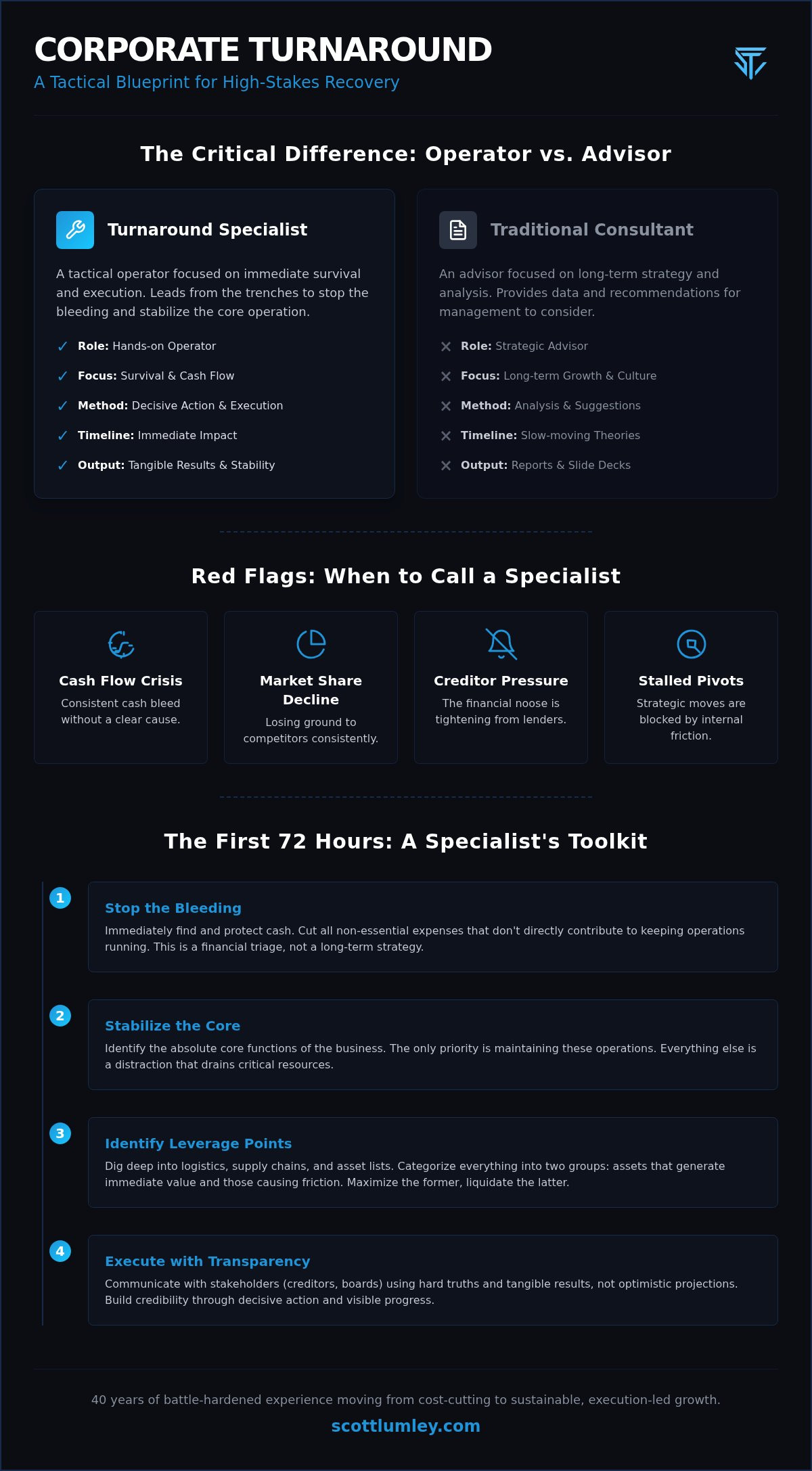
The difference between a consultant and a specialist is the difference between a weather reporter and a storm chaser. Consultants provide data; specialists provide movement. In a crisis, you don't need more analysis. You need decisive action. A corporate turnaround specialist takes the lead in environments where decisions must land with immediate impact. They don't offer suggestions for the board to consider. They execute a recovery plan that prioritizes cash flow and asset protection over everything else. The focus remains entirely on reducing operational friction and restoring leadership credibility through tangible wins.
When to Call a Turnaround Professional
Operational decay rarely happens overnight. It's a slow burn that suddenly turns into a flashover. You know it's time to call a professional when internal leadership can no longer provide objective clarity. Common signs include consistent cash flow issues, declining market share, and heavy creditor pressure. You might feel like every pivot is stalled by internal resistance. This is operational friction. It's the hidden cost of broken processes that your current team is too close to see. A specialist brings the sobering voice of reason needed to strip away the jargon and look at the real numbers. They lead from the trenches, utilizing decades of experience in manufacturing and logistics to navigate the harsh realities of a failing business.
The Turnaround Specialist’s Toolkit: Stabilizing High-Stakes Operations
The first 72 hours are a war zone. You don't have time for committees or consensus. A corporate turnaround specialist arrives to stop the bleeding immediately. This stage isn't about long term visions; it's about finding cash. We cut the motivational fluff and look at the ledger with cold eyes. If an expense doesn't keep the lights on or the machines running, it's gone. Stabilizing the core operation is the only priority. Everything else is a distraction.
Rapid deployment is the only way to save a distressed organization. Strategy is useless if it's not paired with execution. Stakeholders, especially creditors and boards, are usually on the verge of pulling the plug. They need to see movement. They need to see a professional who understands the urgency of corporate renewal professionals in a crumbling market. Transparency is your only currency here. You manage expectations by delivering hard truths and immediate results, not optimistic projections.
Identifying Leverage Points in Distressed Firms
In manufacturing and industrial sectors, the supply chain is often where the most friction hides. We dig into the logistics to find where value is leaking. This often involves using due diligence consulting services to uncover hidden liabilities that previous management missed. We categorize assets into two piles: those that generate immediate value and those that cause friction. The goal is to maximize the former and liquidate the latter to create liquidity. It's a clinical process of stripping the business back to what actually works.
Crisis Management and Operational Recovery
Operational recovery requires a gritty plan that prioritizes survival over optics. It doesn't matter how the company looks on social media if the payroll checks won't clear. This is where crisis management consulting differs from standard strategic planning. Standard planning assumes a stable environment; crisis management assumes the building is on fire. You make decisions in hours, not weeks. The stakes are too high for hesitation.
Rapid decision making is non-negotiable in manufacturing and retail. If a production line is costing more than it earns, you shut it down. If a retail location is a sinkhole for cash, you exit. A corporate turnaround specialist provides the objective clarity needed to make these hard calls. If you're facing this level of pressure, seeking experienced strategic planning can be the difference between a total collapse and a successful recovery.
Executing the Pivot: 5 Steps to Business Recovery
Recovery isn't a theory. It's a sequence of high-velocity decisions. You don't guess your way out of a crisis; you execute a proven framework. A corporate turnaround specialist uses a five-step process to transition a business from the brink of collapse to operational stability. This isn't about hope. It's about the mechanics of survival and the grit required to make hard choices when the stakes are highest.
Step 1: The Blunt Reality Check
Most CEOs fail to see the signs of a turnaround until the bank is calling. They're often too close to the problem to remain objective. They see "market challenges" where a specialist sees systemic failure. Bringing in an interim business consultant provides the sobering audit necessary to survive. This audit strips away the jargon to reveal the real numbers. We use industry-specific due diligence to find the operational bottlenecks that are strangling your cash flow and eroding your leadership credibility.
Step 2: Liquidity Protection. You can't fix a business without cash. This step involves aggressive cash management to stop the bleed immediately. We prioritize payments that keep the core engine running and freeze everything else. It’s a clinical process. We accelerate receivables, renegotiate vendor terms, and find immediate liquidity hidden in underperforming assets. If it doesn't keep the lights on or the machines moving, it isn't a priority.
Step 3: Restructuring for Speed, Not Just Size
Many leaders think downsizing is a turnaround strategy. It isn't. It's a stopgap. Real recovery requires tactical restructuring that removes operational friction from the core. We focus on leverage points on the industrial and manufacturing floor. If a process doesn't add value, it's friction. We eliminate the corporate fluff that slows down strategic execution. A corporate turnaround specialist ensures the organization is built for speed, not just a smaller version of its previous, failing self. We look for durability in the supply chain and efficiency in the labor force.
Step 4: Strategic Re-Alignment. Once the bleeding stops, we position the company for growth. This isn't about returning to the old way of doing things. It's about aligning the new, leaner operation with current market realities. We identify the assets and service lines that offer the highest margin and focus resources there. We look at the data, not the legacy of "how we've always done it."
Step 5: Sustainable Execution. The final step is handing back a resilient organization. We don't just fix the problem and leave. We install the systems and leadership structures needed to maintain the recovery. The result is a lean, battle-hardened business that understands its costs and respects its liquidity. We leave you with a blueprint for growth that is grounded in reality, not optimistic projections.
Industrial and Real Estate Turnarounds: Managing Complexity
Real estate and industrial assets aren't just entries on a balance sheet. They are moving parts, heavy machinery, and physical footprints that require a specific tactical blueprint. Unlike retail, where recovery might focus on brand repositioning, a property-heavy turnaround demands deep operational knowledge of construction, zoning, and capital structure. A corporate turnaround specialist enters these environments to manage complexity that would paralyze a generalist. They look for the value hidden in distressed assets while cutting the friction out of the recovery process. This is about physical assets and high-stakes logistics, not just digital spreadsheets.
Real Estate and Property Investment Advisory
Property firms facing financial retrenchment often struggle with more than just debt. They face project delays and cost overruns that bleed liquidity. Effective recovery requires real estate leadership advisory to identify which projects are viable and which are sinkholes. We look at everything from the Property Tax Debt System to investment recovery strategies. Leadership in the construction sector isn't about hope. It's about making hard calls on which developments to stall and which to push through to completion. We manage the expectations of creditors while ensuring the property tax debt system is utilized to protect your equity. It’s about protecting the portfolio from total collapse through decisive, high-stakes maneuvers.
Manufacturing and Logistics Recovery
Industrial sector recovery happens on the floor, not in the boardroom. We optimize the manufacturing floor by identifying exactly where friction is slowing down production. A corporate turnaround specialist understands that manufacturing isn't just about output; it's about the cost of every second of downtime. A battle-hardened approach to logistics focuses on the supply chain. We find the leaks. We stabilize firms without relying on the false promise of venture capital, which often brings more interference than value. Instead, we use four decades of hands-on experience to generate internal liquidity. We focus on the gritty reality of logistics: movement, storage, and distribution. We strip away the fluff to reveal the raw operational truth. This clinical focus on the logistics chain ensures that every dollar spent contributes directly to the recovery.
If your industrial or real estate firm is bleeding cash, you need an operator who has been in the trenches. Connect with a professional who understands strategic planning and tactical execution for high-stakes environments.
Scott Lumley: Execution-Led Strategy for Distressed Organizations
Survival and recovery are the mandatory foundations of sustainable growth. You can't scale an organization that's currently hemorrhaging cash and losing leadership credibility. Scott Lumley provides a sobering voice of reason for firms that have hit the wall. With four decades of hands-on experience in construction, manufacturing, and logistics, he understands that theory doesn't save businesses; execution does. This is a no-nonsense approach to business turnaround consulting that focuses on the harsh realities of the market rather than optimistic projections.
Transitioning from "crisis mode" to "growth mode" requires a strategic business advisor who has seen both extreme success and significant adversity. Scott doesn't offer polished marketing promises. He offers hard-won wisdom from the trenches. As a corporate turnaround specialist, his priority is to strip away the corporate fluff and identify the exact leverage points where your operation is failing. Once the core is stabilized, the focus shifts to building a leaner, more resilient organization capable of durable growth.
The Battle-Hardened Operator’s Perspective
Scott Lumley leads from the front. He doesn't sit in a theoretical boardroom waiting for reports; he navigates the operational storms of the industrial and property sectors alongside your team. This perspective is vital when dealing with complex construction delays or manufacturing friction. He prioritizes transparency and integrity over superficial appearances. In a high-stakes environment, the only thing that matters is the tangible outcome. If a process is slowing down the recovery, it's eliminated. If an asset is underperforming, it's restructured. This commitment to the truth ensures that every move made is centered on the next actionable step toward recovery.
Your Next Move: Stabilize and Scale
The first step toward recovery is a tactical audit. This isn't a standard financial review. It's a gritty, objective look at where your organization is losing movement. We identify the hidden liabilities and operational bottlenecks that are strangling your liquidity. By installing strategic safeguards and an execution-led strategy, we reduce business risk and restore the confidence of your creditors and board members. A corporate turnaround specialist provides the clarity needed to make decisive moves at high speed.
Stop waiting for the situation to improve on its own. It won't. You need a pragmatic strategist who values survival as much as expansion. Contact Scott Lumley to stabilize your operations today.
Stop the Bleeding and Rebuild for Durability
Recovery is a choice between continued decay and decisive action. You've seen how a corporate turnaround specialist moves beyond theoretical advice to provide immediate, tactical results. By focusing on the first 72 hours and stripping away operational friction, you can stabilize even the most distressed assets. It's about protecting liquidity and rebuilding a leaner, more resilient core that can actually withstand market volatility. This isn't about optimistic theories; it's about the gritty reality of saving a business when the stakes are highest.
Don't let indecision finish what the crisis started. With 40 years of industrial and real estate experience, Scott Lumley provides the no-nonsense, execution-led approach required to navigate high-stakes environments. We identify the specific friction points that stall your pivots and clear the path for sustainable recovery. You have the tools to survive; now you need the operator who leads from the trenches to execute the plan. The road back to profitability is paved with hard choices and tactical precision. Your business is too valuable to leave to chance. Secure a battle-hardened strategy for your business recovery.
Frequently Asked Questions
What is the difference between a business consultant and a turnaround specialist?
A consultant advises you on what might be wrong; a specialist takes the lead to fix it. Consultants deliver reports that often gather dust on a shelf. A corporate turnaround specialist enters the operation to reduce friction and stop the bleeding immediately. They don't just analyze data; they own the execution of the recovery plan. It's the difference between a weather reporter and a storm chaser. You need a battle-hardened operator who leads from the trenches.
How long does a typical corporate turnaround engagement take?
Stabilization usually happens within the first 30 to 90 days. However, a full recovery can take 12 to 18 months depending on the level of damage. The first 72 hours are about stopping the bleed and protecting liquidity. Once the core operation is steady, we move into tactical restructuring. We don't linger longer than necessary. The goal is to hand back a leaner, more resilient organization that doesn't need external support to maintain its recovery.
What are the first signs that my business needs a turnaround specialist?
Persistent cash flow issues and declining leadership credibility are the primary red flags. You might notice that every strategic pivot feels like wading through wet concrete. This is operational friction. When creditors start tightening terms and internal processes are breaking down, your current team is likely too close to the problem to remain objective. You need a battle-hardened operator to strip away the fluff and look at the raw numbers before the damage becomes terminal.
Can a turnaround specialist help avoid bankruptcy or liquidation?
Yes, by identifying internal liquidity and renegotiating stakeholder expectations before a filing becomes mandatory. A corporate turnaround specialist finds the value hidden in distressed assets. We prioritize aggressive cash management to stay out of court. Bankruptcy is a legal tool, but operational recovery is a business tool. We focus on the latter to protect your equity and keep the machines running without the crushing cost of a Chapter 11 process.
How does a turnaround specialist handle creditors and board members?
Through absolute transparency and the delivery of immediate, tangible wins. Creditors are looking for movement. Boards are looking for a return to stability. We manage these expectations by delivering hard truths and tactical updates. There's no room for optimistic projections here. We use strategic planning and crisis management to restore trust. When stakeholders see a professional taking decisive action, the pressure usually shifts from liquidation to supporting the recovery plan.
What industries do you specialize in for corporate recovery?
My experience covers four decades in construction, manufacturing, retail, and logistics. These sectors share a common thread of complex physical assets and high-stakes logistics chains. Whether it's managing property tax debt systems for a real estate firm or optimizing a manufacturing floor, the principles of recovery remain the same. We focus on industrial and property firms where operational friction has the most devastating impact on the bottom line and survival is the only priority.
Do you provide interim leadership as part of the turnaround process?
Yes, leadership consulting is a core part of the recovery blueprint. We don't just offer advice from the sidelines. We lead from the front to ensure the tactical plan is executed with precision. This often involves taking the lead in high-stakes environments where decisions must land with immediate impact. We provide the steady hand needed to move an organization from crisis mode into a sustainable growth phase while training your team to maintain those gains.
What is the cost of hiring a corporate turnaround specialist?
Compensation typically involves a structure tailored to the urgency and complexity of the distressed organization. Most specialists utilize a combination of fixed fees and success-based incentives tied to specific recovery milestones. The cost reflects the high-stakes nature of the work and the four decades of experience required to navigate a crisis. Hiring a specialist is an investment in protecting your remaining assets and ensuring the business survives to see another year of sustainable growth.


