

Most development projects don't fail because of bad math; they fail because of friction on the job site that no spreadsheet predicted. You've likely felt the weight of a project grinding to a halt while interest rates for industrial assets sit between 6.76% and 7.06%. It's frustrating to receive polished reports from consultants that offer zero utility when a site goes dark or costs escalate. You're looking for a way to protect your capital and keep the machines moving. You need a partner who understands that theory doesn't pour concrete.
This is where execution-led commercial real estate development advisory changes the game. I'm going to show you how to navigate complex property cycles and neutralize operational friction with the direct, high-stakes guidance of a veteran who's spent forty years in the trenches. We'll explore how to reduce risk through expert due diligence, capitalize on the permanent 100% bonus depreciation under the OBBBA, and build strategic blueprints that drive sustainable growth for your property portfolio. This isn't about optimistic projections. It's about the hard-won wisdom required to survive and scale in a high-stakes market.
Key Takeaways
- Understand why commercial real estate development advisory must be an active partnership in risk management rather than a passive oversight service.
- Identify the "silent killers" of development, such as operational friction and silos, that cause projects to stall despite sound financial modeling.
- Learn to interrogation assets through execution-led due diligence, evaluating the teams and processes that actually drive site performance.
- Discover how to transition from a fee-for-service consulting model to a value-for-leverage approach that prioritizes immediate, actionable moves.
- Build a resilient property portfolio by applying leadership consulting strategies that focus on organizational grit and process over mere land and buildings.
Defining Commercial Real Estate Development Advisory in 2026
Stop thinking of advisory as a passive resource or a luxury for large-scale firms. In 2026, the market doesn't have room for "big box" firms that deliver 200-page reports and then disappear when the first shovel hits the dirt. True commercial real estate development advisory is an active partnership in risk management. It's about sitting in the trenches and making high-stakes decisions alongside the owner. The industry is shifting toward specialized operators who understand the real estate development process from the ground up, not from a textbook. This shift from passive oversight to execution-led leadership is a response to a volatile economy where every delay costs thousands in interest.
The core components of this new model are feasibility, strategic planning, and operational due diligence. It's no longer enough to look at a spreadsheet and assume the numbers will hold. You have to account for the friction of site logistics, labor shortages, and regulatory hurdles before they stall your progress. This isn't just about identifying what might go wrong. It's about building the infrastructure to ensure things go right.
The Operator vs. The Consultant
A consultant tells you what the problem is. An operator solves it. Lived experience in construction and manufacturing carries a weight that theoretical degrees can't match. When a site stalls because of a supply chain break or a labor shortage, you don't need a summary of the issue. You need a blueprint for execution. Battle-hardened wisdom identifies the operational friction that even the most advanced software misses. It's the difference between a generic checklist and a deep interrogation of the asset. We're moving away from sterile theory and toward the gritty reality of site management. If your advisor hasn't seen a project fail, they don't know how to make one succeed.
The 2026 Development Landscape
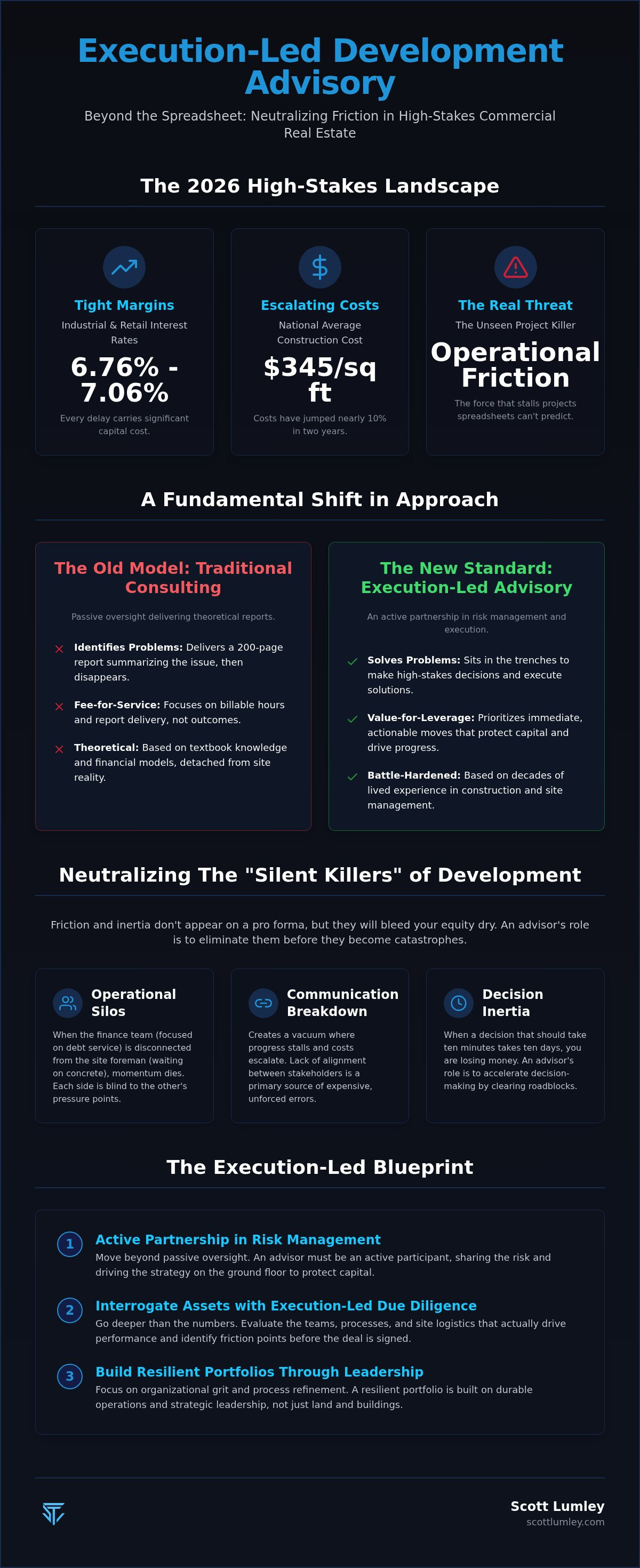
Margins are tighter than ever. With retail and industrial rates hovering between 6.76% and 7.06%, precision is the only way to survive. Technology provides the data, but humans provide the strategy. Sustainable scaling in this environment requires more than just capital; it requires organizational grit. You're navigating a field where construction costs have climbed to a national average of $345 per square foot. Every move must be calculated. Every risk must be mitigated through rigorous strategic planning and operational due diligence. This landscape rewards those who prioritize durability over hype. It's about finding the leverage points that turn a struggling asset into a growing portfolio.
Navigating Operational Friction in Complex Development Projects
Friction and inertia are the silent killers of commercial development. They don't appear on a pro forma, but they'll bleed your equity dry. Projects often stall because of operational silos. The finance team is staring at debt service coverage ratios while the site foreman is waiting for a concrete delivery that’s three days late. Neither side understands the other's pressure points. This lack of alignment creates a vacuum where momentum goes to die. When communication breaks down, costs escalate. In a market where construction costs have jumped nearly 10% in two years, you can't afford a single day of stagnation.
Effective commercial real estate development advisory bridges this gap. It's about accelerating the speed of decision-making. If a decision that should take ten minutes takes ten days, you're losing money. An advisor acts as the grease in the gears, ensuring that communication flows and roadblocks are cleared before they become catastrophes. This is about strategic stabilization. It's about identifying exactly where the gears are grinding and applying the necessary force to get them turning again.
Crisis Management in Real Estate
When a project hits a wall, the first 72 hours are everything. You need strategic stabilization, not a committee. This is the moment to interrogate the asset using analytical tools and case studies to determine if the project is still viable. Recognizing a distressed asset before it hits the balance sheet is the difference between survival and total loss. Leveraging specialized crisis management consulting allows you to protect your equity by making the hard pivots that others are too afraid to suggest. It's about triage. You stabilize the bleeding, then you fix the wound.
Turnaround Strategies for Stalled Projects
Restoring viability to a stalled project requires more than just a fresh injection of cash. It requires a total restructuring of operations. You have to cut the fat without compromising the structural integrity of the deal. This is where the role of a business turnaround consultant becomes essential in property development. It's about identifying the specific leverage points that will get the project moving again. If you're feeling the weight of operational friction, it's time to move toward a model of execution-led advisory that prioritizes recovery over theory.
Advisory vs. Traditional Consulting: A Strategic Comparison
Consultants provide autopsies. They look at what happened, bill you for the hours spent looking, and hand over a report that confirms your project is in trouble. Commercial real estate development advisory is different. It's a forward-looking partnership. It doesn't focus on the "fee-for-service" model that incentivizes slow movement and endless billable cycles. Instead, it operates on a "value-for-leverage" basis. The goal is to identify the single move that unlocks the most progress. In high-stakes environments, you don't need someone to describe the fire. You need someone who knows where the extinguisher is and how to use it.
Large "big box" firms often prioritize their own overhead over your project outcomes. They assign junior associates to manage complex industrial assets, relying on templates that don't account for real-world friction. This sterile approach fails when things get gritty. A direct, no-nonsense advisor leads from the trenches. They value survival and recovery as much as expansion. If an advisor hasn't navigated a market crash or a construction crisis, their advice is just theory. In 2026, theory is a liability you can't afford. You need a partner who understands that a 4.60% Treasury yield means your cost of capital is too high for mistakes.
Choosing Your Leverage Point
There's a time for technical experts, like geotechnical engineers or tax accountants. But a technical expert isn't a strategic leader. Generic advice in a specialized market leads to stagnation. You need to know when to stop hiring for specific tasks and start hiring for leverage. This is why real estate leadership advisory acts as a force multiplier. It aligns the technical pieces with a cohesive execution strategy. It ensures that every dollar spent on due diligence actually moves the needle toward completion. It's about finding the leverage point that turns a stalled site back into a productive asset.
The Myth of the "One-Size-Fits-All" Solution
Standard "best practices" often crumble when applied to unique commercial environments. What works for a suburban office park won't work for a high-density industrial conversion. Templated consulting reports are designed for safety, not for speed or profit. You need a customized blueprint built on lived experience. According to resources from the Commercial Real Estate Development Association, the industry is increasingly moving toward integrated, strategic models. A strategist who has navigated both extreme success and significant adversity understands that every deal has its own pulse. They don't give you a template. They give you a path through the noise.
Execution-Led Due Diligence: Identifying Risk Before the Deal
Due diligence isn't a passive checklist. It's an interrogation of the asset. Most firms focus exclusively on the balance sheet and ignore the operations. That's a fatal mistake. In manufacturing and industrial real estate, the real friction is often hidden in the workflow or the team's inability to handle pressure. If the people behind the concrete can't execute, the math doesn't matter. You need to know if the project team has the grit to handle a multi-year development cycle. This is the core of execution-led commercial real estate development advisory.
Operational due diligence evaluates the teams and processes that actually move the project forward. It identifies hidden liabilities in manufacturing sites that a standard audit misses. If a project is already underperforming, you need to know why before you commit capital. Strategic planning isn't something that happens after the deal is done. It's the natural conclusion of a successful due diligence phase. It provides the blueprint for survival and growth in a market where construction costs have reached a national average of $345 per square foot.
Risk Mitigation Beyond the Balance Sheet
Spotting operational red flags requires a trained eye. You're looking for signs of organizational decay or project teams that lack resilience. Evaluating the "grit" of a team is just as important as evaluating the soil. In the industrial sector, hidden liabilities can include anything from specialized equipment failure to supply chain bottlenecks. Using specialized due diligence consulting services allows you to uncover these liabilities before they become your problem. It's about seeing the friction points that don't show up in a sanitized report.
Strategic Planning for Development Firms
Building a blueprint for 2026 requires accounting for market volatility. You're dealing with high stakes and tight margins. Leadership in construction means managing complex, multi-year projects with absolute precision. You must integrate specialized tools like the Property Tax Debt System into your broader investment strategy. This system provides a leverage point for managing distressed assets that traditional advisors often ignore. If you want to protect your capital and ensure project viability, you need an execution-led strategic plan that prioritizes reality over theory.
Leadership Consulting: Building Resilient Property Portfolios
Real estate is a business of people and processes. Land and buildings are merely the static outcomes of human execution. If your team lacks the organizational grit required to navigate complex property cycles, your portfolio is at risk. Mid-size development firms often hit a ceiling where their original systems fail under the weight of new projects. This is where leadership consulting services become a necessity rather than an option. You need more than just a project manager. You need a strategist who can identify where your internal culture is creating operational drag.
The final takeaway of any commercial real estate development advisory engagement is simple. My job is to ensure you don't just build structures. I want you to build a resilient, thriving business. This means moving beyond the sterile theory of management books and into the reality of high-stakes leadership. It's about survival, recovery, and eventual dominance. If your leadership isn't as durable as the concrete you're pouring, the project is already in trouble.
The Battle-Hardened Approach to Growth
Scaling a development firm without breaking the operational core is a delicate balance. Most businesses fail during expansion because they lose sight of the friction points that were manageable at a smaller scale. You must transition from project-to-project survival to a model of sustainable expansion. This requires a strategic business advisor who has lived through the volatility of the market. They act as a sobering voice of reason when optimism threatens to cloud your judgment. They help you build the systems that allow for growth without sacrificing the integrity of the deal. They identify the weaknesses in your process before the market exposes them.
Next Steps: From Friction to Execution
Identifying the need for an external audit is the first step toward recovery. If your projects are consistently behind schedule or your margins are shrinking due to unforeseen operational friction, your current leadership model isn't working. A no-nonsense, direct consultation for your next project provides a clear strategic blueprint. It strips away the fluff and focuses on the next actionable move. You don't need a cheerleader. You need an authoritative expert who leads from the trenches. Stop managing friction and start leading your development. The difference between a stalled project and a successful exit is the speed and clarity of your execution.
From Friction to Execution: Leading Your Next Development
The days of passive oversight are over. If you want to survive a market where construction costs have climbed to $345 per square foot, you need more than a report. You need execution-led commercial real estate development advisory. We've seen how operational friction and silos kill momentum. True due diligence is an interrogation of the team and the process, not just a financial checklist. Strategic leadership is the only way to build a resilient portfolio that survives complex property cycles.
Don't let your next project stall in the gap between theory and reality. You need a partner who leads from the trenches with 40 years of high-stakes experience in construction and manufacturing. It's time to stop managing friction and start driving results. Get the direct, no-nonsense guidance required to navigate the harsh realities of property development. You've got the assets. Now, get the grit to see them through to completion.
Secure Your Strategy: Contact Scott Lumley for Execution-Led Advisory
Frequently Asked Questions
What is the difference between a development consultant and a development advisor?
A development consultant typically provides a technical report or a post-mortem analysis of project data. In contrast, commercial real estate development advisory acts as an active partnership in risk management. Advisors don't just identify problems; they provide the strategic leadership required to solve them. You're hiring for lived experience and execution-led blueprints rather than theoretical oversight. It's the difference between someone who describes the fire and someone who knows how to put it out.
When is the best time to hire a commercial real estate development advisory firm?
The best time to hire an advisor is during the feasibility stage or immediately when operational friction begins to stall progress. Waiting until a project is in total crisis often leads to equity loss that could've been avoided. Early intervention allows for a more rigorous interrogation of the asset and the team. If you're feeling the weight of high interest rates or supply chain inertia, you've already waited too long to seek strategic guidance.
How does development advisory help with distressed property assets?
Advisory helps with distressed assets by providing immediate strategic stabilization. We look past the balance sheet to identify the specific operational failures causing the distress. This involves restructuring processes, restoring project viability, and identifying leverage points for recovery. It's not about optimistic projections; it's about the harsh reality of turnaround management. We focus on protecting your capital and ensuring the asset doesn't bleed your portfolio dry during a complex property cycle.
Can an advisor help with industrial real estate and manufacturing facilities?
Yes, specialized expertise in industrial real estate and manufacturing is a core component of this service. With forty years of hands-on experience in construction and manufacturing, the advisory understands the unique friction points of these sectors. We evaluate site logistics, equipment workflows, and labor resilience. Most generic firms don't understand the gritty reality of a manufacturing floor. We do. This ensures your industrial development is built on a foundation of operational efficiency.
What should I look for in a real estate strategic planning partner?
Look for a partner who has navigated both extreme success and significant adversity. You don't want a cheerleader; you want a battle-hardened operator who leads from the trenches. Prioritize lived experience in construction and manufacturing over theoretical degrees. Your partner should value transparency and integrity above polished marketing promises. They must be able to provide a clear strategic blueprint that accounts for the current market landscape and the rising costs of commercial construction.
How does operational due diligence differ from financial due diligence?
Financial due diligence is an audit of the numbers, while operational due diligence is an interrogation of the people and processes. Financials tell you what the project costs, but operational due diligence tells you if the team can actually execute. We look for organizational decay, team grit, and site-level friction that a spreadsheet misses. Understanding the human and mechanical infrastructure behind the concrete is just as critical as verifying the debt service coverage ratio.
Does Scott Lumley provide legal or tax filing services for developers?
No, Scott Lumley does not provide legal representation or CPA and tax filing services. The focus is strictly on commercial real estate development advisory, strategic planning, and leadership consulting. While we work alongside your legal and financial teams to ensure project success, we don't handle filings or litigation. You should always consult with licensed legal and accounting professionals for those specific needs. Our role is to provide the operational strategy that those technical experts often lack.
How does the Property Tax Debt System integrate with development advisory?
The Property Tax Debt System is a specialized leverage point used within a broader investment strategy. It's specifically designed to help organizations manage distressed property assets and navigate complex tax obligations that threaten project viability. By integrating this system into your strategic plan, you can recover value from underperforming portfolios. It's a pragmatic tool for turnaround management that focuses on survival and recovery rather than just expansion. It turns a liability into a manageable operational move.


