

Most business growth strategies are expensive hallucinations. They look perfect on a slide deck but crumble the moment they hit the friction of a real-world job site or a complex supply chain. If your expansion has stalled, it's rarely because you lack a vision. It's because your operations can't handle the heat of high-stakes execution. This is the reality that standard business growth consulting often ignores while charging you for sterile theory.
You're likely tired of advisors who've never managed a crisis, met a payroll, or run a complex P&L. You need more than a cheerleader. You need a roadmap that accounts for the grit of daily operations and the reality of high-stakes environments. We agree that strategy without execution is just expensive noise. This guide shows you how to strip away operational friction and build a foundation for sustainable revenue growth. We'll preview the exact steps to stabilize your leadership, secure your assets, and move from theoretical plans to actionable results that actually move the needle during a turnaround or expansion.
Key Takeaways
- Learn how execution-led business growth consulting identifies and removes the operational friction that kills expansion plans.
- Discover why you must stabilize your foundation in the "Recovery Zone" before attempting to scale a high-stakes operation.
- Identify the hidden leaks in your current business model that drain resources and compromise your long-term stability.
- Maximize the value of your existing physical assets, including real estate and equipment, to fund sustainable growth.
- Understand why a battle-hardened operator's perspective provides more value than theoretical strategy when the stakes are high.
What is Business Growth Consulting and Why Does it Fail?
Most leaders mistake business growth for a marketing problem. They believe more leads and a polished brand will solve their stagnation. They're wrong. True business growth consulting isn't about fluff or motivational speeches; it's about the strategic removal of operational friction. If your foundation is cracked, pouring more revenue into the system won't help. It will just accelerate the collapse. This is why most growth initiatives fail within the first 12 months. They focus on the "what" while ignoring the "how."
In mid-market industrial and real estate operations, the stakes are too high for guesswork. You aren't just managing a digital storefront; you're managing physical assets, complex supply chains, and large teams. One misstep in logistics or a failure in leadership during a transition can wipe out years of equity. Traditional consulting models fail because they rely on sterile theory. They offer slide decks that look great in a boardroom but crumble the moment they hit the floor of a manufacturing plant or a construction site.
The Difference Between Growth and Scaling
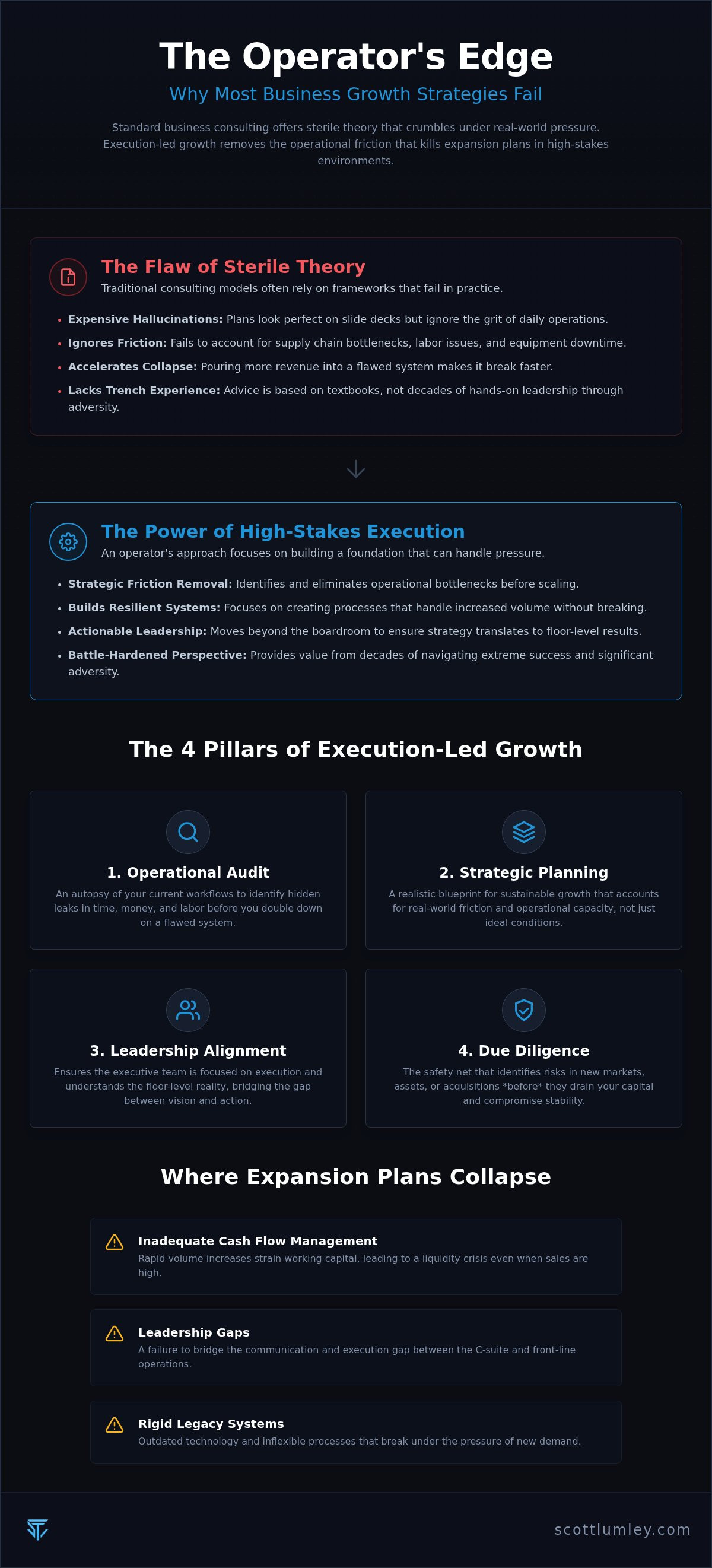
Growth is easy; scaling is hard. You can grow revenue by simply working harder or spending more, but you scale by building systems that handle volume without breaking. When revenue outpaces your operational capacity, you hit a wall. In manufacturing and logistics, these friction points appear as supply chain bottlenecks, labor inefficiencies, and equipment downtime. Operational friction is the gap between strategic intent and floor-level execution. Without a blueprint that accounts for these realities, expansion is just a faster way to go broke. Common failure points include:
- Inadequate cash flow management during rapid volume increases.
- Leadership gaps that fail to bridge the distance between the office and the field.
- Rigid legacy systems that break under the pressure of new demand.
- Lack of real-world due diligence before entering new markets or asset classes.
Why Industry Experience is Non-Negotiable
Generalist consultants love their frameworks. They've spent their lives in climate-controlled offices, far away from the grit of a manufacturing floor or the chaos of a recovery operation. They offer advice based on textbooks rather than the trenches. Real business growth consulting requires an operator's eye to spot the leaks that an MBA would miss. You don't need a cheerleader. You need a strategist who has spent four decades navigating both extreme success and significant adversity.
Moving beyond slide decks requires a deep commitment to transparency and integrity. It means identifying the harsh realities of your business rather than chasing optimistic theories. Actionable leadership means moving beyond the boardroom and into the heart of the operation to ensure every move is backed by durability and experience. When the stakes are high, you don't hire a coach; you hire an operator who knows how to lead from the front.
The Core Pillars of High-Stakes Business Growth Consulting
Effective business growth consulting rests on four distinct pillars: an operational audit, strategic planning, leadership alignment, and due diligence. You can't build a skyscraper on a swamp. Most leaders skip the audit and rush straight into expansion. They ignore the hidden leaks in their business model until the pressure of growth turns a small crack into a catastrophic failure. An operational audit identifies where your time, money, and labor are being wasted before you double down on a flawed system. It is an autopsy of your current workflows to ensure they are fit for purpose.
Strategic planning is your blueprint. It must account for real-world friction, not just ideal conditions. Due diligence is the safety net. It identifies risks in new markets or acquisitions before they drain your capital. Finally, leadership alignment ensures your executive team isn't just selling a vision. They must be focused on execution. If the C-suite doesn't understand the floor-level reality, the strategy is dead on arrival. You need a partner who understands these pressures from decades spent in the trenches.
Operational Resilience in Industrial Sectors
In manufacturing and logistics, throughput is everything. If your floor isn't optimized for maximum output, growth will erode your margins. Streamlining logistics is about more than just moving parts; it's about ensuring your supply chain can handle increased demand without collapsing. This level of execution is the hallmark of a strategic business advisor who prioritizes results over theory. You don't need more software. You need better movement. You need resilience that holds up when the volume spikes and the stakes are at their highest.
Strategic Leadership for Property and Real Estate
Real estate development is a high-stakes game defined by long cycles and massive capital requirements. Navigating these cycles requires expert advisory that goes beyond simple brokerage. For industrial and commercial property investors, portfolio optimization is the difference between an asset and a liability. Leadership consulting plays a critical role here. It ensures that high-stakes construction projects remain on track and under budget. You're managing risk as much as you're managing property. Durability comes from making hard decisions early, based on grounded data rather than optimistic projections. Stop hoping for growth and start building the infrastructure to support it.
Growth vs. Turnaround: Stabilizing the Foundation First
Scaling a business that is currently in a tailspin is a death sentence. You can't out-earn fundamental operational failure. If your cash flow is negative or your leadership is fractured, growth will only accelerate your bankruptcy. Many executives hire for business growth consulting when they actually require a business turnaround consultant. Understanding the difference between needing a coach and needing a crisis manager is the first step toward survival.
The "Recovery Zone" is where the real work happens. In high-stakes operations, you often have a 72-hour window to stabilize cash flow and stop the bleeding. This isn't the time for five-year plans or branding exercises. It's about immediate, decisive action to preserve assets. You need to identify the signs that your business is failing. Are your margins shrinking despite higher revenue? Is employee turnover at an all-time high? If the answer is yes, you're in a turnaround situation. Once the foundation is level and the bleeding has stopped, you can begin the pivot toward sustainable expansion.
The First 90 Days of Business Recovery
Stabilization must precede growth. During the first 90 days, the focus shifts entirely to operational recovery. For distressed industrial firms, this means tightening supply chains and securing physical assets. You don't launch new products while your manufacturing floor is hemorrhaging money. Crisis management tactics involve aggressive due diligence and immediate leadership consulting to reset expectations across the board. This phase is about grit and resilience. Only after the operations are steady do you reintroduce the concept of scaling.
Restructuring for Future Scaling
Successful turnarounds set the stage for exponential growth by trimming the fat. You must remove low-margin services and legacy products that no longer serve the core mission. This often requires a hard look at the org chart. Rebuilding the leadership team for a post-crisis environment is essential. You need operators who can handle pressure, not just visionaries who like the idea of success. When you strip away the friction, the business becomes lighter and more responsive. This lean structure is what eventually allows for business growth consulting to deliver measurable results. You aren't just surviving anymore. You're building a platform that can finally handle the weight of expansion without cracking under the pressure.
Strategic Planning: Building a Blueprint for Sustainable Growth
Strategic planning isn't a collection of vague goals. It's a blueprint for survival and expansion. In a crowded industrial landscape, finding your "right to win" requires more than just a better product. It requires a superior operational model. This is the core of business growth consulting that actually delivers. We focus on asset optimization. We make your existing real estate and equipment work harder. If a machine isn't running at peak efficiency, it's a liability. If a property isn't generating maximum yield, it's a drain. You don't grow by doing more of the same; you grow by making what you have more effective.
Risk mitigation is the safeguard that prevents overextension. Many businesses collapse because they chase revenue without accounting for the increased strain on their infrastructure. You need to build "kill switches" and safety nets into your growth plan. Execution monitoring turns these high-level strategies into a daily operational checklist. If your floor managers don't know what the growth plan means for their shift today, you don't have a strategy. You have a daydream. Real growth is measured in daily increments of improved throughput and reduced waste.
Developing a Gritty Growth Roadmap
You need a roadmap that survives the first contact with reality. This isn't about optimistic projections; it's about hard data and honest assessments. Follow these three steps to build a foundation for expansion:
- Step 1: Conduct a brutal assessment of current operational capacity. Most owners overestimate their team and their systems. You need the hard truth about your limits before you try to push past them.
- Step 2: Identify high-leverage growth opportunities in your specific sector. Don't chase every lead. Chase the ones that fit your existing infrastructure and provide an unfair advantage over the competition.
- Step 3: Allocate capital to assets that drive immediate ROI. Growth requires fuel. Ensure your cash is going where it creates the most heat and drives the fastest recovery of capital.
Due Diligence and Acquisition Strategy
Acquisition is a fast track to growth, but it's also a minefield. Many firms buy for financial gain but fail because of poor operational fit. Use due diligence consulting services to uncover the hidden liabilities that the sellers are trying to hide. You're looking for operational friction, not just bad debt. Integrating new assets requires a steady hand to avoid disrupting your existing cash flow. You scale by adding strength, not by inheriting someone else's mess. Start building your strategic planning blueprint with an operator who knows how to execute under pressure.
The Operator’s Edge: Why Hands-On Consulting Wins in 2026
In 2026, the marketplace doesn't reward potential; it rewards results. When the stakes are high, you don't need a consultant who memorized a textbook. You need an operator who has survived the storm. Most business growth consulting firms sell "best practices" that haven't been tested in a crisis. They offer data-driven science without the hard-won wisdom of the trenches. Real-world experience matters because it accounts for the human element and the mechanical failures that spreadsheets ignore. Integrity and transparency are non-negotiable in high-stakes advisory. If your consultant is afraid to tell you your operations are broken, they are a liability, not an asset. You need a sobering voice of reason, not a cheerleader.
A fractional business advisor provides rapid deployment leadership for SMBs that need elite strategic planning without the overhead of a full-time executive. This isn't about giving advice from the sidelines. It's about stepping into the friction and moving the needle immediately. We've navigated both extreme success and significant adversity, providing a level of pragmatic strategy that generalist firms can't match. Growth is not a goal you chase; it's the reward for operational excellence. When you fix the foundation and eliminate the waste, expansion becomes a natural, sustainable byproduct.
Execution Over Sterile Theory
We've seen enough motivational fluff to last a lifetime. Scott Lumley focuses on tangible outcomes and durable results that survive real-world pressure. In manufacturing and construction, theory doesn't move equipment or manage labor. Hard-won operational wisdom is the only currency that matters when the deadline is looming and the margins are tight. A "no-nonsense" approach means we identify leverage points quickly and act decisively. We don't hide behind jargon or polished marketing promises. We define the service by what it achieves on the floor, prioritizing movement and recovery over superficial appearances.
Next Steps: Securing Your Business Growth
Identifying if your business is ready for a strategic growth partner is a matter of looking at your operational friction. If your expansion is stalled, your leadership is inefficient, or your transitions are causing instability, it's time for an operator's perspective. The consultation process moves quickly from identifying your specific pain point to establishing a clear, actionable leverage point for recovery or growth. This is a high-level briefing designed for speed and clarity. Explore our leadership consulting services to begin organizational restructuring and secure your future. Stop managing the chaos and start leading the execution.
Execute Your Operational Blueprint
Most expansion plans fail because they're built on optimistic theories rather than operational grit. You've learned that sustainable growth requires more than just a vision; it demands a stable foundation and the strategic removal of friction. High-stakes industrial and real estate sectors don't have room for error. They require an operator's eye to spot the leaks that compromise your equity and slow down your momentum.
Effective business growth consulting isn't a slide deck. It's a daily operational checklist. It bridges the gap between strategic intent and floor-level execution. Scott Lumley brings four decades of operational experience in construction, manufacturing, and logistics to ensure your strategy survives real-world pressure. This is execution-led leadership that prioritizes durable results over motivational fluff. It's about moving from theoretical recovery to measurable expansion.
The reward for operational excellence is long-term stability and revenue growth. Stop managing the chaos and start building a legacy that lasts. Build your future on hard-won wisdom and a commitment to integrity.
Secure your operational future with Scott Lumley’s business growth consulting.
Your operation is either scaling or stagnating. Make the move that ensures your survival and secures your next level of success.
Frequently Asked Questions
What exactly does a business growth consultant do?
A business growth consultant identifies the operational friction that stalls expansion and builds an execution-led roadmap to fix it. They don't just offer marketing advice or theoretical frameworks. Instead, they focus on throughput, asset optimization, and leadership alignment. By bridging the gap between strategic intent and floor-level reality, they ensure your business can handle increased volume without breaking. It's about creating a durable system that delivers measurable revenue results.
How is growth consulting different from traditional business coaching?
Traditional business coaching often focuses on mindset and motivational fluff. In contrast, business growth consulting is grounded in the gritty reality of operations and strategic execution. Consultants are battle-hardened operators who lead from the trenches rather than passive advisors. They provide actionable checklists and blueprints for expansion. You aren't paying for a cheerleader; you're paying for a pragmatist who understands how to stabilize and scale a real-world business.
When is the right time to hire a turnaround management consultant?
You hire a turnaround consultant when your business is in a tailspin or the foundation is cracked. Signs include shrinking margins despite high revenue, negative cash flow, or fractured leadership. If you try to grow a distressed business, you'll only accelerate its collapse. Turnaround management provides the crisis management needed to stabilize assets in the first 72 hours. Once the bleeding stops, you can pivot back to a growth-oriented strategy.
Can a consultant help with real estate and property investment strategy?
Expert advisory is essential for navigating complex real estate development and property investment cycles. Scott Lumley provides specialized Real Estate Advisory for industrial and commercial property investors. This includes portfolio optimization and leadership consulting for high-stakes construction projects. Whether you're managing physical assets or looking for strategic planning in property sectors, an operator's perspective ensures you identify risks before they become catastrophic financial failures.
How do you measure the success of a business growth strategy?
Success is measured through tangible outcomes like sustainable revenue growth and operational stability during transitions. We look at specific data points such as increased throughput, improved profit margins, and the removal of supply chain bottlenecks. A successful strategy creates a roadmap that survives real-world friction. If your executive team is focused on execution and your systems remain durable under pressure, the consulting engagement has delivered its promised ROI.
What industries does Scott Lumley specialize in for growth consulting?
Scott Lumley specializes in construction, manufacturing, logistics, and retail. These sectors require a deep understanding of physical assets and complex supply chains. With four decades of hands-on experience, he provides an authoritative expert voice that generalists can't replicate. His background allows him to lead from the trenches, offering pragmatic strategies for mid-market industrial firms that are navigating transitions, turnarounds, or rapid national expansion.
Does growth consulting include due diligence for acquisitions?
Yes, due diligence is a critical component of any growth strategy involving acquisitions. It goes beyond financial audits to uncover hidden operational liabilities and friction points. This process ensures that a new asset or company is a strategic fit for your existing business model. By identifying risks early, you avoid inheriting someone else's mess. It's about integrating new assets without disrupting your current cash flow or stability.
How long does a typical business turnaround process take?
The stabilization phase of a business turnaround typically happens within the first 72 hours to 90 days. This immediate "Recovery Zone" focuses on stopping the bleeding and securing assets. While the full transition to sustainable expansion may take longer, the most critical crisis management tactics are deployed rapidly. The goal is to level the foundation quickly so the business can move from survival mode back into a strategic growth phase.


