

Most business strategies don't fail because of a lack of vision. They fail because they can't survive the brutal reality of the warehouse floor or the logistics hub. You've likely seen this play out. You invest in expensive automation that promises a massive ROI, yet your team is still relying on manual workarounds just to keep pace. When complexity outgrows leadership, a battle-hardened operational efficiency consultant is often the only way to stop the friction from bleeding your cash flow dry.
It is a high stakes position, but it's one that can be corrected with a focus on results over rhetoric. Polished slide decks don't solve manufacturing bottlenecks or stabilize distressed assets. You need a no-nonsense approach that prioritizes the trenches over the boardroom. This article explains how to identify the hidden friction points that stall turnarounds and prevent scaling. We'll examine the exact blueprint for removing bottlenecks, stabilizing your operations, and securing predictable growth through real-world execution rather than abstract theory.
Key Takeaways
- Learn why an operational efficiency consultant focuses on removing real-world friction rather than delivering theoretical slide decks.
- Discover why software investments often fail and how the "Operator’s Rule" fixes processes before you spend a dime on an ERP.
- Identify the "Growth Paradox" in manufacturing and logistics to prevent scaling from turning into operational debt.
- Master a 5-step audit framework that begins with triaging the immediate bleeding points in your P&L.
- Understand why 40 years of trench-tested experience is the only way to stabilize distressed assets and ensure long-term recovery.
What Does an Operational Efficiency Consultant Actually Do?
An operational efficiency consultant isn't there to hand you a 50-page binder of "best practices" and walk away. They are friction-removers. They look for the specific places where your money, time, and talent are getting stuck in the gears. Most consultants act like sterile academics. They analyze data from a safe distance and offer polished theories. A battle-hardened operator does the opposite. They get into the trenches to see why the loading dock is backed up or why the assembly line keeps stalling. It's about movement, not just measurement.
There's a critical difference between "growth at any cost" and "efficient scaling." Growth at any cost is a suicide mission. It hides waste under a layer of new revenue until the weight eventually collapses the business. Efficient scaling ensures that every new dollar of revenue doesn't require two dollars of operational overhead. As a strategic business advisor, the goal is to stabilize a crumbling foundation before you try to build more floors. You can't scale chaos. You have to fix the engine while the truck is still moving.
The Difference Between Efficiency and Excellence
Efficiency is a mathematical reality. It's the ratio of what you put in versus what you get out. Excellence is the subjective outcome. If you chase "excellence" without fixing your efficiency, you're just burning out your best people to cover up broken systems. High-performing teams often mask deep operational flaws through sheer effort. This isn't sustainable. The consultant’s job is to identify the hidden leaks in the P&L. These aren't always massive line items. They are the small, repetitive failures that happen every hour of every day, slowly draining your margins.
When to Hire an External Operator
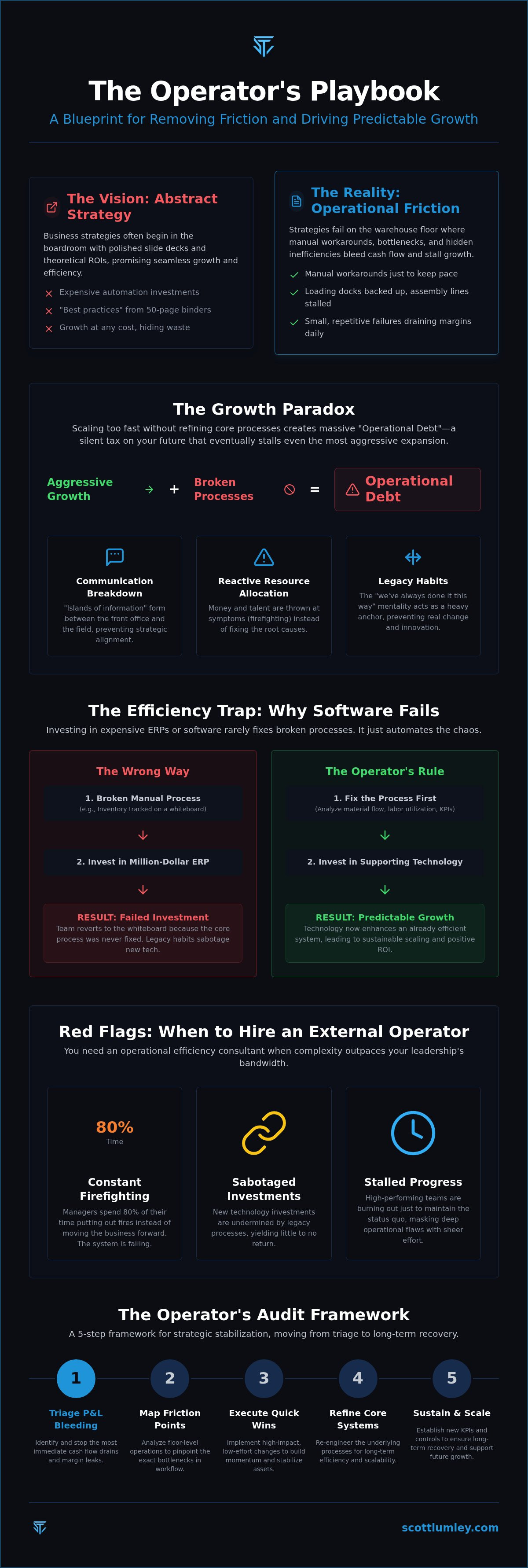
You hire an operational efficiency consultant when your complexity has outpaced your leadership’s bandwidth. If your managers spend 80% of their time putting out fires instead of moving the needle, the system is failing. Another red flag is when legacy processes sabotage new technology investments. If you buy a million-dollar ERP but your team still tracks inventory on a whiteboard, you don't have a tech problem. You have an operations problem. An external operator provides the neutral, experienced perspective needed to make high-stakes decisions without the baggage of internal politics or "the way we've always done it."
Identifying the Friction: Where Mid-Market Operations Break Down
Mid-market industrial operations rarely die from a lack of opportunity. They die from internal drag. This is the "Growth Paradox." Scaling too fast without refining your core processes creates massive operational debt. Every new contract adds weight to a system that's already buckling. An operational efficiency consultant sees this debt for what it is: a silent tax on your future. It's the cumulative cost of legacy habits and misaligned resources that eventually stalls even the most aggressive expansion efforts. You aren't just losing time; you're burning capital.
Friction generally manifests in three primary areas. First, communication breaks down between the front office and the field, leading to "islands of information." Second, resource allocation becomes reactive rather than strategic, where you're throwing money at symptoms instead of causes. Third, legacy habits, the "we've always done it this way" mentality, become a heavy anchor. This is where leadership consulting services bridge the gap. They ensure the executive vision survives the trip down to the foreman's level. Without this bridge, strategy is just wishful thinking.
Manufacturing and Logistics Bottlenecks
Stepping over dollars to pick up pennies is a common sight on the warehouse floor. It happens when companies focus on micro-cutting small costs while ignoring massive inefficiencies in material flow or labor utilization. When you bring in an operational efficiency consultant, they look for these misalignments first. Supply chain silos are another margin killer. When procurement buys based on price and operations manages based on speed, the resulting friction creates a bottleneck that no software can fix. Operational friction is the gap between strategic intent and floor-level execution. If the intent is faster delivery but the execution is conflicting KPIs, the business loses.
Real Estate and Construction Complexity
In property development and construction, complexity is the default state. You can't manage high-stakes projects without losing margin unless you have total oversight. This is why real estate leadership advisory is essential. It moves the focus from the physical blueprint to the organizational blueprint. If your team structure doesn't match the project's scale, you'll bleed cash through delays, mismanaged subcontractors, and rework. Real leadership means building a system that can handle the weight of the project. If you're seeing these cracks in your own operation, it might be time for a strategic assessment of your current execution model.
The Efficiency Trap: Why Software Rarely Fixes Broken Processes
Software is not a strategy. It's a tool. If you automate a mess, you just get a faster mess. By January 2026, 78% of enterprises had integrated AI into their operations. However, as of August 2026, only 26% of organizations have fully documented governance in place. This gap creates massive risk. Many mid-market firms fall into the trap of thinking a new ERP or AI-driven dashboard will magically resolve floor-level friction. An operational efficiency consultant knows that technology only amplifies the underlying process. If that process is broken, the tech makes the failure more expensive. The "Operator’s Rule" is simple: you must be able to fix the process with a paper and pencil before you buy the software. If you can't map the flow manually, you don't understand it well enough to automate it.
This is why due diligence consulting services are vital before any major tech investment. You need to identify where the friction actually lives. Is it a lack of data, or is it a lack of discipline? Most of the time, it's the latter. Expensive automation often fails to deliver the promised throughput because it's built on a foundation of shaky manual habits. You can't code your way out of poor leadership.
The High Cost of "Digital Transformation" Without Direction
It's common to see companies using only 20% of their software's capacity while paying for 100% of the license. This is waste, plain and simple. The "Sunk Cost" fallacy keeps leaders pouring money into failing implementations because they've already spent so much. A real operator stops the bleeding. You have to stress-test every tool against real-world constraints. Will it work when the warehouse is at 110% capacity? Does it actually reduce touches on the floor? If the answer is no, the software is just another bottleneck. Digital transformation without a clear operational goal is just an expensive hobby.
The Human Element: Culture vs. Efficiency
Legacy decisions are often the biggest barrier to new efficiency. These are the "ghosts" of past leadership that still haunt your workflows. Efficiency requires a culture of clarity, structure, and discipline. You can't just mandate change; you have to lead it. This involves coaching executives to stop rewarding "firefighting" and start rewarding "fire prevention." The operator’s approach to change management isn't about hand-holding. It's blunt, transparent, and entirely results-focused. You either move the needle or you don't. There's no middle ground for "trying" when the stakes are this high.
The Operator’s Audit: A Framework for Strategic Stabilization
Stabilization isn't a suggestion. It's survival. A real operational efficiency consultant doesn't start with a three-month study or a series of focus groups. They start with an audit that leads to immediate, decisive action. As of August 2026, only 8% of operations leaders believe they have achieved operational excellence, according to research from Smartsheet. The other 92% are often buried under manual workarounds and fragmented systems. To move into that top tier, you need a framework that prioritizes survival and recovery before it ever touches expansion. You can't scale a building that has a cracked foundation.
The 5-step framework for strategic stabilization includes:
- Triage: Identify the specific "bleeding" points in the P&L that threaten immediate cash flow.
- Asset Optimization: Sweat your existing resources. You shouldn't buy new equipment if your current machines run at low capacity due to poor scheduling.
- Process Decoupling: Remove unnecessary dependencies. If a delay in procurement stops the entire production line, your system is too tightly coupled.
- Accountability Architecture: Define who owns what outcome. No more "the team is responsible."
- Scaling the Blueprint: Once the foundation is stable, apply these efficiencies to new growth.
Triaging the Crisis
In high-stakes environments, the first 72 hours are often the most decisive. A business turnaround consultant focuses on immediate operational leverage points rather than long-term cultural shifts. This is about cash flow and operational oxygen. Strategic stabilization is the process of halting operational decline to prepare for recovery. You identify the leaks, plug them, and ensure the business has the stability to reach the next phase of growth.
Defining Accountability
If a KPI doesn't drive execution, it's just a vanity metric. Accountability architecture is about stripping away the "management by committee" that slows down mid-market firms. You need clear, blunt ownership of results. By using crisis management consulting methods, you can create rapid-response teams that solve problems in hours instead of weeks. This requires a no-nonsense approach where results are the only currency. If you're ready to stop the bleeding and stabilize your foundation, it’s time to book a strategic audit to identify your highest-leverage friction points.
Execution-Led Efficiency: Navigating the Recovery Zone
Theory is a luxury that businesses in distress cannot afford. When your margins are shrinking and your operations are stalling, you don't need a polished presentation. You need an operational efficiency consultant who has actually built, managed, and recovered businesses in the real world. Scott Lumley brings 40 years of hands-on experience across manufacturing, logistics, and construction. This isn't academic knowledge. It's the kind of gritty, battle-hardened wisdom that only comes from navigating the trenches of high-stakes turnarounds. An MBA can teach you the math of efficiency, but it can't teach you the resilience required to stabilize a failing asset.
Moving from a state of constant reaction to a state of strategic execution requires a total shift in focus. Most leaders are trapped in a cycle of firefighting. They solve the same problems every week because they never address the friction at the source. The Lumley promise is simple: direct, grounded, and results-driven advisory. There's no interest in superficial appearances or corporate jargon. The goal is survival, recovery, and then durable expansion. You stop guessing and start executing.
The Value of Lived Experience
Rugged resilience is the core of Scott’s approach. Polished promises don't survive the reality of a construction site or a manufacturing plant. By focusing on the harsh realities of business, Scott identifies the leverage points that others miss. The lessons learned in the industrial sector apply to any high-stakes operation where movement and friction dictate the bottom line. A battle-hardened operator understands that sustainable growth is impossible without first securing the foundation. You build for durability, not just for the next quarter’s report.
Next Steps: From Friction to Flow
Initiating an operational audit is the first step toward reclaiming your margin. This isn't a passive process. It's a deep dive into the mechanics of your business to find where execution is failing. The focus remains entirely on tangible outcomes. You're looking for a blueprint that removes bottlenecks and stabilizes cash flow for the long term. If your current leadership is overwhelmed by complexity, you need a partner who has seen these problems before and solved them. Contact Scott Lumley to stabilize and scale your operations and move your business out of the reaction zone and into a state of predictable flow.
Reclaim Your Margin Through Execution
Operational debt isn't just a line item; it's the weight that eventually breaks a growing business. You've seen how software alone fails to bridge the gap between executive vision and floor-level reality. True transformation requires a battle-hardened operational efficiency consultant who prioritizes the trenches over the boardroom. By triaging the bleeding points in your P&L and enforcing an accountability architecture, you move from reactive firefighting to strategic flow.
Scott Lumley brings 40 years of high-stakes experience to the table, specializing in turnarounds and the recovery of distressed assets. This is direct, execution-led strategy designed for operators who value results over polished promises. Don't let legacy habits or broken processes dictate your future. It's time to stabilize your foundation and prepare for durable growth. Get a No-Nonsense Operational Audit from Scott Lumley and start driving real execution today. Your business has the potential to scale; you just need to remove the friction holding it back.
Frequently Asked Questions
What is the main goal of an operational efficiency consultant?
The main goal of an operational efficiency consultant is to identify and remove the friction that prevents a business from executing its strategy. It's not about writing reports; it's about movement. A consultant focuses on stabilizing cash flow, optimizing existing assets, and ensuring that every dollar of overhead drives revenue. They bridge the gap between executive intent and floor-level execution, turning a chaotic operation into a predictable, scalable engine that survives high-stakes environments.
How is operational efficiency different from cost-cutting?
Operational efficiency is about losing less to waste, while cost-cutting often involves arbitrary subtraction that can damage the business. Cutting costs might mean reducing headcount or quality to save money today. Efficiency focuses on improving the ratio of output to input. You're removing the bottlenecks and invisible taxes that slow down production. The goal is to make the business leaner and faster without sacrificing the core capabilities required for long-term recovery and growth.
What industries benefit most from operational efficiency consulting?
High-stakes industrial sectors like manufacturing, logistics, construction, and retail benefit most from this type of advisory. These industries rely on physical movement and complex supply chains where friction is most visible and expensive. Real estate development firms also gain significant leverage through strategic planning and project oversight. Any business with a heavy asset base or complex operational requirements needs a battle-hardened perspective to prevent complexity from outgrowing leadership’s bandwidth and stalling turnaround efforts.
How long does an operational turnaround typically take?
Stabilization typically begins within the first 72 hours of an intervention. This initial phase focuses on halting the immediate decline and securing cash flow. A full operational turnaround and the implementation of a sustainable growth blueprint generally take several months of focused execution. The duration depends on the depth of the operational debt and the willingness of leadership to abandon legacy habits. It's a methodical process of triaging the crisis before moving toward predictable scaling.
Can a consultant help if our business is already in a crisis?
Yes, a consultant specializing in crisis management is often most valuable when a business is already in distress. The first priority is triaging the bleeding points in the P&L to prevent total collapse. By applying a no-nonsense approach to stabilization, an operational efficiency consultant can identify immediate leverage points that internal teams might miss due to proximity. This involves rapid-response strategies that prioritize survival and recovery over long-term theoretical goals that the business can't currently afford.
What is the ROI of hiring an operational efficiency advisor?
The ROI is realized through recovered profit margins, reduced operational waste, and the stabilization of distressed assets. By identifying hidden leaks in the P&L, an advisor helps you stop stepping over dollars to pick up pennies. Organizations leveraging AI-driven operations have reported a 40% reduction in operational costs as of early 2026. However, the greatest return often comes from the ability to scale predictably without a proportional increase in overhead, ensuring the business remains durable under pressure.
Does operational efficiency always require new technology or software?
Efficiency does not always require new technology. In many cases, an automated mess is just a faster, more expensive mess. The Operator’s Rule dictates that you must fix the process with a paper and pencil before investing in an ERP or automation. True efficiency comes from leveraging existing assets and removing unnecessary dependencies. Software is a tool to amplify a solid process, but it is never a substitute for clear structure and disciplined execution.
How do you measure the success of an operational efficiency project?
Success is measured by the movement of tangible KPIs that directly impact the bottom line. This includes metrics like increased throughput, reduced process cycle times, and stabilized cash flow. You also look for a reduction in the firefighting that consumes leadership's time. If the business can operate predictably without constant manual workarounds, the project is a success. The ultimate goal is a durable recovery where the organization can scale without reverting to its previous, inefficient state.


