

Distressed real estate isn't just an investment opportunity. It's a broken business made of concrete and bad decisions. With 227,548 foreclosure filings recorded in the first half of 2026 alone, the market is flooded with assets that look like bargains but function like traps. Success in evaluating distressed real estate deals requires more than a spreadsheet. It demands a willingness to dig into the dirt that other investors ignore.
You've likely felt the sting of a deal that looked perfect on paper until the hidden tax debt surfaced or the repair estimates doubled. It's exhausting to watch your projected returns vanish into a hole of operational friction and inaccurate CAPEX projections. You know that the difference between a windfall and a wreck is often found in the details that most people are too lazy to check.
This guide provides a battle-hardened operator's framework for vetting assets that actually perform. I'll show you how to strip away the hype, conduct aggressive due diligence, and build a clear path to stabilized growth. We'll move from identifying the right leverage points to executing a recovery plan that turns a liability into a stabilized asset.
Key Takeaways
- Stop chasing low entry prices and start identifying the operational reality of broken assets before you commit capital.
- Implement a three-pillar framework for evaluating distressed real estate deals that prioritizes physical integrity and deep financial transparency.
- Treat due diligence as a tactical weapon to expose hidden liens, tax debt, and debt maturity risks that others overlook.
- Use the proprietary Property Tax Debt System to identify off-market opportunities buried in financial friction and public records.
- Follow a proven 90-day stabilization roadmap to move from acquisition to profitable growth while cutting operational friction.
The Lure of Distress: Why Most Real Estate Deals Fail at the Finish Line
Distressed real estate is an asset under extreme pressure. It isn't just a property with a low price tag. It's a business in crisis, often categorized alongside other distressed securities that require aggressive intervention to survive. Whether the pressure is physical, financial, or operational, the asset is failing. Successfully evaluating distressed real estate deals means looking past the discount to find the underlying friction. With foreclosure filings hitting 227,548 in the first half of 2026, the market is full of these high-stakes opportunities that look like bargains but function like traps.
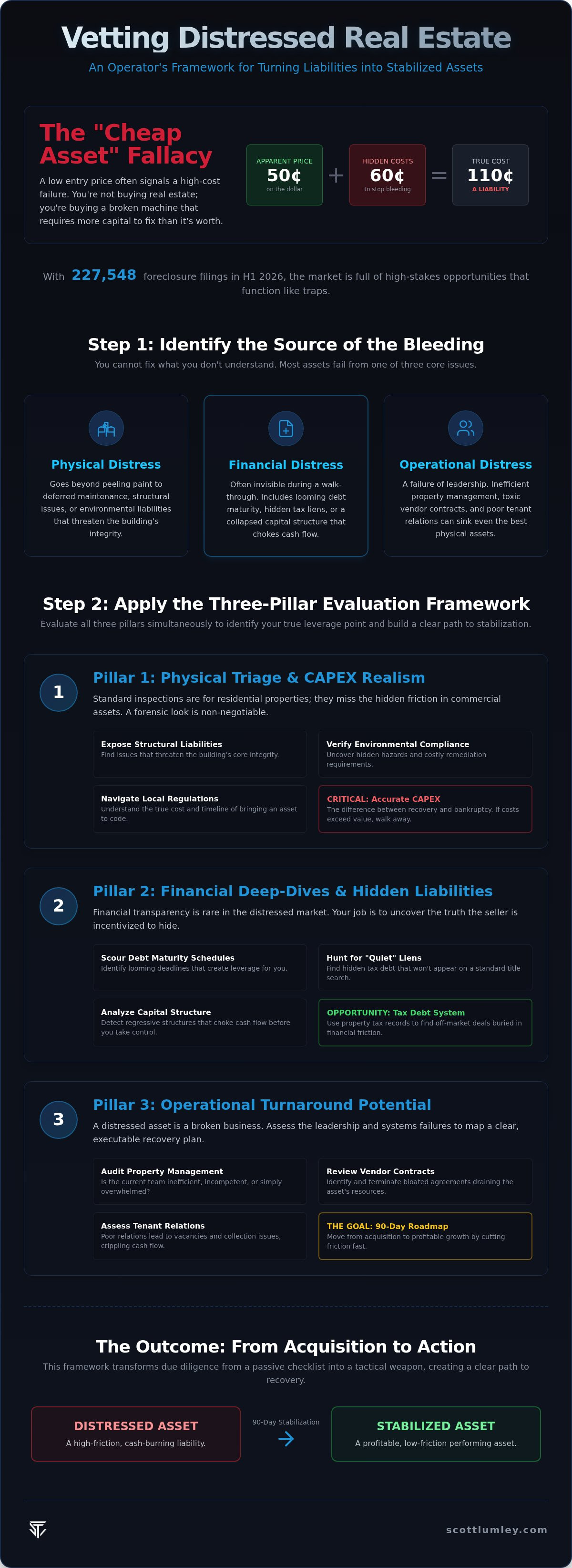
The "Cheap Asset" fallacy kills more portfolios than market crashes. Amateur investors see a low entry price and assume the margin for error is wide. It's not. A low price usually signals a high-cost failure. If you buy a property for 50 cents on the dollar but it requires 60 cents on the dollar just to stop the bleeding, you've bought a liability. You aren't buying real estate; you're buying a broken machine. There is no such thing as a passive distressed investment. You either lead the recovery or you fund the failure.
The Psychology of the Distressed Market
Bargains create blind spots. When a deal looks like a steal, investors often ignore the red flags waving in their faces. This is the psychology of the trap. You must maintain a sobering voice of reason. It's vital to distinguish between fixable friction, like poor property management, and terminal failure, like a structural liability that exceeds the asset's value. Don't let the urgency of a high-speed acquisition cloud your judgment. If you can't identify exactly why the current owner is failing, you're likely to repeat their mistakes.
Identifying the Source of the Bleeding
You cannot fix what you don't understand. Identifying the root cause of the distress is the first step in any successful turnaround. Most assets suffer from one of three failures:
- Physical Distress: This goes beyond peeling paint. It involves deferred maintenance, structural issues, or environmental liabilities that threaten the building's integrity.
- Financial Distress: This is often invisible during a walk-through. It includes looming debt maturity, hidden tax liens, or a collapsed capital structure that chokes cash flow.
- Operational Distress: This is a failure of leadership. Inefficient property management, toxic vendor contracts, and poor tenant relations can sink even the best physical assets.
Success in evaluating distressed real estate deals requires identifying whether the bleeding is a flesh wound or a severed artery. If the market has dislocated, you might have a timing advantage. If the asset has been mismanaged, you have an operational opportunity. Know the difference before you sign the contract.
The Three-Pillar Framework for Evaluating Distressed Assets
Successful asset recovery doesn't happen by accident. It requires a rigid, three-pillar framework that exposes the reality of an asset before you commit capital. When evaluating distressed real estate deals, most investors make the mistake of looking at these pillars in isolation. That is a fatal error. Physical problems often mask financial rot, and operational friction can make even a structurally sound building a total loss. You must evaluate physical integrity, financial transparency, and operational capacity simultaneously to identify your true leverage point.
Physical Triage and CAPEX Realism
Standard inspections are designed for residential properties. They miss the hidden friction common in industrial and commercial assets. You need a forensic look at structural liabilities and environmental compliance. Bringing an asset back to code isn't just about repairs. It's about navigating local regulations and vendor contracts that may be bloated. Don't fall into the sunk cost trap. If the cost of stabilizing the physical structure exceeds the projected market value, walk away. Resilience means knowing when a bargain is actually a bottomless pit. Accurate CAPEX estimates are the difference between a recovery and a bankruptcy.
Financial Deep-Dives and Hidden Liabilities
Financial transparency is rare in the distressed market. You aren't just looking at the P&L; you're scouring debt maturity schedules and searching for quiet liens that don't appear on a standard title search. Regressive capital structures can choke the life out of an asset before you even take control. This is where professional due diligence consulting services become a strategic necessity. They help you expose the financial rot hidden behind creative accounting. Understanding the nuances of Investing In Distressed Properties means recognizing that the debt is often as damaged as the roof. If the numbers don't provide absolute clarity, the risk is too high.
Finally, evaluate the operational capacity of the existing management. Is the floor running at peak efficiency? Poor property management is a fixable problem, but leadership rot is terminal. If the current team has lost control of the vendors or the tenants, you'll need to restructure from day one. If you find yourself overwhelmed by the complexity of a potential acquisition, seeking a real estate advisory partner can provide the sobering perspective needed to make a hard decision. You don't win by buying cheap; you win by buying right.
Due Diligence as a Strategic Weapon, Not a Compliance Checklist
Stop treating due diligence like a homework assignment. It's an offensive maneuver. When evaluating distressed real estate deals, most investors look for reasons to say no. I look for the leverage point that makes the deal work. Scouring debt maturity records is a prime example of this strategy. If a lender is facing a hard deadline, you aren't just buying a property; you're solving a structural financial problem. That is your leverage. You aren't checking boxes. You're searching for the pressure point that forces a favorable exit for the seller and a high-yield entry for you.
The "First 72 Hours" rule is non-negotiable. You must stabilize the data flow before the offer is cold. This isn't about a cursory glance at a pro forma. It's about forensic verification of every claim the seller makes. Industry experience in construction and manufacturing isn't just a bonus; it's a prerequisite for this level of scrutiny. If you don't understand how a building is put together or how a production floor operates, you'll miss the structural decay or the operational friction that sinks the ROI. Real estate due diligence requires the eyes of an operator, not just an accountant.
Operational Due Diligence: The Missing Link
Operational due diligence is where most deals fail. You're evaluating human friction. Is the property failing because the asset is bad, or because the leadership is incompetent? Mismanagement is an opportunity for a turnaround. An unmanageable asset is a liability you should avoid. Gaining strategic business advisor insights is vital here. You need the perspective of someone who has led turnarounds to see where the culture has rotted and where the systems have collapsed. If the "human friction" is too high, the cost of recovery will outweigh the discount.
The Legal and Zoning Minefield
The legal and zoning minefield is where amateur deals go to die. Verify every square inch of legal use for industrial and commercial assets. Back taxes and unpaid utility bills are silent killers that don't always show up on a surface-level search. You must dig into the municipal records yourself. When you have the data, you negotiate from a position of absolute strength. You don't ask for a discount. You present the reality of the liability and let the seller decide if they want to keep the problem or let you solve it. Data doesn't care about feelings. It only cares about the bottom line.
Financial Triage: Dealing with Property Tax Debt and Liens
Tax debt is the ultimate leverage point. Most investors see a tax lien and run. I see a motivated seller and a strategic entry point. The Strategic Property Tax Debt System transforms a heavy liability into a tactical advantage. When evaluating distressed real estate deals, you must audit the asset's tax history with forensic precision. You aren't just looking for the total amount owed. You're looking for the timeline of neglect. A multi-year delinquency tells you more about the owner's desperation than a balance sheet ever will. It's the first sign of a total operational collapse.
Restructuring this debt is about moving from crisis to control. You need to clear the title and stop the bleeding immediately. Tax deed investing requires an operator's mindset. It's not a spreadsheet exercise. It's a high-stakes negotiation with municipalities and lien holders. You're solving a problem for the local government while securing an asset at a steep discount. Data doesn't lie; tax records are the most honest documents you'll ever read. They expose the friction that the seller's pro forma tries to hide.
Executing the Financial Pivot
Clearing the title is your first priority. You cannot stabilize an asset while quiet liens or utility bills are still surfacing. Balance your pro forma against the reality of the turnaround. In early 2026, the national foreclosure inventory rate hit 0.4%, the highest in six years. This inventory is often saddled with complex financial friction that requires aggressive intervention. If the back taxes and penalties exceed 60% of the asset's stabilized value, you've likely reached a terminal state. Walk away. Don't let ego fund a failing asset. Knowing when to fold is as important as knowing when to buy.
Leveraging Tax Liens for Acquisition
Tax debt is a powerful tool for off-market negotiation. The legal landscape has shifted significantly in 2026. The federal SALT deduction cap increased to $40,000, which changed the tax burden for many commercial owners. Across the country, many jurisdictions are moving toward auctioning tax lien certificates more aggressively to recover unpaid revenue. This creates a window for acquisition that didn't exist two years ago. Integrating these tax strategies into real estate leadership advisory frameworks allows you to move faster than the competition. You aren't just buying property. You're executing a financial recovery. If you're struggling to navigate these complex liabilities, you need a crisis management specialist who has seen it all before.
From Acquisition to Action: Executing the Asset Turnaround
Evaluation ends when the ink dries. Now the real work begins. The first 90 days of ownership are about stabilization and operational recovery. You aren't looking for perfection; you're looking for control. Stop the bleeding by identifying every point of friction in the current operation. This means auditing every vendor contract, firing incompetent property managers, and verifying that every dollar of revenue is actually hitting the bank. Evaluating distressed real estate deals was the mental exercise. Executing the turnaround is the physical one. If you don't move with speed, the asset's decay will outpace your capital.
Restructuring management is often the first move. If the previous team couldn't maintain the asset, they won't be the ones to save it. You need to cut the bloat in vendor contracts that was likely ignored during the period of distress. Rebuilding the pro forma isn't about optimistic projections. It's about grounded, operational reality. You're moving the asset from survival to a state of sustainable growth. This transition requires the specific skill set of a business turnaround consultant who understands how to navigate high-stakes environments. Real estate is just a business made of bricks; the rules of recovery remain the same.
Leadership and Strategic Planning Post-Deal
Install a battle-hardened leadership team on-site immediately. You need operators who lead from the trenches, not advisors who watch from a distance. Establish KPIs that track the speed of recovery, not just occupancy rates. Track the time it takes to resolve maintenance tickets, the cost of tenant acquisition, and the reduction in utility waste. Execute the pivot with precision. Decide early which sections of the asset to renovate, which to re-lease, and which to sell. A clear, decisive strategy prevents the "scope creep" that kills turnaround budgets.
Sustainable Growth and Asset Optimization
Stabilization is the gateway to optimization. Once the friction is removed and the cash flow is predictable, the asset moves from "distressed" to "stabilized" in the eyes of lenders. This is where you scale. Use the recovery of a single asset as the blueprint for a broader portfolio. In a market where foreclosure filings increased by 21% in early 2026, the ability to repeat this process is a massive competitive advantage. You're no longer just an investor; you're an operator who manufactures value where others only saw a liability.
Ready to execute? Partner with Scott Lumley for high-stakes real estate advisory.
Lead the Recovery, Don't Fund the Failure
Distressed assets don't forgive hesitation. You've seen how the "cheap asset" fallacy leads to high-cost failures. Success in evaluating distressed real estate deals comes down to forensic due diligence and an operator's mindset. It isn't enough to identify the problem; you must have the stomach to execute the recovery. Pillar by pillar, you strip away the friction until only the value remains.
This process isn't for the passive investor. It's for the strategist who values hard-won wisdom over polished promises. Backed by 40 years of real-world operational experience, I provide a proven turnaround strategy for distressed assets that doesn't rely on theory. It relies on execution.
If you're ready to move from identifying liabilities to manufacturing growth, it's time to lead from the trenches. Secure Your Next Deal with Scott Lumley’s Advisory and leverage direct, no-nonsense leadership consulting to stabilize your portfolio. The market is full of broken machines. Go find the one you can fix.
Frequently Asked Questions
What is the biggest red flag when evaluating a distressed real estate deal?
The biggest red flag is a lack of data transparency. If a seller can't provide clear utility records or debt maturity schedules, they're likely hiding a terminal liability. You can't fix what you can't see. Silence from a seller is a signal to walk. Don't waste capital on assets where the source of the bleeding remains a mystery. If the "why" behind the failure is missing, the deal is toxic.
How do I accurately estimate repair costs for an industrial property?
Accurate industrial estimates require a forensic CAPEX audit. You must go beyond surface-level inspections to check structural load capacities, environmental compliance, and heavy-duty electrical systems. Standard residential inspectors will miss these details every time. Hire specialists who understand industrial friction. Always build a 20% contingency into your budget to account for the hidden decay that only surfaces once the stabilization process begins. Data from the field beats a spreadsheet every time.
Can I use tax liens as a primary strategy for acquiring distressed assets?
Tax liens are a powerful entry point for off-market acquisitions. By targeting properties with significant tax debt, you identify owners who have already checked out operationally. This provides massive leverage for negotiation. However, you must understand the specific redemption periods and auction rules in your target state. In 2026, market shifts have made these liens more accessible for operators who have a system for evaluating distressed real estate deals and resolving financial friction quickly.
What is the difference between physical distress and financial distress?
Physical distress is visible decay like a failing roof or structural cracks. Financial distress is invisible rot like looming debt maturity or hidden tax liens. One requires a construction crew; the other requires a strategic recovery plan. Most assets suffer from both. You must identify which is the primary driver of the failure to determine if the asset is a fixable opportunity or a terminal liability that will drain your capital before you stabilize it.
How long does a typical real estate turnaround take to show ROI?
Stabilization happens in the first 90 days. During this window, you stop the bleeding by restructuring management and cutting bloated vendor contracts. True ROI usually begins to show between 12 and 18 months as the asset reaches a stabilized growth phase. Speed is non-negotiable in this sector. The longer an asset remains in a state of friction, the more your projected returns will erode. Move fast or don't move at all.
Is it possible to fix a property with significant zoning violations?
Zoning violations are fixable if they are procedural, but terminal if they are structural land-use failures. You must verify the municipal appetite for a turnaround before you close. A zoning issue is often a strategic leverage point that allows you to negotiate a lower entry price. However, if the city has a permanent restriction on the property's intended use, no amount of capital will fix the deal. Always verify the legal use yourself.
Why do most investors fail at operational due diligence?
Most investors fail because they treat evaluating distressed real estate deals as a purely financial exercise. They audit the spreadsheet but ignore the floor operations. They miss toxic property management cultures and inefficient vendor relationships that choke cash flow. Operational due diligence is about identifying human friction. If you don't evaluate the leadership and the systems behind the asset, you are buying a broken business you don't know how to run or recover.
Should I buy a distressed asset without a turnaround plan in place?
No. Buying a distressed asset without a turnaround plan is just gambling with concrete. You must have a 90-day stabilization roadmap established before the offer is made. This plan should include immediate leadership changes, debt restructuring, and a clear CAPEX schedule. Hope is not an operational strategy. If you don't know exactly how you'll move the asset from survival to growth, you're just funding someone else's exit from a failing deal.


