

A spreadsheet won't save a failing production line. In the high-stakes world of manufacturing and logistics, theory is a luxury you can't afford when throughput is stalling and supply chain volatility is eating your margins. You feel the weight of an aging leadership model trying to compete in a 2026 market where 50% steel tariffs are the new baseline. It's frustrating to watch operational friction slow your growth while competitors pivot faster. This is where an industrial sector business advisor with forty years of lived experience makes the difference between a shutdown and a turnaround.
You need more than a consultant. You need a partner who leads from the trenches. In this case study, you'll discover how to navigate extreme operational friction to stabilize your assets and create a clear roadmap for sustainable scaling. We're moving past the fluff to look at the hard-won strategies that turn distressed operations into resilient powerhouses. It is time to stop reacting to the market and start dictating your own terms.
Key Takeaways
- Stop relying on theoretical slide decks that don't work on the factory floor. Learn why an execution-led approach fixes the friction that consultants ignore.
- Identify the invisible operational drag slowing your throughput. Build a roadmap that survives 2026 supply chain volatility and shifting trade policies.
- Deploy a 72-hour audit to plug immediate cash leaks. Discover how an industrial sector business advisor uses asset optimization to stabilize distressed firms quickly.
- Adopt the "I Survived Africa" mindset for high-stakes logistics and manufacturing. Manage operations where the margin for error is zero and the stakes are absolute.
- Shift from a passive leadership model to one that leads from the trenches. It's the difference between watching a crisis happen and actually solving it.
Why the Industrial Sector Needs an Advisor, Not a Consultant
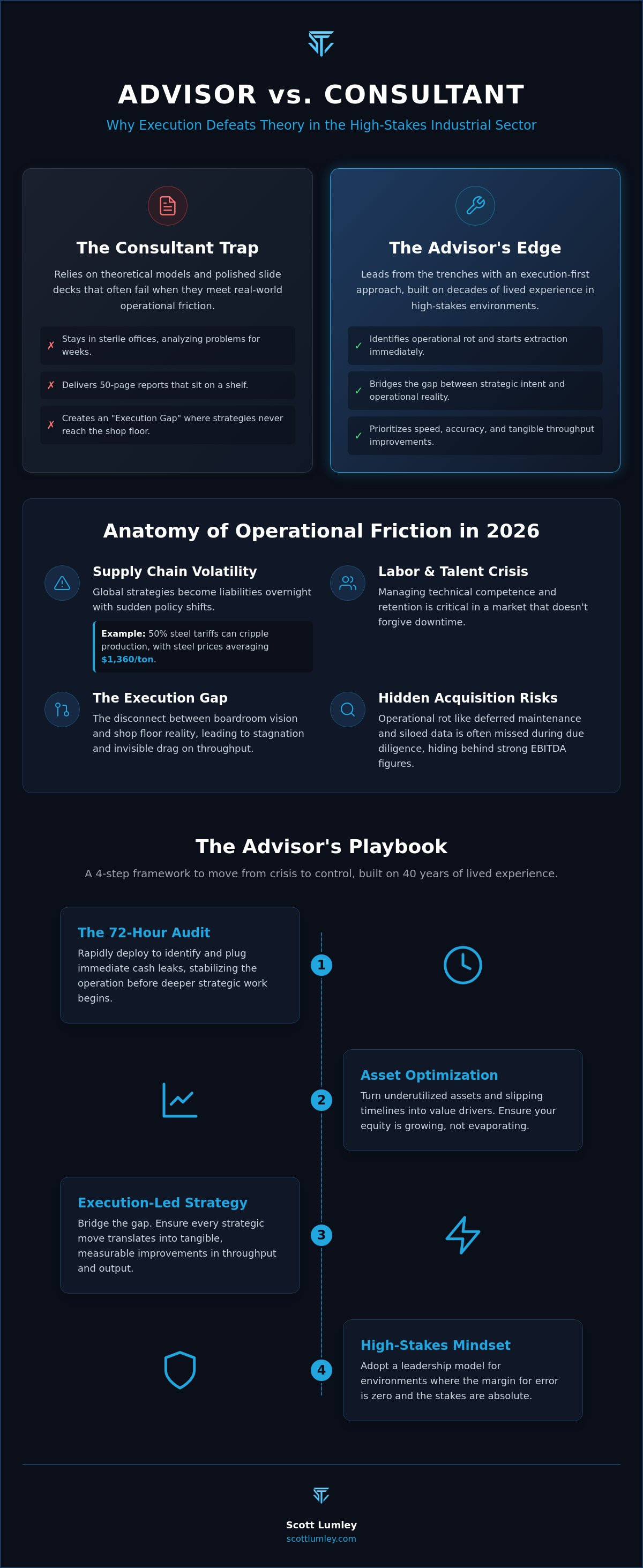
A standard business consultant often arrives with a polished slide deck and a list of suggestions. They tell you what should happen in a perfect world. An industrial sector business advisor does the opposite. They tell you what will happen because they've already stood where you are standing. In the gritty world of manufacturing and construction, suggestions don't clear backlogs. Execution does. While a consultant might analyze your problems for weeks, an advisor identifies the rot and starts the extraction immediately.
The 'Consultant Trap' is a common failure point for high-stakes firms. It's the moment when theoretical models hit the friction of a real-world manufacturing floor. Slide decks can't fix a broken supply chain or manage the fallout of a 50% steel tariff. While consultants stay in sterile offices, an advisor identifies the vibration in the machinery that signals a looming shutdown. They prioritize hard-won wisdom over optimistic theories. They understand that in 2026, survival depends on speed and accuracy, not a fifty-page report that sits on a shelf.
The role of an advisor is the critical bridge between strategic intent and operational reality.
The Execution Gap in Modern Manufacturing
Traditional growth strategies usually die at the implementation phase. Boardrooms agree on a vision, but the shop floor never gets the memo. This execution gap creates stagnation. Scott Lumley’s strategic business advisor model rejects the endless cycle of meetings. It favors movement. Leadership must bridge the distance between the executive suite and the assembly line to ensure that every strategic move translates into tangible throughput. If a strategy doesn't result in a physical improvement in output, it's just noise.
Beyond the Spreadsheet: The Value of Lived Experience
An MBA is a fine credential, but it's useless when a logistics crisis hits at midnight. Forty years in the trenches provides a perspective that a spreadsheet cannot replicate. An industrial sector business advisor sees the hidden risks in retail and logistics before they appear on a balance sheet. They understand that friction isn't just a data point; it's a cost that compounds every hour. Lived experience allows for rapid stabilization when the stakes are highest. You don't need someone to read you the map; you need someone who has already walked the terrain and knows where the pitfalls are buried.
- Identify cash leaks that standard audits miss.
- Stabilize operations during supply chain volatility.
- Replace theory with execution-led growth.
The Anatomy of Operational Friction in 2026
Operational friction is the invisible drag on your industrial throughput. It’s the sound of money leaking from your production line. In 2026, this friction has evolved. It’s no longer just about slow machines; it’s about supply chain fragility and the sudden shift toward localized manufacturing. When tariffs hit 50% on steel imports, your global strategy becomes a liability overnight. True operational resilience requires more than a backup supplier. It requires a fundamental restructuring of how you move goods and manage assets in a market where U.S. cold-rolled coil steel averages $1,360 per short ton.
The labor crisis adds another layer of grit. Managing the human element in an automated world isn't about morale boosters. It's about technical competence and retention in a market that doesn't forgive downtime. For an industrial sector business advisor, operational health is directly tied to asset value. If your real estate is underutilized or your construction timelines are slipping, your equity is evaporating. You cannot scale a business that is fighting itself. You must identify the friction points before they become systemic failures.
Identifying Friction Before the Deal
Acquisitions are where friction often hides. Investors often get blinded by EBITDA and miss the operational rot beneath the surface. This is why due diligence consulting services are vital for any industrial purchase. You must look for red flags like deferred maintenance schedules or siloed data streams that don't talk to each other. Quantifying "operational drag" means looking at the ratio of input to actual realized output. If you can't measure the friction, you can't price the risk. An industrial sector business advisor spots these discrepancies during the audit phase, long before the first dollar is committed.
The High Cost of Inaction
Ignoring minor inefficiencies is a death sentence. A small leak in a logistics firm’s fuel management or a slight delay in a manufacturing cycle eventually leads to systemic failure. The psychological toll on leadership is just as heavy. Stalling businesses breed indecision. We see retail and logistics firms bleed cash during supposed "growth" phases because they scaled their friction along with their volume. They didn't fix the foundation; they just built more on top of the cracks.
Stabilizing these assets requires an operator’s eye and a refusal to accept "good enough." If you are ready to identify and extract the friction in your own firm, you can review your current strategic planning to see where the leaks are happening. Don't wait for a total shutdown to address the drag that is already slowing you down.
Case Study: Managing High-Stakes Operations in Volatile Markets
Africa is the ultimate proving ground for operational resilience. It is a place where infrastructure is often a suggestion and the margin for error is zero. When you manage logistics and construction in these environments, you learn one thing very quickly: your plan is worthless the moment it hits the dirt. This reality is the benchmark for the "I Survived Africa" narrative. It isn't a story of adventure. It's a case study in managing assets when failure isn't an option. This level of extreme adversity is exactly what an industrial sector business advisor brings to the table for domestic firms facing their own versions of chaos.
Managing global operations requires a blend of adaptability and raw grit. You don't have the luxury of calling a technician or waiting for a consultant's report. You solve the problem with what you have, or you lose the asset. This battle-hardened approach directly informs the leadership consulting services we provide today. We take the lessons of survival and apply them to high-stakes manufacturing and logistics hubs in the United States. If you can keep a construction project moving in a conflict zone, you can certainly stabilize a factory floor in the Midwest.
Navigating Global Supply Chain Chaos
In high-risk territories, supply chains don't just bend; they shatter. We've managed operations where shipments were seized and routes were blocked by sudden local instability. In those moments, rapid deployment leadership is the only thing that matters. You don't hold a meeting to discuss options. You execute a pivot. This experience translates into domestic industrial growth by teaching leaders how to build redundancy into their strategy. We show teams how to maintain momentum when their primary plan falls apart, ensuring that a single failure point doesn't bring down the entire firm.
The "I Survived Africa" Mindset for US Industry
The biggest threat to US industry is complacency. Many domestic firms have grown comfortable in a stable market, but that stability is an illusion in 2026. We bring a sense of urgency to domestic manufacturing that mirrors emerging market operations. We strip away the corporate fluff and focus entirely on what keeps the lights on. Survival and recovery aren't just for crises. They are a daily discipline. By building a culture that values resourcefulness over bureaucracy, we ensure that your leadership team is prepared to lead from the trenches when the market turns volatile.
- Prioritize survival of the core asset over superficial growth.
- Build teams that can pivot without waiting for executive permission.
- Eliminate the "comfortable" habits that lead to operational stagnation.
Strategic Stabilization: The Advisor’s Playbook for Distressed Assets
Stabilizing a distressed industrial asset isn't a slow process. It’s a surgical extraction of failure. While others wait for quarterly reports, an industrial sector business advisor moves with immediate intent. The playbook for recovery starts with identifying cash leaks and operational chokepoints through a 72-hour audit. You don't need a deep dive into history; you need to know where the money is leaving the building right now. Once the leaks are plugged, we shift to asset optimization. This means squeezing every bit of value out of your existing real estate and equipment.
Liability management is the next hurdle. Many industrial firms are weighed down by property obligations they can't meet. We utilize a tax deed investing strategy to turn these liabilities into leverage points. This isn't just about compliance; it's about tactical survival. Finally, we implement a cultural reset to realign your leadership with the new operational reality. Growth only happens once the friction is gone. Sustainable scaling is the final step, building a blueprint that doesn't break when the volume increases.
Recovering Value from Distressed Real Estate
Industrial portfolios often hide significant untapped value, even when they appear broken. Our real estate leadership advisory model specializes in fixing these fractured assets. We look at the physical property as a tool for recovery, not just a line item. By deploying our Property Tax Debt System, we help firms recover from mounting tax burdens that threaten their core operations. We turn what looks like a terminal liability into a strategic advantage during a turnaround.
The 72-Hour Stabilization Protocol
The absolute priority during the first 72 hours of a business crisis is the immediate preservation of liquid capital and the identification of terminal operational failures.
Manufacturing CEOs don't have time for a committee. You must stop the bleed by cutting non-essential expenditures and freezing all activities that don't contribute to immediate throughput. Communication with stakeholders must be blunt and transparent. Tell them what happened, how you are fixing it, and what the timeline for stabilization looks like. If you are facing a crisis that requires immediate intervention, you can secure strategic planning support before the situation becomes irreversible.
- Audit cash flow to find immediate leaks.
- Optimize existing equipment for maximum output.
- Manage tax debt liabilities to free up capital.
- Reset leadership expectations to match the recovery plan.
Leadership That Survives: Choosing an Execution-Led Advisor in 2026
The era of the hands-off consultant is over. In a 2026 market defined by rising energy costs and shifting trade alliances, you don't have the luxury of waiting for a quarterly review. You need an operator. A business turnaround consultant who hasn't personally managed a production line or a logistics fleet is a liability. An industrial sector business advisor must lead from the trenches. This is the difference between an advisor who watches your firm struggle and one who steps in to stop the bleed. Trust in this sector is built on shared operational scars, not polished presentations.
Leading from the trenches means identifying the friction before it hits the balance sheet. It means knowing the vibration of a failing machine and the tension of a fractured supply chain. While theorists offer optimistic projections, an execution-led advisor offers a sobering voice of reason. They prioritize hard-won wisdom over marketing promises. If your advisor hasn't navigated extreme adversity, they won't know what to do when your margins start to evaporate. You need a strategist who values survival and recovery as much as expansion.
Vetting for Grit and Integrity
When you interview an advisor, look past the pedigree. Ask about their failures. A battle-hardened expert will tell you exactly where they hit a wall and how they climbed over it. If they don't have a story about a recovery that seemed impossible, they haven't been in the game long enough. Transparency is the most valuable asset in this relationship. You need a no-nonsense partner who tells you the truth about your assets, even when it's uncomfortable. Scars indicate experience. Slides indicate a lack of it. Integrity in the industrial sector means doing the work, not just talking about it.
Your Next Actionable Move
The first step toward recovery is admitting that your current leadership model is stalling. An operational audit with Scott Lumley isn't a series of polite meetings. It's a tactical assessment of your firm's readiness for a strategic pivot. We look at your cash flow, your throughput, and your asset utilization to determine if you are built for survival or just waiting for a shutdown. You must decide if your firm is ready to shed the weight of aging leadership models. In 2026, execution is the only metric that matters. Move from operational friction to strategic clarity by choosing a partner who knows what it takes to survive the trenches.
- Demand transparency regarding past operational failures and recoveries.
- Prioritize advisors with at least four decades of hands-on experience.
- Focus on immediate execution over long-term theoretical planning.
- Transition from a passive leadership model to an active, operator-led strategy.
Stabilize Your Operations and Dictate Your Future
Operational friction is a silent killer of industrial throughput. Slide decks and theoretical models won't fix a stalling manufacturing line or a fractured supply chain. You need the grit of an industrial sector business advisor who has already navigated the high-stakes crises you're facing. Success in 2026 doesn't reward hesitation. It requires moving past the boardroom talk and into immediate, tactical execution. Whether it's managing a 72-hour audit or optimizing distressed real estate, the goal is always the same: survival followed by sustainable scaling.
Don't let aging leadership models or invisible drag dictate the fate of your firm. Leverage forty years of operational experience and battle-hardened resilience to turn your liabilities into leverage. It's time to stop reacting to the market and start leading from the trenches with an execution-led strategy that delivers results. Ready to strip away the friction? Contact Scott Lumley for a direct operational assessment.
Your recovery starts with a single decisive move. The roadmap to resilience is clear; you just have to take the lead.
Frequently Asked Questions
What is the difference between an industrial advisor and a general business consultant?
An industrial advisor is an operator who executes strategy rather than a consultant who merely suggests it. While general consultants provide theoretical slide decks, an advisor brings the weight of forty years of lived experience to the manufacturing floor. We prioritize hard-won wisdom over optimistic theories. We don't just identify problems; we step into the trenches to extract the friction that is stalling your throughput.
How does an industrial sector business advisor help with supply chain issues?
An industrial sector business advisor builds localized resilience to counter global supply chain fragility. In a market where steel tariffs have reached 50%, we restructure your movement of goods to minimize risk. We replace reactive habits with predictive modeling. This ensures your production doesn't halt when a single global route fails. We focus on movement and tangible output rather than endless meetings.
What industries does Scott Lumley specialize in for advisory services?
Scott Lumley specializes in the manufacturing, construction, and logistics sectors where the stakes are highest. His advisory also extends into retail environments facing heavy operational friction. These are industries where deferred maintenance or siloed data can cause systemic failure. With four decades in the field, he focuses on turnarounds for firms that require immediate stabilization and a clear roadmap for scaling.
Can a business advisor help with distressed real estate and property tax debt?
Yes, we provide specialized Real Estate Advisory and a Property Tax Debt System to recover value from broken portfolios. We treat physical property as a strategic tool for recovery rather than a terminal liability. By utilizing a tax deed investing strategy, we help firms manage mounting debt that threatens their core operations. We turn these financial chokepoints into leverage points during a business turnaround.
What is the first step in a business turnaround for a manufacturing company?
The first step is a 72-hour audit to identify immediate cash leaks and terminal operational chokepoints. You must stop the bleed before you can scale. We cut non-essential expenditures and freeze activities that don't contribute to immediate throughput. This protocol provides the clarity needed to stabilize the asset. It sets the stage for a cultural reset and sustainable growth.
How does 'I Survived Africa' relate to US-based industrial consulting?
'I Survived Africa' serves as a benchmark for extreme operational resilience in environments with zero margin for error. If you can manage logistics in a conflict zone, you can stabilize a factory floor in the Midwest. This mindset brings a necessary urgency to US-based firms that have grown comfortable. It forces a focus on resourcefulness and survival that is often missing in domestic industrial strategies.
How do you measure the ROI of hiring an industrial sector business advisor?
ROI is measured by the immediate reduction in operational friction and the increase in realized throughput. We look at the ratio of input to actual output and the extraction of hidden cash leaks. An industrial sector business advisor also impacts your bottom line by stabilizing asset value and resolving tax liabilities. Success is defined by tangible movement on the balance sheet, not a set of optimistic projections.
Does Scott Lumley offer leadership coaching for industrial management teams?
We offer Leadership Consulting that focuses on execution-led strategy for high-stakes operations. This is not a passive coaching model; it's a guide for leaders who need to lead from the trenches. We help management teams bridge the gap between the boardroom and the shop floor. Our goal is to build a culture of survival and recovery that can withstand market volatility.


