

Growth is often the fastest way to kill a healthy business. Most operators chase top-line revenue like it's a lifeline, only to realize they've just scaled their own inefficiencies. If your current operations are already grinding gears, adding more speed won't fix the engine; it'll just blow it. You need profitable business expansion strategies that prioritize sustainable margins over vanity metrics. Scaling friction is just scaling failure. It's a hard lesson many learn only after the damage is done.
You're likely feeling the weight of margin compression or the constant drag of operational friction. It's frustrating to watch growth eat your profits. This guide provides a clear roadmap for sustainable scaling. You'll learn how to identify the highest ROI expansion paths while protecting your current cash flow. We'll look at the due diligence required to move into new markets without the risk of a total operational collapse. It's time to stop guessing and start executing with precision.
Key Takeaways
- Growth that kills your margins isn't growth; it's a liability. Learn how to prioritize EBITDA over top-line noise to avoid operational bankruptcy.
- Use high-leverage frameworks to identify whether you should squeeze more from current assets or move into new territories.
- Implement profitable business expansion strategies by choosing data-backed strategic moves over reactionary client-chasing.
- Audit your internal processes to remove friction before it scales. If your systems aren't documented, they aren't ready for more volume.
- Define clear kill switches and 90-day stabilization goals to protect your existing cash flow during high-stakes growth.
The Expansion Trap: Why Most Growth Strategies Kill Profitability
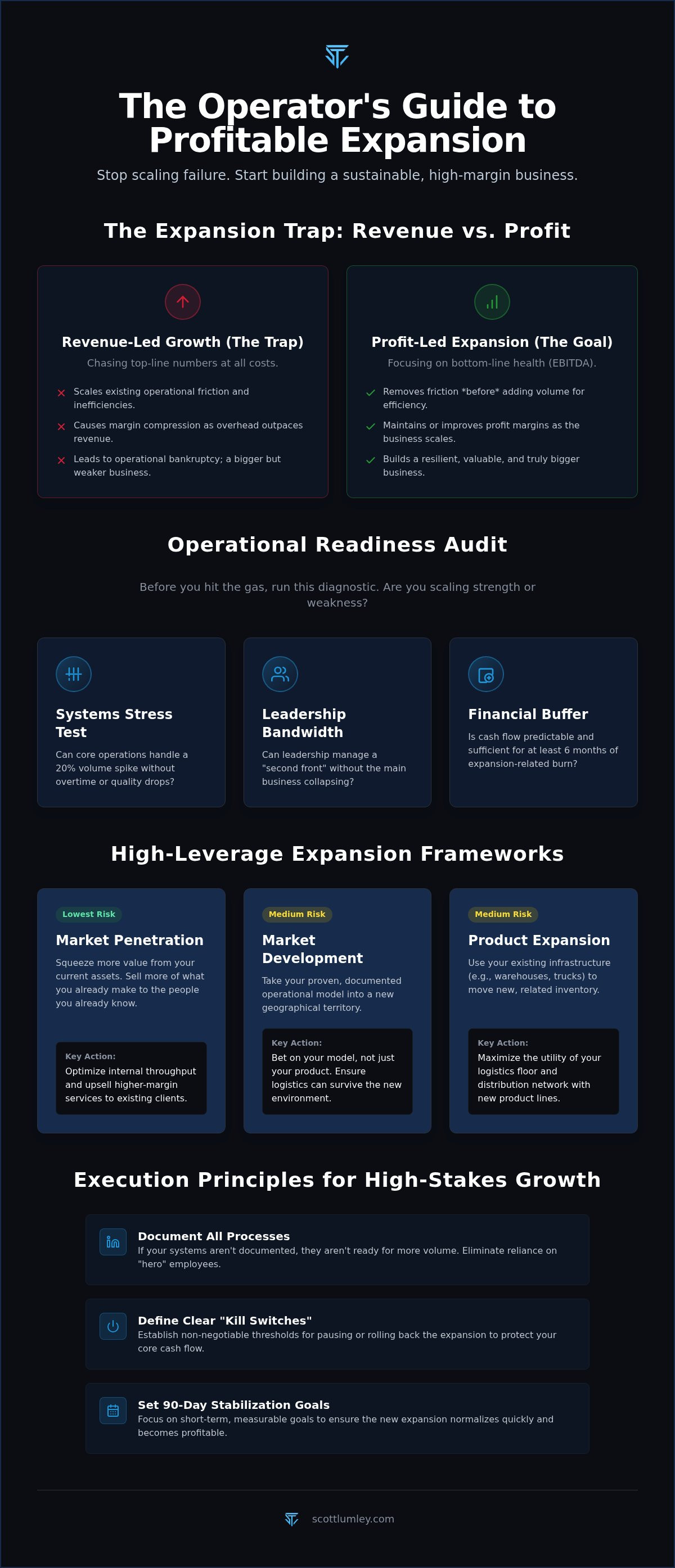
Growth is a siren song. Most operators see a spike in demand and mistake it for a green light. It is often a warning. Profitable expansion is not about getting bigger; it is about getting better. It means maintaining or improving your EBITDA margins while you scale. If your margins shrink as you grow, you are not building an empire. You are building a tomb. This is the reality of the "Growth Paradox." Scaling a broken process just breaks it faster. If your logistics floor is a mess at $5M, it will be a disaster at $10M.
True profitable business expansion strategies require you to identify where the friction lies before you add weight. You do not scale until the friction is gone. Many firms fail because they mistake activity for achievement. They chase business development strategies that prioritize market share over market sustainability. This is revenue-led growth, and it is a trap. Strategic expansion is profit-led. It focuses on the bottom line first, ensuring that every new dollar earned is more efficient than the last.
Revenue vs. Profit: The Critical Distinction
Revenue-led growth is for people who like to brag at country clubs. Profit-led expansion is for people who want to stay in business. In high-stakes industries like manufacturing or real estate, top-line growth is a vanity metric. Operational overhead has a nasty habit of scaling faster than revenue if left unchecked. If you do not watch your cash flow during the transition, you will find yourself growing right into a bankruptcy filing. You must manage the transition phase with surgical precision. Cash is your oxygen; do not spend it on vanity projects that do not move the needle on your margins.
Signs of Operational Readiness
Knowing when to move is as important as knowing how to move. You are ready to execute profitable business expansion strategies when you meet three specific criteria:
- Your core systems handle a 20% volume spike without anyone working overtime or losing quality.
- Your leadership has the bandwidth to manage a "second front" without the main floor collapsing.
- Your cash flow is predictable and provides a buffer for at least six months of expansion-related burn.
Conversely, you are not ready if your success depends on a single "hero" employee. You are also not ready if your core manufacturing or logistics processes are still "in someone's head" instead of documented. Run a stress test. If your system buckles under a hypothetical 20% increase, stay where you are. Fix the engine before you hit the gas. Scaling a mess just makes a bigger mess.
Core Expansion Frameworks: Choosing Your High-Leverage Path
Textbook theories like the Ansoff Matrix often fail because they ignore the grit of real-world operations. For a battle-hardened operator, these aren't just quadrants on a slide deck. They are risk profiles. Choosing the right path is the difference between a calculated victory and a chaotic retreat. You need profitable business expansion strategies that align with your existing infrastructure. Don't build a new bridge if your current one still has empty lanes.
Market Penetration is the first stop. This is about squeezing every drop of juice from your current assets. Sell more of what you already make to the people you already know. It's the lowest risk because the variables are known. Market Development takes it a step further. You take your proven model to a new territory. If your logistics work in the Midwest, can they survive the coast? You're betting on the model, not the product. Product Expansion involves using your existing pipes, such as your warehouses and trucks, to move new inventory. It's about maximizing the utility of your logistics floor.
Market Penetration for Industrial Firms
In the industrial sector, market penetration is the process of increasing your share of an existing market by optimizing internal throughput and deepening current client relationships. Stop looking for new customers until you've maximized the ones you have. Optimize the shop floor. Increase throughput without buying new machines. Leverage your existing reputation in manufacturing or construction to upsell higher-margin services. It's easier to expand a contract than to win a new one. If you need help identifying these internal efficiencies, professional strategic planning can reveal the hidden capacity in your current setup.
Horizontal vs. Vertical Integration
Vertical integration is about protection. You own the supply chain to stop others from squeezing your margins. If your supplier is the bottleneck, buy them. If the distributor is taking too much, do it yourself. It's a move toward total control. Horizontal integration is about scale. You buy a competitor to instantly acquire their market share and equipment. Both are profitable business expansion strategies when executed with proper due diligence.
The Buy vs. Build debate in real estate and logistics is simple. Building takes time and introduces unknown variables. Buying takes capital but provides immediate cash flow. In high-stakes environments, buying a distressed asset and turning it around is often the faster path to profitable scaling. Don't reinvent the wheel if you can just buy the factory that makes them. Focus on acquiring assets that complement your existing strengths rather than trying to learn a new trade from scratch.
Reactionary vs. Strategic Expansion: Assessing the Risk
Expansion is a choice, not an accident. Many growth stories are actually just reactions to external pressure. A client calls with a big project in a new state. You say yes to the revenue. You ignore the risk. This is reactionary expansion. It feels like winning until the first invoice is late or the local labor costs double your estimate. You've scaled your footprint, but you've compromised your foundation. In high-stakes industries, this is how healthy companies start to bleed.
Strategic expansion is different. It relies on a repeatable model. You aren't chasing a check; you're building a beachhead. You move because the data says the market is underserved, not because one person promised you work. Implementing profitable business expansion strategies requires you to be the aggressor, not the respondent. If you're reacting, you've already lost the initiative. You are operating on someone else's timeline and someone else's terms. That's a recipe for operational collapse.
The Dangers of Client-Led Expansion
Following a single customer into a new territory creates massive customer concentration risk. You build infrastructure for one person. If they pivot or their budget gets cut, you're left with a lease and a payroll you can't support. This accidental growth is common in the construction sector. It's a trap. You must pivot from a one-off project to a sustainable regional presence within the first six months. If you can't find a second and third client quickly, you shouldn't be there. One client is a job; three clients is a market. Don't confuse the two.
Strategic Due Diligence Framework
You need a cold, hard look at the numbers before you sign a lease. Analyze market demand against the actual operational cost of entry. Don't just look at rent. Look at the local labor market. Can you find skilled manufacturing or construction talent in that zip code? If you have to import your team, your margins are already dead. You're paying for travel, lodging, and per diems that eat your profit before you even break ground.
Effective profitable business expansion strategies depend on rigorous vetting. This isn't about optimism. It's about finding reasons to say no. Use due diligence consulting services to identify operational friction before you commit capital. Survival is the first step of any expansion plan. If the move threatens your core business, it isn't growth. It's a gamble. In this industry, gamblers eventually go broke. Strategic operators move only when the odds are stacked in their favor.
Operational Due Diligence: Removing Friction Before You Scale
Operational friction is the silent killer of growth. It is the invisible drag that turns a fast market move into a slow, expensive death. When you scale, you aren't just scaling your revenue; you're scaling your inefficiencies. If your current systems are held together by tribal knowledge and the memory of your longest-tenured employee, they will snap under the weight of expansion. Profitable business expansion strategies require you to harden your operations before you commit to a new territory or a larger facility.
Audit your processes with a cold eye. Are they documented, or are they just "in people's heads"? If a key floor manager walks out tomorrow, does the process die with them? If the answer is yes, you are not ready to scale. You must also look beyond the spreadsheets. Your data might show you that production is slow, but your floor managers will tell you exactly why the machines are jamming. This "trench" perspective is vital. It reveals the bottlenecks in your supply chain that look fine on paper but will buckle when you double your order volume. Identify these weak links now, or they will become catastrophic failures later.
Process Hardening for Growth
Consistency is the only way to protect your margins across multiple locations. You need a standardized "operating system" that ensures quality remains identical whether you are in your home base or a new regional hub. This is where many industrial firms struggle. They try to do everything themselves and end up spread too thin. Utilizing leadership consulting services can provide the fractional expertise needed to manage this friction without bloating your permanent payroll. It's about bringing in a seasoned operator to build the tracks before you try to run the train.
Infrastructure and Asset Optimization
Real estate and facility needs must be assessed through the lens of long-term logistics, not just immediate demand. Don't sign a lease based on where you are today; sign it based on where the friction will be in three years. Technology should follow your process, not lead it. Buying a million-dollar ERP system won't fix a broken warehouse layout. It will only track your failures in real-time. Fix the physical flow first. Then, and only then, automate it.
You must also prepare for "The Dip." Scaling requires an upfront investment in assets, people, and time. Your margins will drop temporarily during the setup phase. If you haven't accounted for this margin compression in your cash flow projections, you'll run out of oxygen before you reach the summit. Secure your foundation first. If you're ready to identify the hidden friction in your business, get an operational audit to ensure your infrastructure can actually support your ambitions.
Executing the Pivot: Moving from Strategy to High-Stakes Growth
The first 90 days of an expansion are not about winning. They are about not losing. You are establishing a beachhead. This is the period where theoretical plans meet the friction of reality. If your logistics model fails on day ten, you pivot immediately. You don't wait for a quarterly review. Rapid response is the only way to ensure profitable business expansion strategies don't turn into expensive lessons in humility. You must stabilize the new operation before you try to optimize it.
Establish 'Kill Switches' before you spend the first dollar. Define the exact loss threshold or timeline that triggers a total withdrawal. If the new territory hasn't met its primary operational KPIs within six months, you pull the plug. Knowing when to pull back is what keeps a bad move from becoming a fatal one. It is not a failure; it is asset protection. Ego is the enemy of profit. Strategic operators value their core cash flow more than their pride.
Your role as a leader must shift during this phase. You start in the trenches to stabilize the new site. Once the process is hardened, you move back to strategic oversight. If you stay in the weeds too long, you lose sight of the horizon. You need a system that runs without your constant intervention. This transition is where most founders fail. They become the bottleneck they were trying to avoid.
Strategic advisory from Venta Belgarum helps business owners navigate this pivot, ensuring they reclaim their personal freedom while building a more profitable and efficient operation.
Stabilization and Rapid Deployment
Success requires setting clear KPIs that measure operational health, not just sales volume. Monitor throughput, error rates, and local labor turnover daily. You need rapid feedback loops from the new expansion site to catch friction before it scales. If the data shows a lag, find the bottleneck on the floor. Don't look for answers in a spreadsheet. You need a strategic business advisor who has lived through the collapse and knows how to spot the warning signs in real-time. Execution-led advisory beats theoretical consulting because it prioritizes the reality of the shop floor over the comfort of the boardroom.
The Scott Lumley Approach to Expansion
Scott Lumley brings 40 years of operational wins and scars to the table. This isn't about optimistic theories or corporate jargon. It is a direct, no-nonsense strategy focused on protecting your core assets while pursuing high-leverage growth. Whether you are navigating manufacturing, logistics, or real estate, the goal remains the same: sustainable profit. We identify the highest ROI path and build the infrastructure to support it. We don't just plan for growth; we execute for survival and recovery. Secure your expansion with an execution-led strategy that puts 40 years of experience in your corner. Stop guessing and start scaling with precision.
Hardening Your Operations for the Next Front
Expansion is not a trophy. It's a stress test. Most businesses fail because they scale their friction instead of their efficiency. You've learned that true profitable business expansion strategies require more than just a higher top line. They demand documented processes, a clear kill switch, and a total lack of ego when the data says to pivot. Don't chase a single client into a new territory if it leaves your core business vulnerable. Build a beachhead with precision. Focus on EBITDA, not vanity metrics.
Scott Lumley brings 40 years of operational experience to your growth strategy. This is hands-on industrial sector expertise forged in the trenches of manufacturing, logistics, and real estate. You don't need a cheerleader. You need results-driven advisory that prioritizes survival and recovery as much as expansion. The stakes are too high for theoretical advice. Your next move should be your strongest. Build it to last.
Scale your operations with an execution-led growth strategy from Scott Lumley
Frequently Asked Questions
What is the most profitable business expansion strategy for mid-size firms?
Market penetration is often the most profitable path because it leverages your existing assets and relationships. Instead of chasing new markets, you squeeze more throughput from your current floor. This minimizes CAPEX and utilizes a model you've already proven. It keeps the cost of acquisition low and your margins thick by focusing on what you already do better than the competition.
How do I know if my business is ready for geographic expansion?
You're ready when your home base runs without your daily intervention and your systems handle a 20% volume spike without breaking. If your logistics floor is already grinding gears, a new location will only double your problems. You also need enough liquidity to cover six months of setup burn without touching your core operational cash flow. Don't move until the foundation is immovable.
What are the biggest risks of expanding a manufacturing or construction business?
Labor shortages and supply chain bottlenecks are the primary killers in the industrial sector. If you move to a region where skilled trades are scarce, your per-diem and lodging costs will incinerate your profit. You also risk "accidental growth" where one large project dictates your entire strategy. This leaves you over-leveraged and vulnerable when that single contract inevitably ends.
Should I use debt or equity to fund my business expansion?
Use debt if your cash flow is predictable and the ROI on the expansion is clearly higher than the interest rate. It keeps you in total control of the company. Equity is for high-risk moves where you need a partner to share the downside. For industrial firms with heavy assets, debt often makes more sense as long as you have the collateral to back it.
How does operational friction impact the profitability of scaling?
Operational friction acts as a hidden tax on every new dollar of revenue you generate. If your processes aren't documented, every new hire or location increases the time spent on "firefighting" rather than production. This drag eats your EBITDA. Implementing profitable business expansion strategies requires removing these bottlenecks before you hit the gas, ensuring that growth doesn't lead to a margin collapse.
What is the difference between organic growth and strategic expansion?
Organic growth is a slow, steady increase in sales through your existing channels and customer base. Strategic expansion is a deliberate, high-stakes move into new products, markets, or acquisitions. Organic growth often happens naturally; strategic expansion is something you execute with intent. One is about maintaining your current position, while the other is about transforming your market footprint.
How can a business growth strategy consultant help with turnaround and expansion?
A consultant with execution-led experience identifies the operational rot that spreadsheets and data often miss. They provide the "scars and wins" from 40 years in the trenches to stop you from making rookie mistakes. Whether it's through due diligence or leadership consulting, they harden your foundation so the expansion doesn't lead to an operational collapse. They focus on reality, not theory.
What are the signs that an expansion strategy is failing?
Margin compression is the first red flag that your strategy is off the rails. If your revenue is up but your bank balance is down, the expansion is likely cannibalizing your core business. Other signs include high turnover at the new site and a constant state of crisis management at headquarters. If you're missing your 90-day stabilization milestones, it's time to hit the kill switch.


