

A spreadsheet is not a strategy. Most investors are currently drowning in data but starving for real-world execution. You've likely felt the sting of operational friction slowing your ROI, or watched a distressed asset drain capital while your consultants offer nothing but academic theories. Effective real estate leadership advisory should provide a sobering voice of reason, not more corporate jargon. It's about recognizing that a projected cap rate means nothing if your ground-level operations are in total chaos. You need a strategist who understands that high-stakes assets require more than just passive oversight; they require a battle-hardened approach to recovery and growth.
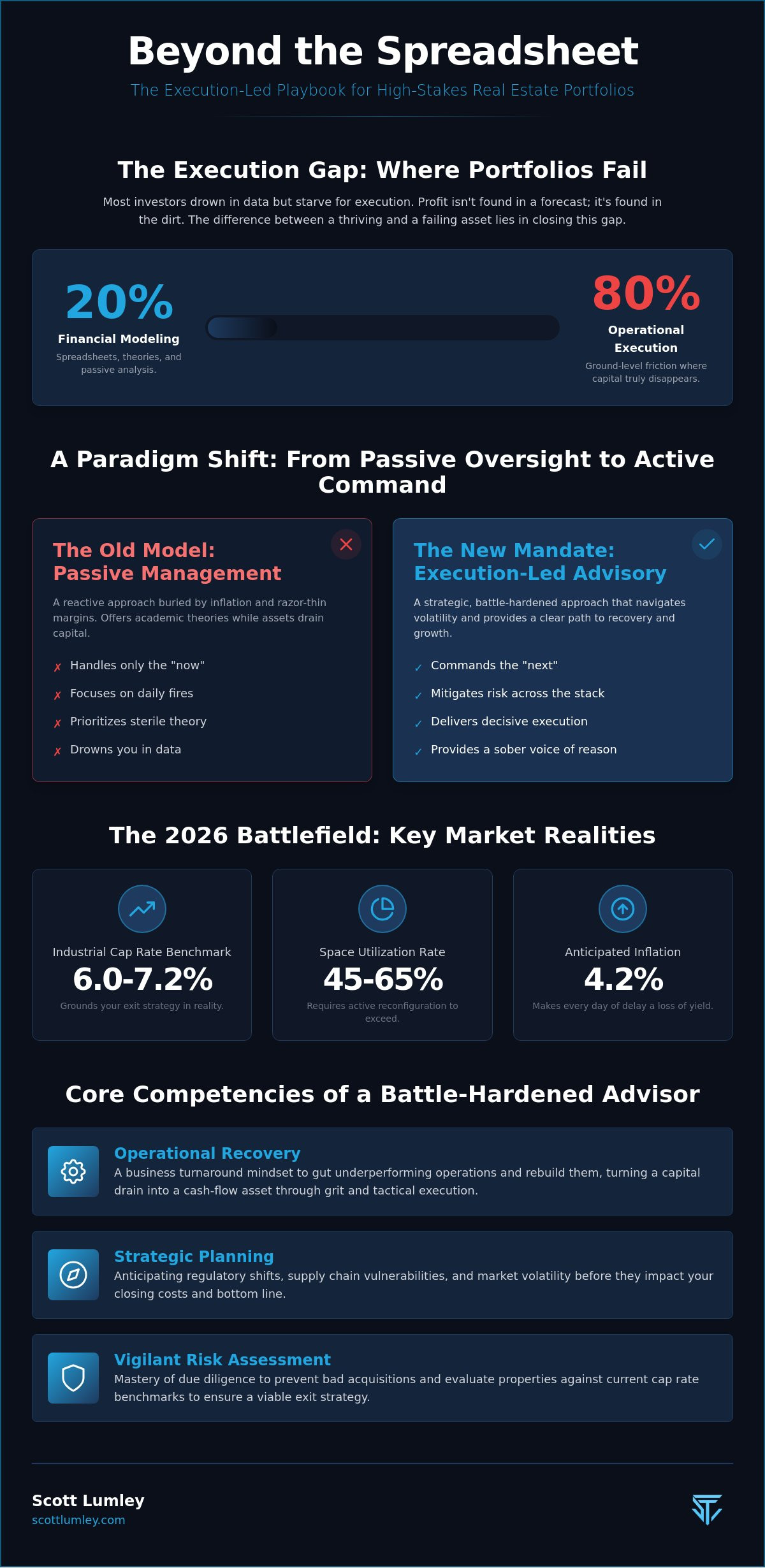
You already know that the difference between a failing portfolio and a resilient one lies in the details of the daily grind. In this guide, you'll learn how a veteran portfolio advisor identifies the specific friction points that are quietly killing your returns. We'll show you how to execute growth strategies that stabilize your investments and provide a clear path to recovery for assets that are currently underwater. From navigating tight borrowing conditions to hitting the 2026 industrial cap rate benchmarks of 6.0 to 7.2 percent, this is your briefing on moving from theoretical planning to decisive, tactical execution.
Key Takeaways
- Identify why the shift from passive property management to execution-led advisory is critical for protecting high-stakes assets in 2026.
- Learn how to close the "execution gap" by focusing on the 80% of portfolio success that financial models fail to capture.
- Apply the "Operator Test" to vet advisors based on their real-world ability to handle friction rather than their theoretical expertise.
- Understand the critical protocols for the first 72 hours of a crisis to stabilize operations and recover distressed properties.
- Discover how professional real estate leadership advisory leverages decades of operational experience to turn survival into sustainable scaling.
What is a Real Estate Portfolio Advisor in 2026?
In 2026, a real estate portfolio advisor is not a suit in a glass office. They are strategic leaders managing the entire lifecycle of property assets to extract every cent of value. The old model of passive management is dead. It was buried by inflation, shifting work patterns, and razor-thin margins. Today, the role demands execution-led advisory. You don't need someone to tell you the market is volatile. You need someone to tell you how to survive it.
Traditional consulting often fails because it prioritizes theory over the harsh realities of a construction site or a logistics hub. While Modern Portfolio Theory provides a framework for diversification and risk-adjusted returns, it doesn't account for a broken HVAC system or a tenant who refuses to pay. That is where real estate leadership advisory steps in. It's the difference between looking at a map and actually driving the truck. Stability in high-stakes markets is earned through movement and friction, not just spreadsheets.
The Difference Between Management and Advisory
Property management handles the "now." It's about maintenance, leases, and daily fires. Advisory is about the "next." It focuses on capital allocation and risk mitigation across your entire stack. A seasoned advisor identifies operational friction before it bleeds into your bottom line. They don't just report on the 2026 benchmark space utilization rate of 45 to 65 percent; they tell you how to reconfigure the asset to exceed it. Management keeps the lights on. Advisory ensures there's a building left to light up.
Core Competencies of a Battle-Hardened Advisor
You can't advise on what you haven't touched. A real advisor needs deep knowledge of construction and industrial sector dynamics. They must possess a business turnaround consultant mindset, ready to gut underperforming operations and rebuild them from the floor up. This requires a mastery of due diligence to prevent bad acquisitions from entering the portfolio in the first place.
- Operational Recovery: Turning a capital drain into a cash-flow asset through grit and tactical execution.
- Strategic Planning: Anticipating regulatory shifts, like the 2026 VA fee revisions, before they impact your closing costs.
- Risk Assessment: Evaluating industrial properties against the current 6.0 to 7.2 percent cap rate benchmarks to ensure your exit strategy is grounded in reality.
This isn't about polished marketing promises. It's about 40 years of lived experience in the trenches. If your advisor hasn't navigated a crisis, they aren't prepared to lead you through one.
Strategic Asset Allocation vs. Operational Execution
Financial modeling is comfortable. It's safe. It's also only 20% of the equation for portfolio success. The remaining 80% is where most investors bleed out. They mistake a well-formatted spreadsheet for a viable strategy. In reality, the execution gap is a chasm where capital disappears. You don't need another analyst; you need real estate leadership advisory that understands how to move from paper to property. Profit isn't found in a forecast; it's found in the dirt.
Stress-testing a strategy requires more than just adjusting a few cells in Excel. It requires due diligence consulting services that hunt for operational friction before the deal closes. Are the local contractors reliable? Is the supply chain for your industrial assets actually stable? If you're in a high-growth phase, a strategic business advisor becomes essential. They ensure your expansion doesn't outpace your ability to manage the assets you already own. Growth without execution is just a slower way to fail.
Bridging the Gap Between Data and Action
Market research identifies where to build, but operational execution determines if you'll actually finish. Paralysis by analysis is a luxury you can't afford in a market where 2026 inflation sits at 4.2 percent. Every day of delay is a day of lost yield. Stop staring at the data and start directing the action. In 2026, operational execution trumps theoretical planning because profit is found in the movement of assets, not the observation of them.
Leadership in Construction and Development
Development pipelines are where margins go to die. Friction between owners, contractors, and municipal regulators is the primary culprit for cost overruns. Effective construction business consulting aligns every vendor with the overarching portfolio goals. It's about accountability. It's about ensuring the project doesn't just look good on a blueprint but performs on the balance sheet. If your development projects are stalling, you need an operator who knows how to break the logjam.
If your current strategy feels like a series of unfinished thoughts, it's time for a change. You need a partner who leads from the trenches rather than the boardroom. Consider a strategic execution briefing to identify exactly where your portfolio is losing momentum.
Evaluating Your Advisor: Key Performance Benchmarks
Most advisors hide behind complex charts and vanity metrics. They'll talk about market sentiment or projected appreciation. These numbers look good in a board deck but don't pay the bills. Real impact is measured in cash flow and operational stability. If your advisor can't explain how they'll fix a failing asset, they aren't an advisor; they're a spectator. You don't need a spectator when your capital is on the line.
You need the "Operator Test." Does your advisor have dirt under their fingernails? Have they ever managed a construction crew or navigated a logistics crisis? In 2026, real estate leadership advisory is about being in the trenches. It's about knowing the difference between a contractor's excuse and a genuine supply chain failure. Hard-won wisdom is the only benchmark that matters when the stakes are high. If they haven't lived through a turnaround, they shouldn't be leading yours.
The Portfolio Advisor Scorecard
A battle-hardened advisor should be judged on tangible outcomes, not theoretical potential. Use these three metrics to grade their performance:
- Speed of operational stabilization: In a crisis, every hour is lost capital. A strong advisor stabilizes operations and stops the bleeding within the first 72 hours.
- Accuracy of due diligence: Bad acquisitions are the fastest way to sink a portfolio. Evaluation must be surgical, identifying structural and operational friction before the deal is inked.
- Overhead reduction: Can they cut the fat without sacrificing asset quality? In 2026, a space utilization rate of 45 to 65 percent is the benchmark for commercial properties. If your advisor isn't hitting these numbers, your portfolio is bloated.
Theory vs. Experience: The Red Flags
Don't be blinded by a polished resume. Look for the cracks in their approach. If an advisor relies heavily on corporate jargon and motivational fluff, they're masking a lack of substance. Experience in manufacturing, retail, or logistics sectors is non-negotiable. These assets aren't just entries on a ledger; they are complex operations with moving parts. An advisor who avoids the "trenches" will never see the friction points that kill your ROI.
Transparency and integrity are the only paths to survival. You need a strategist who tells you the truth, even when it's ugly. You don't need a cheerleader. In a market where commercial investment is projected to rise 16 percent to $562 billion in 2026, the stakes are too high for anything less than total clarity. Demand an advisor who values your recovery as much as your expansion.
Mitigating Risk and Stabilizing Distressed Assets
In a real estate crisis, the first 72 hours determine if you survive or fold. This isn't the time for committees or theoretical models. It's the time for triage. Effective real estate leadership advisory treats crisis management as a non-negotiable pillar of resilience. When an asset is bleeding capital, you don't need a report. You need movement. You need to stop the bleeding, secure the site, and audit every dollar moving through the operation. Speed is your only leverage.
Stabilizing a failing property requires executing aggressive real estate turnaround services. This process often reveals hidden friction that passive owners miss. Property tax debt is a common silent killer. Utilizing a specialized Property Tax Debt System as a strategic framework can help navigate these liabilities without draining your remaining liquidity. With over 22 million renter households currently experiencing housing-cost burdens in 2026, the risk of multifamily delinquency is high. You must identify these operational overhead traps before they compromise the entire portfolio.
The Recovery Framework for Distressed Property
Recovery is a methodical climb out of a hole. It starts with an immediate cash flow audit and operational triage to identify where the leaks are. Once the bleeding stops, you move to restructuring management and vendor contracts. Most distressed assets are weighed down by bloated agreements that don't serve the current reality. Finally, you establish long-term strategic planning. You decide whether to execute a clean exit or reinvest to scale. There is no middle ground in a recovery phase.
Reducing Risk Through Gritty Due Diligence
Risk mitigation begins before you own the problem. You have to look past the polished marketing and high-gloss brochures of potential acquisitions. Physical site inspections and deep operational audits are the only ways to verify asset health. Don't trust the seller's data; verify it yourself. Rigorous operational due diligence prevents 90% of downstream operational crises by identifying structural deficits and hidden liabilities before capital is committed. If you can't see the friction during the due diligence phase, you'll feel it in your margins later.
Crisis is inevitable in high-stakes real estate, but failure is not. You need a strategist who has navigated the worst-case scenarios and come out the other side. Secure your distressed asset recovery plan before the next market shift turns a minor friction point into a total collapse.
The Scott Lumley Approach: Execution Over Sterile Theory
Success isn't found in a boardroom. It's found in the friction of high-stakes operations. Scott Lumley provides real estate leadership advisory built on four decades of lived experience. This isn't theoretical. It's the grit of construction, the complexity of retail, and the heavy lifting of manufacturing. Most advisors focus on finding people. Scott focuses on fixing the business. If you're drowning in organizational chaos, you don't need another consultant with a slide deck. You need a strategist who knows how to move the needle in the real world.
The industrial sector and property investment firms require a specific type of intensity. These assets don't respond to polite suggestions. They respond to execution. Scott’s approach is unapologetically direct. It prioritizes survival and recovery because growth is impossible without a stable foundation. We move from chaos to sustainable, execution-led growth by focusing on what actually works on the ground. It's about stripping away the fluff and getting to the core of the operation.
Why a Battle-Hardened Operator Matters
You can't lead through a crisis if you've never been in one. Scott’s history is a map of extreme success and significant adversity. This isn't a polished marketing claim; it's a survival record. The lessons from "I Survived Africa" translate directly to global operational resilience. When things go sideways, you don't need a cheerleader. You need direct leadership that cuts through corporate noise to deliver results. Scott leads from the trenches. He values survival as much as expansion. He understands that recovery is often the first step toward true scaling.
Next Steps: Stabilizing Your Portfolio
Organizational chaos is a choice. You can stay stuck in the "execution gap" or you can move toward sustainable growth. The process starts with a strategic audit of your current assets. We identify the leverage points for rapid recovery. We strip away the fluff. We focus on the hard realities of your property investments. In 2026, where market activity fees for municipal advisors are seeing a temporary 45 percent credit, there's a window for strategic movement. Don't waste it on sterile theory.
- Initiate a Strategic Planning session to map your recovery.
- Audit every operational friction point currently draining your ROI.
- Stabilize distressed assets with immediate, tactical triage.
- Scale using proven industrial sector strategies that prioritize durability.
Don't wait for the next market shift to expose your weaknesses. Execute your growth strategy with Scott Lumley and turn your portfolio into a resilient, high-performing machine. It's time to stop planning and start executing.
Secure the Future of Your High-Stakes Assets
Success in volatile markets requires more than just a well-formatted spreadsheet. You've seen how the chasm between data and action can swallow capital. True real estate leadership advisory bridges that gap by prioritizing execution over sterile theory. Whether you are navigating the first 72 hours of an operational crisis or stress-testing a new industrial acquisition, the focus remains the same: identify friction and move with purpose. Stabilization is not a suggestion; it is a requirement for survival.
Scott Lumley brings 40 years of hands-on experience in construction and property investment to your most complex challenges. This is a proven turnaround and crisis management record forged in the trenches of the industrial sector. Don't let operational drag settle for another quarter. It's time to move from organizational chaos to sustainable, execution-led growth. Get the execution-led strategy your portfolio deserves from Scott Lumley. Your assets are capable of more, and the path to recovery starts with a single, decisive move.
Frequently Asked Questions
What does a real estate portfolio advisor actually do?
A real estate portfolio advisor executes strategic lifecycle management to maximize asset value. They don't just provide data; they identify operational friction and implement growth strategies. This role is about movement and results rather than just theoretical planning. They look at the entire stack to ensure your capital is working at peak efficiency and your operations are lean.
How is a portfolio advisor different from a property manager?
Property managers handle daily operations while portfolio advisors focus on long-term capital strategy. Managers ensure the lights stay on and tenants are happy. Advisors mitigate risk and plan for the next acquisition or exit. Professional real estate leadership advisory provides the high-level briefing necessary for decisive, tactical execution across multiple assets rather than just one building.
When should a real estate firm hire an external advisor?
Hire an external advisor when your internal team is overwhelmed by operational friction or entering a high-stakes growth phase. If your ROI is slowing despite strong market indicators, you have an execution gap. An advisor provides a sobering voice of reason to help you navigate volatile markets and complex development pipelines without losing your momentum or your margins.
Can a portfolio advisor help with distressed assets or business turnarounds?
Yes, stabilizing distressed assets is a core pillar of strategic advisory. It starts with immediate operational triage to stop the bleeding within the first 72 hours. The advisor then restructures management and vendor contracts to turn a capital drain into a cash-flow asset. This gritty approach prioritizes survival and recovery over sterile financial models that don't work in a crisis.
What industries does Scott Lumley specialize in for real estate advisory?
Scott Lumley specializes in the construction, industrial, retail, and logistics sectors. These industries require a battle-hardened operator who understands the physical realities of the site. His expertise is built on four decades of hands-on experience navigating both extreme success and significant adversity in these complex environments. He understands the dirt, the docks, and the development pipeline.
How does due diligence fit into real estate portfolio management?
Due diligence is the primary tool for stress-testing a portfolio strategy before capital is committed. It involves physical site inspections and operational audits that look past polished marketing brochures. Gritty due diligence identifies structural deficits and hidden liabilities. It prevents the vast majority of downstream operational crises by verifying asset health in the real world before you sign the deal.
What is the "Property Tax Debt System" mentioned in Scott Lumley’s services?
The Property Tax Debt System is a strategic framework designed to manage and resolve property tax liabilities. It is not a software product. Instead, it serves as a tactical tool to protect liquidity and navigate complex debt structures. This system helps investors stabilize their portfolios by addressing one of the most common silent killers of property ROI before it leads to foreclosure.
How long does it take to see results from real estate leadership advisory?
Stabilization often begins within the first 72 hours of an engagement. While long-term scaling is a methodical process, immediate results come from stopping operational leaks and auditing cash flow. Sustainable growth takes longer, but the path to recovery starts with decisive moves that provide absolute clarity on your next actionable step. You'll see movement long before you see a final report.


