

Growth is often a death sentence for a mid-sized operation. It isn't a lack of vision that kills most companies; it's the friction of their own success. You've likely felt the weight of stagnant revenue despite your team working harder than ever. To survive, you need business growth strategies that prioritize execution over theory. When operations can't keep pace with ambition, your business doesn't just slow down. It breaks.
You know that scaling requires more than just a higher marketing budget. It demands a total removal of the operational grit that slows down your delivery. This article moves past the corporate fluff to deliver gritty, execution-led tactics designed for high-stakes environments. You'll learn how to implement systems that scale without shattering your internal stability.
We're going to look at the reality of sustainable expansion. We will cover how to identify leverage points, eliminate drag, and apply high-level leadership directly in the trenches. By the end, you'll have a blueprint for increasing asset value while maintaining total operational control.
Key Takeaways
- Shift your focus from vanity revenue to sustainable growth by aligning your margins with actual operational capacity.
- Implement battle-tested business growth strategies that use tactical blueprints to scale without creating internal chaos.
- Identify and neutralize friction points in labor and supply chains before they become catastrophic failure points during expansion.
- Secure your expansion by integrating crisis management and due diligence into every stage of your strategic planning.
- Execute a hard-nosed operational audit to ensure your infrastructure can handle the weight of increased market share.
The Brutal Reality of Business Growth: Why Most Strategies Fail
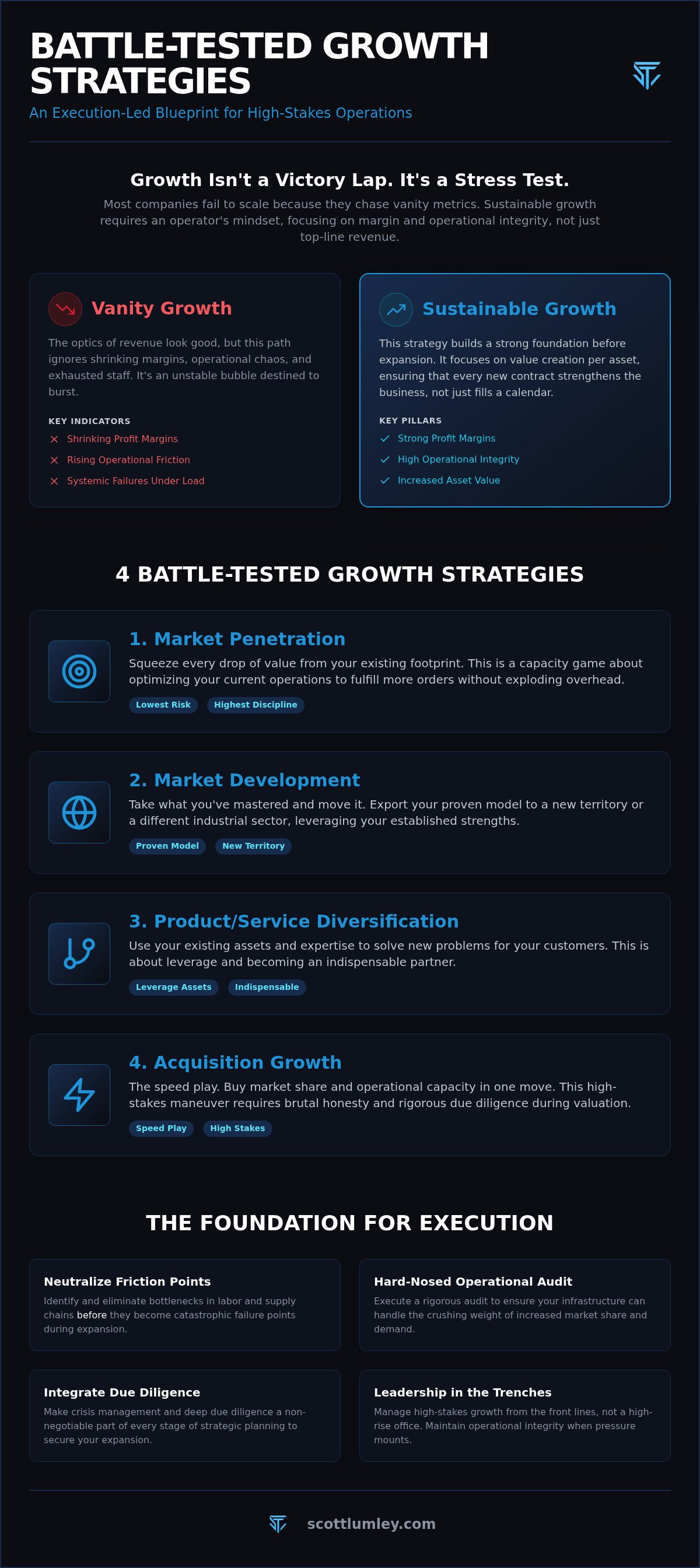
Growth isn't a victory lap. It's a stress test. Most companies treat expansion like a sales problem, but it's actually an operational one. A real growth strategy is a tactical blueprint for increasing revenue and market share without snapping the spine of the company. If your plan only looks at the top line, you aren't growing. You're inflating a bubble that's destined to burst. Successful business growth strategies require a foundation that is as strong as the ambition driving them.
There's a massive difference between vanity growth and sustainable growth. Vanity growth is about the optics of revenue. It looks good in a press release but ignores shrinking margins and exhausted staff. Sustainable growth focuses on margin and operational integrity. You need a stable foundation before you push for more. Growth requires an operator’s mindset, not just a marketing budget. Without leadership that can manage the friction of expansion, the #1 growth killer, operational friction, will quickly outpace your capacity to lead.
The High Cost of Scaling Chaos
Increasing volume without fixing existing bottlenecks leads to systemic failure. When you pour more work into a broken system, the cracks widen. This is where strategic business consulting enters the picture. It provides the stabilization needed to ensure your current ops don't collapse under the weight of new demand. You must identify "distressed growth" early. If your customer service is failing and your lead times are doubling, your expansion is a liability, not an asset.
Value Creation vs. Pure Expansion
Pure expansion is a trap. Adding more customers is easy. Creating more value per asset is the real challenge. For firms in manufacturing or logistics, the focus should be on throughput and efficiency rather than just order count. Every new contract should strengthen the business, not just fill the calendar. Leadership must stay in the trenches during these transitions. You can't manage high-stakes growth from a high-rise office. It requires a presence that maintains integrity when the pressure mounts. Implementing effective business growth strategies means knowing when to push and when to fortify your position.
4 Battle-Tested Growth Strategies for High-Stakes Operations
Growth isn't a single path. It's a choice between four distinct tactical maneuvers. Most academic models fail because they don't account for the friction of real-world implementation. These business growth strategies focus on where the rubber meets the road. You can't just pick one and hope for the best. You have to execute with precision.
- Market Penetration: This is about squeezing every drop of value out of your existing footprint. It's the lowest risk but requires the highest operational discipline.
- Market Development: You take what you've mastered and move it. Whether it's a new territory or a different industrial sector, you're exporting a proven model.
- Product/Service Diversification: This is leverage. You use your existing assets and expertise to solve new problems for your customers. It's about becoming indispensable.
- Acquisition Growth: This is the speed play. You buy market share and operational capacity in one move. It's high stakes and requires brutal honesty during the valuation phase.
Market Penetration in the Industrial Sector
In manufacturing and logistics, penetration is a capacity game. You don't just need more orders. You need the ability to fulfill them without your overhead exploding. This means optimizing the shop floor to increase throughput. Using due diligence consulting services allows you to find the hidden waste that's currently strangling your margins. Often, the best way forward is a temporary retrenchment. You cut the dead weight and the low-margin distractions. This tactical reset clears the way for a concentrated growth spurt that actually sticks.
Strategic Real Estate Expansion
Real estate growth isn't just about accumulating acreage. It's about strategic positioning. Applying real estate leadership advisory helps you see the portfolio as a cohesive machine rather than a collection of deeds. Distressed property assets are a prime example of high-margin growth vehicles. They're messy, they're risky, and they're where the real money is made. Due diligence remains the bedrock of this strategy. You don't buy based on a broker's polished brochure. You buy based on the hard reality of the asset's current state and its future operational potential. If you want to scale without breaking, professional Strategic Planning is your first line of defense.
Every one of these strategies requires leadership that isn't afraid to get dirty. You can't lead a turnaround or a massive expansion from behind a desk. It takes presence. It takes an operator who understands that business growth strategies are only as good as the team executing them in the trenches every day.
Scaling Operations vs. Scaling Chaos: Managing Friction
Scaling a business is a high-speed maneuver. If you do it wrong, you don't just miss your targets; you destroy your infrastructure. Most business growth strategies overlook the physical reality of the supply chain and labor market. You can't just wish your way into a larger footprint. You have to build the capacity to handle the weight. Growth isn't a reward for hard work. It's a new set of problems that require a different level of tactical execution.
Every growth push needs a crisis management consulting plan baked into the strategy. Things will break. Vendors will fail. Key staff will quit. If you don't have a recovery plan ready, these friction points become terminal. One 2026 summary linked cash flow problems to 82% of business closures; this is the price of growing faster than your capital and operations can support. You need a strategy that accounts for these shocks before they happen.
Successful operators maintain a strict "Operator's Ratio" between expansion speed and operational stability. If you push speed past your stability threshold, you're just scaling chaos. This is why moving from a founder-led model to professional strategic leadership is mandatory. You can't micromanage a multi-site industrial operation the same way you ran a three-man shop. You need systems that work when you aren't in the room.
Identifying Operational Bottlenecks
Audit your logistics and manufacturing flow for hidden drag. Look at the shop floor and the warehouse. Leadership debt is real. It's the cost of making quick, messy decisions during early growth that you now have to pay back with interest. Operational friction is the gap between strategic intent and floor-level execution. If your team on the floor doesn't understand the mission, your strategy is just paper. You have to bridge that gap with clear, decisive communication and better processes.
Sustainable Scaling for Mid-Market Firms
Tech companies can blitzscale because software has zero marginal cost. Industrial and construction firms don't have that luxury. You have trucks, tools, and people. Scaling these assets requires a methodical approach, not a blind sprint. Build a gritty recovery plan for when growth initiatives hit unexpected walls. Leadership consulting services are vital here. They help manage the team transitions that happen when your old ways of working no longer fit your new scale. You need leaders who can stabilize the front lines while you focus on the next move.
The Strategic Blueprint: 5 Steps to Execute Growth
Growth is a sequence, not a wish. To implement business growth strategies that actually stick, you need a repeatable framework. You don't need another theoretical model. You need a checklist that works in the field. Execution is the only thing that separates a hallucination from a strategy. Follow these five tactical steps to build a scalable operation.
- Audit: Conduct a hard-nosed assessment of your current operational integrity. If you can't handle your current volume without constant fire-fighting, you aren't ready to scale.
- De-Friction: Fix the broken processes that will snap under the pressure of scale. This is the time to eliminate "workarounds" and temporary fixes.
- Resource Allocation: Direct your capital and your best leadership to high-leverage growth zones. Don't starve your winning departments to feed your failing ones.
- Execution: Deploy tactical teams to implement the growth plan in the trenches. Strategy happens in the boardroom, but execution happens on the floor.
- Monitor & Pivot: Use real-world feedback to adjust the strategy in real-time. A plan that can't survive contact with reality isn't a plan; it's a liability.
Conducting a No-Nonsense Operational Audit
You have to look past the P&L. Profitability can hide a lot of operational sins. You need to see the reality of the floor and the field. Validate your data against the actual movement of goods and services. Often, this process reveals "distressed assets" within your own organization that need a business turnaround consultant. Identifying these weak points before you scale is the difference between controlled expansion and a total collapse.
Tactical Execution Over Sterile Theory
A 50-page report is useless without a 1-page execution plan. Your team doesn't need more theory. They need to know what to do on Monday morning. The role of a strategic advisor is to lead the pivot, not just suggest it. You must maintain a relentless focus on the core business while chasing expansion. Don't let the shiny new project distract you from the operations that pay the bills. If you're ready to move beyond corporate fluff and start building real value, it's time for professional Strategic Planning that prioritizes results over promises.
Successful business growth strategies require leadership that stays in the trenches. You can't manage high-stakes growth through a dashboard alone. You need to be where the work is happening, ensuring that every tactical move aligns with the larger strategic goal. This is how you build an asset that is durable, scalable, and valuable.
Moving Beyond Sterile Theory to Real-World Results
Academic strategy dies on the shop floor. You don't need a consultant with a fresh MBA and a slide deck. You need an operator who has faced the friction of a supply chain collapse or a manufacturing bottleneck. Real-world business growth strategies are forged in the trenches, not in a classroom. When the stakes are high, theory is a liability. Experience is the only currency that matters. If your current advisor hasn't seen a turnaround through to the end, they aren't prepared to lead your expansion.
Scott Lumley brings 40 years of hands-on experience in construction, manufacturing, and logistics. This isn't theoretical advice. It's the hard-won wisdom of an advisor who has navigated extreme success and significant adversity. A certification won't help you when a production line stops during a critical scale-up. Lived experience will. This background allows for a high-level briefing style that provides clarity at high speed. There is no wasted space in this approach. Every move is designed to reinforce your position and protect your assets.
Why Hands-On Experience is Your Greatest Asset
There's a fundamental difference between a "coach" and a battle-hardened operator. A coach tells you what to do from the sidelines. An operator leads from the front lines. Scott's background in industrial sector turnarounds and real estate leadership provides a unique perspective on expansion. He understands that growth is a blueprint for high-stakes operations, not a marketing experiment. This perspective is vital for mid-market firms that can't afford the failures seen in the tech world. Scott Lumley’s approach is the intersection of strategic foresight and tactical grit.
Next Steps: Securing Your Strategic Growth Blueprint
Operational leaders don't have time for superficial appearances. You need results. Engaging for Strategic Planning, Crisis Management, or Real Estate Advisory means choosing a partner who values survival and recovery as much as expansion. The impact is immediate. You move from reactive fire-fighting to proactive execution. This isn't about optimistic theories. It's about the harsh realities of business and the leverage points required to overcome them.
Whether you're facing stagnant revenue or operational chaos during scaling, the solution isn't more theory. It's a direct, results-driven approach to business growth strategies. Secure your foundation. Remove the friction. Scale with precision. The window for smart growth is always narrow. Don't waste it on sterile plans that can't survive the reality of the field. Stop planning for growth and start executing for it.
Executing for Longevity: Your Next Operational Move
Growth is a test of your operational integrity. It isn't a sales race; it's a battle against friction. You've seen that sustainable expansion requires more than just high-level theory. It demands tactical blueprints and a willingness to lead from the trenches. Effective business growth strategies prioritize the removal of bottlenecks before adding the weight of new volume. Without this discipline, you aren't scaling. You're just accelerating toward a breaking point.
Success in high-stakes environments comes down to execution. You need an advisor who understands the grit of the shop floor and the complexity of industrial turnarounds. With 40 years of operational experience, Scott Lumley provides hands-on industrial advisory that moves past corporate fluff to deliver tangible asset value. It's time to stop fire-fighting and start building a durable, scalable operation.
Don't let your growth become a liability. Take control of your trajectory with a strategy built on lived experience and strategic foresight. Secure Your Strategic Growth Blueprint with Scott Lumley and ensure your business is equipped to handle the pressure of the next level. Your future operations depend on the moves you make today.
Frequently Asked Questions
What is the difference between organic growth and strategic expansion?
Organic growth is incremental. It's the result of doing what you already do slightly better or more often. Strategic expansion is a deliberate, tactical move into new markets, products, or acquisitions. It requires a blueprint and a significant shift in resource allocation. While organic growth relies on existing momentum, strategic expansion demands new operational capacity and leadership bandwidth to handle the increased friction of scale.
How do I know if my business is ready for a growth strategy?
You're ready when your current operations are stable, profitable, and running without constant fire-fighting. If your team is already at 100% capacity and your margins are thinning, you aren't ready for business growth strategies. You're ready for stabilization. Readiness is defined by having the "Operator's Ratio" in your favor. You need excess leadership bandwidth and a proven, repeatable process that won't break under the weight of new volume.
Can a business grow too fast? What are the risks?
Yes. Growing too fast leads to "distressed growth" where revenue outpaces operational capacity. The primary risks include catastrophic cash flow failure, quality degradation, and total leadership burnout. One 2026 summary noted that cash flow issues drive 82% of business closures. When you scale chaos, you don't just lose money; you destroy your brand's integrity. Rapid expansion without a corresponding crisis management plan is a gamble, not a strategy.
What is the role of a business growth consultant in a turnaround?
A growth consultant in a turnaround acts as a tactical operator who identifies and removes friction. They don't just offer advice; they lead from the trenches to stabilize the foundation. Their role is to audit assets, cut dead weight, and fix the broken processes that caused the decline. Once the operation is stabilized, they implement business growth strategies that prioritize margin over vanity metrics, ensuring the next phase of expansion is durable.
How does due diligence impact business growth strategies?
Due diligence is the bedrock of any expansion or acquisition move. It isn't just a legal check; it's a hard-nosed assessment of operational reality. By identifying hidden waste and "leadership debt" early, you avoid buying or building a liability. Proper due diligence ensures your growth strategy is based on verified data rather than optimistic projections. It allows you to price risk accurately and build a recovery plan before you commit capital.
What are the most common mistakes in mid-market growth planning?
The most frequent error is focusing on revenue while ignoring operational friction. Many firms attempt "blitzscaling" without the infrastructure to support it. They fail to audit their logistics or manufacturing flow, leading to systemic failure when volume increases. Another mistake is "leadership debt." This happens when founders refuse to move from micromanagement to professional strategic leadership. Without clear systems and delegated authority, the business snaps under the pressure of scale.
How can real estate firms use leadership advisory to scale portfolios?
Real estate firms use leadership advisory to move from property management to portfolio strategy. Advisory services help leaders evaluate distressed assets as high-margin growth vehicles while maintaining operational control. It provides the strategic foresight needed to manage risk across multiple sites. By focusing on asset value and throughput, firms can scale their footprint without losing the integrity of their individual investments. It's about building a cohesive machine rather than a collection of deeds.
Why do most growth strategies fail at the execution level?
Most strategies fail because they are built on sterile theory rather than tactical reality. A 50-page report is useless if the team on the floor doesn't know what to do on Monday morning. Failure happens in the gap between strategic intent and trench-level execution. Without leadership present on the front lines to manage pivots and remove bottlenecks, the plan collapses. Execution requires grit, presence, and a relentless focus on fixing what breaks in real-time.


