

Growth is often the fastest way to kill a business that hasn't earned the right to scale. Most leaders think more revenue solves everything. It doesn't. Without the right architecture, more volume just creates more friction. You feel it every day. You're stuck in every meeting, delivery is slowing down, and you're worried that the next big win might actually be the thing that breaks the company. It's a high-stakes trap where your own success starts to feel like a liability.
We agree that you shouldn't have to choose between a growing company and a functional life. This article shows you how a business scaling consultant identifies the fractures in your operations before they become fatal. You'll discover how to remove friction and scale your business without breaking the systems that built it. We're moving past the fluff to focus on strategic execution, higher profit margins, and building a company that operates with total clarity, even when you aren't in the room.
Key Takeaways
- Identify the scaling ceiling where volume starts to break your current systems. Learn the difference between simple growth and the structural shifts required for true scaling.
- Move from "doer" to "strategist" by building infrastructure that supports speed. High-stakes operations require systems that run without the CEO managing every detail.
- Work with a business scaling consultant to conduct an operational audit. Finding and fixing friction points is the only way to protect profit margins as you expand.
- Systematize your critical path to automate delivery. This roadmap prevents collapse by ensuring your core processes stay intact during rapid growth phases.
- Choose strategic leverage over growth at all costs. Use a battle-tested blueprint to enter new sectors without taking on unnecessary risk or debt.
Scaling vs. Breaking: Why Growth Destroys Mid-Market Firms
Growth is a seductive liar. Most owners believe that if they just land one more big contract, the pressure will vanish. It won't. If your current systems are straining at 100% capacity, they will shatter at 110%. This is the scaling ceiling. It is the invisible line where your processes, people, and software simply stop working. Crossing it without a plan doesn't lead to wealth; it leads to a total operational collapse. You end up with a business that is too big to manage but too expensive to sustain.
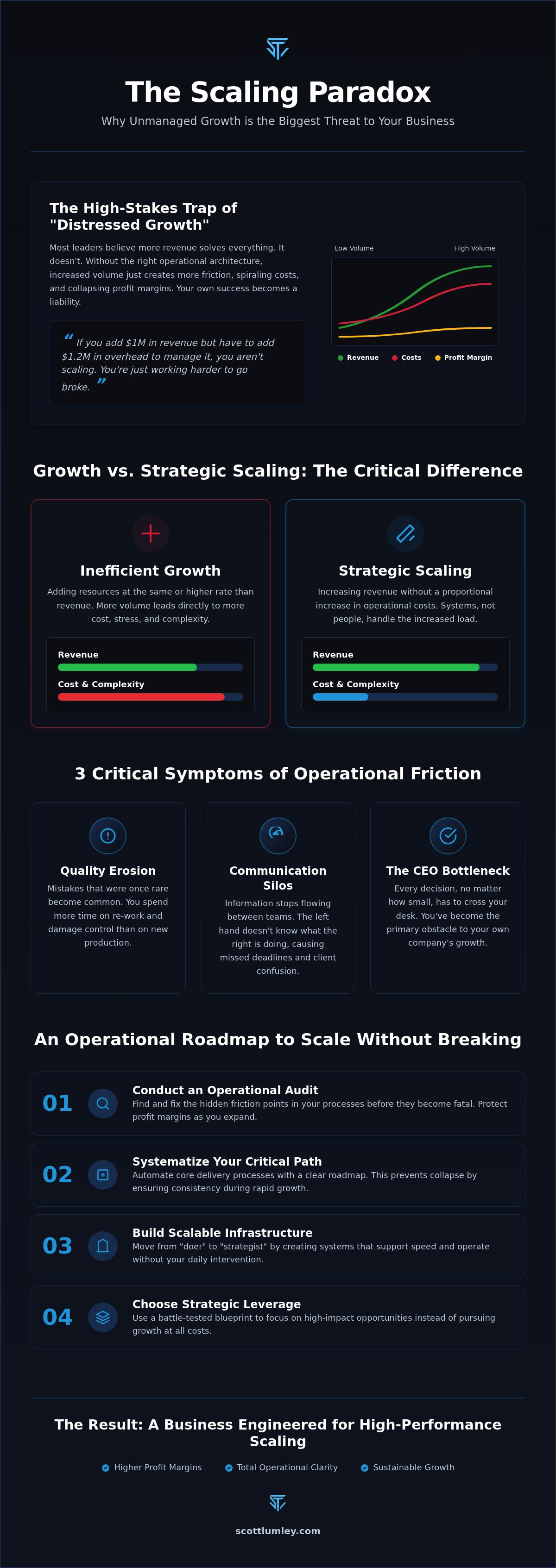
True Scalability is not just about getting bigger. It is a fundamental shift in how the machine operates. Business scaling is the ability to increase revenue without a proportional increase in operational cost or stress. If you add $1 million in revenue but have to add $1.2 million in overhead to manage it, you aren't scaling. You're just working harder to go broke. A veteran business scaling consultant knows that the goal isn't just a larger top line. The goal is a more efficient bottom line that produces higher margins at higher volumes.
Pouring money into marketing while your operations are leaking is a death sentence. It is like putting a bigger engine in a car with a broken transmission. You might go faster for a mile, but the explosion will be spectacular. Many advisors focus on "surging" revenue because it looks good on a slide deck. They ignore the fact that unmanaged surges break the backbone of mid-market firms. You don't need more leads if you can't deliver the ones you have without burning out your staff or compromising your reputation.
The Symptoms of Operational Friction
Friction is the heat generated by a system that wasn't built for its current speed. You can see it in the data and feel it on the floor every day. When volume increases, these cracks become craters:
- Quality Control Erosion: Mistakes that used to be rare are now becoming standard procedure. You're spending more time on re-work than on new production.
- Communication Silos: Information stops moving from leadership to the execution teams. The left hand no longer knows what the right hand is doing, leading to missed deadlines and confused clients.
- The CEO Bottleneck: Every decision, no matter how small, has to cross your desk before it can move forward. You've become the primary obstacle to your own company's growth.
Overcoming this bottleneck is essential for sustainable growth. B2C founders, in particular, can benefit from the structured guidance of Founder Freedom to help them move from being the center of every task to leading a truly scalable enterprise.
The Growth-Turnaround Paradox
There is a very thin line between a fast-growing company and a distressed one. Often, a business scaling consultant has to act as a business turnaround consultant because the growth was unmanaged. This is "distressed growth." It is a scenario where revenue is hitting record highs, but cash flow is dying because the cost of delivery has spiraled out of control. You must stabilize the core before you add the next layer of expansion. Expansion on top of chaos is just bigger chaos. Real scaling requires a steady hand to audit the friction points and fix them before the next phase of growth begins.
The Anatomy of a Scalable Operation: Beyond the Revenue Hype
Scaling isn't a marketing trick. It's an engineering problem. Most businesses fail because they try to grow on a foundation of sand. A business scaling consultant focuses on the hard assets and digital infrastructure that actually carry the weight of increased volume. If your software crashes or your floor layout chokes production when you hit a peak, your revenue growth is worthless. You need systems that handle high-speed execution without human intervention for every minor detail. Infrastructure is the skeleton of your company. If it isn't built for the weight of your ambitions, the whole body collapses.
Identifying internal rot is the first step toward durability. You cannot scale a broken process; you can only make it more expensive. Professional due diligence consulting services aren't just for buying companies. They are for auditing your own house to see where the friction is hiding. This rigorous assessment reveals if your infrastructure can survive common scaling challenges or if it will buckle under the pressure. It's about finding the truth in the numbers and the operations before the market finds them for you.
Leadership Execution Over Sterile Theory
Managers maintain. Operators execute. To scale, your leadership team must transition from being "doers" who fix problems to "strategists" who build systems. Hero culture is the enemy of expansion. If one person has to save the day every Tuesday, your business isn't scalable. It's fragile. By utilizing leadership consulting services, you establish a resilient chain of command. This allows the CEO to step back from the day-to-day grind and focus on the next move. You need a team that owns the outcome, not just the task list.
Asset Optimization in Scaling
In industries like manufacturing or logistics, your physical footprint is a growth engine. It is not just an expense on the P&L. Real estate and equipment must be optimized for flow and efficiency. A business scaling consultant looks at how your assets support your trajectory. Through real estate leadership advisory, you can ensure your facilities are positioned for maximum output. Whether it's warehouse logistics or production lines, every square foot should contribute to the bottom line. If you're ready to stop guessing and start executing, consider how Scott Lumley's strategic planning can fortify your foundation. Assets should be leveraged to create momentum, not just to house inventory.
Strategic Scaling vs. Growth at All Costs: Choosing Your Leverage
Growth at all costs is a suicide mission. Most "best-in-class" advice focuses on top-line revenue as the only metric that matters. It isn't. If you scale a flawed operation, you aren't building an empire; you're just accelerating toward a cliff. A business scaling consultant helps you decide when to push and when to stabilize. You have to choose between organic growth, which builds on proven systems without drowning in debt, and strategic expansion, which uses a battle-tested blueprint to enter new sectors. For many mid-market firms, partnering with Strategy & Execution Advisors provides the rigorous framework needed to ensure this expansion remains profitable and sustainable.
Scaling too fast creates a burn rate that outpaces your ability to deliver. When your overhead explodes but your efficiency drops, you fall into the burn rate trap. This is the point where many high-growth firms suddenly need crisis management consulting to stop the bleeding. Real leverage comes from identifying whether you need better technology, more skilled people, or strategic capital to move the needle without adding friction. You don't need all three at once; you need the one that unlocks the next phase of stability.
The Risk of Unfiltered Expansion
In manufacturing, an empty second shift is a silent killer. You hire the staff and pay the utilities, but if the orders or materials aren't synchronized, you're just burning cash. More sales don't always mean more value. If your operations are inefficient, a higher volume actually decreases your total valuation. Investors and buyers look for durability, not just a big number on a spreadsheet. You need to find the specific lever that provides the most movement with the least amount of friction. If you can't see the lever, you shouldn't be pulling it.
The Operator’s Perspective on Growth
Scott Lumley doesn't offer fluffy marketing promises. With 40 years of experience in construction, manufacturing, and logistics, he understands the grit required to stay profitable. There is a massive difference between a traditional consultant and a battle-hardened operator. A business scaling consultant who has actually run the floor focuses on tangible outcomes: cash flow, asset value, and operational speed. This perspective ensures that every growth move is grounded in reality, not just optimistic theory. Success is measured by how well you survive the expansion, not just how fast you start it.
How to Scale Without Breaking: An Operational Roadmap
Scaling isn't a theory. It's a sequence of deliberate, high-stakes moves. Most leaders try to scale by doing more of what they're already doing. That's a mistake. If your current process is inefficient, doing more of it just creates more waste. A business scaling consultant doesn't start with a sales plan. They start with an operational roadmap. This is a tactical guide designed to harden your infrastructure before the next wave of volume hits. You need a business that can breathe under pressure, not one that gasps for air every time a new client signs on.
Auditing for Friction
You can't fix what you haven't measured on the floor. An audit isn't a look at your bank balance; it's a look at where the work gets stuck. You have to identify legacy friction. These are the processes that worked perfectly when you were a $1M company but are now causing a total logjam at $10M. Using strategic business advisor methods allows you to map the future by identifying these specific failure points today. If a process requires a "workaround" more than once a week, it's broken. Fix it or it will bury you.
Once you've cleared the friction, the roadmap follows a strict execution path:
- Systematizing the Critical Path: Identify the non-negotiables of your delivery. These are the "must-haves" that ensure quality. Automate or document them so they happen the same way every time, regardless of who is on the clock.
- Strategic Delegation: You have to get out of the way. Build a leadership layer that can execute the plan without your constant input. If you're still the primary decision-maker for daily tasks, you're the biggest risk to the company.
- Risk Mitigation: Install safeguards. These are the operational brakes that allow you to go faster. You need alerts and KPIs that tell you a system is redlining before it actually explodes.
- Sustainable Execution: Scaling is a marathon, not a sprint. You have to maintain a pace that doesn't burn out your best people. High turnover during a growth phase is a leading indicator of a future collapse.
Building the Scalable Bench
Your business is only as durable as the people running the systems. You don't just need managers; you need leaders who understand operational grit. These are individuals who lead from the trenches and take ownership of the outcome. In many cases, bringing in fractional advisors can provide the senior-level expertise you need without the full-time overhead. This creates a culture of accountability that survives the stress of expansion. If you're ready to stop the internal chaos and start growing with precision, contact Scott Lumley for strategic planning today. A scalable bench ensures that the business keeps moving forward, even when the stakes are at their highest.
Scott Lumley: The Hands-On Business Scaling Consultant for 2026
Theory doesn't survive the first day on the floor. Most advisors offer sterile plans developed in an ivory tower. Scott Lumley is different. He is a business scaling consultant who has spent four decades in the trenches of construction, manufacturing, retail, and logistics. This isn't academic knowledge; it's hard-won wisdom from 40 years of navigating extreme success and significant adversity. When the stakes are high, you don't need a cheerleader. You need an operator who knows how to move assets and manage risk in real-time.
Execution matters more than the plan itself. A strategy that looks good on paper but can't be executed by your team is a liability. Scott focuses on gritty, tangible results rather than polished marketing promises. He strips away the fluff to reveal the harsh realities of your operation. This no-nonsense approach ensures that every move you make is grounded in operational durability. In the high-pressure environment of 2026, resilience is the only currency that counts.
The Scott Lumley Advantage
Scott provides hands-on advisory for organizations facing complex operational shifts. This isn't a passive coaching relationship. It is a total commitment to transparency and integrity. Whether you are utilizing his expertise for Strategic Planning or need immediate Crisis Management to stabilize a failing expansion, the focus remains on the outcome. His reach extends into Real Estate Advisory and specialized Property Tax Debt Systems, ensuring that your physical assets are working as hard as your people. He leads from the front, prioritizing survival and recovery as much as aggressive expansion.
Next Steps for Your Operation
Not every business is ready for a strategic scaling partner. You have to be willing to face the friction points identified in your audit. If you're ready to move beyond the revenue hype, the process begins with a focused, 72-hour assessment. This rapid audit identifies the fractures in your system before they lead to a collapse. It's time to stop the day-to-day burnout and start building a company that runs with total clarity. You can secure your operational future with Scott Lumley and begin the transition from a doer to a true strategist today.
Secure Your Operational Future
Scaling is a test of your operational backbone. It isn't about hope or marketing hype. It is about the deliberate removal of friction before it destroys the systems that built your success. You've seen how unmanaged growth leads to collapse. You know that true leverage comes from infrastructure, leadership, and asset optimization. Now, you have a choice. You can continue to be the bottleneck in your own company, or you can build a machine that executes with precision.
Scott Lumley brings 40 years of operational experience in construction, manufacturing, and logistics. He doesn't offer theories. He delivers direct, no-nonsense strategic execution. As your business scaling consultant, he focuses on the hard realities of the floor to ensure your growth is sustainable and profitable. It is time to stop reacting to chaos and start leading from a position of strength.
Partner with a battle-hardened scaling consultant today. Your business has earned the right to scale. Now, give it the systems it needs to survive the journey.
Frequently Asked Questions
What is the difference between a business growth consultant and a scaling consultant?
A growth consultant focuses on the top line and customer acquisition. A business scaling consultant focuses on the bottom line and operational efficiency. Growth is about getting bigger; scaling is about getting better so you can handle the volume without a proportional increase in stress or overhead. Scaling requires hardening the infrastructure to support the weight of new revenue.
For business owners seeking personalized guidance to navigate these complexities, you can learn more about SA Business Coaching to discover how one-on-one mentoring can support your transition to a scalable model.
How do I know if my business is ready to scale or if it needs a turnaround?
Check your cash flow against your revenue. If your sales are hitting record highs but your bank account is empty, you're in "distressed growth" and need a turnaround. Scaling is for businesses with a stable core that can survive an operational audit. If your systems break every time you add a new client, you aren't ready to scale yet.
Can a business scaling consultant help with real estate and property investment?
Yes, Scott Lumley integrates Real Estate Advisory into the scaling process. For asset-heavy industries, your physical footprint should be a leverage point for growth rather than a stagnant expense. Optimizing property assets often provides the capital or operational capacity needed for expansion. It's about making your facilities work as hard as your production line.
What industries does Scott Lumley specialize in for scaling services?
Scott specializes in construction, manufacturing, retail, and logistics. These are high-stakes, "gritty" industries where operational friction has immediate consequences. His 40 years of lived experience allows him to lead from the trenches rather than offering theoretical advice. He understands the specific challenges of moving physical assets and managing large-scale labor forces.
How long does a typical scaling engagement take to show results?
You can see the first signs of friction reduction within 72 hours of the initial assessment. While total structural transformation can take months, identifying and removing the primary bottlenecks happens quickly. Strategic execution is about immediate movement. We focus on quick wins that stabilize the core while building the long-term roadmap for expansion.
Is scaling possible without significant outside venture capital funding?
Scaling is entirely possible through organic growth and strategic planning. You don't need to dilute your equity with venture capital if you focus on profit margins and asset optimization. Many mid-market firms scale successfully by reinvesting their own cash flow into better systems, often with the support of a long-standing advisory firm like Business Wise. Capital is a tool, but it isn't a substitute for sound operations.
What is the #1 mistake mid-market firms make when trying to scale?
The biggest mistake is scaling a broken process. If your operations are inefficient at $5 million, they will be catastrophic at $20 million. Most firms try to solve operational friction with more marketing. This only accelerates the eventual collapse. You must fix the transmission before you put a bigger engine in the car.
How does operational friction impact a company’s final valuation?
Friction acts as a direct tax on your EBITDA. Buyers and investors look for durability and systems that run without the CEO in every meeting. If your business requires "hero culture" to survive, your valuation will suffer because the risk of collapse is too high. A scalable business always commands a higher multiple because it is a predictable asset. If you are preparing for an exit, a business broker dallas tx can help you leverage these operational improvements to secure the best possible deal.


