

A glossy report won't help you when $1.5 trillion in commercial debt hits the wall by the end of 2026. Most consultants hand you a 50-page PDF and walk away while your project stalls under 7.1% construction cost inflation. Real commercial real estate development advisory isn't found in a quiet boardroom; it's forged through the friction of the job site. You're likely tired of operational delays and the high-stakes risk that comes with a volatile market where conventional mortgage rates now reach 8.86%.
I agree that the industry is saturated with sterile theories that fail the moment they hit reality. You need a partner who has survived the trenches and knows how to move a project forward when the numbers get tight. This article promises to cut through the corporate jargon and deliver an execution-led strategy for the current cycle. We will provide a clear roadmap to minimize your operational risk, secure sustainable growth, and ensure your 2026 developments actually reach the finish line.
Key Takeaways
- Understand why commercial real estate development advisory must move beyond sterile reports to prioritize active leadership and execution.
- Identify the 2026 market factors, from rising tariffs to debt maturities, that cause operational friction and stall project timelines.
- Learn to utilize due diligence as a high-stakes risk reduction tool that evaluates physical assets and operational realities, not just balance sheets.
- Discover how to stabilize failing projects and pivot your strategy to manage the financial risks of a volatile economy.
- Transition from project completion to sustainable asset management by applying the grit and wisdom of a battle-hardened operator.
Beyond the Blueprint: Why Development Projects Stall Without Strategic Advisory
A blueprint is a wish list. Real estate development isn't won on a drafting table; it's won in the mud and the boardrooms where hard decisions get made. Effective commercial real estate development advisory isn't about delivering a polished report and exiting the room. It's about leadership. It is the difference between a project that breaks ground and one that dies in the entitlement phase because the lead operator couldn't handle the friction. Sterile corporate reporting won't save a deal when the reality of the site contradicts the spreadsheets.
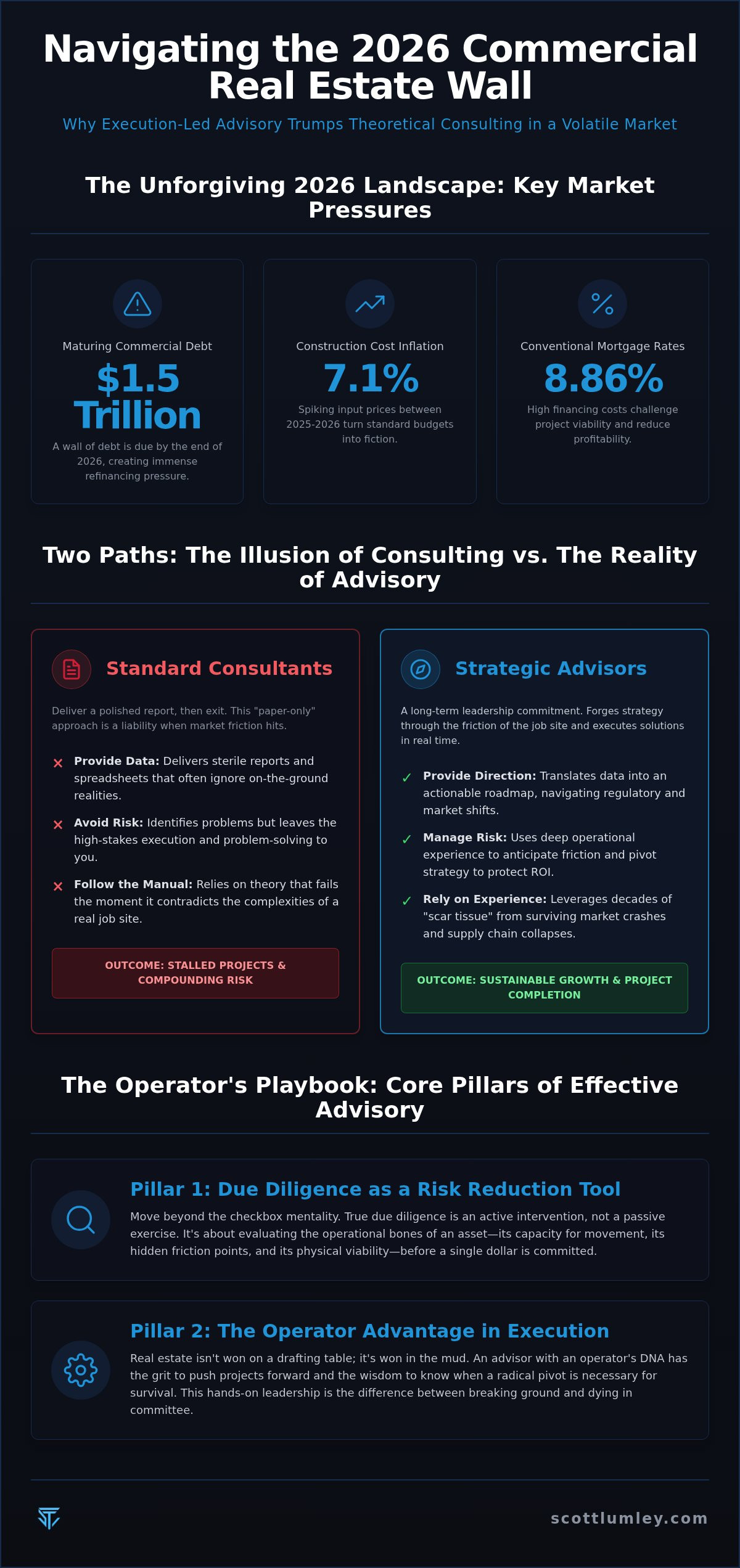
The 2026 landscape is unforgiving. We are facing a wall of approximately $1.5 trillion in maturing commercial debt. Construction input prices spiked 7.1% between 2025 and 2026. New tariffs of up to 12.5% on imports from over 80 countries have turned "standard" budgets into works of fiction. In this environment, a "paper-only" feasibility study is a liability. If your advisor hasn't lived through a market crash or a supply chain collapse, they aren't advising you; they're guessing at your expense.
The True Cost of Operational Friction
Operational friction is the silent killer of ROI. When the Real estate development process hits a snag in the design or permitting phase, the meter doesn't stop running. Interest carries. Labor costs escalate. Internal teams often develop tunnel vision, missing the blind spots that a veteran operator sees instantly. They focus on the tasks they know while ignoring the shifting regulatory landscape, such as the retroactive changes to industrial use definitions in Florida's 2026 legislation. Without a strategist to navigate these pivots, momentum stalls and the financial risk compounds daily.
Strategic Advisory vs. Standard Consulting
Standard consulting is a one-off transaction. You pay for a report that identifies a problem and then you're left to fix it. Commercial real estate development advisory is a long-term leadership commitment. It's about moving from identifying problems to executing solutions in real time. A strategist doesn't just point out that office vacancy rates sit at 13.9%; they build the execution plan to convert that underutilized space into residential units under the 21st Century ROAD to Housing Act.
- Consultants provide data; Advisors provide direction.
- Consultants avoid risk; Advisors manage it through execution.
- Consultants follow the manual; Advisors rely on four decades of scar tissue.
True advisory requires an operator who has built and managed firms from the ground up. It's about having the grit to push through the "no" and the wisdom to know when a project needs a radical pivot to survive. You don't need more theory. You need a roadmap backed by someone who has already been through the fire.
The Core Pillars of Effective Development Advisory: Due Diligence and Execution
Commercial real estate development advisory isn't a passive exercise. It's an active intervention. Most firms treat due diligence as a checkbox on a legal form. They look at the title, the zoning, and the environmental report. They stop there. That's a mistake. Real execution requires looking at the operational bones of an asset. If you don't understand how a 100,000 square foot warehouse actually breathes, you're just gambling with someone else's money. Effective commercial real estate development advisory demands a deep dive into the physical and logistical reality of the property before the first dollar is committed.
I utilize due diligence consulting services as a high-stakes risk-reduction tool. We don't just evaluate the balance sheet. We evaluate the asset's capacity for movement. In a market where industrial vacancy is projected to hit 7.8% by the end of 2026, you can't afford to hold stagnant space. You need to know if the loading docks are positioned for modern logistics or if the floor slab can handle heavy manufacturing equipment. We look for the friction points that stall growth before the deal even closes.
Operational Due Diligence in Property Investment
Assessing the physical viability of an acquisition is about survival. You're looking for hidden friction in construction and industrial assets that a standard inspector will miss. This includes evaluating old electrical grids in manufacturing plants or drainage issues on undeveloped land. Due diligence is the bridge between investment and execution. It's about stripping away the sales pitch to find the hard truth of the site. If the operational foundation is broken, the financial projections are worthless.
Strategic Planning for Industrial and Retail Assets
Navigating the transition from manufacturing to retail—or vice versa—requires more than a permit. It requires 40 years of logistics experience to understand the flow of goods and people. With dry warehouse construction costs sitting between $55 and $175 per square foot, every design error is a massive hit to your ROI. We develop a roadmap that accounts for supply chain shifts and operational bottlenecks. We don't just plan for the building. We plan for the business that lives inside it.
Part of this strategy includes integrating a Property Tax Debt System into your broader investment plan. High-stakes development often leaves owners with complex tax liabilities that can choke cash flow. Recovering from these positions requires a veteran who understands how to stabilize the asset while executing a growth strategy. If your current project feels like it's losing momentum, it might be time for a more aggressive strategic planning approach that prioritizes results over reports.
The Operator Advantage: Why Hands-On Experience Trumps Theoretical Consulting
The most common objection in this industry is simple: "Why do I need an outside advisor for a project my internal team is already managing?" It's a fair question. But the answer usually arrives too late, often when a project is $2 million over budget and six months behind schedule. Internal teams are frequently too close to the operation to see the structural rot. They are bogged down by internal politics and the "we've always done it this way" mentality. True commercial real estate development advisory provides the objective, external pressure required to break through those bottlenecks and force execution.
There is a massive chasm between an analyst and an operator. An analyst looks at a spreadsheet and sees a 6.75% prime rate. An operator looks at the same data and sees a need to renegotiate vendor contracts and tighten the supply chain to maintain margins. You don't need another report filled with sterile data points. You need a strategic business advisor who has actually built, managed, and scaled firms across construction and logistics. Resilience isn't a theory. It's scar tissue earned from four decades in the trenches.
Leadership Born in the Trenches
Boardroom strategy is useless if it can't survive the reality of a construction site. My approach to commercial real estate development advisory is rooted in forty years of hands-on experience. I've seen how a delay in the design phase can cripple a project's momentum. Scaling an operation is not the same as merely advising on growth. Scaling requires the grit to make hard calls on labor, materials, and timelines. A no-nonsense approach isn't just a personality trait; it's a survival mechanism for rapid turnaround when stakes are at their highest.
Surviving Operational Storms
Property crises don't happen in a vacuum. They are often the result of broader operational failures. Navigating a national property challenge requires the same level of discipline as managing a global logistics firm. This is where crisis management consulting becomes the backbone of development. Stabilization isn't about hope. It's about transparency, integrity, and a methodical flow toward the next actionable move.
- Operators focus on delivery; Consultants focus on the deck.
- Operators lead from the front; Consultants watch from the sidelines.
- Operators prioritize survival and recovery; Consultants prioritize billable hours.
When your project hits a wall, you don't need a cheerleader. You need a pragmatist who values hard truths over polished marketing promises. You need someone who has navigated both extreme success and significant adversity to lead your project back to a position of strength.
Executing the Pivot: Strategic Risk Management for 2026 Property Projects
The 2026 economy doesn't care about your original pro forma. With approximately $1.5 trillion in commercial debt coming due by the end of 2026, the margin for error has evaporated. Conventional mortgage rates peaking at 8.86% mean that "business as usual" is a death sentence for projects that haven't reached stabilization. This is where commercial real estate development advisory shifts from a luxury to a survival requirement. You're no longer just managing a site; you're managing a financial battlefield where construction input price inflation of 7.1% can wipe out your equity in a single quarter.
Stabilizing a project that has lost its strategic direction requires a brutal distinction between distressed assets and distressed operations. A distressed asset is a property problem, often tied to market shifts or physical defects. Distressed operations are a leadership problem. When timelines stall and communication breaks down, the asset isn't the failure; the execution is. Utilizing real estate leadership advisory allows you to identify these operational leaks and plug them before they drain the capital stack.
A Tactical Framework for Project Stabilization
Recovery isn't found in a spreadsheet. It's found in a three-step tactical pivot. First, conduct an immediate operational audit to find friction points, whether it's vendor lag or regulatory hurdles like the new tariffs on building materials. Second, re-align your strategic goals with current market realities. If your office project is facing the national 13.9% vacancy rate, you pivot to residential conversion under the 21st Century ROAD to Housing Act. Third, deploy rapid leadership to restore accountability. Momentum is a byproduct of decisive action, not committee meetings.
Mitigating Portfolio-Wide Risk
Aggressive growth is useless without operational durability. You can't scale a portfolio if the foundation is built on sterile theory. Gritty contingency planning means assuming the worst-case scenario for interest rates and supply chains, then building a path through it. My leadership consulting services focus on safeguarding investor capital by prioritizing survival and recovery as much as expansion. We don't just hope for a market correction; we execute a strategy that works regardless of it.
If your project is stalling under the weight of market volatility, you need a strategist who leads from the trenches. Secure an execution-led strategic plan to protect your assets and restore project momentum.
Strategic Real Estate Leadership: Securing ROI in Volatile Markets
Execution doesn't stop at the certificate of occupancy. A building is an empty shell until it generates consistent cash flow. In the 2026 market, getting to the finish line is only half the battle. You need an operator who understands that the "stabilization" phase is where most investors lose their nerve. Scott Lumley is the final word in business turnaround consulting because he doesn't just deliver a property; he delivers a functional, high-performing business unit. He focuses on the harsh realities of the asset, not the optimistic projections of a sales team.
A strategic partnership is a long-term investment in durability. Most firms treat commercial real estate development advisory as a series of isolated events. They buy, they build, and they hope for the best. This approach fails in high-stakes environments. Real leadership requires a continuous loop of strategic planning and operational recovery. It's about protecting the capital stack while the market shifts around you. You don't need a cheerleader. You need a sobering voice of reason to ensure your ROI is secured through grit and execution.
From Conception to Sustainable Growth
Development projects must support long-term organizational goals, not just immediate tax breaks. Property investment requires continuous strategic leadership to navigate the normalization of the industrial and multifamily sectors. With industrial vacancy projected to rise to 7.8% by the end of 2026, you cannot afford a "set it and forget it" mentality. An effective advisor identifies future expansion opportunities, such as converting underutilized Class B office space into residential units, before the rest of the market wakes up to the opportunity. We ensure your growth is sustainable, not just seasonal.
Engaging a Battle-Hardened Advisor
When you're looking for a development strategist, ignore the fancy degrees and the polished marketing decks. Look for scar tissue. Look for a veteran who has navigated 40 years of property cycles, from the highs of rapid expansion to the lows of high-interest debt recovery. Direct, no-nonsense communication is the only way to cut through the corporate fog. It's about honesty. It's about telling you a project is failing while there's still time to pivot.
- Experience: 40 years of hands-on operations in construction and logistics.
- Communication: Brutal transparency that eliminates operational friction.
- Results: A focus on recovery and expansion, not sterile theory.
The time for theory has passed. The 2026 market is already separating the operators from the spectators. If you're ready to eliminate the friction stalling your project and move toward a clear strategic roadmap, the next move is yours. Stop reading reports that offer no execution. Move from sterile strategy to real-world results. Contact a battle-hardened leader today and secure the future of your development portfolio.
Dominate the 2026 Property Cycle Through Execution
Success in this market isn't about having the prettiest pitch deck. It's about having the grit to navigate operational friction before it chokes your capital. We've covered why blueprints fail without leadership and how due diligence must expose the hard truths of an asset. Effective commercial real estate development advisory is the difference between a project that stalls and one that delivers a sustainable ROI. It requires a veteran who prioritizes movement over theory.
You need a strategist who leads from the trenches. With 40 years of operational experience and proven crisis recovery expertise, I provide the national strategic leadership required to stabilize your portfolio. Don't let market volatility dictate your outcome. Take control of your project's trajectory by moving from sterile strategy to aggressive execution. It's time to eliminate the blind spots and restore momentum to your development goals.
Secure Your Project's Future with Scott Lumley's Advisory. Let's get to work and build something durable.
Frequently Asked Questions
What exactly does a commercial real estate development advisor do?
A commercial real estate development advisor provides executive leadership and execution-led strategy to move projects from concept to stabilization. Unlike a standard consultant who delivers a static report and exits, an advisor takes ownership of the operational outcome. They navigate regulatory friction, manage high-stakes financial risk, and ensure the physical foundation of the asset is durable enough to survive shifting market cycles.
When is the right time to hire a development consultant for a project?
The best time to engage an advisor is during the initial strategic planning phase, before the first dollar of capital is deployed. Identifying blind spots early prevents the $1.5 trillion in commercial debt coming due by the end of 2026 from becoming a project-killing liability. If a development is already under construction but stalling due to 7.1% cost inflation, immediate intervention is required to restore momentum and protect equity.
How is development advisory different from traditional project management?
Project management focuses on checklists and daily tasks while commercial real estate development advisory focuses on high-level leadership and ROI. A project manager tracks the schedule; an advisor manages the strategic risk that could break the entire deal. An advisor looks at the macroeconomics, such as the 13.9% office vacancy rate, and pivots the strategy to ensure the asset remains viable in a volatile economy.
Can a development advisor help with a project that is already in crisis?
Yes, an advisor specializes in crisis management and operational recovery for distressed projects. When a development loses its strategic direction or faces extreme financial pressure, the advisor conducts an immediate audit to plug capital leaks. Stabilization isn't about optimistic hope. It's about making the hard, no-nonsense calls necessary to restore accountability and finish the project.
What role does due diligence play in commercial property advisory?
Due diligence is the primary tool for high-stakes risk reduction in property investment. It goes beyond checking zoning to evaluate the physical and operational bones of the asset. Identifying hidden friction points, like outdated logistics infrastructure or supply chain bottlenecks, ensures you aren't buying a liability. It's the bridge between a theoretical investment and successful execution.
How do you measure the ROI of hiring a real estate leadership advisor?
You measure ROI by the cost of the mistakes you didn't make and the delays you avoided. When construction input prices rise rapidly, every week of delay drains your margin. A real estate leadership advisor protects your capital stack by ensuring execution stays ahead of market volatility. The value is found in stabilized assets and protected investor equity, not in the number of pages in a report.
Does Scott Lumley work with both private and institutional developers?
Scott Lumley works with both private and institutional developers who require a battle-hardened operator in the trenches. Whether you are managing a single high-stakes turnaround or a national portfolio, the need for direct leadership remains the same. The focus is always on transparency, integrity, and securing the best possible outcome for the operation regardless of the ownership structure.
What industries benefit most from execution-led development advisory?
Industries with complex physical footprints like manufacturing, logistics, and retail benefit most from this approach. These sectors face unique challenges, from dry warehouse construction costs to shifting trade tariffs and energy price shocks. Commercial real estate development advisory provides the logistical and construction expertise needed to turn these complex assets into high-performing, sustainable investments.


