

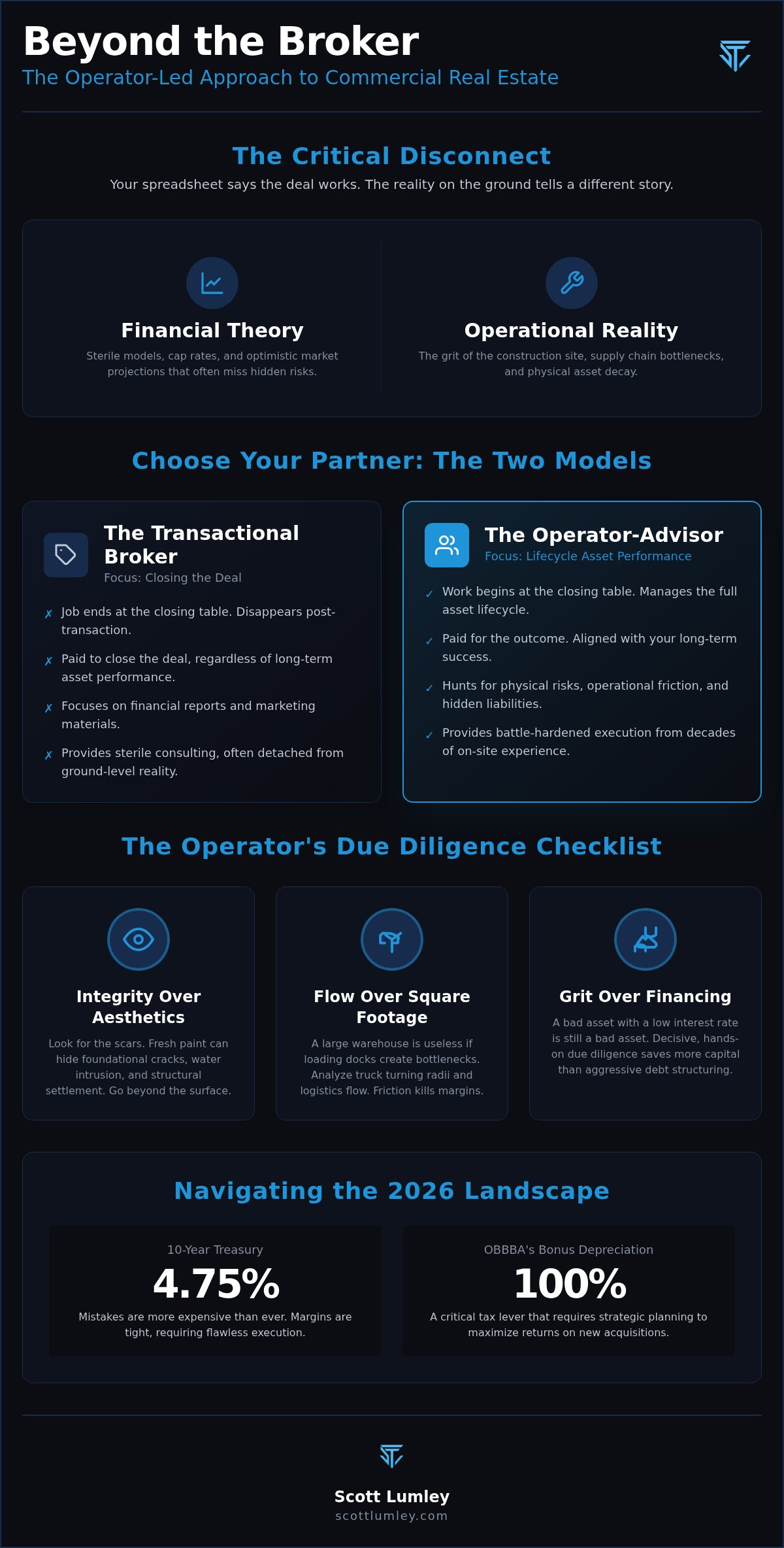
Your spreadsheet says the deal works, but your gut says the asset is bleeding. Most investors realize too late that a high-performing portfolio isn't built on financial theory; it's built on the ability to survive the trenches of a construction site. You're likely tired of brokers who disappear the moment the ink dries, leaving you to handle operational friction and distressed assets alone. It's a common frustration in a market where the 10-year Treasury sits at 4.75% and mistakes are more expensive than ever.
Choosing the right commercial real estate investment advisor means finding a battle-hardened operator who prioritizes execution over polished marketing. You deserve a partner who understands that a recovery plan requires more than just a new loan. In this guide, you'll discover how to move beyond theoretical models to identify hidden risks and lead complex property recoveries. We'll examine the specific strategies needed to navigate the 2026 landscape, from leveraging the OBBBA’s 100% bonus depreciation to executing a total turnaround of underperforming industrial and retail assets. It's time to trade sterile consulting for a strategy that actually lands.
Key Takeaways
- Stop relying on transaction-led brokers and shift to an advisor who manages the asset's full lifecycle from the trenches.
- Master operational due diligence by hunting for the friction and physical risks that sterile financial reports often miss.
- Discover how a commercial real estate investment advisor uses the Property Tax Debt System to transform distressed liabilities into growth.
- Bridge the gap between C-suite strategy and the construction floor to ensure your recovery plans actually get executed.
- Focus on income-driven returns by prioritizing gritty, hands-on management over optimistic market theories.
Beyond the Broker: The Role of a Commercial Real Estate Investment Advisor
Most people think a commercial property deal ends at the closing table. For a broker, that's true. Their job is the transaction. For a commercial real estate investment advisor who actually operates, the closing table is just the starting line. An operator-advisor doesn't just look at the cap rate; they look at the roof, the loading docks, and the supply chain bottlenecks. They manage the entire asset lifecycle. In the volatile market of 2026, where interest rates and cap rates have forced a harder look at margins, you can't afford a middleman who only cares about the sale. You need leadership that understands operational friction. This friction is the invisible cost of poor management, delayed maintenance, and weak logistics that eats your profit before you even see it.
Why Transactional Advice Fails in High-Stakes Environments
Brokers are paid to close. If the property fails six months later, it isn't their problem. Advisors are paid for the outcome. When the ground-level reality shifts, sterile theory from a spreadsheet won't save your equity. It's easy to spot a consultant who has never actually managed a construction site. They talk about synergy and optimization instead of concrete pours and electrical loads. If they haven't stood on a manufacturing floor or handled a logistics crisis, they aren't advising you. They're just reading a script. High-stakes environments demand grit, not just a glossy pitch deck. A commercial real estate investment advisor with real-world experience knows that the best deal on paper can become a nightmare if the execution is flawed.
The Operator-Led Advantage for Mid-Size Firms
Mid-size firms often find themselves caught between massive institutional funds and small-time local landlords. You need the sophistication of a major player but the hands-on intensity of an owner-operator. Leveraging four decades of industry grit allows an advisor to see what bankers miss. It's the difference between passive asset management and active Real Estate Leadership Advisory. This approach moves beyond checking boxes. It involves strategic planning and crisis management that treats your property like a business, not just a line item. We don't just identify the friction; we remove it. By prioritizing durable outcomes over superficial appearances, an operator-led strategy ensures your portfolio stays resilient regardless of market shifts.
Operational Due Diligence: Identifying Friction Before the Deal
Financial audits are post-mortems. They show you where the money went; they don't show you where the friction is hiding. Most investors treat due diligence as a clerical hurdle. They check the rent rolls and verify the taxes. This is a mistake. A commercial real estate investment advisor acts as a tactical scout. They hunt for operational risk before it hits the balance sheet. This process requires a shift from passive observation to active interrogation of the asset. You aren't just looking at what the property is. You're looking at what it does when under pressure.
Evaluating the "operational bones" of a property means looking past the fresh paint. In industrial real estate, this means measuring truck turning radii and testing floor load capacities. In retail, it means auditing the loading zones and HVAC lifespans. Official frameworks like the OCC Commercial Real Estate Risk Management guidelines help banks manage credit risk, but they won't tell you if a logistics hub has a fatal layout flaw. Hidden liabilities often lurk in the construction history or the utility infrastructure. Spotting these requires the staccato, decisive judgment of someone who has actually run a job site. If the bones are weak, the deal is dead. Period.
The Gritty Checklist for Property Acquisition
- Integrity over aesthetics: Fresh paint often hides structural settlement or water intrusion. Look for the scars.
- Flow over square footage: A 100,000-square-foot warehouse is useless if the loading docks create a bottleneck. Friction kills margins.
- Grit over financing: A bad asset with a low interest rate is still a bad asset. Battle-hardened due diligence saves more capital than aggressive debt structuring ever will.
Risk Reduction Through Strategic Safeguards
You need a recovery plan before the crisis hits. This means stress-testing your investment thesis against the harsh realities of construction delays and tenant defaults. Using due diligence consulting services allows you to identify these leverage points early. Operational due diligence is the process of uncovering friction that financial audits ignore. It provides the clarity needed to walk away from a "good" deal that is actually an operational nightmare. If you want to protect your portfolio, ensure your next acquisition undergoes a strategic planning review that prioritizes execution over theory.
Navigating Distressed Assets and Industrial Real Estate Recovery
Distressed assets aren't failures. They're mismanaged opportunities. Most investors run when they see blood in the water. A battle-hardened commercial real estate investment advisor swims toward it. Why? Because recovery is where the real margin lives. In the industrial sector, this requires more than just capital. It requires an operator’s DNA. You need to apply manufacturing-floor logic to property operations. If the logistics flow is broken, the asset value is capped. We use the Property Tax Debt System to create immediate leverage. This isn't theoretical. It's about clearing the path for growth by removing the financial and operational friction that others ignore. Industrial real estate demands a different leadership DNA than office or retail. It's about movement, weight, and utility.
While the operator's DNA is crucial, access to capital remains the fuel for any recovery. For fast, asset-backed commercial loans that allow you to act decisively, JGL Capital LLC provides the specialized financing required for high-stakes real estate investments.
Stabilizing High-Stakes Property Operations
The first 72 hours of a property crisis are critical. You don't focus on expansion during this window. You focus on stabilization. Stop the bleeding. If a retail asset is failing because the underlying business is dying, you must pivot the business to save the real estate. This is where The Business Turnaround Consultant mindset becomes essential. We look at the tenant’s operations with the same scrutiny we apply to the building's infrastructure. If the tenant fails, your cash flow dies. Stabilization is about securing the perimeter. It's about ensuring core functions remain intact while we build a long-term recovery plan. We move fast. We decide quickly. We execute without hesitation.
Industrial Sector Resilience: Lessons from the Trenches
Industrial real estate is a different beast. It demands a level of grit that Class A office buildings never will. Managing a complex construction project or a massive warehouse retrofit requires leadership that has survived more than just a boardroom meeting. My global experience, including the lessons detailed in "I Survived Africa," informs every local property strategy I develop. It teaches you to identify unfixable friction early. Some operational gaps can be recovered through better leadership and gritty process improvements. Others are terminal. A seasoned commercial real estate investment advisor tells you the difference before you waste millions. We focus on durable infrastructure and logistics hubs that can withstand market volatility. We don't just find deals; we build the operational resilience that keeps them profitable.
Strategic Leadership for Property Investment Firms
Real estate is a people business disguised as a brick-and-mortar industry. You don't just manage concrete; you manage the friction between the C-suite and the construction floor. Most property investment firms suffer from a massive disconnect between the boardroom and the job site. This gap is where profit dies. A commercial real estate investment advisor who understands operations knows that leadership is the missing ingredient in most portfolios. You need more than a manager. You need a strategist who can navigate the gritty reality of a manufacturing floor while maintaining a high-level vision for the asset.
When you manage a property, you are managing a living ecosystem of vendors, tenants, and contractors. If your leadership team doesn't understand the friction points within those relationships, the asset will underperform. Strategic leadership means having the foresight to anticipate a labor shortage or a material delay before it halts production. It means having the guts to make a hard call when a project manager isn't meeting the standard. This isn't about being a passive coach; it's about being an authoritative expert who leads from the trenches. Developing a business crisis recovery plan for developers isn't about optimistic theories. It's about survival and recovery.
Execution Over Sterile Theory in Real Estate
Passive investing is a luxury of the past. To survive the 2026 market, you must become a strategic leader. Decision-making paralysis is the enemy of growth. Our leadership consulting services are designed to eliminate this stall. We build a culture of accountability where every stakeholder knows their role and the stakes involved. This isn't corporate jargon. It's about ensuring that a delay on the site doesn't derail your entire investment thesis. We replace sterile theory with actionable movement.
Scaling Your Portfolio Without Operational Breakage
Expansion is seductive, but over-expansion without a solid operational foundation is a death sentence. You must identify the specific leverage points in your organization that allow for growth without breakage. This means auditing your internal systems as rigorously as you audit your properties. As a Strategic Business Advisor, I help firms build the infrastructure needed to support a massive portfolio. A commercial real estate investment advisor ensures that your leadership team isn't just reacting to the market, but actively shaping the asset's future. We focus on durable outcomes and hard-won wisdom.
If your current leadership structure is creating more friction than value, it's time to seek Leadership Consulting to realign your operations with your goals.
Partnering with a Battle-Hardened Commercial Real Estate Advisor
Real estate advisory isn't a generic course or a passive mentorship program. It's a high-stakes partnership centered on one-on-one strategic execution. If your portfolio is bleeding, you don't need a cheerleader; you need an operator who has spent four decades in the trenches of construction and logistics. A commercial real estate investment advisor must bring a national perspective to the table. This is especially true when navigating the Property Tax Debt System or identifying industrial growth opportunities across different jurisdictions. The Lumley difference is built on 40 years of surviving market storms. We don't just predict the weather; we guide you through the recovery. It's time to stop managing friction and start executing growth.
Executing growth also means securing your assets for the long term. For investors looking to protect their legacy, find out more about specialized estate planning and trust administration services that complement a high-stakes real estate strategy.
What to Expect from High-Level Advisory
Expect direct, no-nonsense feedback on your current portfolio risks. We don't sugarcoat the reality of a distressed asset. You'll receive a clear, actionable roadmap for turnaround or expansion that prioritizes cash flow over superficial metrics. This advisory provides immediate access to a deep network of construction, manufacturing, and logistics expertise. We bridge the gap between financial planning and ground-level reality. Every move is calculated to reduce operational risk and maximize durable outcomes.
Taking the First Step Toward Operational Recovery
The most common objection in this industry is the belief that a firm can fix its own internal friction. "We can handle this ourselves" is a dangerous sentiment in a high-stakes real estate market. With the 10-year Treasury note at 4.75% in 2026, the cost of inaction is staggering. Every day you spend debating a recovery plan is a day your margins erode. Operational recovery requires an outside perspective that isn't blinded by internal politics or legacy processes. Our Strategic Planning and Crisis Management services are designed for firms that value survival as much as expansion. Scott Lumley serves as the sobering voice of reason in a sea of corporate fluff, ensuring your next move is your strongest.
Secure Your Portfolio with Execution-Led Strategy
Theory won't protect your equity in the 2026 market. You've seen how identifying operational friction before a deal is signed can save millions. You know that industrial and distressed assets require a leader who has spent 40 years of operational grit in the trenches. Moving from a passive investment mindset to an execution-led strategy is the only way to ensure sustainable growth. It's about bridging the gap between the C-suite and the construction floor with hard-won wisdom.
Partnering with a battle-hardened commercial real estate investment advisor gives you the tactical advantage needed to navigate complex logistics and manufacturing hubs. By leveraging national property tax debt expertise and a gritty approach to due diligence, you can transform distressed liabilities into high-performing assets. Stop managing the friction that eats your margins and start building a portfolio designed for durability. You have the tools to turn risk into recovery. Your next move should be your strongest.
Execute Your Real Estate Strategy with Scott Lumley
Frequently Asked Questions
What is the difference between a commercial real estate broker and an investment advisor?
A broker's job ends at the transaction; an advisor's job begins there. Brokers are incentivized by the sale and the closing table. A commercial real estate investment advisor focuses on the asset's entire lifecycle. We provide strategic planning and leadership that extends far beyond the initial deal. We care about the outcome and the operational durability of the property, not just the commission check.
How does an advisor help with distressed commercial property recovery?
Recovery requires a tactical turnaround plan that addresses the root cause of failure. We identify operational friction, such as broken logistics or poor tenant management, and execute a stabilization strategy. We move beyond spreadsheet theory to implement gritty, real-world fixes that restore cash flow. Our focus is on the first 72 hours of a crisis to stop the bleeding and secure the asset's future.
Why is operational due diligence more important than financial due diligence?
Financial due diligence tells you where the money went; operational due diligence tells you why the asset is bleeding. Financial audits are post-mortems that look at the past. Operational reviews hunt for physical and process risks that will kill your future margins. We evaluate the "operational bones" of a property, such as structural integrity and logistics flow, to identify friction before you sign the deal.
Can a real estate advisor help with construction project leadership?
Yes, an advisor provides the leadership needed to bridge the gap between the C-suite and the job site. We manage people and processes to ensure complex projects stay on track and within budget. This leadership prevents decision-making paralysis and holds contractors accountable. We ensure the physical construction reflects the original investment thesis and doesn't become a liability through poor execution or lack of oversight.
What types of commercial properties does Scott Lumley specialize in?
Scott specializes in industrial, retail, and logistics properties where operational complexity is highest. These sectors require a deep understanding of manufacturing-floor logic and supply chain movement. We focus on assets that demand gritty, hands-on management and strategic turnaround. With 40 years of experience in construction and logistics, we target properties where our operational grit can remove friction and create immediate value.
How does the Property Tax Debt System benefit commercial investors?
The Property Tax Debt System provides a strategic leverage point for portfolio growth by clearing financial friction. It allows investors to resolve tax liabilities that often paralyze distressed assets and prevent recovery. By cleaning up the balance sheet, we open the door for successful turnaround management. This system is a tactical tool used to stabilize a property's finances so the operational recovery can begin without delay.
What is the "first move" when a commercial property asset begins to fail?
Stabilization is the first move. Within the first 72 hours of identifying a failure, you must stop the bleeding and secure the perimeter. This means identifying the primary source of operational friction and removing it immediately. We don't worry about expansion or long-term growth until the core operation is steady. You have to save the patient before you can start the rehab; stabilization is that life-saving step.
Is commercial real estate advisory suitable for mid-size industrial firms?
A commercial real estate investment advisor is essential for mid-size firms that lack the massive infrastructure of institutional funds. You need the sophistication of a major player combined with the hands-on intensity of an owner-operator. We provide the strategic leadership and due diligence necessary to scale your portfolio without operational breakage. We help you build the infrastructure needed to compete at a higher level without losing your operational edge.


