

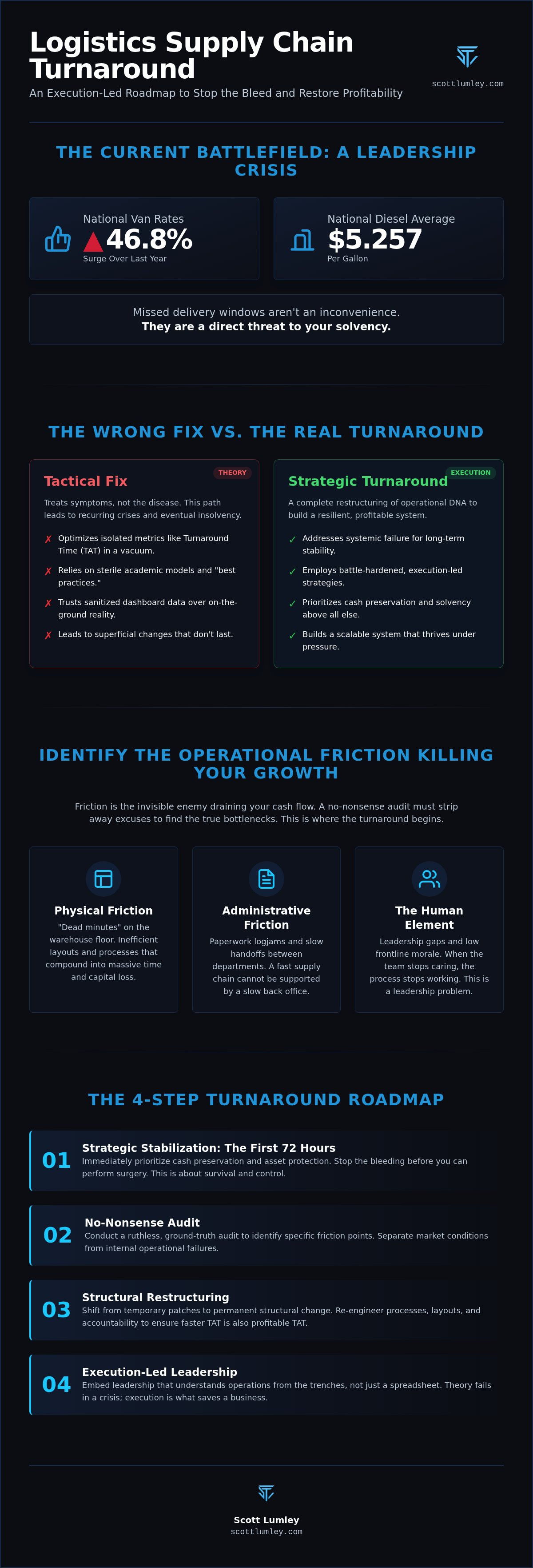
A failing supply chain isn't a math problem. It's a leadership crisis. You don't need a new software dashboard when your warehouse is hemorrhaging cash and your transport cycles are broken. You're likely staring at national van rates that have surged 46.8% over the last year. Diesel sits at a staggering $5.257 per gallon. Executing a logistics supply chain turnaround is the only way to stop the bleed. It's a brutal environment where missed delivery windows aren't just an inconvenience. They're a direct threat to your solvency.
I've spent forty years in the trenches of industrial operations. I know that stabilizing a distressed network requires more than sterile theory. This guide outlines the exact steps to prioritize speed and profitability over superficial metrics. We'll start by stripping away the operational friction that's stalling your growth. Then, we'll move into the mechanics of restructuring for long-term stability. You'll walk away with a clear roadmap to reduce turnaround times and secure predictable costs in an unpredictable market.
Key Takeaways
- Differentiate between a tactical fix and a complete logistics supply chain turnaround to address systemic failure.
- Conduct a no-nonsense audit to identify the specific operational friction points that are stalling your growth and bleeding capital.
- Prioritize cash preservation and asset protection during the critical first 72 hours of a supply chain recovery.
- Shift from temporary tactical adjustments to structural restructuring that ensures faster turnaround times remain profitable.
- Learn why execution-led leadership from the trenches outpaces theoretical models when a business is in distress.
Beyond the Metric: What a Logistics Supply Chain Turnaround Really Means
A logistics supply chain turnaround is not a simple exercise in time management. Most consultants treat Turnaround Time (TAT) as an isolated metric to be optimized with a spreadsheet. They're wrong. Tactical TAT is merely the time it takes to move an asset from point A to point B. A true turnaround is the complete restructuring of the operational DNA to ensure the business doesn't collapse under its own weight. When a company begins to fail, the friction usually shows up in the warehouse or on the road first. It’s the canary in the coal mine.
The problem with traditional supply chain management is the heavy reliance on sterile theory. Academic models look great in a boardroom but fall apart on a rain-slicked loading dock at 3:00 AM. You don't need more "best practices" designed by people who've never managed an asset. You need an execution-led strategy that prioritizes solvency over PowerPoint slides. Moving from survival mode to strategic execution requires a shift in perspective. You aren't just trying to survive the week. You're building a system that can scale without breaking.
The Relationship Between TAT and Solvency
Slow TAT is a direct tax on your cash flow. Every hour an asset sits idle is capital that isn't working for you. In a distressed business, speed is often a symptom of underlying health rather than the cure itself. If your cycles are sluggish, it ripples through the entire organization. It delays invoicing, frustrates customers, and forces you into expensive "spot" markets to cover gaps. This friction doesn't just slow you down. It erodes your margins until there's nothing left to save.
Signs Your Supply Chain Needs a Strategic Pivot
Recognizing the "silent killers" in your operations is a leadership requirement. Software updates won't fix a broken layout or a culture of complacency. If you're constantly missing delivery windows despite having the latest tools, your infrastructure is likely the problem. You're bleeding cash through inefficient transport cycles and bloated warehouse labor. A strategic pivot is necessary when the existing system can no longer support the weight of your goals. It takes a battle-hardened operator to see these leaks before they become floods. Executing a successful logistics supply chain turnaround starts with admitting that the current path leads to insolvency.
Identifying the Operational Friction Killing Your Supply Chain
Friction is the invisible enemy of growth. It's the snag in your transport cycle that turns a profitable week into a deficit. Identifying these snags is the first step in a logistics supply chain turnaround. You need a no-nonsense audit. This isn't about checking boxes on a corporate template. It's about stripping away every excuse until you find the bottleneck. If your team blames market volatility for every missed window, they're likely hiding operational failure. Market conditions like the $5.257 per gallon national average for diesel are real, but they shouldn't paralyze your execution.
Data can be a deceptive tool. Dashboards often show a sanitized version of reality. If the operators on the floor aren't aligned with the metrics on your screen, the data is lying to you. You have to walk the trenches to see the truth. Is the forklift idling because of a layout issue? Is a driver waiting two hours for a signature? These are internal failures, not external market trends. While national van rates are up 46.8% year-over-year, your internal inefficiencies are what will ultimately sink the ship.
Physical vs. Administrative Friction
Physical friction often manifests as "dead minutes" on the warehouse floor. A poor layout forces workers to travel unnecessary distances, compounding over hundreds of shifts. Administrative friction is just as lethal. Paperwork logjams and slow handoffs between logistics and accounting kill velocity. You can't have a fast supply chain with slow back-office processes. Streamlining these touchpoints is non-negotiable for recovery. Every minute spent waiting for an invoice or a manifest is a minute that drains your solvency.
The Human Element: Leadership Gaps in Logistics
Frontline morale is your leading indicator of health. When the team stops caring, the process stops working. Sometimes you need training. Other times, you need to swap the process or the personnel entirely. This is where leadership consulting services become vital. You need a strategy that focuses on execution, not just theory. A battle-hardened leader knows when to push and when to pivot. If you're ready to find the leverage points in your operation, a strategic business advisor can help you cut through the noise and restore operational discipline.
Strategic Stabilization: The First 72 Hours of a Logistics Recovery
The first 72 hours of a logistics supply chain turnaround are the most volatile. This is the "Recovery Zone." In this window, the speed of your decisions matters more than their perfection. You don't have the luxury of a six-month cultural shift when the business is bleeding cash and missing windows. Stabilization isn't about long-term growth yet. It's about survival. You have to move quickly to stop the hemorrhaging before the damage becomes permanent.
Step one is cash preservation. Every dollar that leaves the company must be scrutinized. Protect your revenue-generating assets first. Step two is identifying the "Critical Path." You must eliminate every non-essential motion in your warehouse and transport cycles. If an activity doesn't directly contribute to a successful delivery or cash collection, stop doing it immediately. You're stripping the operation down to its functional core to regain control of your margins.
Stopping the Bleed in Distressed Operations
Recovery requires cutting the fat without damaging the muscle. You can't just slash budgets blindly. You must identify which costs are dead weight and which are vital for movement. Renegotiating with vendors and logistics partners is often necessary. They see the same market pressures you do, including national diesel prices at $5.257 per gallon. A business turnaround consultant provides the objective distance needed to make these hard calls. They stabilize the tailspin by focusing on tangible outcomes rather than corporate politics. This is about protecting the solvency of the entity at all costs.
Building the Crisis Communication Loop
Transparency is your only currency during a crisis. You have to be blunt with your stakeholders. Admit the delays to your clients, but provide a specific, gritty plan for recovery. This is how you save a contract. If you hide the truth, you lose the client forever. Step three involves direct communication with every key stakeholder. Don't wait for them to call you. Step four is re-establishing operational baseline metrics. You can't manage what you don't measure. You need to know your current capacity, your actual costs, and your true lead times.
Internally, you must align the workforce around a "survival first" mission. This isn't the time for motivational fluff. It's the time for setting realistic expectations. Once you stabilize the baseline, you can begin the broader work of a logistics supply chain turnaround. You need to know exactly where you stand before you can decide where you're going. The goal is to move from a defensive crouch into a position of strategic execution.
Reducing Turnaround Time (TAT) Through Structural Restructuring
Tactical band-aids won't fix a hemorrhaging supply chain. You can't just "plan ahead" when your underlying structure is broken. A successful logistics supply chain turnaround requires a fundamental shift from surface-level tweaks to deep structural change. This means calculating the real ROI of speed. Faster Turnaround Time (TAT) is useless if the cost to achieve it destroys your margins. You need a "Frictionless Flow" where every touchpoint adds value rather than delay. Identifying these hidden risks early is critical. This is where due diligence consulting services prove their worth. They find the operational friction that software dashboards miss.
Tactical Fixes vs. Structural Overhauls
Buying a new software system is a tactical fix. Rewriting the entire workflow is a structural overhaul. If your decision-making process has five layers of approval for a routine shipment, software won't save you. You're just automating a bad process. Structural TAT optimization is the removal of redundant decision layers. Consider the impact of small gains. A 10% reduction in TAT can lead to a 50% increase in solvency by freeing up trapped capital. This isn't theoretical. It's the difference between having the cash to weather a 4.7% Producer Price Index increase and going under. It's about velocity, not just activity.
Leveraging Assets for Maximum Throughput
Don't buy new equipment until you've squeezed every ounce of utility from what you already own. In a distressed environment, capital expenditures should be a last resort. You have to optimize existing equipment before investing in new assets. Focus on cross-docking and just-in-time (JIT) strategies to keep goods moving. Executing a logistics supply chain turnaround means you can't afford to let assets sit idle. The loading dock is often where speed goes to die. Reducing the "Waiting Game" requires tight coordination and a total lack of tolerance for idle time. Every minute a truck sits at the dock is a minute you're paying for at national van rates that are up 46.8% year-over-year. If you need a partner to help you strip away the layers of inefficiency, hire a strategic business advisor who understands the reality of the floor.
Execution-Led Leadership: Why Theory Fails in Logistics Turnarounds
Logistics isn't a spreadsheet. It's a high-stakes environment where reality hits harder than any framework. There's a massive difference between a "Strategic Advisor" and a "PowerPoint Consultant." The latter gives you slides filled with jargon and "best practices." The former gives you an execution-led strategy born from four decades of failure and success. When you're in the middle of a logistics supply chain turnaround, you don't need a cheerleader. You need someone who has navigated the same wreckage you're currently facing.
Scott Lumley’s 40 years of experience isn't just a number. It's a record of surviving the harsh realities of industrial operations. Leading from the trenches means identifying the friction points that software-only solutions miss. You can't fix a broken transport cycle from a boardroom 500 miles away. You have to be where the assets are moving. Logistics is a game of grit. It rewards those who prioritize tangible outcomes over superficial appearances. Theory is cheap. Execution is everything.
The Value of a Strategic Business Advisor
An outsider brings clarity that an internal team often lacks. You’re too close to the process to see the blind spots. A strategic business advisor bridges the gap between your vision for growth and the gritty reality of your operations. This isn't about a quick fix to hide a bad quarter. It's about building sustainable growth. You need to identify where your chain is snagging and remove those layers of friction permanently. Sustainable growth requires a stabilized foundation, not just a temporary spike in activity.
Next Steps: From Friction to Fluidity
Your first move is to conduct an operational friction audit. Strip away the excuses. Look at the loading docks, the back-office handoffs, and the frontline morale. Crisis management isn't just for the bad times. It's the foundation of long-term resilience. If you can stabilize a distressed operation, you can scale a healthy one. Restoring speed and solvency is a methodical process that requires total transparency and a commitment to the truth of the floor.
The final word is simple. A logistics supply chain turnaround succeeds or fails based on execution. If you're ready to stop the bleed and restore your solvency, you need a partner who values results over reports. Connect with Scott Lumley for a no-nonsense operational assessment. It’s time to move from survival to strategic recovery.
Restoring Operational Control and Profitability
A failing supply chain is a leadership challenge, not a software bug. You've seen how friction on the warehouse floor and administrative logjams erode your solvency. Stabilization starts with immediate cash preservation and stripping away every non-essential motion. Moving from survival to growth requires a fundamental restructuring of your workflows. Tactical fixes are temporary. Structural change is permanent. You can't automate your way out of a broken process.
Executing a logistics supply chain turnaround demands a level of grit that sterile consulting models don't provide. You need a partner who leads from the trenches. Scott Lumley brings 40 years of lived experience across logistics, manufacturing, and retail to your operation. His no-nonsense, results-driven approach identifies the blind spots that are bleeding your capital. Don't let your infrastructure break under the weight of your goals. Get a Gritty, Execution-Led Assessment from Scott Lumley today. Your recovery is possible. It starts with a single, decisive move toward operational clarity and sustained resilience.
Frequently Asked Questions
What is the difference between turnaround time and a business turnaround?
Turnaround time is a tactical metric while a business turnaround is a strategic overhaul. Turnaround time measures the speed of a single cycle, like loading a truck or processing an invoice. A logistics supply chain turnaround involves restructuring the entire operation to restore solvency and eliminate systemic friction. One is a clock on the wall; the other is the engine under the hood. You can't save the business without addressing the metrics.
How do I know if my supply chain friction is internal or external?
Internal friction appears as inconsistent execution regardless of market conditions. If your warehouse layout causes "dead minutes" or your paperwork logjams delay invoicing, the problem is inside your walls. External friction involves macro factors like national diesel prices hitting $5.257 per gallon or van rates jumping 46.8% year-over-year. If you're missing windows while competitors aren't, your friction is internal. External volatility is a challenge; internal friction is a choice.
What are the first steps to take when a logistics business faces insolvency?
Prioritize cash preservation and asset protection immediately. You must stop all non-essential spending and identify the "Critical Path" for revenue generation. This often involves renegotiating with vendors and logistics partners to manage immediate pressure. Speed of decision beats perfection in this phase. You aren't looking for long-term cultural shifts yet. You're looking for enough oxygen to keep the entity alive for another 72 hours. Survival comes before expansion.
Can automation fix a fundamentally broken supply chain process?
No, automation only makes a bad process fail faster. If your warehouse layout is inefficient, a new software dashboard will only document the disaster in real-time. You must rewrite the workflow and strip away redundant decision layers before introducing technology. Automation should be the multiplier of a healthy process, not a band-aid for a broken one. Fix the structural DNA first, then use tools to scale the result and improve velocity.
How much time does a typical logistics turnaround take?
Stabilization occurs in days, but a full logistics supply chain turnaround takes months of disciplined execution. The "Recovery Zone" usually lasts the first 72 hours, where you stop the immediate bleeding. Structural restructuring and workflow optimization follow over the next 90 to 180 days. Beware of consultants promising 18-month cultural shifts while you're hemorrhaging cash. You need results that show up on the balance sheet within the first few months of the pivot.
What is the #1 mistake leaders make during a supply chain crisis?
Hesitation is the most lethal mistake in a crisis. Leaders often wait for perfect data or consensus before making hard calls. In a distressed environment, a "good" decision made today is worth more than a "perfect" decision made next month. Hiding the truth from stakeholders is another major error. Transparency with clients and vendors is the only way to save contracts and maintain the trust necessary for recovery. Be blunt and move fast.
How do I calculate the cost of operational friction?
Track the "dead time" of your revenue-generating assets. Every hour a truck sits idle at a loading dock or a forklift travels an inefficient path has a dollar value. Add the cost of delayed invoicing and the premium paid for "spot" market coverage due to missed windows. When you quantify these leaks, you'll likely find that a 10% reduction in friction can lead to a 50% increase in solvency by freeing trapped capital.
Why is hands-on experience more valuable than consulting theory in logistics?
Theory falls apart on the loading dock at 3:00 AM. A "PowerPoint Consultant" understands frameworks, but a battle-hardened operator understands movement and risk. Logistics is a game of grit and real-world application. You need someone who has navigated insolvency and identified friction points that software misses. Lived experience provides the instinct to make high-stakes decisions when the margin for error is zero. Theory is a map; experience is the driver who knows the road.


