

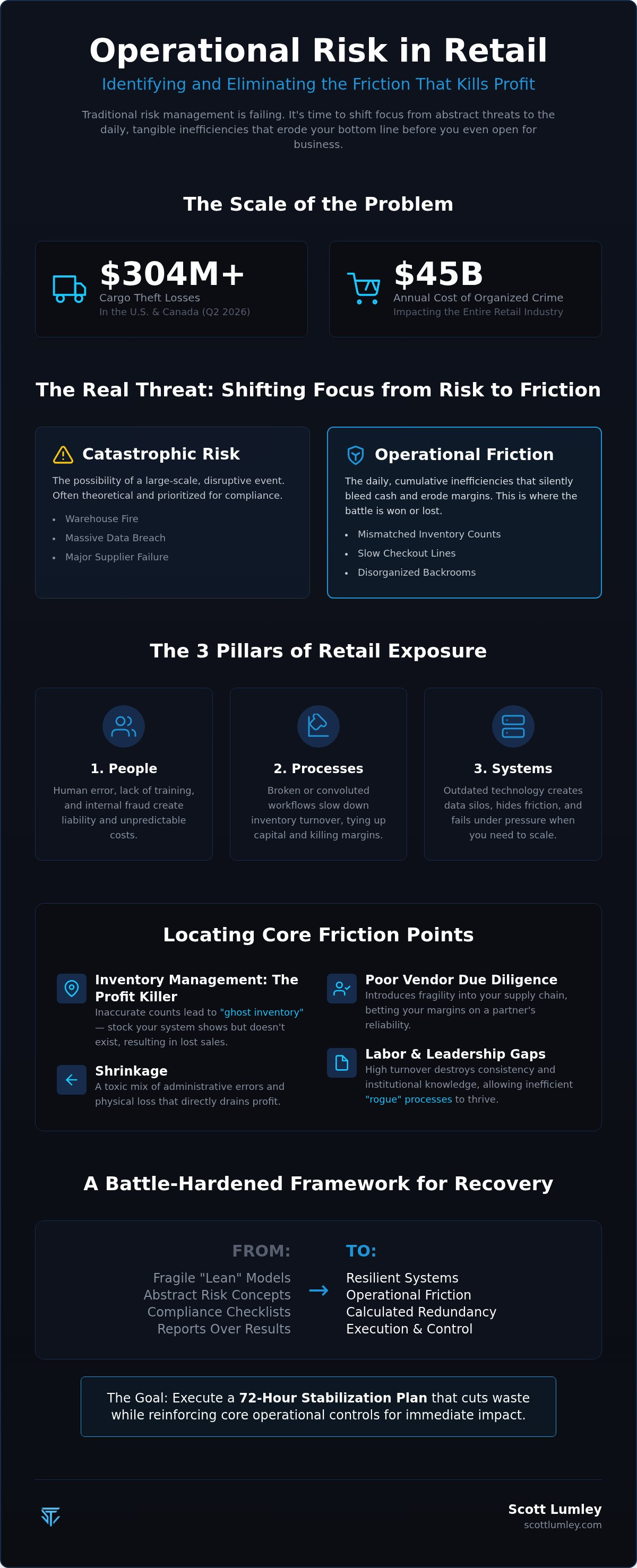
Your retail margins aren't just thinning. They're being bled dry by invisible operational leaks that most executives are too comfortable to notice. In the second quarter of 2026, cargo theft losses in the U.S. and Canada surged to over $304 million. If you think your biggest threat is a competitor's sale, you're looking in the wrong direction. Managing operational risk in retail is no longer about compliance checklists or theoretical safety nets. It's about survival in a landscape where organized retail crime costs the industry $45 billion annually. This isn't a drill; it's a daily battle for the bottom line.
You've likely felt the chaos of a fractured supply chain or the quiet dread of a potential data breach. It's a heavy weight to carry. You know that system failures and human errors are costing you money, even if you can't see the exact leak. This article strips away the corporate jargon to help you identify, assess, and eliminate the friction points that threaten your survival. We provide a battle-hardened strategy to stabilize your operation and protect your profits. From inventory leaks to shifting 2026 regulations, here is your roadmap for operational recovery.
Key Takeaways
- Stop treating risk as an abstract concept and start identifying the daily "operational friction" that erodes your competitive edge.
- Uncover hidden margin leaks by auditing inventory tracking and eliminating single points of failure within your logistics network.
- Implement a battle-hardened framework for managing operational risk in retail by prioritizing risks based on their potential to halt your entire operation.
- Shift your strategy from fragile "lean" models to resilient systems that use calculated redundancy to protect the bottom line.
- Focus on results over reports by executing a 72-hour stabilization plan that cuts unnecessary waste while reinforcing core operational controls.
What is Operational Risk in Retail? Moving Beyond Theory
Operational risk isn't just a line item in a corporate handbook. It's the danger of loss resulting from inadequate or failed internal processes, people, and systems. In the trenches of retail, this translates to "operational friction." It's the invisible drag that eats your margins before you've even opened the doors. Traditional operational risk management often fails because it prioritizes compliance over execution. It focuses on checking boxes rather than fixing the leaks. When you're in a turnaround, one operational failure isn't just a setback. It's often the final blow.
Theory is cheap. Execution is expensive. Most retail leaders wait for a catastrophe to act. They ignore the small, daily failures that signal a deeper rot. Managing operational risk in retail isn't about avoiding the "what if." It's about controlling the "what is." You can't manage a business from a spreadsheet if the data on that sheet is fueled by broken processes. You need to lead from the trenches.
The Difference Between Risk and Friction
Risk is the possibility of a catastrophic event. Think of a warehouse fire or a massive data breach. Friction is different. Friction is the daily inefficiency that bleeds cash. It's the mismatched inventory count. It's the slow checkout line. It's the disorganized backroom. Identifying these friction points is the first step in due diligence consulting services. If you don't find the friction before the deal, you'll pay for it every day after.
Friction creates a ripple effect. A small delay at the loading dock can disrupt the entire retail supply chain. It's a chain reaction of lost time and wasted capital. You aren't just losing a few minutes. You're losing the ability to respond to the market. This is where margins die a slow, quiet death.
The 3 Pillars of Retail Exposure
Managing operational risk in retail requires a hard look at three specific areas. You can't fix what you won't measure. This isn't about blaming staff. It's about hardening your infrastructure.
- People: This includes human error, a lack of training, and internal fraud. If your staff doesn't know the process, they'll invent their own. Their inventions usually cost you money and create liability.
- Processes: These are the broken workflows that slow down inventory turnover. If a product sits in the backroom for three days because the intake process is convoluted, your capital is dead. Efficiency is your only defense against thinning margins.
- Systems: Outdated tech is a liability. It fails when you need to scale. It creates data silos. Most importantly, it hides the very friction you're trying to eliminate. Durable systems provide the clarity needed for high-stakes decision making.
Identifying the Core Friction Points in Your Retail Operation
You can't fix a leak you haven't located. In retail, friction points are the specific areas where your strategy grinds against reality. Managing operational risk in retail starts with identifying these core friction points before they become crises. This requires a move away from the boardroom and into the aisles. It's about recognizing that a minor inventory discrepancy is actually a symptom of a systemic failure. If you want a structured framework for managing risk, you must first admit where your operation is currently failing.
Inventory Management: The Profit Killer
Inaccurate cycle counts are more than just a nuisance. They create ghost inventory. This happens when your system reports stock that doesn't exist, leading to lost sales and frustrated customers. Shrinkage is a combination of administrative error and physical loss. When you fail at vendor due diligence, you introduce fragility into your stock availability. You're essentially betting your margins on a partner's ability to be honest and organized. In a high-stakes turnaround, that's a bet you'll likely lose. You need to verify every shipment and audit every count to stop the bleed.
Labor and Leadership Gaps
High turnover destroys operational consistency. When employees leave every few months, your institutional knowledge vanishes with them. This creates a vacuum where "rogue" processes thrive. These are the workarounds employees create to bypass broken or slow systems. While they might solve a short-term problem, they create long-term exposure. Effectively managing operational risk in retail requires aligning frontline execution with executive strategy. This is why leadership consulting services are a necessity, not a luxury. You need leaders who lead from the trenches, not just the head office.
Fragility and Existential Threats
Supply chain fragility is a ticking time bomb. Relying on single-point failures in your logistics network is a recipe for disaster. In the second quarter of 2026, cargo theft losses reached $304.6 million. If your logistics plan doesn't account for this, you're exposed. Similarly, data security and PCI compliance are non-negotiable. With the average U.S. data breach cost hitting $10.22 million in 2025, one mistake can end your business overnight. If you're unsure where your leaks are, it's time for a professional strategic audit of your current assets.
A No-Nonsense Framework for Managing Operational Risk
Boardrooms are for debates. The floor is for reality. Most retail failures start because leaders lose touch with the front line. Managing operational risk in retail requires a framework that prioritizes survival over polish. You need to identify where the friction is actually stopping the gears. This is not a theoretical exercise. It is a tactical necessity to protect your margins from human error and system failure.
Step 1: The Operational Audit
Start with a deep dive into the last 90 days of operational failures. Don't look at the successes; look at the friction. Interview the frontline staff. They know the "workarounds" because they use them to survive broken systems every day. These workarounds are your biggest vulnerabilities. They represent the gap between your strategy and your execution. If you see processes being bypassed consistently, you likely need a business turnaround consultant to strip back the rot. An audit isn't a checklist. It is an investigation into why your strategic plan isn't reaching the register.
Step 2: Prioritizing Survival
Not all risks are equal. You must score them based on their ability to stop the business entirely. Use a Top Threats and Mitigation Strategies approach to categorize your exposure. Focus on two distinct zones:
- The Red Zone: These are risks that threaten cash flow or legal standing. If a data breach costs upwards of $10.22 million, it is a Red Zone risk. These require immediate, decisive action.
- The Yellow Zone: These are inefficiencies. They hurt growth, but they won't kill the operation today. Broken workflows and slow inventory turnover live here.
Use a blunt cost/benefit analysis. Some risks are too expensive to fix during a crisis. Accept them for now and focus your capital on the Red Zone. Managing operational risk in retail is about making hard choices with limited resources.
Ownership and Stabilization
Risk without an owner is just a complaint. Every friction point identified must have a specific name attached to its resolution. If everyone is responsible, no one is. Build a gritty recovery plan that focuses on stabilization before optimization. You can't optimize a sinking ship. You stop the leaks, stabilize the hull, and then worry about speed. Recovery is about movement and accountability, not perfection. When the stakes are high, execution is the only metric that matters.
Strategic Safeguards: Turning Defense into Growth
Efficiency is often a mask for fragility. Retailers obsessed with "lean" operations often find themselves one disruption away from total failure. Managing operational risk in retail means building redundancy into your blueprint. It's not about being bloated. It's about being durable. You can't scale a business that breaks the moment a single vendor fails. Robust internal controls are the framework that allows you to move faster, not slower. They provide the guardrails necessary to prevent small errors from becoming catastrophic losses.
Due diligence shouldn't end when the contract is signed. It must be a recurring process for every major operational arm. Identifying potential disasters before they strike is the difference between a controlled turnaround and a desperate collapse. You need to look at your operation with the same scrutiny you'd use for a new acquisition. If you wouldn't buy your own logistics setup today, it's time to fix it. This proactive approach turns your defense into a competitive advantage.
Building Supply Chain Resilience
Diversification is your only real defense against the "single source" trap. If your entire inventory depends on one factory or one logistics hub, you aren't an operator; you're a gambler. A strategic business advisor evaluates logistics partners based on their recovery speed, not just their price point. You need real-time visibility into every movement. If you don't know where your stock is, you don't have control. Visibility eliminates the "wait and see" approach that kills margins during shipping delays or inventory shortages.
Culture as a Risk Mitigant
Compliance checklists don't stop fraud; people do. You must train your staff to identify friction points before they escalate into systemic risks. Create a culture of accountability where execution is valued over appearances. If your team is afraid to report a failure, that failure will grow until it becomes a crisis. Build your defense on these three cultural pillars:
- Radical Transparency: Every error is a data point, not a reason for punishment.
- Direct Ownership: Every process has a name attached to its success.
- Execution over Polish: Results in the aisles matter more than reports in the boardroom.
Transparency is your best defense against internal fraud and administrative errors. When everyone owns the result, the friction has nowhere to hide. Safeguards aren't just costs. They are the foundations of a scalable, predictable business. If you are ready to harden your operation against the uncertainties of 2026, you need a partner who has survived the trenches. Secure your operational recovery strategy today.
Executing the Turnaround: Why Theory Fails at the Store Level
Theories look good in a boardroom. They break when they hit the stockroom floor. Managing operational risk in retail isn't an academic exercise; it's a contact sport that requires lived experience. Consultants provide reports. Operators provide results. A 50-page risk report is expensive paper weight if your store manager can't implement it on a Tuesday afternoon. The Lumley approach is grounded, direct, and focused on the bottom line. It values tangible outcomes over sterile theory and polished marketing promises that don't survive the reality of the aisles.
Execution Over Sterile Theory
Real-world application beats academic risk models every time. When a business is distressed, you don't have the luxury of a three-month study. You need to identify the leverage points that provide the fastest operational recovery. This means getting into the trenches to see why the inventory isn't moving or why the staff is bypassing the system. It's about finding the "invisible" risks that standard due diligence often misses. If a process isn't helping you sell more or lose less, it's friction that needs to be removed immediately.
Stabilizing the Retail Blueprint
Stabilization happens fast, or it doesn't happen at all. The first 72 hours of an intervention are the most important. During this window, you must decide what to cut and what to keep. You cut the unnecessary complexity that creates friction and slows down decision-making. You keep the core controls that protect the cash flow and inventory. This isn't about being lean for the sake of a spreadsheet. It's about being durable enough to survive the next shift. Effectively managing operational risk in retail requires this level of decisive, high-stakes execution.
Once the foundation is hardened, the focus shifts. You move from crisis management consulting to a strategy for long-term growth. This transition is only possible if you've eliminated the human errors and system failures that caused the initial rot. Leveraging four decades of experience in logistics and operations allows for a speed of recovery that theory cannot match. If your retail operations are grinding to a halt, let's identify the friction points today. This is how you protect your margins and secure a predictable future.
Stop the Bleed and Secure Your Retail Future
Theory doesn't pay the bills. You've seen how friction eats margins and how "lean" models can easily become fragile liabilities. Managing operational risk in retail is a daily battle for control over your assets and your future. It requires the grit to audit your floor and the backbone to cut what isn't working. You must prioritize stabilization today to ensure growth tomorrow. Every inventory leak and broken process is a liability that you can no longer afford to ignore.
Operational recovery isn't a suggestion; it's a necessity. With 40 years of operational experience, I focus on the harsh realities of business recovery rather than polished marketing promises. I am a specialist in distressed business turnarounds who values tangible results over sterile reports. If you are ready for a direct, no-nonsense advisory that identifies the leaks before they become crises, it is time to act. Secure your operations with an execution-led strategy from Scott Lumley. Your bottom line depends on the moves you make right now. You can stabilize your operation and protect your margins with the right roadmap.
Frequently Asked Questions
What is the biggest operational risk in retail today?
The most significant risk is the combination of inventory shrinkage and supply chain fragility. While organized retail crime gets the headlines, silent margin erosion often stems from administrative errors and failed documentation. In 2026, new regulatory hurdles like California's plastic bag ban and updated food labeling laws add a layer of compliance risk. If your store level execution fails to meet these mandates, the resulting fines can be devastating.
How do you calculate the financial impact of operational risk?
You calculate the impact by summing direct losses, indirect recovery costs, and opportunity costs. Start with hard numbers like missing stock or data breach fines. Then, add the labor hours spent on rework and the lost revenue from stockouts. Managing operational risk in retail requires looking at the total erosion of your margin. It's about quantifying the friction that prevents a predictable bottom line.
What is the difference between operational risk and strategic risk?
Strategic risk is about choosing the wrong path; operational risk is about tripping on the path you chose. A strategic risk might be entering a saturated market. Operational risk is the warehouse failing to ship the inventory to that specific market. One is a failure of vision, while the other is a failure of execution. Strategy is the "what," but operations are always the "how."
How can a business turnaround consultant help with operational risk?
A consultant identifies the friction points that internal teams have become blind to over time. They look for rogue processes and broken workflows that bleed cash every day. By auditing the last 90 days of failures, they provide a stabilization plan that prioritizes survival. They move the business from crisis mode to a predictable, scalable operation by hardening the internal infrastructure and leadership accountability.
Can operational risk ever be completely eliminated in retail?
No, it's an inherent part of doing business. You can't eliminate human error or system failure entirely. Your goal is to mitigate and manage it to a level that doesn't threaten your survival. You build redundancy and resilient systems to ensure that when a failure happens, it's a minor setback rather than a business ending catastrophe. Total elimination is a myth; management is the reality.
How do you manage operational risk during a rapid expansion?
Expansion often masks operational rot until the business scales to a breaking point. You manage this by hardening your core processes before adding new locations. Don't replicate a broken system. Ensure your logistics are durable enough to handle the increased load. Managing operational risk in retail during growth requires constant auditing to ensure the experience gap between stores doesn't widen and destroy your brand.
What role does leadership play in operational risk management?
Leadership sets the standard for accountability and transparency. If leaders ignore small friction points, the staff will follow that lead. Effective management requires leading from the trenches and valuing results over appearances. When leadership prioritizes execution, they create a culture where risks are identified and reported before they become crises. Ownership starts at the top and must flow all the way to the stockroom.


