

The boardroom doesn't understand why your revenue is flat while your machines are running at 90% capacity. Most advisors offer polished theories that fall apart the moment they hit the grease and heat of the shop floor. You're tired of hearing about synergy when you're actually dealing with operational friction and missed shipping windows. Hiring a manufacturing business growth consultant shouldn't mean paying for a fancy binder that sits on a shelf. It means finding someone who knows that growth isn't a digital problem; it's an execution problem.
You're right to be skeptical of anyone who hasn't managed a P&L in the trenches. This article promises to cut through the noise and provide a growth strategy built for the realities of industrial operations. We will explore how to capitalize on the sector's return to expansion in 2026 and leverage the 100% bonus depreciation restored by the One Big Beautiful Bill Act. You'll learn how to stabilize your operations, drive sustainable revenue, and finally build a clear exit or expansion strategy that actually works.
Key Takeaways
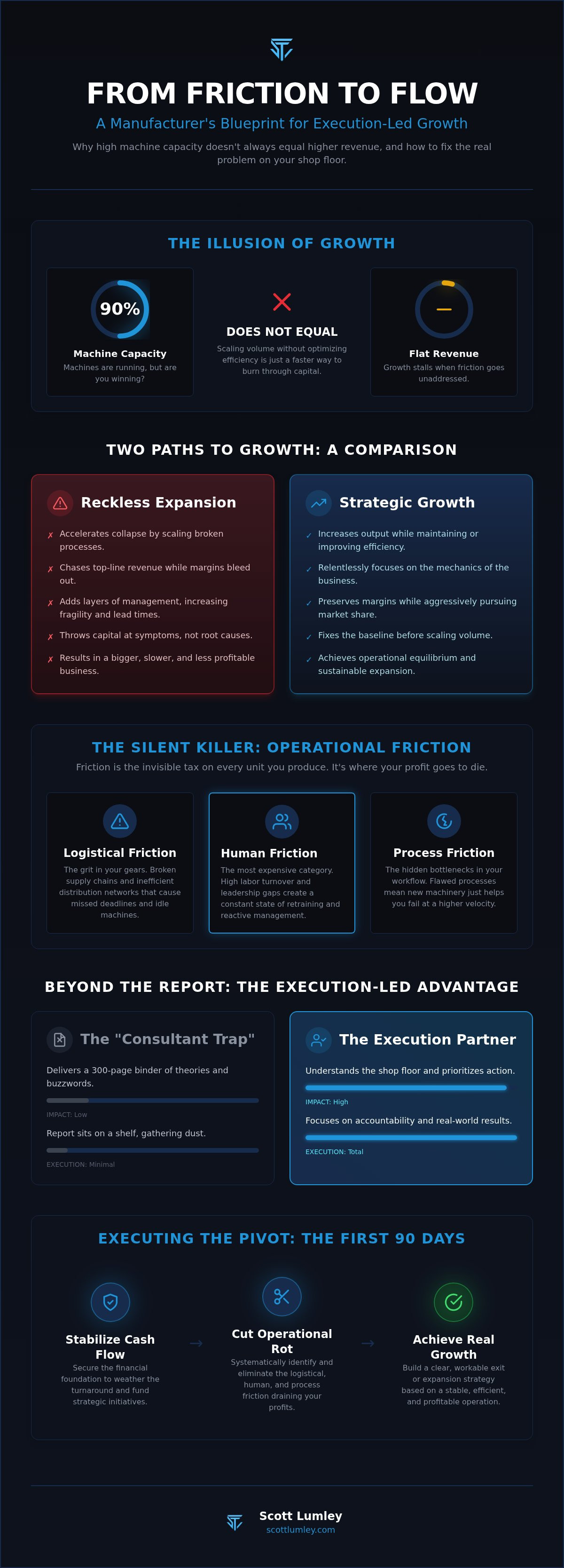
- Stop confusing high output with high profit. Scaling volume without optimizing efficiency is just a faster way to burn through your capital.
- Identify operational friction by conducting a clear-eyed assessment of your shop floor. Reports don't fix machines; finding where time and money are lost does.
- A battle-hardened manufacturing business growth consultant prioritizes strategic execution over buzzwords to ensure your shop floor can actually handle boardroom promises.
- Execute the pivot by stabilizing cash flow and cutting operational rot within the first 90 days of a turnaround.
- Move beyond the "consultant trap" by implementing leadership consulting that focuses on accountability and real-world results rather than thick, useless reports.
Why Most Manufacturing Growth Strategies Fail on the Shop Floor
Growth is a dangerous drug for a manufacturer. If you scale volume without fixing your baseline, you aren't growing; you're just accelerating your collapse. Most firms chase top-line revenue while their margins bleed out through the cracks in the shop floor. They fall into the "Consultant Trap." They hire big-name firms that deliver 300-page binders full of theoretical models and digital buzzwords. These reports rarely survive the first shift change. A real manufacturing business growth consultant doesn't hand over a report and walk away. They act as an execution partner who understands that a strategy is only as good as the person operating the CNC machine.
There is a massive difference between scaling up and just getting bigger. Getting bigger often makes you slower and more fragile. It adds layers of management, increases lead times, and dilutes quality. Scaling, however, is about increasing output while maintaining or improving your efficiency. It requires a relentless focus on the mechanics of your business, not just the optics of your balance sheet. If your growth strategy doesn't account for the grit and friction of daily operations, it's a fantasy. You need an operator, not a theorist, to navigate the transition from a mid-sized shop to an industrial powerhouse.
The Gap Between Boardroom Theory and Production Reality
Top-down digital directives usually fail because they ignore the human element of production. You can't optimize a line from a laptop in a different time zone. Industrial consulting requires lived experience. It requires standing in the heat and seeing the friction firsthand. Moving from reactive firefighting to proactive strategic planning isn't about buying better software. It's about leadership that respects the reality of the floor. When the boardroom dictates change without shop-floor buy-in, the result is always resentment and stalled progress. True growth happens when the strategy is designed in the trenches and refined in the boardroom.
Defining Sustainable Growth for Industrial Firms
Sustainable growth means expanding your footprint without sacrificing your operational equilibrium. You need a strategic business advisor who can spot the hidden bottlenecks before they become catastrophic failures. This involves a deep understanding of operations management principles to ensure every asset is utilized at its highest leverage point. You must preserve your margins while aggressively pursuing market share. Sustainable manufacturing growth is the achievement of increased market share through a calibrated balance of capacity, labor, and capital that maintains a state of operational equilibrium.
Identifying Operational Friction: The Barrier to Scaling
Friction is the silent killer of industrial growth. It's the point where time, money, or quality vanishes into thin air. Many owners think the answer to stagnant revenue is more volume. They're wrong. If your current footprint is riddled with inefficiencies, scaling just amplifies the mess. A manufacturing business growth consultant doesn't look at what you're doing right; they look at what's slowing you down. Friction is where your profit goes to die. It is the invisible tax on every unit you produce, and it won't disappear just because you hired more people or added a second shift.
Capital expenditure (CapEx) is often used as a expensive band-aid for broken processes. You buy a faster lathe or a more expensive welder, yet the bottlenecks remain. This happens because machinery cannot fix a lack of strategic importance of operational innovation within the workflow. If your process is fundamentally flawed, a new machine just helps you fail at a higher velocity. You must address the underlying structural issues before you throw capital at the problem. Real growth requires a clear-eyed assessment of your current footprint, not a shopping list for new equipment.
The Three Pillars of Manufacturing Friction
- Logistical friction: This is the grit in your gears. It includes the broken supply chains that leave you waiting for raw materials and the inefficient distribution networks that cause missed deadlines. Stagnation often starts here.
- Human friction: This is frequently the most expensive. High labor turnover and leadership gaps create a constant state of retraining and reactive management. Without skilled labor, your machines are just expensive paperweights.
- Technical friction: Integration is the issue here. Outdated machinery or software that doesn't talk to your floor leads to manual workarounds that kill productivity and increase the risk of error.
Diagnostic Tools for High-Stakes Operations
Scaling requires an honest audit of your current state. This isn't a feel-good exercise or a corporate retreat. You need to utilize due diligence consulting services to audit your own operations with the same intensity you'd use for an acquisition. You must distinguish between the "bottleneck of the week"—the annoying but temporary distraction—and the systemic failures that threaten your long-term survival. I use a "First 72 Hours" rule. If we can't identify the primary operational leaks within three days on the floor, we aren't looking hard enough. You can't fix what you refuse to see. If you're ready to stop guessing and start fixing, let's look at the data.
Strategic Growth vs. Reckless Expansion: A Comparison
Expansion is a liability if your foundation is cracked. Most owners think a backlog of orders is the ultimate win. It isn't. If your cost per unit rises as you scale, you're caught in the "Growth Paradox." This is the point where more work leads to less money and a higher risk of total failure. A manufacturing business growth consultant helps you differentiate between a lucrative opportunity and a reckless gamble. You need to optimize your current throughput before you lease more square footage or hire a third shift. Expansion without optimization is just a faster way to go out of business.
The 2026 manufacturing rebound is real, but it's dangerous. With the ISM Manufacturing Index climbing above 50 in early 2026, the temptation is to grab every contract available. Don't do it. If your labor productivity isn't growing faster than your hours worked, you're losing ground. Strategic growth requires a relentless focus on margins. You must balance organic expansion with strategic industrial acquisitions that add genuine capability. This isn't about getting bigger; it's about getting stronger. You need to identify "growth traps" where the cost of service swallows the profit of the sale.
Industrial acquisitions are often the fastest path to new capabilities. However, without a battle-hardened perspective, you might just be buying someone else's friction. Due diligence must be operational, not just financial. You aren't just looking at the books. You're looking at the shop floor. You're looking for the same structural rot discussed earlier. If the target firm has stagnant revenue despite high output, you're buying a problem, not a solution. Real growth is calculated and clinical. It values durability over speed.
Framework for Evaluating Growth Opportunities
Entering a new market isn't just about sales. It's about capacity. You must assess the true cost of entry, including the strain on your existing supply chain and the risk to your core clients. Quality control usually suffers first during rapid scaling phases. If you can't maintain your standards at 120% capacity, you shouldn't be there. For firms looking at physical expansion, leveraging real estate leadership advisory is critical. You need to align your facility strategy with your production flow. Don't let a bad lease dictate your manufacturing efficiency.
Risk Mitigation in Industrial Scaling
Debt is a tool, but it's also a trap. Debt-fueled expansion requires a rigid crisis management plan. The stakes are much higher when you're playing with the bank's money. You must protect your core operations while testing new revenue streams. Don't bet the farm on an unproven product line. The One Big Beautiful Bill Act (OBBBA) restored 100% bonus depreciation for machinery, which is a massive lever for growth. Use it wisely to upgrade technology without over-leveraging your cash flow. Bringing in an interim business consultant during these transition periods provides an outside perspective that isn't blinded by internal optimism. They see the risks you've learned to ignore.
Executing the Pivot: Turnaround Tactics for Distressed Firms
Turnaround isn't a suggestion. It's a survival mandate. When your manufacturing firm is bleeding cash, you don't have time for a digital transformation roadmap or a five-year vision statement. You have 90 days. In that window, you either stabilize the patient or prepare for liquidation. This requires a manufacturing business growth consultant who knows how to cut through operational rot with surgical precision. You need to identify where the money is leaking and plug the holes immediately. This isn't about being liked. It's about ensuring the shop floor is still there next year.
Restructuring debt and renegotiating supplier contracts requires grit. It's high-stakes poker. You need a business turnaround consultant who leads from the trenches, not the ivory tower. They should be on the phone with your creditors and on the floor with your foremen. If you aren't willing to have the hard conversations, you've already lost. We stop the bleeding by focusing on liquidity and operational recovery before we even whisper the word expansion. A battle-hardened manufacturing business growth consultant understands that recovery is the prerequisite for sustainable expansion.
Crisis Management in Manufacturing
Crisis management in manufacturing is about brutal prioritization. You must distinguish between "non-negotiable" assets and "disposable" overhead. If a piece of equipment isn't generating margin, it's a liability. Sell it. If a management layer is just adding friction, remove it. Transparency is your only tool for maintaining workforce morale during a pivot. Tell your people the truth about the stakes. Implementing crisis management consulting provides the framework to stabilize operations when every minute counts. Don't hide behind corporate speak while the ship is sinking.
From Recovery to Resilience
You can't grow a broken core. Recovery means stripping the business back to its most profitable elements and rebuilding from there. My experience in global operations, documented in 'I Survived Africa', taught me that resilience is forged in high-adversity environments. You adapt or you die. There is no middle ground. The pivot point is the specific moment where operational recovery stabilizes the foundation enough to transform a defensive turnaround into an aggressive growth strategy. If you're currently in a tailspin, you need to secure your operations now before the ground comes up to meet you.
Beyond the Report: Why Execution-Led Leadership Wins
Reports don't fix machines. People and processes do. If your advisor hasn't stood on a production line while a deadline looms, they shouldn't be giving you advice. Most consulting firms hide behind junior associates and generic templates. They provide observations, not solutions. Scott Lumley provides the opposite. His method focuses on direct accountability and the harsh realities of the industrial sector. This is about results, not optics. A real manufacturing business growth consultant doesn't just point out problems; they help you execute the fix. You need leadership consulting services that prioritize the shop floor over the boardroom.
The 2026 manufacturing sector is showing signs of renewed momentum, but this growth requires a steady hand. With the ISM Manufacturing Index signaling expansion, the difference between success and failure lies in your ability to execute. You don't need another binder full of digital buzzwords. You need a strategy that survives the grease and heat of actual production. Scott's no-nonsense approach is the antidote to corporate fluff. It's built on four decades of grit and real-world application. Execution is the only thing that matters in high-stakes industrial environments. If the strategy doesn't work on the floor, it doesn't work at all.
The Battle-Hardened Operator Advantage
Scott brings four decades of lived experience in construction, manufacturing, and logistics. This wisdom isn't gathered from a textbook; it's forged through 40 years of navigating extreme success and significant adversity. The focus is on sustainable scaling rather than short-term spikes. We don't chase temporary wins that break your infrastructure. You get direct access to a seasoned veteran. There is no hiding behind junior staff or corporate layers. Many firms send a senior partner to close the deal and a junior associate to do the work. We don't. You get the truth, even when it's uncomfortable, and the execution power to make it work. This is the advantage of working with an operator who has been in the trenches.
Building a Durable Industrial Legacy
Systems must outlast leadership. A truly great business runs on processes that survive the exit of the founder. We integrate property investment strategy with industrial growth to ensure your physical assets are working as hard as your machinery. This holistic approach is rare. Most consultants only look at the production line or the balance sheet. We look at the entire footprint, including how the "One Big Beautiful Bill Act" and its 100% bonus depreciation provisions can be leveraged for long-term stability. This is how you build a durable legacy that survives market shifts and economic cycles.
Your next move is simple. Start your operational audit today. Stop guessing where your margins are going. Contact Scott Lumley for a direct operational assessment and find out what a battle-hardened manufacturing business growth consultant can do for your bottom line. It's time to stop talking about growth and start executing it. The window for expansion is open; don't let operational friction hold you back.
Eliminate Operational Friction and Secure Your Industrial Future
Growth isn't found in a boardroom report. It's found in the grit of the shop floor and the clinical removal of operational friction. You now know that scaling volume without fixing your baseline is a death sentence. You've seen why reckless expansion leads to lower profits and higher risk. Now, you need a partner who has lived through these crises and come out stronger. A battle-hardened manufacturing business growth consultant provides the execution-led strategic planning required to turn a struggling plant into a resilient powerhouse.
Scott Lumley brings 40 years of industrial leadership to your operations. He is a specialist in distressed business recovery who understands that your legacy depends on durable systems, not just effort. Don't let another quarter slip away to inefficiency or missed deadlines. It's time to stop guessing and start fixing. Your shop floor is ready for more; make sure your strategy is built to handle the load.
Secure Your Operational Audit with Scott Lumley and start building a business that lasts.
Frequently Asked Questions
What does a manufacturing business growth consultant actually do?
A manufacturing business growth consultant identifies structural friction and implements actionable solutions directly on the shop floor. They don't just provide theoretical reports; they work in the trenches to fix broken processes and stabilize cash flow. This role is about execution-led strategy that aligns leadership with the harsh realities of production. It's the difference between having a plan and actually hitting your targets.
How do I know if my manufacturing business needs a turnaround or just a strategy tweak?
Look at your margins and your cash flow. If you're running at high capacity but revenue remains stagnant or your debt is mounting, you need a turnaround. A strategy tweak is for healthy firms looking to optimize existing wins. A turnaround is a survival mandate for businesses where the current model is no longer sustainable. Don't mistake a structural failure for a minor plateau.
What is the difference between scaling and expansion in an industrial context?
Scaling is the process of increasing your output while maintaining or improving your operational efficiency. Expansion is simply the act of getting larger, such as adding more floor space or hiring more staff. If you expand before you scale your efficiency, you're just growing your problems. Real growth requires scaling your margins before you expand your physical or human footprint.
How long does a typical manufacturing turnaround take to show results?
Expect to see signs of stabilization within the first 90 days. This initial phase focuses on stopping immediate cash leaks and cutting operational rot. A full transition from a distressed state to sustainable, profitable growth typically takes six to twelve months. It requires disciplined execution and a total lack of interest in superficial fixes. Speed matters, but durability is the ultimate goal.
Can a growth consultant help with supply chain and logistics friction?
Yes, resolving logistical friction is a core part of the growth process. A consultant audits your supply chain for vulnerabilities and identifies distribution bottlenecks that kill your lead times. They help you renegotiate supplier contracts with grit and find more resilient sourcing strategies. Protecting your core operations starts with ensuring your materials and products move without unnecessary friction or cost.
What should I look for when hiring an industrial sector business advisor?
Look for a battle-hardened operator with decades of experience when hiring a manufacturing business growth consultant. You need someone who has managed P&L accounts and navigated significant adversity, not a theorist with a fresh MBA. A great advisor speaks the language of the shop floor and understands the weight of high-stakes decision-making. Avoid anyone who relies on generic templates instead of hard-won wisdom.
How does real estate strategy impact manufacturing business growth?
Your facility is either an asset that supports your flow or a liability that creates friction. Real estate advisory helps you align your physical footprint with your production needs and long-term growth strategy. A poorly located or designed facility acts as a permanent tax on your efficiency. Integrating property strategy ensures your real estate supports your industrial goals rather than hindering them.
Is crisis management only for businesses facing bankruptcy?
Crisis management is not just a last resort for failing firms. It's a strategic tool for any business facing high-stakes disruptions like supply chain collapses or sudden regulatory shifts. The goal is to stabilize the situation and protect your core assets before the damage becomes terminal. Waiting for bankruptcy to implement crisis tactics is a recipe for failure. You use it to stay in the game.


