

Spreadsheets don't fix failing plants; operators do. You're likely watching output climb while profit margins shrink, feeling the weight of a leadership vacuum and a supply chain that's more bottleneck than flow. It's a brutal cycle. In 2026, with raw material volatility and labor costs squeezing the life out of facilities, the margin for error has disappeared. You know the current pace isn't sustainable, and you're tired of theoretical advice that doesn't survive the shop floor.
A battle-hardened manufacturing turnaround specialist doesn't offer polished promises. They offer execution. This article shows you how to identify operational rot, stabilize cash flow, and replace chaos with a clear, executable path to growth. We'll examine the specific strategies used to navigate today's high-stakes environment, from managing supply chain delays to restoring leadership integrity, so you can stop the bleeding and start building again.
Key Takeaways
- Stop the bleeding by prioritizing aggressive stabilization and cash triage over theoretical management models.
- Identify and eliminate operational friction, the invisible tax that slows your production cycles and drains your profit margins.
- Learn how a manufacturing turnaround specialist uses the first 90 days to move from crisis management to sustainable growth.
- Understand why 40 years of lived experience in the trenches provides better results than any MBA-led consulting firm.
- Use strategic planning and due diligence as tactical recovery tools rather than just administrative paperwork.
What is a Manufacturing Turnaround Specialist?
A manufacturing turnaround specialist is not a consultant. Consultants write reports and deliver presentations; specialists execute recovery. This role is an aggressive intervention in a distressed firm designed to stop losses and restore profitability. It requires a deep, gritty understanding of the shop floor that goes far beyond what you'll find in a spreadsheet. It is about identifying the friction points where money is literally leaking out of your facility.
In the high-stakes world of turnaround management, success is measured by survival and eventual growth. For an operator like Scott Lumley, this isn't theoretical. It's built on 40 years of lived experience in construction, manufacturing, and logistics. Generic business advice fails in this sector because it ignores the physical reality of assets, labor, and supply chain friction. You don't need a cheerleader. You need someone who has navigated the trenches and knows how to stabilize a failing plant before it hits the point of no return.
Financial Recovery vs. Operational Execution
Fixing a balance sheet is a waste of time if the plant floor is broken. You can't math your way out of a failing production line. While the first 72 hours of an intervention focus on cash flow stabilization and triage, that's only the beginning. The real recovery happens by analyzing tangible assets and supply chain logistics. If your equipment is failing and your supply chain is a series of bottlenecks, your finances will never recover. A true manufacturing turnaround specialist identifies where profits go to die. This isn't about cutting costs until the bone shows. It's about optimizing the movement of goods and the efficiency of labor to create a sustainable operation.
When to Hire a Turnaround Expert
Most leaders wait too long. They see shrinking profit margins despite high output and assume it's a temporary market slump. It's usually not. It's systemic operational rot. You need to look for specific warning signs that indicate your internal team is losing control:
- High employee turnover and a leadership vacuum on the floor.
- Consistent delivery delays caused by internal bottlenecks rather than external factors.
- Cash flow that remains dangerously tight despite steady sales volume.
- A supply chain that feels like a constant crisis rather than a managed process.
There is a point of no return. This happens when internal leadership can no longer pivot because they are too close to the problem. They are blinded by the status quo and paralyzed by indecision. When your team can no longer see the friction points, you need a battle-hardened operator to step in and force the necessary changes.
The Specialist’s Toolkit: 5 Pillars of Manufacturing Recovery
Recovery isn't a suggestion. It's a requirement for survival. When a facility is failing, you don't have the luxury of time or the margin for error. A manufacturing turnaround specialist uses a specific set of tools to dismantle failure and rebuild profitability. These aren't abstract concepts. They are the structural supports for a dying business. If you're looking for a soft touch, you're in the wrong place. These pillars are about aggressive intervention and total operational transparency.
Strategic Planning Over Sterile Theory
Fifty-page reports are useless in a manufacturing crisis. They end up in drawers while the plant floor continues to bleed cash. You need a blueprint that a floor manager can actually execute. This is where a strategic business advisor shifts the focus from academic theory to ground-level execution. Plans must be short, punchy, and actionable. If a directive doesn't result in immediate movement on the line, it's waste. We build the path to recovery by identifying exactly what needs to move and who is responsible for moving it.
Crisis management is the immediate triage phase. You stop the bleeding by stabilizing the "burn rate" before you even think about long-term fixes. This requires a cold, hard look at every dollar leaving the facility. While organizations like the Turnaround Management Association (TMA) set the professional standards for this work, the actual execution happens in the heat of the moment. You prioritize survival. You cut the friction. You ensure the doors stay open long enough to implement a permanent solution.
Due Diligence: The Diagnostic Phase
You can't fix what you haven't accurately diagnosed. This isn't just about reviewing the books; it's about analyzing machine downtime and labor productivity. Utilizing due diligence consulting services allows you to identify deal-breaking risks and hidden friction points in your production lines. It also involves evaluating property and real estate assets for potential liquidity. You need to know the true value of your assets and the exact cost of your inefficiencies before you can pivot.
Leadership alignment is often the hardest pillar to secure. Executive inertia kills recovery faster than a bad supply chain. If your leadership isn't aligned with the turnaround, they are part of the problem. This often requires removing toxic elements at the top to clear the way for progress. Finally, supply chain optimization ensures that raw materials and logistics actually support the recovery. A plant can't turn around if it's waiting on parts. If you're ready to stop the rot, it's time to speak with a battle-hardened operator who understands these realities.
Identifying Operational Friction: Where Profits Go to Die
Friction is the invisible tax on every manufacturing business. It’s the sand in the gears of your production line. While competitors talk vaguely about "operational issues," a manufacturing turnaround specialist looks for specific, tangible points of failure. Profits don’t just vanish. They’re bled out through slow decision-making, idle machinery, and misaligned labor. If you don't identify these points, you're just throwing money into a furnace.
Indecision is the most expensive friction point in any plant. When leadership hesitates, production cycles stall. In a high-stakes manufacturing environment, every hour of delay ripples through the entire schedule. This isn't a theoretical problem; it’s a leadership failure. If you can’t make a decision in ten minutes that should take five, you’re paying for that extra five minutes across every machine and operator on the floor. Speed is a competitive advantage that most failing firms have forgotten how to use.
Asset mismanagement and labor friction are the other silent killers. Underutilized machinery isn’t an investment; it’s a liability. If a million-dollar piece of equipment sits idle because of poor scheduling or deferred maintenance, that’s friction. Similarly, labor friction occurs when management’s goals never reach the shop floor. If the operators don't understand the mission, they can’t execute it. You end up with a workforce that's busy but not productive.
The Logistics of Failure
Poor inventory management chokes cash flow. It ties up capital in raw materials that sit in a warehouse instead of moving through the line. A single supply chain bottleneck can halt an entire facility, creating a ripple effect that destroys delivery reliability. Fixing these logistics is about more than just "efficiency." It’s about mapping the movement of every part and identifying exactly where the flow stops. You restore reliability by removing the hurdles, not by working harder against them.
Leadership as a Leverage Point
Survival mode is a dangerous place to stay. It’s reactive, frantic, and ultimately unsustainable. To move toward growth, you must transition into strategic execution mode. This is why leadership consulting services are vital during a turnaround. You aren't looking for a cheerleader; you're looking for a shift in how the business is run at its core.
Hands-on leadership replaces theoretical management. You don’t lead a turnaround from a corner office. You lead it from the trenches. You identify the friction, address the people causing it, and implement the fix immediately. There’s no room for ego in a crisis. There’s only room for results. If the leadership team isn't willing to get their hands dirty and face the harsh realities of the floor, the turnaround will fail before it starts.
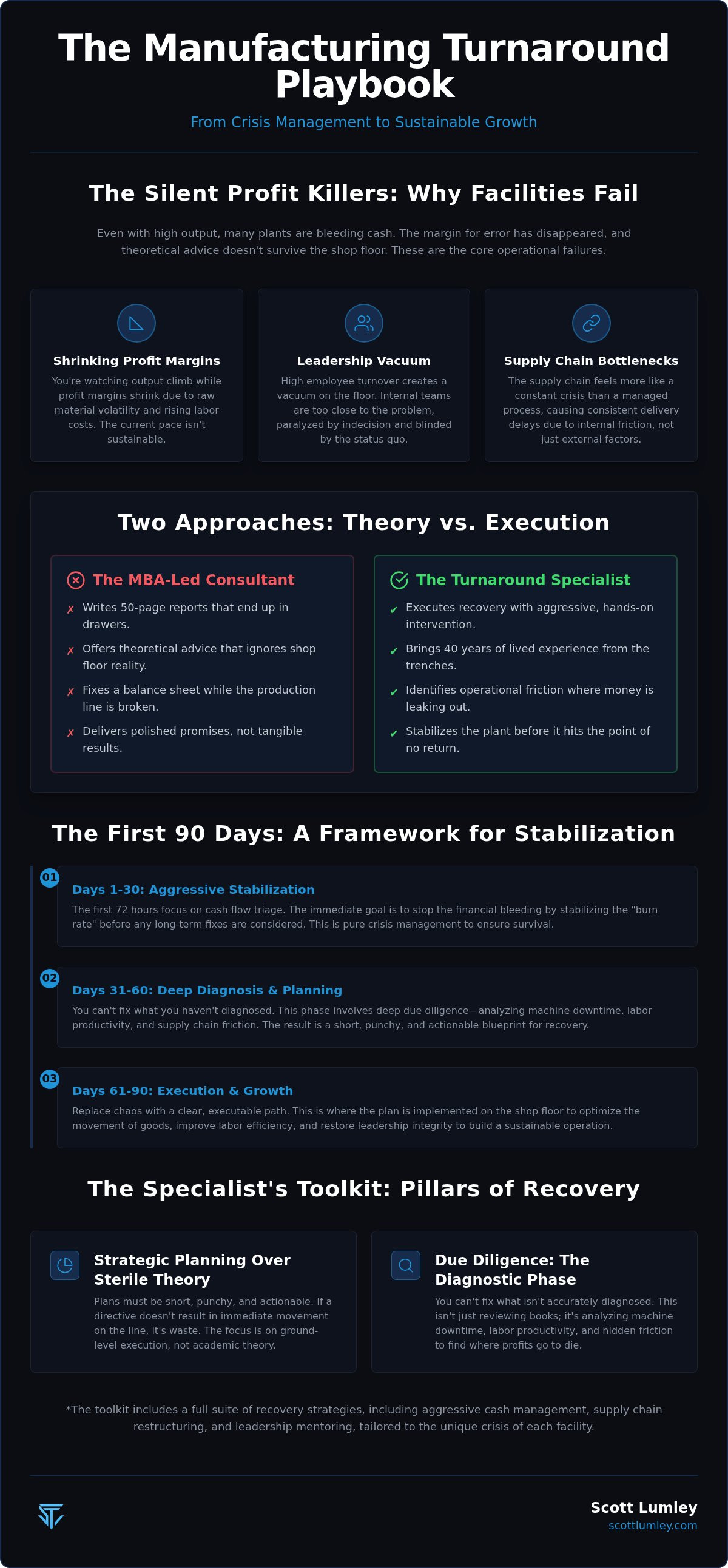
The First 90 Days: A Framework for Manufacturing Stabilization
The first 90 days determine whether a plant survives or collapses. You don't have months to debate strategy. You have weeks to execute. A manufacturing turnaround specialist operates on a compressed timeline where every hour counts. This framework isn't about gradual improvement; it's about aggressive stabilization and the total removal of operational rot. If you can't stop the bleeding in the first month, you won't be around to see the third.
Triage and Stabilization
Days 1 through 30 are about survival. The first 72 hours require the establishment of a command center for the turnaround. You must stop the bleeding by cutting non-essential "fluff" immediately. If an expense doesn't directly contribute to production or safety, it's gone. This is also the time to communicate directly with creditors and suppliers. You buy operational runway by being transparent about the recovery plan. You don't hide from the numbers; you own them. Stabilization is a brutal process of triage where only the core functions of the business are protected.
During days 31 to 60, the focus shifts to an operational deep-dive. This is where we remove the immediate friction points identified during the triage phase. We look at the shop floor reality, not just the management reports. If a machine is down 20% of the time, we find out why and fix it now. If a shift is underperforming, we address the leadership vacuum on that line. We establish KPIs that actually matter to the bottom line, such as:
- Cash Conversion Cycle: How fast a dollar spent on raw materials returns as revenue.
- Throughput Efficiency: Measuring actual output against machine capacity.
- Scrap and Rework Rates: Identifying where material waste is killing margins.
Restructuring for Sustainable Growth
Days 61 through 90 are dedicated to implementing the new strategic growth blueprint. By now, the chaos should be replaced by a methodical rhythm. We redesign workflows to eliminate redundant steps that have likely existed for years. This isn't just about moving machines; it's about re-engineering how people and materials move through the facility. We also focus on training leadership to maintain these new operational standards. Without a team capable of holding the line, the business will eventually slide back into crisis.
Maintaining long-term stability requires a shift in mindset. You move from a reactive "survival mode" to a proactive "strategic execution" mode. This is where the role of a business turnaround consultant becomes a bridge to future expansion. You've stabilized the ship; now you have to navigate it toward profit. If your current trajectory is leading toward a shutdown, it’s time to bring in a battle-hardened operator to reset the course.
The Scott Lumley Approach: Execution-Led Strategy
Theory doesn't save plants. Experience does. When a facility is on the brink of collapse, an MBA-led report won't stop the bleeding. You need a manufacturing turnaround specialist who has navigated the harsh realities of the shop floor for 40 years. Scott Lumley’s approach is built on lived experience in construction, manufacturing, and logistics. It’s an unapologetically direct, no-nonsense advisory that prioritizes tangible results over corporate feelings. If a process isn't contributing to the bottom line, it’s stripped away. If a leader isn't executing, they are replaced.
This isn't about temporary fixes or surface-level patches. It’s about total operational recovery. The mission is to move beyond mere survival and into a phase of sustainable scaling. By identifying the specific friction points that bleed profit, we rebuild the business on a foundation of durability. This national reach ensures that whether you're managing a single plant or a complex network of logistics hubs, the strategy remains grounded in the physical reality of your assets and workforce.
High-Stakes Expertise Across Sectors
The principles of manufacturing recovery are universal. Whether it’s retail, logistics, or industrial operations, the core issues remain the same: friction, indecision, and a lack of leadership. Applying these grit-based principles to diverse sectors allows for a more comprehensive recovery. For instance, real estate leadership advisory plays a critical role in securing a firm's physical footprint during a pivot. You can't ignore the land and buildings while trying to fix the machines.
This level of resilience is captured in the 'I Survived Africa' mindset. It represents the ability to maintain composure and decisiveness in the face of absolute chaos. When the stakes are at their highest, you need an operator who has seen extreme adversity and knows how to lead a team through it. It’s about survival, recovery, and eventually, total dominance in your market.
Your Next Move
Waiting another quarter is a strategic failure. Every day you hesitate is another day of lost margins and increasing risk. If you can see the warning signs, your creditors and competitors can see them too. Engaging Scott Lumley for a rapid operational assessment isn't just a business decision; it's an act of survival. We don't spend months studying the problem. We spend days identifying the leverage points and weeks executing the fix.
Turnarounds are won by those who execute, not those who plan. The blueprint is only as good as the operator behind it. If you're ready to stop the rot and restore profitability to your manufacturing plant, you need a battle-hardened strategist who leads from the trenches. The path to growth is clear, but it requires the courage to act now.
Stop the Bleeding and Rebuild
Friction and indecision are the silent killers of industrial profit. We’ve explored how a manufacturing turnaround specialist identifies operational rot, stabilizes cash flow, and executes a 90-day recovery framework. Success isn’t found in a consultant’s report; it’s forged on the factory floor through aggressive triage and leadership alignment. You can’t math your way out of a broken production cycle. You have to lead your way out.
Scott Lumley brings 40 years of lived experience to every engagement. As a national industrial strategy expert, he offers no-nonsense execution focused on results, not theories. The window for recovery is often smaller than you think. If you act now, you can stabilize your operations and build a foundation for sustainable growth. Your plant has the potential to thrive again, but only if you have the grit to pivot today.
Secure Your Operational Recovery with Scott Lumley
Frequently Asked Questions
What is the difference between a turnaround specialist and a traditional consultant?
A manufacturing turnaround specialist is an operator, not an advisor. Traditional consultants deliver reports and leave the implementation to you. A specialist steps into the trenches to take control of operations, identify friction, and execute the recovery plan. It is the difference between someone telling you the engine is broken and someone actually getting under the hood to fix it. We focus on execution over theory.
How long does a typical manufacturing turnaround take to show results?
You should see cash flow stabilization within the first 30 days. While a full recovery takes longer, a professional manufacturing turnaround specialist establishes a command center in the first 72 hours to stop immediate losses. By the 90 day mark, the facility should be operating under a new, profitable rhythm. If you don't see movement in the first quarter, the strategy is failing.
Do I have to fire my entire leadership team during a turnaround?
Total termination is rarely the answer, but removing toxic inertia is mandatory. Some leaders thrive under a new, execution led structure. Others are the source of the friction that caused the distress. A specialist evaluates performance based on output and alignment with the recovery blueprint. Those who can't or won't execute are replaced to protect the survival of the firm and its assets.
Can a manufacturing turnaround be successful without outside funding?
Many turnarounds succeed by optimizing internal assets and stabilizing cash flow without taking on new debt. Funding is often a band aid for bad operations. By identifying where profits are leaking and removing redundant workflows, a specialist can often find the necessary capital within the existing business. You fix the mechanics of the plant floor before you look for outside cash to fuel growth.
What are the most common causes of manufacturing business failure?
Most failures stem from a combination of slow leadership and unmanaged operational friction. High employee turnover, supply chain bottlenecks, and underutilized machinery are the primary killers. When management stays in survival mode too long, they lose the ability to pivot. This creates a leadership vacuum that allows small inefficiencies to snowball into a total financial crisis that threatens the entire operation and its footprint.
Is a turnaround specialist the same as a bankruptcy lawyer?
No, a specialist focuses on the shop floor while a lawyer focuses on the courtroom. Bankruptcy lawyers handle the legal restructuring and filings required for Chapter 11. A specialist focuses on the physical reality of the business. They stabilize production, fix logistics, and restore profitability so you can avoid the courtroom entirely or emerge from it with a viable, profitable company that can scale.
How does Scott Lumley’s approach differ from large consulting firms?
Large consulting firms rely on MBA theory and standardized slide decks. Scott Lumley relies on 40 years of lived experience in construction, manufacturing, and logistics. His approach is execution led, meaning he prioritizes what works on the plant floor over what looks good in a boardroom. It is a direct, no nonsense strategy that values survival and tangible growth over superficial management trends and academic fluff.


