

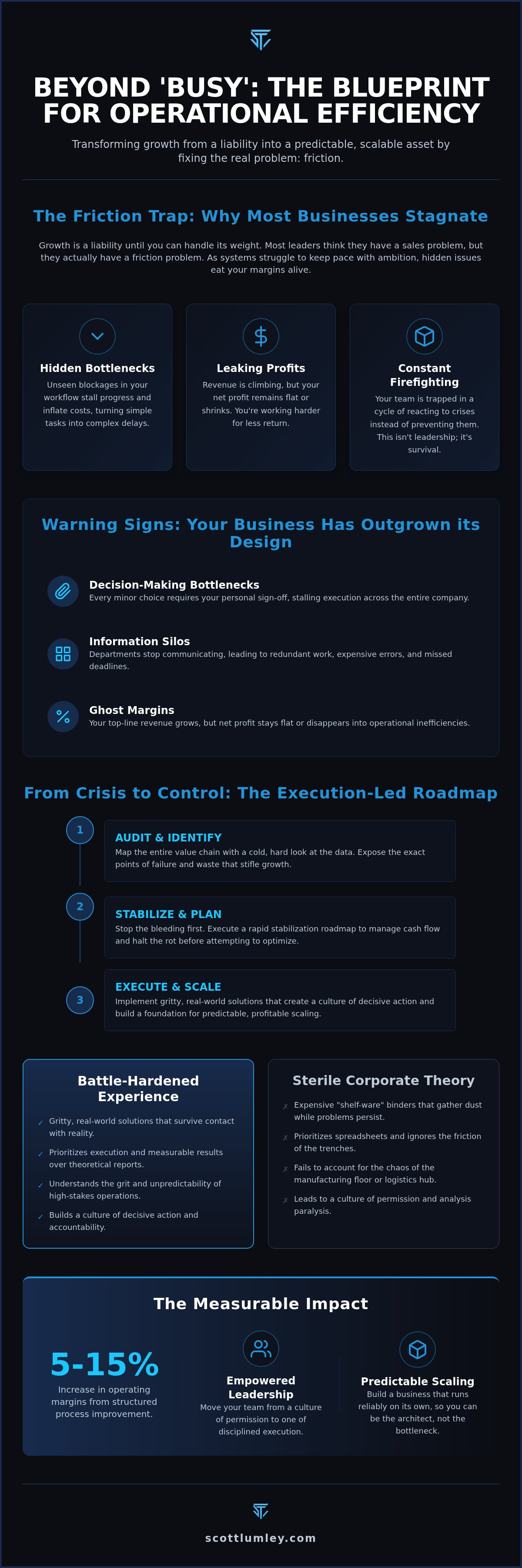
Growth is a liability until you prove you can handle the weight of it. Most leaders think they have a sales problem, but they actually have a friction problem. As your systems struggle to keep pace with your ambition, hidden bottlenecks eat your margins alive. You're likely exhausted from constant firefighting and watching your business demand more of your time while returning less profit. It's a common trap, but it's one you can't afford to stay in for long.
Bringing in an operational efficiency consultant isn't about adding corporate jargon to your slide decks. It's about a cold, hard look at where your cash is leaking. You'll learn how to identify the exact points of failure in your current workflow and eliminate the waste that's stalling your progress. I'll show you how to execute a growth strategy that sticks, ensuring you get a measurable ROI on every operational change. We're moving toward a business that runs reliably on its own, so you can stop being the bottleneck and start being the architect of your own predictable scaling.
Key Takeaways
- Identify the difference between being "busy" and being "productive" by optimizing the specific ratio of your operational output to input.
- Learn how an operational efficiency consultant maps your value chain to expose the hidden bottlenecks eating your profit margins.
- Build execution-led strategies that move your leadership team from a culture of permission to a culture of decisive action.
- Execute a rapid stabilization roadmap to manage cash flow and stop the rot during high-stakes operational turnarounds.
- Leverage decades of battle-hardened experience to implement gritty, real-world solutions that sterile corporate theory can't provide.
What is an Operational Efficiency Consultant and Why Do You Need One Now?
Most businesses don't fail because they lack sales. They fail because they can't handle the success they've already built. In high-stakes environments, growth often masks deep-seated structural rot. You see it in the frantic energy of your team and the thinning of your margins. An operational efficiency consultant isn't a life coach for your business; they are a mechanic for your value chain. Their job is to look at the cold, hard ratio of your output to your input and fix whatever is skewing the numbers.
Right now, your organization is likely trapped in a cycle of tactical firefighting. You're reacting to crises instead of preventing them. This isn't leadership; it's survival. To move beyond this, you must understand what is operational efficiency? and how it differs from mere activity. Being busy is just movement. Productivity is progress. If your leadership team is constantly exhausted but the needle isn't moving, you have a friction problem. Friction eats profit. It burns out your best talent. It turns a promising venture into a slog.
Efficiency vs. Effectiveness: The Critical Distinction
Effective leaders do the right things. Efficient leaders do those things without wasting blood, sweat, or cash. In a turnaround or a rapid scaling phase, you need both. Sterile corporate theory often fails here because it prioritizes spreadsheets over the gritty reality of the manufacturing floor or the logistics hub. You can't optimize a process you don't understand from the trenches. Operational efficiency is the aggressive elimination of growth-stifling friction. It's about stripping away the layers of "how we've always done it" to find a leaner, faster path to your goals.
Signs Your Business Has Outgrown Its Current Design
Complexity is the silent killer of scale. If you're experiencing any of the following, your current systems are no longer fit for purpose:
- Decision-making bottlenecks: Every minor choice requires your personal sign-off, stalling execution across the board.
- Information silos: Departments have stopped talking, leading to redundant work, expensive errors, and missed deadlines.
- Ghost margins: Your revenue is climbing, but your net profit remains flat or starts to shrink.
These aren't just growing pains. They are signals that your operational design is failing. A battle-hardened consultant identifies these friction points before they become terminal, moving you from a culture of permission to a culture of disciplined execution.
The Core Pillars of an Execution-Led Operational Strategy
Efficiency isn't a theory. It's a survival tactic. An operational efficiency consultant builds blueprints that survive contact with the real world. Most firms fail because their strategy lives in a vacuum. They ignore the friction of the manufacturing floor or the chaos of the logistics hub. To win, you must stabilize the ship before you attempt to optimize it. This begins with aggressive due diligence to identify operational risks before they turn into terminal liabilities. If your foundation is rotting, no amount of automation will save you. You stop the bleeding first. Only then do you build for scale. To ensure your commercial growth is as resilient as your operations, you can discover Carter Strategies for business strategy consulting tailored to mid-size companies.
Strategic Planning Beyond the Concrete
Traditional consulting often results in "shelf-ware." These are expensive binders that gather dust while your team continues to struggle. A real strategic business advisor prioritizes execution over theory. You need a plan that aligns your actual operational capabilities with your long-term enterprise goals. According to McKinsey & Company, structured process improvement can increase operating margins by 5 to 15 percent in the manufacturing sector. Achieving those gains requires more than a spreadsheet. It requires a roadmap that accounts for the grit and unpredictability of high-stakes operations. If you aren't planning for the friction of the trenches, you aren't planning at all.
Leadership as an Operational Lever
Tools don't fix businesses. People do. Accountability must be baked into the DNA of your organization. Leadership consulting services bridge the gap between a founder's vision and the daily reality of the floor. You must move your team from a culture of permission to a culture of execution. This often requires the intervention of an interim leader who can drive rapid pivots without the baggage of internal politics. When leadership is used as a lever, every other operational change gains more force. It's about building a team that doesn't just follow orders but owns the outcome.
Technology plays a role, but it's a tool, not a savior. Understanding the role of technology in operational efficiency is critical for removing manual errors and speeding up data flow. However, digital tools only amplify what's already there. If your processes are broken, technology just helps you fail faster. You need a strategist who knows when to automate and when to strip a process down to its bare bones. This grounded approach is what separates a battle-hardened operator from a theoretical advisor. If you're ready to stop the firefighting and start scaling, it might be time to consult with Scott Lumley to get your operations back on track.
Auditing Your Value Chain: Identifying Friction Points
Auditing a value chain isn't about looking at what's working. It's about hunting for what's broken. You follow the money and the work from end to end, tracing every touchpoint where value is added or lost. An operational efficiency consultant maps this flow to find the specific points where momentum dies. Most businesses suffer from a single constraint that limits total throughput. You can't fix everything at once. You find the one bottleneck that's strangling your capacity and you break it. This is how you recover lost profit and maximize your margins. It's process tightening, not just cost-cutting. It's the difference between guessing where the leak is and seeing the hole in the pipe.
Asset optimization is the other half of the equation. Your real estate and equipment shouldn't just exist; they must work for your balance sheet. If your physical assets aren't contributing to your operational flow, they're just expensive paperweights. We look at capacity utilization and maintenance cycles to ensure your hardware is an engine for growth, not a drain on cash. When assets are optimized, they provide the durability needed to survive market shifts. You don't need more assets. You need more from the assets you have.
Real Estate and Property Portfolio Optimization
Efficiency principles apply to property just as much as they do to a production line. A real estate leadership advisory approach uncovers hidden value in your portfolio by aligning property usage with operational needs. We look at the Property Tax Debt System as a strategic hedge. It's an asset strategy that turns a liability into a leverage point. You aren't just managing buildings. You're managing capital efficiency. This level of scrutiny ensures your portfolio supports your scaling efforts instead of anchoring them down.
Manufacturing and Logistics: The Gritty Reality
Corporate offices rarely see the friction on the floor. They see reports. They don't see the three minutes wasted every hour because a tool is misplaced or a loading dock is poorly staged. In manufacturing and logistics, these minutes aggregate into thousands of dollars in lost margin. Strategic material sourcing is also critical to combat current supply chain volatility. You need a resilient supply chain, not just a cheap one. Due diligence in operations prevents deal-killing surprises by exposing hidden liabilities before they hit the balance sheet.
This grounded approach identifies floor-level friction that a spreadsheet-only advisor will always miss. When an operational efficiency consultant audits the floor, they aren't looking for compliance. They're looking for movement. It's about finding the grit in the gears and flushing it out before it causes a total system failure. If the work isn't flowing at the floor level, the strategy at the top level doesn't matter.
From Crisis to Control: A Roadmap for Operational Turnaround
Efficiency is often marketed as a luxury for healthy companies. This is a dangerous misconception. In high-stakes operations, efficiency is the difference between recovery and collapse. When your business is spiraling, you don't need a cheerleader. You need a strategist who can stop the bleeding. An operational efficiency consultant enters a crisis to strip away the noise and focus on the mechanics of survival. The goal isn't just to stay afloat. It's to rebuild the engine so it can actually handle the next phase of growth. You can't optimize a sinking ship; you have to plug the holes first.
The roadmap to a turnaround is brutal but linear. It begins with rapid stabilization. Cash flow is the only metric that matters in the first 48 hours. You secure your liquid assets and cut every non-essential expense. Once the immediate bleed is stopped, we identify the core operational rot. Surface-level symptoms like low morale or missed deadlines are just noise. The real issue is usually a broken process, a bloated supply chain, or a total lack of accountability at the leadership level. Restructuring for survival means making hard choices about what stays and what goes. We strip the business back to its core profitable functions. Only after the foundation is secure do we implement the mechanisms for sustainable scaling.
The First 90 Days of an Operational Pivot
The first 90 days are about high-impact wins. You need immediate relief to regain the trust of your stakeholders and your team. This is why a business turnaround consultant must be a battle-hardened operator. You can't lead a pivot from a boardroom. You lead it from the floor, where the work actually happens. Clear communication is non-negotiable. Employees and investors need to know the plan is gritty, realistic, and focused entirely on execution. If they don't see movement within the first quarter, they'll check out. We prioritize the changes that return the most cash or time to the organization immediately.
Crisis Management: Surviving the Storm
Recovery plans must account for worst-case scenarios. Hope isn't a strategy. Crisis management consulting provides the strategic stabilization required to weather the storm. It's about maintaining composure while everything is on the line. We move you from a state of constant reaction back into a strategic growth posture. This transition is fast-paced and decisive. It requires a total lack of interest in superficial appearances and a deep commitment to transparency. If your operations are currently in a tailspin, you need to act now. Reach out to Scott Lumley to start your operational recovery today.
Why a Battle-Hardened Consultant Beats Sterile Corporate Theory
Most consulting is a collection of spreadsheets and optimistic theories. It's sterile. It rarely survives contact with a manufacturing floor or a construction site. You don't need another MBA with a slide deck. You need 40 years of lived experience. An operational efficiency consultant who has spent decades in the trenches knows that reality is messy. They've navigated the harsh cycles of logistics and construction. They've seen what happens when systems break under high pressure. This hard-won wisdom is the only thing that provides a real-world perspective on your operations. It isn't about polished marketing. It's about what actually works when the stakes are high.
Leading from the trenches is non-negotiable. You can't fix friction from a boardroom. You have to see the work, talk to the operators, and find the grit in the gears yourself. This requires a level of transparency and integrity that internal teams often avoid. Employees might hide bottlenecks to protect their positions. Managers might sugarcoat reports to avoid conflict. A battle-hardened strategist tells the hard truths that no one else will. This is the sobering voice of reason you need to move from theory to execution. It's about survival. It's about recovery in environments where failure isn't an option.
The Industrial Sector Advantage
Construction, manufacturing, and retail demand a specific kind of strategist. These sectors deal with physical assets and complex human variables. Generalist advice doesn't apply here. Applying lessons from "I Survived Africa" provides a unique perspective on global operational resilience. This gritty experience also informs how due diligence consulting services protect your industrial investments. We look for the operational friction that a standard financial audit will always miss. We ensure the deal is as solid as it looks on paper. We identify the risks before they become your liabilities.
Taking the Next Actionable Move
Analysis paralysis is a growth killer. If you spend all your time measuring friction, you never actually remove it. You must have a bias toward action. It's time to stop analyzing and start executing. Engaging for a strategic briefing or a full operational audit is the first step toward reclaiming your margins. This isn't a passive coaching session. It's a high-level briefing designed to lead you toward absolute clarity and your next move. Every sentence in your plan must serve the next actionable step. Don't let your operations outgrow your systems any longer. Work with Scott Lumley to eliminate operational friction and scale your business.
Stop Firefighting and Start Scaling
Friction is the silent killer of profit. You've seen how to identify bottlenecks and why a culture of execution beats a culture of permission every time. Moving from crisis to control requires more than just a new software package or a better spreadsheet. It requires a fundamental shift in how your business handles work and money. If you're tired of your operations outgrowing your systems, it's time to stop reacting and start designing for durability.
Engaging an operational efficiency consultant ensures your growth strategy actually sticks. Scott Lumley provides more than just advice; he provides a roadmap built on 40 years of hands-on operations experience. From national real estate leadership advisory to expertise in distressed business turnarounds, the focus remains on tangible outcomes. It's time to strip away the noise and focus on what moves the needle. You don't need more theories; you need movement.
Book a Strategic Briefing with Scott Lumley to eliminate friction and reclaim your time. Your business has the potential to run reliably without your constant intervention; you just need the right blueprint to get there. Build a company that serves your vision instead of consuming your life.
Frequently Asked Questions
What exactly does an operational efficiency consultant do?
An operational efficiency consultant identifies and removes the specific friction points that kill your profit margins. They map your value chain from end to end to find exactly where time and capital are leaking. Instead of delivering a theoretical report, they implement gritty, execution-led strategies to fix broken processes. Their goal is a business that runs reliably without constant leadership intervention or firefighting.
How long does it take to see results from operational consulting?
You should see measurable relief within the first 90 days of an operational pivot. The first phase focuses on rapid stabilization and cash flow management to stop any active bleeding. While total structural overhauls take longer to fully mature, high-impact changes provide a measurable ROI almost instantly. We prioritize the specific moves that return the most time and capital to your organization first.
Is operational consulting only for large corporations?
No, it's critical for any business where operational complexity has outgrown its current systems. Mid-sized firms in manufacturing, construction, and logistics often face the highest stakes. These organizations have enough volume to suffer massive losses from minor friction but lack the bloated overhead of global firms. Efficiency is a survival tactic for scaling businesses, not a luxury reserved for the Fortune 500.
What is the difference between a business coach and an operational consultant?
A business coach focuses on your mindset and motivation; an operational consultant focuses on your mechanics and margins. One acts as a cheerleader while the other acts as a mechanic. Consultants lead from the trenches to fix actual workflows, supply chain issues, and leadership gaps. They don't just tell you to do better. They build the systems that make high performance the default outcome.
How do you identify hidden bottlenecks in a manufacturing business?
We identify hidden bottlenecks by following the work on the floor, not just reading reports in the office. This involves mapping the flow of materials and information to find the single constraint limiting your total throughput. According to McKinsey & Company, structured process improvements can increase manufacturing operating margins by 5 to 15 percent. We hunt for the specific floor-level friction points that prevent you from reaching those targets.
Can an operational consultant help with a business turnaround or crisis?
Yes, they are essential for stabilizing a ship that's already taking on water. Crisis management involves identifying core operational rot and restructuring the business for immediate survival. A battle-hardened strategist moves you from a state of constant reaction back into a strategic growth posture. They provide the sobering voice of reason needed to make the hard choices that internal teams often avoid during a tailspin.
What industries benefit most from operational efficiency strategies?
High-stakes sectors like manufacturing, construction, logistics, and retail see the most immediate benefits from these strategies. These industries rely on physical assets and complex value chains where friction is exceptionally expensive. Real estate portfolios also gain significant value through specialized asset optimization and leadership advisory. Any industry with thinning margins and high operational risk needs a direct, execution-led strategy to remain resilient.
How much does hiring an operational efficiency consultant cost?
Industry rates for independent consultants in 2026 typically range from $100 to $500 per hour, with senior specialists often charging $1,000 or more. Day rates generally fall between $1,000 and $10,000 depending on the project's complexity and the consultant's experience level. Many engagements also utilize value-based fees, which typically range from 10 to 20 percent of the quantified value created for the client. You should evaluate these rates against the potential ROI of recovered margins and increased throughput.


