

Real estate leadership is not a search for talent; it is the tactical elimination of operational friction. With home price growth hitting a fifteen-year low of 0% in 2026, you can't afford to wait for the market to save you. Most firms are currently drowning in sterile slide decks while high interest rates and operational rot erode their asset value. You need a real estate leadership advisory approach that prioritizes the trenches over the boardroom. It's time to stop managing a slow decline and start forcing growth in a stagnant market.
You likely feel the weight of a team losing alignment as market shifts accelerate. It's a common frustration, but it's one that ends with decisive execution. This article provides a tactical blueprint to eliminate the friction slowing down your acquisitions and stabilize distressed assets with speed. We'll move past the fluff of traditional consulting to focus on hard-won wisdom. You'll learn how to align your leadership for high-stakes execution and turn operational recovery into a competitive advantage.
Key Takeaways
- Stop managing decline; the 2026 market demands asset-driving execution over passive seat-warming.
- Use real estate leadership advisory to bridge the gap between high-level strategy and the gritty reality of on-the-ground operations.
- Identify operational rot by auditing your team's hard wisdom instead of relying on superficial soft skills.
- Deploy a tactical 90-day stabilization blueprint to protect distressed assets and force growth in volatile conditions.
- Prioritize battle-hardened operational experience over sterile consulting theory to eliminate the friction stalling your growth.
The Collapse of Passive Real Estate Management in 2026
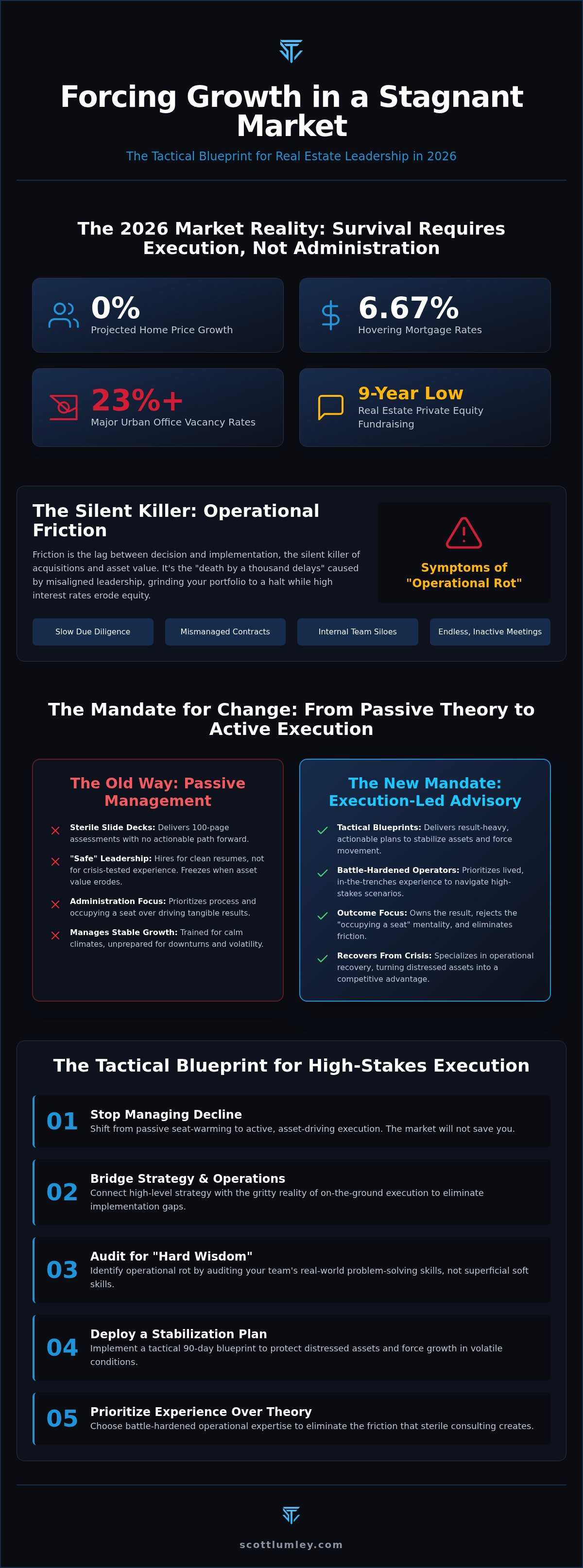
The era of passive management is dead. In 2026, the market doesn't reward "holding." It rewards "driving." With mortgage rates hovering around 6.67% and home price growth stalling at 0% annually, the margin for error has evaporated. Many firms still operate under the illusion that a polished mission statement or a generic strategic plan will stabilize a portfolio. It won't. Survival now requires a tactical hunt for efficiency, not a corporate retreat. If your leadership isn't actively dismantling obstacles, they're likely creating them.
Traditional models fail because they prioritize administration over execution. Occupying a seat is easy. Driving an asset requires a grit that most leadership teams haven't developed. You're likely seeing it now: endless meetings that produce no movement and leadership fluff that masks a lack of results. This is where corporate real estate portfolios begin to bleed value. When commercial rates shift and regulatory hurdles tighten, the cost of "waiting to see" becomes an unpayable debt. You don't need more reports; you need more movement.
The Friction Trap: Why Your Team is Stalling
Operational friction is the silent killer of acquisitions. It's the lag between a decision and its implementation. In the context of real estate, this friction manifests as slow due diligence, mismanaged vendor contracts, or internal siloes that prevent data from reaching decision makers. Misaligned leadership creates "death by a thousand delays." Every week a project stalls is a week where high interest rates eat your equity. Effective real estate leadership advisory isn't about coaching people to feel better; it's about stripping away these delays to force growth when the market is stagnant. You must identify where the gears are grinding and apply the pressure needed to restart the engine.
Moving Beyond the "Safe" Succession Model
Boards often hire for "safety." They want the candidate with the cleanest resume and the fewest waves. In a volatile market, this is the most dangerous move you can make. A "safe" leader is often a theoretical advisor who excels in stable climates but freezes when asset value erodes. They're trained to manage growth, not to recover from a crisis. You need battle-hardened operators who lead from the trenches. These are the strategists who value survival as much as expansion and understand that real estate leadership advisory must be grounded in lived experience. If your leadership team hasn't navigated a downturn, they aren't prepared to lead you through 2026.
Leadership Advisory as a Tactical Tool for Execution
Real estate leadership advisory is the process of aligning strategy with the gritty reality of property operations. Most firms treat leadership as a talent trend or an HR checkbox. They're wrong. In a post-pandemic commercial real estate market where office vacancy rates in major urban hubs have climbed past 23%, you don't need a cheerleader. You need the strategic deployment of experience. This isn't "coaching." It is the application of four decades of industrial and property expertise to cut through corporate jargon and move the needle on asset value. It's about having an operator who has seen these cycles before and knows exactly where the friction is killing your returns.
Management is about process. Strategic leadership is about outcomes. When interest rates sit at 6.67%, process alone won't save your margins. You must own the result. This shift requires a total rejection of the "occupying a seat" mentality. It demands a leader who can identify operational rot before it becomes a terminal liability. If you're ready to stop managing the friction and start solving it, exploring a strategic planning framework is the next logical move. You need a strategist who values survival and recovery as much as expansion.
Execution Over Sterile Theory
Traditional consultants sell slide decks. They provide 100-page "assessments" that offer no actionable path forward. This is sterile theory. Execution-led advisory is the opposite. It is result-heavy. In the 2026 market, where real estate private equity fundraising has hit a nine-year low, the advisor must act as a sobering voice of reason in the C-suite. They identify the rot, call out the delays, and force the movement necessary to stabilize the portfolio. You don't need a deck; you need a result. You need someone who leads from the trenches to ensure your strategy actually survives contact with the real world.
The Pillars of High-Stakes Strategic Planning
Planning in a vacuum is a recipe for failure. Your blueprint must account for the harsh realities of 6.67% average mortgage rates and the tightening grip of 2026 FinCEN regulatory hurdles. High-stakes planning ensures every leadership move has a direct, measurable impact on the bottom line. It isn't about what might happen if the market recovers. It's about what you will force to happen regardless of market sentiment. We build blueprints that prioritize durability over optimism. This requires a deep dive into the operational mechanics of your portfolio, ensuring your team is prepared for the next actionable move.
Identifying Operational Rot: The Leadership Due Diligence Phase
Operational rot doesn't start in the field. It starts at the top. When your leadership team lacks the hard wisdom to navigate 2026's stagnant market, you're losing money every day. Soft skills don't stabilize distressed assets. Only strategic execution does. Most firms fail because they treat leadership as a personality contest rather than a performance metric. This is where a specialized real estate leadership advisory approach becomes mandatory. You must audit your team with the same forensic intensity you'd use for a property's financial records. Identifying misaligned incentives is the first step. If your team is incentivized by process rather than profit, they'll prioritize looking busy over being effective.
The Leadership Audit Checklist
Leadership due diligence is a forensic audit of decision-making speed. How long does it take your team to pivot when a deal turns sour? In a market where pending home sales dropped 2.2% year-over-year in July 2026, speed is survival. You need to evaluate decision-making velocity. If your team is stuck in a loop of "strategic intent" while the operational reality burns, you have a friction problem. Analyze the gap. If the strategy says "expand" but the operations are stalled by 4.5% year-over-year sales fluctuations, your leadership isn't reading the room. High-stakes execution requires a tight loop between identifying a problem and deploying a solution.
Eliminating the "Performance of Work"
Some leaders are experts at the performance of work. They attend every meeting. They produce beautiful decks. Yet, the assets continue to decline. They're managing the decline instead of forcing growth. This is operational fat. Restructuring for survival and recovery is not a sign of failure; it is a strategic act of growth. By removing non-performers, you free up capital and mental bandwidth for high-stakes execution. This process mirrors the rigors of Due Diligence Consulting Services, where we identify friction before the deal closes. Apply that same logic to your personnel. If a leader isn't driving the asset forward, they're dragging it down. Cutting the fat isn't just about saving on payroll; it's about removing the obstacles to your firm's survival. You don't need a cheerleader who ignores the 6.5% interest rate reality; you need an operator who knows how to fight through it.
Stabilization and Growth: The Recovery Zone Blueprint
The "Recovery Zone" is where portfolios go to die or be reborn. In 2026, the margin for error is non-existent. Median home sale prices increased only 2.2% year-over-year as of June 2026, while pending sales dropped. You can't wait for a rising tide to lift your boat; you have to plug the holes yourself. Real estate leadership advisory in this phase is about triage. It is the cold, hard assessment of what stays and what goes. Stabilization isn't a passive state. It is an aggressive, 90-day sprint to stop the bleeding and re-establish a baseline of operational discipline. You need a leadership team that understands the difference between a temporary dip and a structural shift.
Stabilizing Distressed Assets
Stabilization requires a tactical hunt for efficiency. You start by reducing overhead that doesn't directly contribute to execution. This isn't just about cutting costs; it's about re-aligning your debt and operational expenses to the 2026 economic reality. If your interest rates are eroding asset value, your leadership must pivot. This is exactly what a Business Turnaround Consultant does in high-stakes environments. They don't look at what was promised in 2024; they look at what is possible in 2026. You need to protect the firm from future operational storms by building strategic safeguards today. This involves a relentless focus on the bottom line and a total rejection of "business as usual."
The Force Growth Strategy
Waiting for the market to improve is an abdication of leadership. Real growth is forced, not found. While real estate private equity fundraising has slowed to a nine-year low, opportunities in the industrial sector remain a leverage point. You need to identify where demand is still strong despite the 6.67% average mortgage rate environment. This requires applying Strategic Business Advisor principles to scale your property investments without breaking your operational backbone. You look for the "lever points" where a small change in execution leads to a massive shift in margin. Strategic growth in 2026 is about precision, not volume.
Growth in a hostile market is a choice. It requires a leadership team that doesn't flinch at the sight of distress. If your current strategy is just "holding on," you're already losing. It is time to deploy an execution-led real estate leadership advisory model that prioritizes survival and recovery as much as expansion. If you are ready to stabilize your portfolio and find the leverage points your competitors are missing, it's time for strategic planning that actually works in the trenches.
Why Execution-Led Advisory Outperforms Traditional Consulting
Traditional consulting is a performance. It’s a parade of global talent scouts promising a "great CEO" in record time. But a new hire doesn't fix a broken culture. It doesn't lower interest rates. You don't need a headhunter. You need a strategist who has spent four decades in the trenches. Scott Lumley’s approach to real estate leadership advisory isn't about recruiting talent; it's about deploying experience. When office vacancies hit 23.4% in major hubs, you don't need a cheerleader. You need someone who values survival as much as expansion. We prioritize the harsh realities of the 2026 market over polished marketing promises.
The ROI of clarity is immediate. When your leadership team stops guessing, the friction disappears. Traditional consultants leave you with a slide deck and a bill. We leave you with an operational blueprint that actually works. This isn't theoretical. It's hard wisdom. It was earned through 40 years of navigating both extreme success and significant adversity. You don't need more meetings. You need more movement. We provide the sobering voice of reason required to stabilize your portfolio and protect your equity from further erosion.
The Battle-Hardened Operator Perspective
Why does experience in construction, manufacturing, and retail matter for real estate leadership? Because property is an operational business. A battle-hardened operator sees the friction points in a vendor contract or a project timeline that a "talent trend" consultant misses. When the stakes are high, we move from passive advisors to interim leaders. We don't just tell you what's wrong. We step into the gap to fix it. This is the core of Leadership Consulting Services. It’s execution-led strategy for operations that can't afford to fail. We focus on the gritty details of property operations to ensure your strategy survives contact with reality.
Taking the Next Tactical Move
Engaging with a partner should be seamless. You don't need a months-long onboarding process. You need results now. The process starts by identifying the operational rot we’ve discussed and moving immediately into stabilization. Stop managing the decline of your assets. Start forcing the growth that the 2026 market won't give you for free. It is time to move past the sterile theory of the ivory tower and return to the trenches. Contact Scott Lumley for a no-nonsense advisory session today. The next move is yours. Don't wait for the market to save you; build the leadership team that can save the market.
Stop Managing Decline and Start Forcing Growth
Passive management is a luxury the 2026 market won't allow. With home price growth stalled and office vacancies climbing, the difference between survival and collapse is tactical execution. You've seen how operational rot and misaligned leadership kill asset value. It is time to replace sterile consulting theory with a real estate leadership advisory model that actually moves the needle. You need a strategist who prioritizes the gritty reality of the trenches over the safety of the boardroom.
Success in this volatile environment requires more than just holding on; it requires forcing growth through precision and discipline. Leveraging 40 years of operational experience and specialized expertise in distressed asset recovery, Scott Lumley provides a no-nonsense, execution-led methodology designed for high-stakes environments. Stop letting operational friction dictate your firm's future. It's time to take control of your portfolio and lead with absolute clarity.
Get a Tactical Blueprint for Your Real Estate Operations and start your recovery today. You have the tools to navigate this storm; now you just need the discipline to execute.
Frequently Asked Questions
What is the difference between real estate leadership advisory and traditional consulting?
Traditional consulting often sells sterile theory and "soft skills" delivered via slide decks. Real estate leadership advisory is different because it prioritizes execution and hard wisdom over reports. Consultants tell you what is wrong; advisors stay in the trenches to ensure the strategy survives the 2026 market reality. We focus on movement and results rather than polished marketing promises. It is the difference between a theorist and a battle-hardened operator.
How does an execution-led strategy help stabilize distressed property assets?
An execution-led strategy stabilizes distressed assets through a tactical hunt for efficiency. We re-align debt and operational costs to the current 6.67% interest rate environment immediately. This isn't about optimistic projections or waiting for a rebound. It involves aggressive 90-day sprints to stop equity erosion. We identify non-performers and cut operational rot to protect the bottom line. Growth is forced through precision execution rather than passive management.
What are the signs that my real estate firm needs external leadership advisory?
Your firm needs help if decisions take weeks instead of hours. Look for "death by a thousand delays" in your acquisition pipeline or property management reports. If your leadership team is managing a slow decline rather than driving an asset, you have operational rot. Another sign is a persistent gap between strategic intent and actual results. If you attend endless meetings that produce no movement, your leadership structure is failing.
Can leadership advisory help with 2026 regulatory hurdles like FinCEN reporting?
Leadership advisory is critical for navigating 2026 FinCEN reporting and other shifting regulatory hurdles. These rules demand a level of transparency and speed that traditional management models often lack. We build strategic safeguards into your operations to ensure compliance doesn't stall your decision-making velocity. It’s about creating a blueprint that accounts for legal friction without sacrificing execution. We treat compliance as a tactical requirement, not an administrative burden.
How long does it take to see results from a leadership turnaround?
You should see a measurable shift in decision-making velocity within the first 30 days. A full leadership turnaround typically delivers clear results during a 90-day stabilization sprint. This isn't a slow-burn process; it's a high-stakes recovery. We identify friction points immediately and begin the recovery phase without the typical consulting lag. By the end of the first quarter, the operational rot is removed and the team is aligned for execution.
What industries within real estate does Scott Lumley specialize in?
Scott Lumley specializes in the construction, property investment, and industrial sectors. These are high-stakes environments where operational friction is most expensive. Four decades of experience in these gritty fields provide the hard wisdom needed to lead from the trenches. Whether you're managing manufacturing facilities or large commercial portfolios, the focus remains on strategic planning and due diligence. We work where assets are built, recovered, and driven toward growth.
Is this service only for large investment firms, or do you work with mid-size developers?
Real estate leadership advisory is for any firm where the stakes are high and the leadership is stalling. Large investment firms use this service to stabilize massive distressed portfolios. Mid-size developers use it to scale their operations without breaking their internal backbone. The size of the firm matters less than the urgency of the problem. If you have assets at risk or acquisitions that aren't moving, you need a strategist.
How do you identify operational friction within a leadership team?
We identify operational friction through a forensic audit of your decision-making speed. We look for the "performance of work" where leaders look busy but assets continue to lose value. By analyzing the gap between your strategy and your results, we find exactly where the gears are grinding. This due diligence phase exposes misaligned incentives and non-performers. Once the friction is identified, we move immediately to eliminate it and restart your growth engine.


