

Most leadership advice is a luxury you can't afford when margins are bleeding and operations are grinding to a halt. You don't need a cheerleader or a theoretical framework. You need an operator who has survived the friction of a business turnaround. If your real estate or industrial firm is stalling, the problem isn't a lack of motivation; it's a lack of operational durability. This is where specialized resilient leadership consulting steps in to replace soft advice with hard-won execution. It's about surviving the trenches, not just sitting in a boardroom.
You've likely realized that polished marketing promises don't stabilize a complex portfolio or fix a broken supply chain. It's a frustrating reality. As regulators in 2026 move from reviewing policy documents to demanding tangible proof of resilience, the stakes have never been higher. We're moving past the empathy traps to build a battle-hardened leadership framework designed for crisis and sustainable growth. This article provides a clear blueprint for recovery. We'll examine how to turn high-stakes pressure into a leverage point and move your organization toward total operational stability and decisive expansion.
Key Takeaways
- Stop treating resilience as a soft skill and start seeing it as a tactical framework for maintaining operational integrity under extreme pressure.
- Identify the specific friction points in manufacturing, logistics, and construction that require a battle-hardened approach to leadership and decision-making.
- Learn why theoretical coaching collapses during a crisis and why your bottom line depends on execution-led recovery strategies over "soft" advice.
- Build a proactive blueprint for expansion by integrating due diligence with high-stakes strategic planning to identify risks before they stall growth.
- Discover how specialized resilient leadership consulting provides the operational durability needed to navigate complex business turnarounds and high-stakes environments.
What is Resilient Leadership in High-Stakes Operations?
Resilient leadership isn't a psychological state. It's the ability to maintain operational integrity under extreme pressure. It's about keeping the gears turning when the bank is calling or the supply chain is snapping. Most studies on leadership style focus on "soft" skills like empathy or vision. Those are luxuries for stable times. In a high-stakes environment, resilience is a tactical framework for decision-making. It's a gritty, grounded approach to survival and recovery.
Many firms mistake "soft" resilience for operational durability. They focus on mindset when they should focus on mechanics. If your logistics fleet is stalled or your construction project is bleeding cash, a "positive outlook" won't fix the bottom line. You need a durable leadership style built on lived experience. This means moving beyond theoretical coaching. It requires resilient leadership consulting that understands the harsh realities of industrial sectors.
The Difference Between Theory and Execution
Academic leadership models often crumble in industrial environments. They're designed for boardrooms, not manufacturing floors. When assets are distressed, you don't need a cheerleader. You need a battle-hardened operator. This is the core difference between a theoretical advisor and someone who leads from the trenches. A theoretical advisor offers suggestions. A battle-hardened operator delivers a no-nonsense plan to stabilize operations. It's about execution over sterile theory. It's about identifying friction points and clearing them at high speed.
Why 2026 Demands Operational Durability
The year 2026 has brought a new level of market volatility. Interest rate shifts and tightening labor markets have made operational friction more expensive than ever. For mid-size firms, a single mistake in logistics or construction can cost millions. Resilience is now a competitive advantage. It's no longer just about surviving; it's about outlasting the competition. Regulators are also raising the bar. From the UK Operational Resilience Framework to new EU mandates, the demand for tangible proof of resilience is active and enforced. You can't hide behind policy documents anymore. You need leadership that can withstand high-stakes pressure and deliver results. This is why resilient leadership consulting has become essential for firms looking to scale during uncertainty.
The Pillars of Operational Resilience: Manufacturing, Logistics, and Construction
Operational friction is the silent killer of mid-size firms. In manufacturing, logistics, and construction, resilience isn't a buzzword. It's the difference between a profitable exit and a total loss. A single error in a supply chain or a construction site can wipe out millions in inventory or property value. Managing this friction requires more than a spreadsheet. It requires a tactical presence on the ground. Effective resilient leadership consulting identifies these operational cracks before they become chasms. It prioritizes the hard realities of the floor over the polished promises of the boardroom.
Due diligence is the first pillar of this durability. You cannot lead what you haven't properly assessed. In high-stakes environments, identifying risks before they become crises is the only way to maintain momentum. This isn't about avoiding risk entirely. It's about knowing exactly where the friction exists and having a plan to execute through it. When the stakes are this high, your leadership framework must be as solid as the assets you manage.
Real Estate Leadership and Property Strategy
Real estate leadership goes beyond concrete and steel. It’s about the strategy behind the asset. Navigating property investment requires a veteran’s eye for risk, not just an optimistic forecast. Utilizing real estate leadership advisory services helps secure long-term portfolio growth by prioritizing operational durability over superficial gains. Strategic planning for development firms in high-stakes markets must include rigorous due diligence. You have to identify risks before the deal is signed, not after the market shifts. A durable strategy ensures that your portfolio can withstand interest rate spikes and market volatility without breaking.
Manufacturing and Logistics: Leading the Floor
On the manufacturing floor, the margin for error is zero. You don't have time to "reflect" when a production line stops or a logistics hub bottlenecks. Industry experience is the only teacher that matters here. To build leadership resilience, you must understand the movement and friction of the real world. My own lessons in global operational resilience, detailed in "I Survived Africa," weren't learned in a classroom. They were forged in environments where survival was the only metric that mattered. Optimizing these operations requires a leader who can make decisive moves under pressure. If you're facing a complex turnaround, you need an operator who knows how to move the needle. You can explore how strategic planning turns these high-stakes pressures into growth opportunities.
Why Theoretical Coaching Fails During a Business Turnaround
In a crisis, reflection is a luxury you cannot afford. Most leadership coaches want to talk about emotional chemistry or empathy traps. That won't fix a broken supply chain or a bleeding balance sheet. When the stakes are highest, you need action, not a therapy session. This is where resilient leadership consulting separates itself from traditional coaching. It focuses on the hard mechanics of operational recovery. If the bank is calling, your "feelings" about the situation won't pay the debt. You need a tactical framework that prioritizes survival over sterile theory.
The first 72 hours of a business crisis are the most critical. You must stabilize the ship before you can even think about changing the course. This is why a business turnaround consultant must be an operator first. They need to have navigated the trenches, not just read about them in a textbook. While government frameworks might list five key traits of resilient leaders, the most important trait in a turnaround is the ability to execute under fire. You don't need a cheerleader; you need a strategist who understands the weight of a failing asset.
The Survival vs. Expansion Mindset
Survival requires a different mindset than expansion. You have to know when to cut losses and when to double down. Most coaches avoid gritty decisions because they're uncomfortable. They want to maintain harmony. In a turnaround, harmony is secondary to liquidity. You might have to restructure entire departments or exit failing markets. These are the decisions that battle-hardened operators make without hesitation. It's about maintaining a steady hand when everyone else is panicking. You focus on the assets that work and shed the ones that don't. It's a calculated, no-nonsense approach to staying alive.
Crisis Management: Beyond the Boardroom
Stabilizing a distressed asset happens on the floor, not in the boardroom. Strategic execution replaces reactive panic. You need a veteran who understands that crisis management consulting is about leverage. It's about finding the one or two moves that stop the bleeding immediately. Once operations are stabilized, then you can look at long-term growth. But first, you survive. This requires moving from a state of emergency to a state of strategic execution. It’s not about polished marketing promises; it’s about tangible outcomes and hard-won wisdom. This is the only way to ensure resilient leadership consulting delivers a bottom-line result when the stakes are highest.
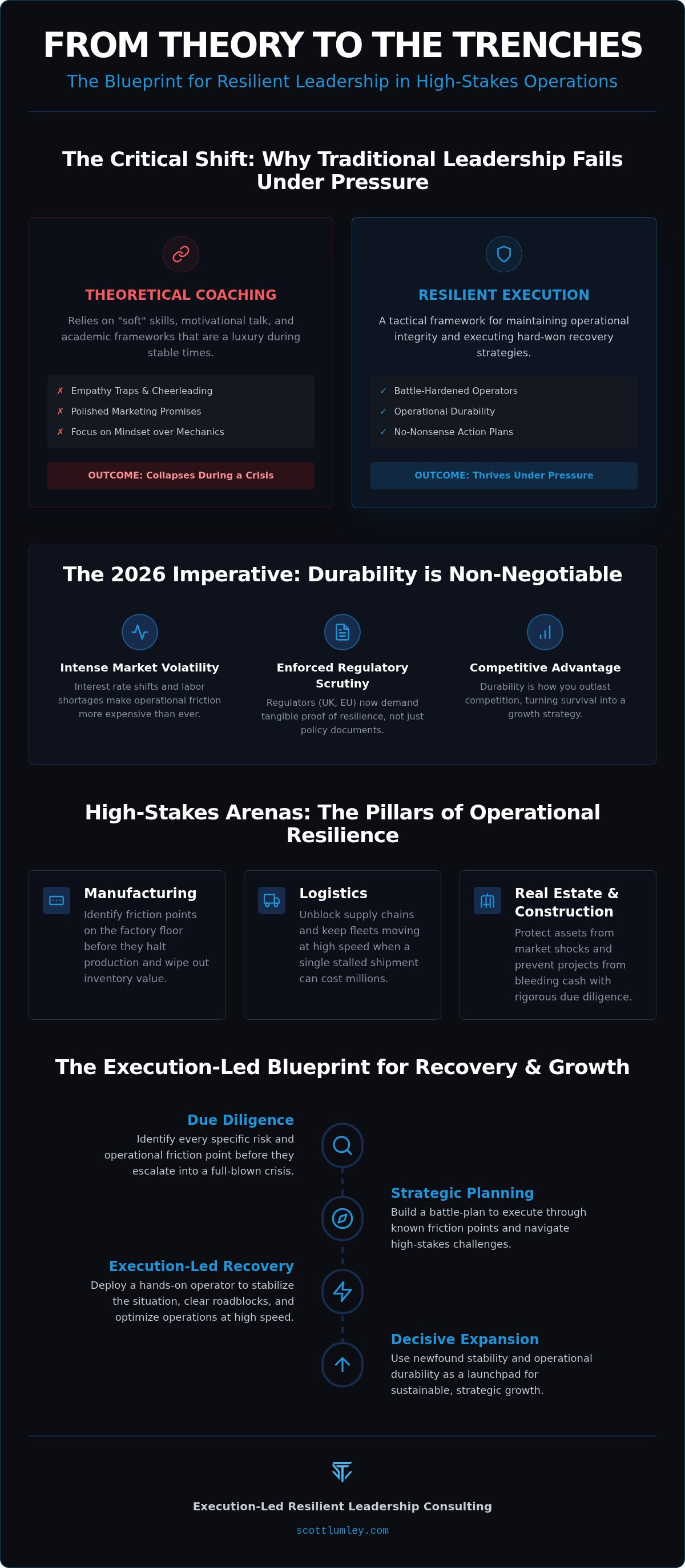
Building a Resilient Framework: From Due Diligence to Strategic Planning
Resilience is not a reaction. It is a pre-emptive strike against operational chaos. While others wait for a crisis to reveal their weaknesses, a battle-hardened leader identifies them during the planning phase. Strategic planning for high-stakes operations requires a blueprint that accounts for friction, not just profit margins. This is the core of resilient leadership consulting. It moves the focus from optimistic projections to the cold reality of asset durability. You don't build a business on hope. You build it on a framework that can survive the worst-case scenario.
Identifying friction starts long before a project breaks ground or a deal closes. It begins with due diligence consulting services that strip away the veneer of a transaction. You have to look for the hidden risks that competitors ignore. Is the supply chain fragile? Are the labor costs sustainable? Is there a debt trap waiting to snap? Proactive resilience means finding these answers when you still have the leverage to walk away or renegotiate. It is about identifying the pressure points before they become breaking points.
The Due Diligence Checklist for Resilient Leaders
Looking under the hood is the most resilient act a leader can perform. You must evaluate every asset and liability with a skeptical eye. This involves more than just checking boxes. It requires an operational audit of hidden risks. My Property Tax Debt System serves as a primary model for this level of strategic due diligence. It is about uncovering the financial and operational rot that can sink a turnaround before it even starts. If you don't find the friction now, it will find you later. A leader who ignores the details is a leader who invites disaster.
Strategic Growth and Scaling
Scaling a business often leads to operational bloat. Growth is useless if it breaks your operational backbone. To scale sustainably, you need to maintain the grit that built the company while adding the systems that support expansion. A strategic business advisor ensures that your growth is execution-led, not ego-driven. The blueprint for expansion in 2026 demands lean, high-speed decision-making. You must grow without losing your edge. Bloat is the enemy of durability. If you are ready to build a framework that lasts, start your strategic planning with an operator who has navigated the trenches for four decades.
Scott Lumley: Execution-Led Resilient Leadership Consulting
Scott Lumley doesn't deal in abstractions. He deals in results. With four decades of hands-on experience in construction, manufacturing, and logistics, he understands the weight of high-stakes operations. This is resilient leadership consulting forged in the trenches, not the classroom. It’s a direct, grounded approach designed for leaders who are tired of ineffective "soft" advice that fails to fix the bottom line. When your organization faces a crisis or a complex turnaround, you need an operator who has navigated both extreme success and significant adversity.
To support this high-level operational strategy, Simon Lead LLC provides executive coaching aimed at enhancing leadership capabilities, ensuring that the executive team is prepared for the rigors of a turnaround.
Most leadership consulting services fail because they are detached from the floor. They offer suggestions while you need solutions. Scott prioritizes execution over sterile theory. He leads organizations through their most complex operational challenges by focusing on movement and friction. He is not a cheerleader. He is a pragmatic strategist who values survival and recovery as much as expansion. This is about building operational durability that lasts.
The Scott Lumley Advantage
Next Steps: Stabilizing Your Operations
Stabilizing your operations requires identifying your primary leverage point for recovery. You cannot address every friction point at once. You must focus on the move that provides the most immediate stability. Engaging an interim or fractional advisor allows for rapid deployment leadership. This is essential for firms that need to move quickly to protect assets or scale without breaking their operational backbone. Don't let operational friction slow your growth any longer. It's time to move from reactive panic to strategic execution. You can secure your operational future with Scott Lumley and start building a battle-hardened framework today.
Secure Your Operational Durability
Theory doesn't stop a bleeding balance sheet. Action does. We've explored why operational durability requires a tactical framework rather than a simple psychological state. You've seen how identifying friction through due diligence and strategic planning prevents the panic of a business turnaround. High-stakes environments in 2026 don't allow for second guesses or academic models. You need a blueprint that works when the pressure is highest and the margin for error is zero.
This is the core of resilient leadership consulting. It’s about moving from reactive crisis management to sustainable, execution-led growth. Scott Lumley brings 40 years of industrial and real estate expertise to every engagement. He’s a battle-hardened operator specialized in business turnarounds who leads from the trenches rather than the boardroom. Stop relying on motivational fluff and start executing a no-nonsense strategy that protects your assets and your bottom line.
The path forward is clear. You identify the leverage point, stabilize the friction, and scale with intent. You don't have to navigate these complexities alone. Book a Strategic Briefing with Scott Lumley today to stabilize your operations and reclaim your growth trajectory. You've already survived the hardest parts; now it's time to build a framework that ensures you never have to do it again.
Frequently Asked Questions
What is the difference between leadership coaching and resilient leadership consulting?
Coaching focuses on mindset and reflection. Resilient leadership consulting focuses on mechanics and tactical execution. One asks how you feel about a crisis; the other builds the operational framework to survive it. We prioritize the hard realities of the bottom line over "soft" motivational advice.
How can resilient leadership improve a business turnaround?
It stops the bleeding through immediate stabilization of distressed assets. A turnaround requires a 90-day plan that identifies the specific leverage points providing the most impact. This moves your organization from a state of reactive panic to one of strategic execution and recovery.
Do you provide real estate-specific leadership advisory?
Yes. Real estate leadership goes beyond the concrete to focus on property strategy and risk assessment. We utilize a veteran's eye to ensure your portfolio can withstand market volatility and interest rate shifts. It’s about securing long-term growth through operational durability.
What sectors do you specialize in for operational resilience?
We specialize in construction, manufacturing, retail, and logistics. These are asset-heavy sectors where operational friction is most expensive. We focus on high-stakes environments where a single mistake in the supply chain or on the floor can cost millions.
How does due diligence factor into resilient leadership?
Due diligence is the foundation of resilience. You can't lead what you haven't properly audited. It involves stripping away the veneer of a transaction to find hidden risks before they become crises. It’s a pre-emptive strike against operational chaos.
What should I expect in the first 90 days of a turnaround engagement?
Expect rapid deployment leadership and immediate stabilization. The first 72 hours focus on stopping the loss of cash and momentum. The remainder of the 90-day plan centers on resolving core financial issues and building a durable operational foundation for future growth.
Can resilient leadership help with scaling a business sustainably?
It prevents the operational bloat that often kills growing firms. Scaling requires adding systems without losing the grit that built the company. We provide the blueprint for expansion that keeps your decision-making lean and your operational backbone strong.
Why is industry experience critical for a crisis management consultant?
Theory fails when the bank is calling or the supply chain breaks. A veteran who has navigated the trenches knows how to make decisive moves under pressure. Lived experience is the only teacher that matters when the stakes are highest and the margin for error is zero.


