

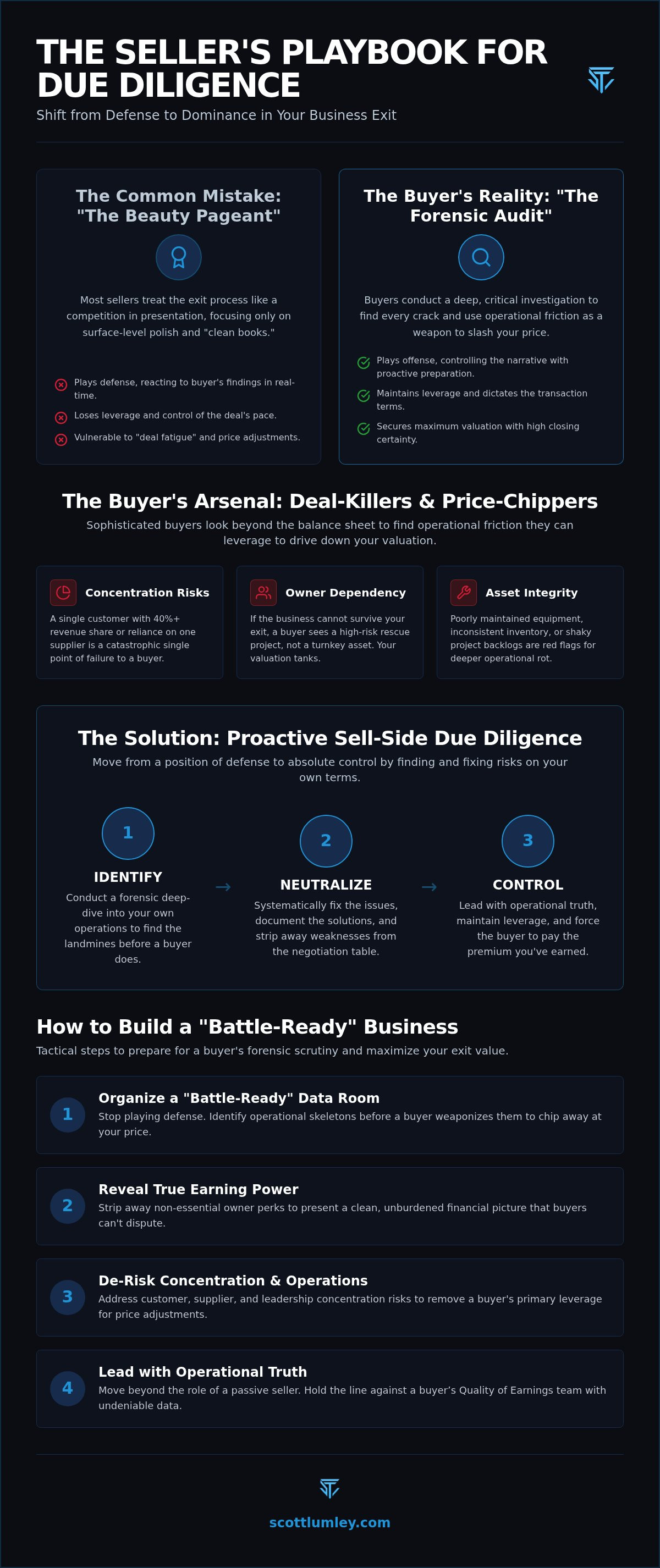
Most sellers treat the exit process like a beauty pageant. They're wrong. It's a forensic audit where every operational crack becomes a reason for a buyer to slash your price. Professional sell-side due diligence services aren't a luxury. They're a tactical necessity to prevent buyers from weaponizing your own data against you. You've spent years building this company. Don't let hidden risks or employee concentration kill your deal at the finish line.
You don't need to play defense. We'll show you how to neutralize operational friction before it reaches the negotiation table. This isn't about sterile theory or polishing the books. It's about a results-driven approach to finding what's broken and fixing it before a buyer ever sees it. You'll learn how to identify deal-killing weaknesses, maintain leverage, and secure a maximum exit valuation without the typical price adjustments. It is time to stop worrying about what a buyer might find and start controlling the narrative yourself.
Key Takeaways
- Stop playing defense. Professional sell-side due diligence services identify operational skeletons before a buyer weaponizes them to chip your price.
- Identify the operational friction buyers use to justify price adjustments. This includes customer and supplier concentration risks.
- Build a battle-ready business. Organize your data room and strip away owner perks to reveal true, unburdened earning power.
- Apply hard-won lessons from the manufacturing and construction sectors. Protect equipment life-cycles and project backlogs from forensic scrutiny.
- Move beyond the role of a passive seller. Learn to hold the line against a buyer’s Quality of Earnings team by leading with operational truth.
The Reality of Sell-Side Due Diligence: Why Preparation is Your Only Leverage
Sell-side due diligence is not a financial cleanup or a simple accounting exercise. It is a proactive, forensic deep-dive into your own operations designed to find risks before a buyer does. Most owners wait for the buyer to start poking around. That is a mistake. By then, you have already lost the initiative. Professional sell-side due diligence services allow you to identify the landmines in your own backyard and diffuse them on your own terms. It is about moving from a position of defense to a position of absolute control.
Buyers do not enter a room looking for reasons to pay you more. They look for reasons to chip the price. In the high-stakes environment of 2026, "clean books" are just the bare minimum. With the Bank Prime Loan Rate sitting at 6.75%, every dollar a buyer spends is under intense scrutiny. They are looking for operational friction, customer concentration, and leadership gaps they can use as leverage to drive down your valuation. A standard accounting audit might tell you the numbers are accurate; tactical preparation tells you if the business is actually sellable.
The Defensive Shield: Neutralizing Buyer Weaponry
The period after signing a Letter of Intent (LOI) is the most dangerous time for a seller. This is when "red flags" like inconsistent inventory records or high employee turnover trigger aggressive price re-negotiations. Without prior due diligence, you are forced to react to the buyer's findings in real-time. This lead-footed response creates deal fatigue, a psychological state where the seller becomes so exhausted by the process they accept a lower offer just to end the pain. Being the most prepared person in the room shifts that pressure back onto the buyer and keeps the deal moving at your pace.
Maximizing Exit Value Through Transparency
Hiding the rot never works. Modern M&A teams are too sophisticated to miss significant operational flaws. When a buyer finds a hidden risk, they don't just ask for a discount; they lose trust in everything else you have said. Early disclosure of known issues, paired with a plan for how they are being fixed, actually increases closing certainty. Exit Value is the result of minimized perceived risk. If a buyer sees a transparent, friction-free operation, they have no choice but to pay the premium you've earned. You win by being the one to point out the problems and the solutions simultaneously.
Beyond the Balance Sheet: Identifying Operational Friction and Hidden Risks
A CPA looks at the past. A buyer looks at the future. This disconnect is where most deals die. While your financial statements might look pristine, operational friction is the silent killer of exit value. Buyers use these hidden inefficiencies to justify aggressive EBITDA adjustments. They aren't just looking at what you made. They're looking at what it will cost them to keep making it once you're gone. Sell-side due diligence services strip away the polish to reveal these risks before they become deal-breakers.
Customer and supplier concentration is a prime example of this friction. You might see a 40% revenue share from one client as a sign of loyalty. A buyer sees it as a catastrophic single point of failure. The same applies to your supply chain. If a single logistics hiccup halts your production, your business is fragile. This is especially critical in specialized sectors. For instance, seller-side due diligence for government contractors often focuses on the stability of specific contract vehicles that a buyer might not be able to replicate. If the revenue isn't portable, it isn't valuable.
Evaluating the Management Infrastructure
Can the business survive your exit? If the answer is "maybe," your valuation just tanked. Buyers want a turnkey asset, not a rescue project. They evaluate organizational depth beyond the C-suite to ensure the machine keeps humming without the founder's daily intervention. Documenting every process and empowering middle management is non-negotiable. If your leadership structure is thin, utilizing leadership consulting services can help build the institutional weight required to satisfy a sophisticated buyer. It's about proving the business is a self-sustaining engine.
Asset and Inventory Integrity
In manufacturing and retail, "ghost inventory" is a common nightmare. These are items on the books that don't exist on the shelves. When a buyer's team does a physical count and finds a 5% discrepancy, they won't just adjust the inventory value. They'll question your entire management system. The physical state of your facilities matters just as much. Deferred maintenance is a liability trap. An unmaintained shop floor is a documented signal of operational neglect that buyers will use to slash their offer. If you want to hold your price, you need to address these gritty realities now. You can start by identifying these gaps through professional due diligence before the first walkthrough occurs.
The Pre-LOI Advantage: Building a "Battle-Ready" Business
Preparation is not a suggestion. It is the price of entry for a successful exit. Most business owners wait for a Letter of Intent (LOI) to start gathering documents. By then, it is too late. You are already playing catch-up. Building a battle-ready business means organizing the chaos before the first introductory call. Speed is the ultimate deal-saver. If a buyer asks for a contract and it takes you three days to find it, you have just signaled that your operations are a mess. Professional sell-side due diligence services ensure you are the one setting the pace, not the one being interrogated.
Your "Virtual Data Room" (VDR) should be a fortress of clarity. It needs to hold every lease, every employee agreement, and every intellectual property filing. Beyond the paperwork, you must address legal and compliance housekeeping. This includes a rigorous "Property Tax Debt" check to ensure no lingering liabilities stall the closing process. Every unresolved issue is a crack in your armor. Fix it now, or watch the buyer use it to pry open your valuation and strip away your leverage.
Financial Readiness and Quality of Earnings (QofE)
In the 2026 transaction environment, a sell-side QofE report is the gold standard. It is no longer enough to hand over tax returns. You need to present a normalized EBITDA that strips away "owner perks" and personal expenses to show the true earning power of the machine. Buyers will try to capitalize one-time expenses to lower your baseline. You win by reconciling these costs upfront. Engaging due diligence consulting services allows you to present a vetted, undeniable financial narrative that leaves no room for buyer interpretation.
Operational Stabilization Before the Market
Fixing obvious operational holes is cheaper than taking a low-ball offer. If your inventory system is broken or your leadership is centralized in one person, the market will punish you. Sometimes a mini-turnaround is required before you ever list the business. This is where a strategic business advisor becomes essential. They don't just point out the problems. They execute the fixes. You want to go to market with a stabilized, high-performing asset. A business that looks like a project will be priced like a project. A business that looks like an engine will be priced like a premium investment.
Sector-Specific Due Diligence: Hard-Won Lessons from Manufacturing, Construction, and Retail
Generic advice is for people who want generic results. In high-stakes M&A, the friction is specific to the dirt on your boots and the machines on your floor. Professional sell-side due diligence services must go beyond the spreadsheet to address the gritty realities of your industry. If you are in manufacturing, a buyer isn't just looking at your output. They are looking at equipment life-cycles and the forensic trail of your maintenance logs. If you've deferred upgrades to pad your margins, a sophisticated buyer will find that gap and subtract it from your purchase price. Safety records are another indicator of management discipline. One major OSHA violation isn't just a fine. It is a documented signal of operational neglect.
In the construction sector, the battle is won or lost in the Work-in-Progress (WIP) schedules. Buyers hunt for inflated project backlogs that lack signed contracts or realistic timelines. They want to know if your revenue is a solid pipeline or a collection of "handshake deals" that will vanish the moment you exit. Retailers face a different set of pressures. Lease liabilities and inventory turnover are the primary targets. You must present a narrative that proves the business is "Amazon-proof." This means showing a resilient customer base and a supply chain that doesn't collapse at the first sign of a logistics bottleneck.
Industrial and Logistics Risk Assessment
Fleet health and environmental compliance are the silent deal-killers in the industrial world. If your logistics infrastructure is aging, the buyer sees a massive capital expenditure (CapEx) requirement on day one. Environmental issues are even more dangerous. A single contaminated site can tie up a transaction in legal purgatory for years. Property-heavy firms must prioritize asset optimization and strategic planning to maintain their leverage. For these complex operations, utilizing real estate leadership advisory ensures your physical assets are positioned as strengths rather than liabilities. Secure your exit value by booking a professional due diligence assessment before the buyer starts their own hunt.
The "I Survived Africa" Resilience Test
Operational resilience is a sellable asset. We apply the "I Survived Africa" test to domestic mid-market deals. This isn't about theory. It is about 40 years of experience surviving logistics collapses and political volatility in extreme environments. If your business can handle a "Crisis Management" scenario without breaking, you have a rugged resilience that buyers will pay a premium for. We look for businesses that can function when the primary plan fails. Proving your company is built for survival makes it a low-risk, high-reward target for any acquirer. You don't just want a buyer to see your success. You want them to see your durability.
Executing the Exit: How Expert Advisory Secures the Transaction
A broker puts your business on a shelf. A due diligence advisor gets in the mud to ensure it actually sells. There is a massive difference. Sell-side due diligence services are about active defense. When the buyer’s Quality of Earnings (QoE) team arrives, they aren't there to confirm your success. They are there to find a reason to lower the price. You need an advisor who holds the line on operational truth. We don't just hand over reports. We manage the narrative. If a buyer's auditor questions your inventory turnover, we provide the operational context that shuts down the adjustment. We lead from the trenches because that is where the deal is won or lost.
The Scott Lumley approach is built on 40 years of lived experience in manufacturing, retail, and construction. We know the difference between a theoretical risk and a real-world friction point. Most consultants offer sterile advice from a boardroom. We offer tactical execution from the floor. This perspective is vital when managing a buyer who is looking for any excuse to weaponize your data against you. We don't guess. We've seen the tricks because we've lived the operations. We ensure your business is presented as a high-performing engine, not a project for the buyer to fix at your expense.
Navigating the Post-LOI "Grind"
The period between the Letter of Intent and the final wire transfer is a war of attrition. Data requests will flood in. If your management team gets distracted by the paperwork, your operational performance will dip. If performance dips, the buyer will renegotiate. It is a vicious cycle designed to wear you down. We handle the data room and the forensic inquiries so your team can focus on the floor. Inevitable surprises will surface. It is the nature of high-stakes M&A. Dealing with these requires the steady, composed leadership of a business turnaround consultant. You don't panic. You solve the problem and keep the momentum moving forward.
Final Value Capture and Closing
Closing is where the last-minute proceeds theft happens. You must watch the Net Working Capital (NWC) peg with extreme caution. If it isn't negotiated with a deep understanding of your operational cycle, you'll leave millions on the table. We ensure the NWC target reflects reality, not a buyer's aggressive accounting theory. Finalizing the transition plan is the last hurdle. You want a clean break, not a lingering liability that tethers you to the business for years. We help you define the boundaries of your exit so you can walk away with your valuation intact. Don't leave your legacy to chance. Secure your exit with Scott Lumley’s due diligence expertise.
Neutralize Friction and Secure Your Valuation
Selling a business is a high-stakes operation. You don't leave it to chance. You've seen how operational friction and hidden risks can become weapons in a buyer's hands. By the time you reach the closing table, you need to be the most prepared person in the room. Our sell-side due diligence services provide that tactical clarity. We strip away the corporate fluff and focus on the gritty realities of your manufacturing, retail, or construction assets. This isn't theoretical advice. It is the result of 40 years of operational execution and specialized industrial expertise. We offer a no-nonsense, results-driven advisory that passive brokers simply cannot match. You've earned a clean exit with maximum value. Don't let a buyer's auditor dictate the terms of your hard work. You have the power to neutralize the friction before the first call is ever made. Get a Battle-Hardened Operational Review Before You Sell. Your legacy is worth the fight.
Frequently Asked Questions
What are sell-side due diligence services?
Sell-side due diligence services are a tactical, pre-sale evaluation of your company's operational and financial health. Instead of waiting for a buyer to poke holes in your business, you do it yourself first. This process identifies operational friction, hidden liabilities, and valuation gaps. It allows you to fix these issues before they reach the negotiation table. It is about controlling the narrative and maintaining leverage throughout the transaction.
How much does sell-side due diligence cost for a mid-size firm?
Industry data for 2026 suggests that total due diligence costs typically range from 0.2% to 4% of the deal value. For mid-market firms, this often falls between $75,000 and $250,000 depending on the complexity of the operations. While this is an upfront investment, it prevents much larger price adjustments during the final stages of a sale. The goal is to protect your equity from aggressive buyer chips and late-stage renegotiations.
Does sell-side due diligence replace the buyer’s own investigation?
No, it does not replace the buyer's investigation, but it dictates the pace of it. A buyer will always conduct their own forensic review. However, having your own report prepared forces them to react to your data rather than hunting for their own. It sets the baseline for the operational truth. This makes it much harder for their team to manufacture reasons for a price reduction or a "re-trade" post-LOI.
How long does the sell-side due diligence process take?
A thorough operational review typically takes between four and eight weeks. The timeline depends on the state of your records and the complexity of your supply chain. If you are in a high-stakes sector like manufacturing or construction, expect the deeper forensic work to take the full eight weeks. Starting this process at least six months before you go to market ensures you have time to actually fix the problems we find.
Can sell-side due diligence help if my business is currently struggling?
Yes, especially if you need a turnaround before a sale. Identifying why the business is struggling is the first step toward stabilizing it for an exit. We find the operational friction that is draining your cash flow and provide a roadmap to fix it. A buyer will pay more for a business with a documented recovery plan than for one that is in a visible, unexplained downward spiral. You sell the solution, not the problem.
What is the most common deal-killer found during operational due diligence?
Customer or employee concentration is the most frequent deal-killer. If 40% of your revenue comes from one client, or if the business stops functioning the moment you go on vacation, a buyer sees a project, not an asset. We identify these single points of failure early. This gives you the opportunity to diversify your client base or build a management layer that survives your exit. You want to prove the business is a self-sustaining engine.
Is sell-side due diligence necessary for a private equity exit?
It is essential. Private equity firms are professional buyers with sophisticated forensic teams. They hunt for EBITDA adjustments with surgical precision. If you don't have your own sell-side due diligence services in place, you are walking into a knife fight without a blade. PE firms respect sellers who have already done the hard work of identifying and neutralizing their own operational risks. It signals that you are a sophisticated operator.
How do I choose between a CPA firm and an operational advisor for due diligence?
Choose based on what you want to protect. A CPA firm focuses on the past by verifying that your numbers are accurate. An operational advisor focuses on the future by verifying that your business is durable. If you have complex floor-level efficiency, equipment life-cycles, or supply chain issues, a standard audit won't save you. You need someone who has run operations in the trenches to find the risks that a spreadsheet will never show.


