

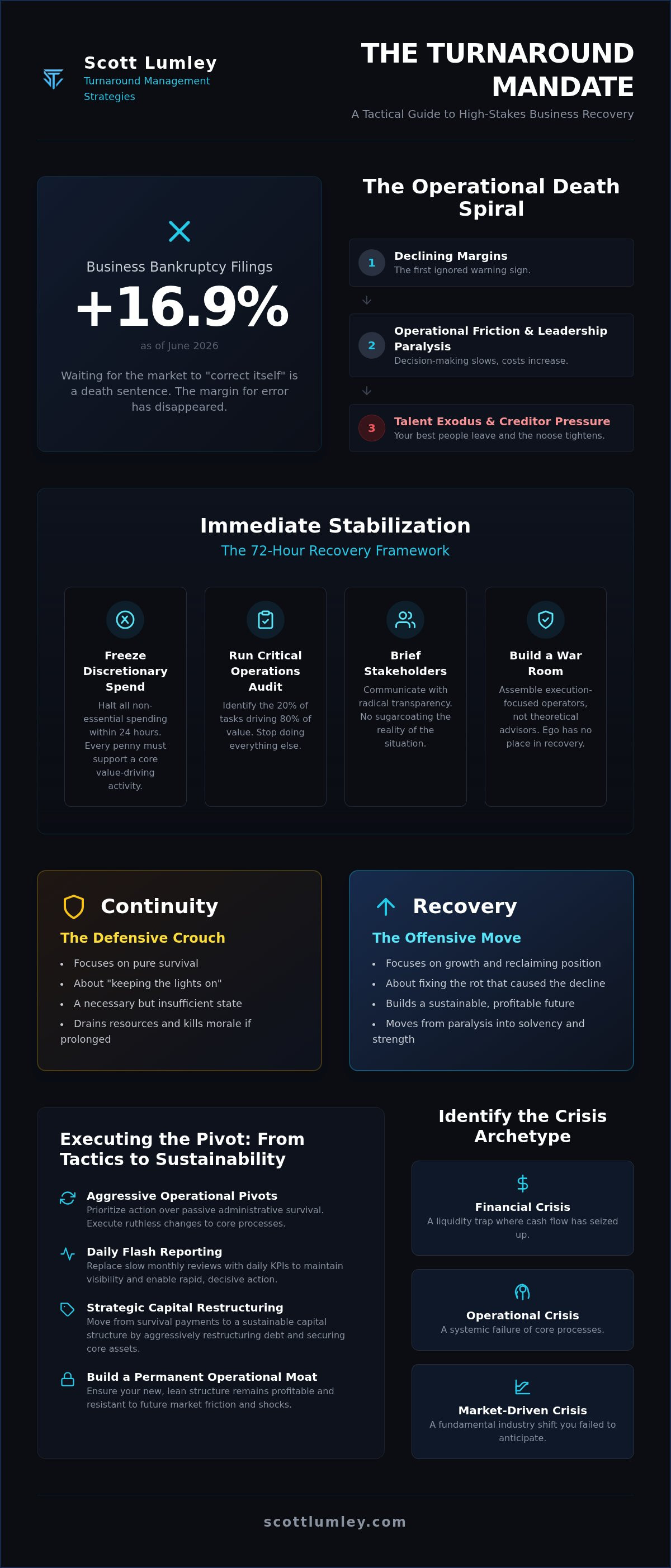
Hope is not a strategy, and waiting for the market to "correct itself" is a death sentence. With business bankruptcy filings up 16.9 percent as of June 2026, the margin for error has disappeared. You're watching margins collapse while operational friction grinds your daily progress to a halt and creditors tighten the noose. You don't need a motivational speech or a binder of corporate jargon. You need turnaround management strategies that work in the trenches, where the stakes are high and the timeline is short.
We agree that the weight of a talent exodus and leadership paralysis can feel insurmountable when your back is against the wall. It's a heavy burden, but the right moves can still reverse the tide. This guide provides a battle-tested recovery plan to stop the bleeding, stabilize your cash flow immediately, and reclaim your market position. We'll outline a 72-hour action plan to secure your foundation and a methodical path toward sustainable growth. It's time to stop reacting to the chaos and start dictating the terms of your survival.
Key Takeaways
- Stop the bleeding with a 72-hour framework focused on freezing discretionary spend and auditing value-driving tasks.
- Implement high-impact turnaround management strategies that prioritize aggressive operational pivots over passive administrative survival.
- Replace monthly reviews with daily flash reporting to maintain visibility and decisiveness during high-stakes recovery.
- Move from survival-mode payments to a sustainable capital structure by aggressively restructuring debt and securing core assets.
- Build a permanent operational moat to ensure your lean, post-recovery structure remains profitable and resistant to future friction.
The Brutal Reality of Turnaround Management Strategies
Real turnaround management isn't a polished slide deck or a collection of "best practices." It isn't a suggestion. It's an aggressive, tactical pivot designed to stop a business from bleeding out in real time. Most executives mistake a plan for action. A plan is just a document gathering dust on a shelf. Action is the ruthless execution of turnaround management strategies that prioritize cash and operational survival over corporate optics. When your margins are collapsing and creditors are at the door, you don't need a theory. You need a hammer.
Every crisis falls into one of three archetypes. A financial crisis is a liquidity trap. An operational crisis is a systemic failure of your core processes. A market-driven crisis is a fundamental shift in your industry that you failed to anticipate. Usually, by the time a company realizes they're in trouble, all three are happening at once. Theoretical plans fail because they don't account for the friction of reality. They assume people will follow orders perfectly and markets will remain stable. They won't. If your strategy relies on "box-ticking" rather than grit, it'll crumble the moment the stakes get high.
Recovery vs. Continuity: Reclaiming Your Position
There's a massive difference between keeping the lights on and building a future. Business continuity is a defensive crouch. It's about survival, and while survival is necessary, it's not enough. Recovery is an offensive move. It's about reclaiming the market share you've lost and fixing the rot that caused the decline in the first place. Staying in "survival mode" for too long is a trap. It drains your resources and kills morale. You can't shrink your way to greatness indefinitely.
A business turnaround consultant bridges this gap. They move the organization from the paralysis of chaos into the clarity of solvency. They don't just look at the balance sheet; they look at the people and the processes causing the friction. They provide the external pressure needed to make the hard choices that internal leadership often avoids. In a high-stakes environment, that perspective is the difference between a total collapse and a successful pivot.
The Operational Death Spiral
The early signs of failure are always there if you're willing to look. It starts with declining margins and ends with a talent exodus. In 2026, a "wait and see" mentality is a death sentence. Data from the first half of 2026 shows a 50 percent increase in small business bankruptcies compared to the previous year. The market doesn't wait for you to find your footing. If you aren't moving, you're sinking.
Operational friction acts like a tax on every move you make. It slows down decision-making and increases costs without adding value. When leadership becomes paralyzed by the weight of these problems, the spiral accelerates. You lose your best people, your creditors lose patience, and your customers lose trust.
The operational death spiral is the compounding effect of ignored inefficiencies.
Immediate Stabilization: The 72-Hour Recovery Framework
When the business is failing, you don't have weeks for a diagnosis. You have hours. The first 72 hours of implementing turnaround management strategies determine whether you survive or fold. This isn't the time for debate. It's the time for triage. You must move with a level of speed that feels uncomfortable to those used to corporate consensus. If you aren't making decisions that feel painful, you aren't moving fast enough.
The framework begins with four non-negotiable steps. First, freeze all discretionary spending within the first 24 hours. Every penny that doesn't directly support a core value-driving activity is dead weight. Second, run a critical operations audit. Identify the 20% of tasks driving 80% of your value and stop doing everything else. Third, brief your stakeholders with radical transparency. Tell them exactly where the water is leaking without sugarcoating the reality. Finally, build a war room. You need execution-focused operators, not theoretical advisors. These high-stakes turnaround management strategies require a total lack of ego from the leadership team. If you can't be honest about the failure, you can't lead the recovery. Effective Turnaround Recovery Strategies rely on this immediate, aggressive posture.
Cash Flow Triage: Stopping the Bleed
Zombie projects are the silent killers of a struggling firm. These are the initiatives that seemed like a good idea six months ago but are now just burning cash with no immediate ROI. Kill them today. Negotiate with vendors immediately. Don't wait for the invoice to go past due. Call them and ask for term extensions in exchange for long-term loyalty once the ship is righted. Ruthless prioritization is your only tool here. If a project doesn't stabilize the bank account this week, it's a distraction. If you need to stabilize your operations quickly, you must be willing to make enemies of the status quo.
Stakeholder Communication Under Fire
Talk to your bank before they call you. If they find the problem through an automated alert, you've already lost their trust. Control the narrative by presenting a clear, gritty path forward. The same applies to your team. A talent exodus happens when people feel the ship sinking but hear nothing from the captain. Direct, honest messaging is the only way to keep your best people from jumping to a competitor. Crisis management consulting provides the objective authority required to have these difficult conversations. It brings a level of sobriety to the room that internal leadership often lacks during a panic. Knowing exactly where you stand against the Small Business Reorganization Act (SBRA) debt limit, which is $3,424,000 as of mid-2026, is vital for your credibility during these talks.
Core Components of a High-Stakes Recovery Strategy
Stabilization buys you time. Structure buys you a future. Once the immediate bleeding stops, your focus must shift toward reinforcing the foundation of the firm. Implementing turnaround management strategies at this stage is about more than just surviving the week. It's about building an entity that's lean enough to move and strong enough to win. This requires a dual focus on protecting what you have and restructuring what you owe. You're no longer just treading water; you're rebuilding the engine while the ship is still moving.
The strategy rests on four non-negotiable pillars. Asset Protection ensures your core value doesn't evaporate during the chaos. Debt Restructuring moves you from predatory survival payments to a sustainable capital structure. Operational Lean involves stripping away the corporate fat that caused the initial friction. Finally, Market Re-entry is your tactical plan to win back customer confidence. You can't skip steps. Attempting to grow before you've leaned out your operations only scales your existing problems. If the core is rotten, the growth will be too.
Asset Protection and Risk Mitigation
Your customer lists, vendor contracts, and supply chain relationships are the lifeblood of your recovery. During turmoil, these assets are vulnerable to poaching and neglect. You must secure your intellectual and physical property immediately. In heavy industries like manufacturing and logistics, hidden liabilities often lurk in aging infrastructure or poorly managed contracts. Utilizing due diligence consulting services allows you to uncover these threats before they become catastrophic. It provides the clarity needed to mitigate risk while the organization is still fragile. Don't assume your "best" assets are safe just because they're yours.
Strategic Debt Management
Liquidity is your only metric of success in a turnaround. High-interest debt and aggressive repayment schedules act as anchors that will eventually pull you under. You must negotiate. Seek principal reductions and term extensions that align with your new, leaner cash flow projections. High-priority liabilities, such as property tax debt, require a specific, strategic approach to prevent asset seizure and maintain operational control. Strategic debt management is the art of preserving liquidity at all costs. By moving away from survival-mode payments, you create the breathing room necessary for turnaround management strategies to actually take root and drive long-term value.
Executing the Pivot: Turning Tactics into Sustainable Recovery
Planning is comfortable. Execution is a brawl. Once you've secured the perimeter with immediate turnaround management strategies, the real work begins. You must transition from reactive survival to methodical execution. This phase isn't about grand visions or five-year projections. It's about winning the next 24 hours. If you can't manage the day, you'll never manage the decade. High-stakes recovery demands a relentless focus on movement and a total rejection of administrative bloat.
Implement the Rule of Three. In a crisis, your team is already redlining. Don't give them a list of twenty priorities. Give them three. Every week, the entire organization focuses on three specific, measurable goals. If a task doesn't support those three, it doesn't happen. This clarity reduces the operational friction that causes teams to freeze under pressure. Leading from the front is equally non-negotiable. The CEO shouldn't be hiding in a boardroom. They should be visible on the manufacturing floor or the logistics hub. You can't lead a turnaround through an email thread. You lead it in the trenches.
Flash Reporting: The Pulse of the Turnaround
Monthly reports are useless in a turnaround. By the time you see the data, the opportunity to react has passed. You need Flash Reporting. Monitor the metrics that actually drive survival: Cash on hand, daily Burn rate, and the sales Pipeline. For public companies, this might include daily monitoring of the Market Value of Listed Securities (MVLS) to ensure you stay above the $5 million Nasdaq requirement as of July 2026. Set up daily 15-minute stand-up meetings. No chairs. No long-winded updates. Just the data, the roadblocks, and the decisions. This rhythm uses hard data to strip the emotion out of high-stakes choices. It replaces panic with a steady, clinical focus on the pulse of the business.
Maintaining Workforce Morale in the Trenches
Crisis fatigue is real. Your best people are working harder than ever for a company that looks unstable. You have to reward your "crisis heroes" even when the bank account is low. If you can't offer cash bonuses today, offer equity or written promises for future incentives once the pivot is complete. Transparency is your greatest tool for retention. Communicate small wins daily. If you secured a new vendor term or hit a production milestone, tell the team. Momentum is built on small, repeated victories.
Utilizing leadership consulting services can help train your managers to lead through this specific type of adversity. It prepares them to maintain discipline without crushing morale. If you are ready to execute a recovery plan that actually sticks, you need to master the human element of the pivot.
Eventually, you'll hit the Pivot Point. This is the moment where your defensive measures have stabilized the floor and you can shift to an aggressive offense. You'll know you're there when your Flash Reporting shows consistent positive variance and your Rule of Three starts focusing on growth rather than just plugging holes. This is where you stop just surviving and start reclaiming your market position with intent. Take advantage of the 100% bonus depreciation revived in 2026 to reinvest in the assets that will drive your next phase of growth.
From Survival to Growth: Building the Operational Moat
Solvency is a low bar. If you stop at just "not failing," you've wasted a perfectly good crisis. The most effective turnaround management strategies don't just return a company to zero; they rebuild it into an entity that is fundamentally harder to kill. Your recovery plan isn't a temporary fix to be discarded once the cash flow stabilizes. It is the blueprint for a leaner, more profitable future. The intensity you brought to the war room must now be institutionalized into your standard operating procedures. This is how you build an operational moat.
An operational moat is your protection against the return of friction. It's the result of stripping away the waste that nearly sank the ship and replacing it with a culture of clinical execution. You've survived the collapse. Now, you must navigate the psychological shift from a survivor mindset to a growth leader mindset. Survivors are reactive. Growth leaders are intentional. You have the scar tissue and the data to prove what works. Leverage that battle-hardened reputation to win high-value, complex contracts that your more "comfortable" competitors are too bloated to handle.
Institutionalizing the Lean Mindset
The efficiency you found during the triage phase shouldn't be an exception. It must be the new standard. Diversify your supply chains based on the vulnerabilities you uncovered when the pressure was highest. If a vendor didn't work with you during the stabilization phase, they don't belong in your future. Every process that was streamlined out of necessity should remain streamlined out of principle.
A strategic business advisor can help maintain this long-term momentum. It's easy to slip back into old habits once the immediate threat of bankruptcy recedes. External pressure ensures your "crisis efficiency" remains the baseline. In 2026, with BAA corporate bond yields forecasted at 6.3 percent, the cost of capital remains high. You can't afford to let bloat creep back into your balance sheet. Keep the flash reporting. Keep the stand-up meetings. Keep the grit.
Scaling Out of the Crisis
There is a specific moment to move from cost-cutting to aggressive reinvestment. You'll see it in your KPIs before you feel it in your gut. With the permanent 21% federal corporate tax rate and the revival of 100% bonus depreciation under the One Big Beautiful Bill Act, the environment for reinvestment is favorable for those with stabilized cash flow. Use your turnaround story as a brand differentiator. Clients want to work with operators who have navigated adversity and won. It proves durability in a way that years of easy success never could.
The transition from survival to growth is not a mystery. It's a choice to remain disciplined when the pressure lets up. If you're ready to stop the bleeding and start building a moat that lasts, it's time to act. Schedule a strategic consultation with Scott Lumley today and execute a plan that turns your operational survival into a market-leading recovery.
Reclaiming the Initiative
Survival isn't a destination. It's the baseline. You've seen how a 72-hour framework can stop the bleeding and how flash reporting replaces panic with clinical precision. The difference between a business that folds and one that flourishes is the willingness to execute. Implementing aggressive turnaround management strategies requires grit and a total lack of ego. You've learned to protect your assets and restructure your debt to create a durable foundation. Now, it's about maintaining that lean, high-velocity rhythm as you scale beyond the crisis.
Success in high-stakes environments doesn't come from a textbook. It comes from the trenches. With 40 years of operational experience and national crisis management expertise, I provide the execution-led turnaround strategy needed to navigate the most complex recoveries. Don't wait for the friction to consume your remaining margins. Take the first step toward reclaiming your market position today. Secure Your Business’s Future with a Strategic Consultation. You've navigated the storm; it's time to lead the recovery.
Frequently Asked Questions
What is the difference between turnaround management and business continuity?
Business continuity is a defensive crouch designed for survival. It focuses on keeping the lights on during a temporary disruption. Turnaround management is an offensive pivot. It addresses the root causes of failure, such as operational friction or margin collapse, to reclaim market share. Continuity asks how you can stay the same; turnaround management asks how you must change to win again.
How long does a typical business turnaround process take?
The timeline varies by the severity of the rot, but the rhythm is consistent. Triage and stabilization happen in the first 72 hours to 30 days. The execution of core turnaround management strategies usually takes three to six months to yield measurable stability. A full transition to sustainable growth often requires twelve to twenty-four months of disciplined execution.
What are the five essential elements of a business recovery plan?
A viable recovery plan requires five pillars: cash flow triage, an operational audit, debt restructuring, asset protection, and leadership realignment. You must stop the bleeding first. Once liquidity is stable, you audit the 20% of tasks driving 80% of the value. The final stages involve securing your core assets and ensuring you have execution-led operators in the war room.
How do I manage cash flow triage during the first 72 hours of a crisis?
Freeze all discretionary spending immediately. You don't need a committee to stop non-essential outflows. Identify every "zombie project" that drains resources without providing an immediate return and kill it. Call your primary vendors to negotiate term extensions before you miss a payment. In a crisis, cash isn't just king; it's your only oxygen.
Should I hire a turnaround consultant or handle the recovery internally?
Internal teams are often too close to the problem or paralyzed by the status quo. An external consultant brings the sobriety and objective authority required to make painful, high-stakes decisions. They aren't burdened by internal politics or past mistakes. This perspective is vital when you need to strip away corporate fat and implement aggressive recovery tactics without hesitation.
What is the biggest mistake owners make during an operational turnaround?
Waiting too long to act is the most common cause of total failure. Many owners adopt a "wait and see" mentality, hoping the market corrects itself while their margins evaporate. By the time they acknowledge the crisis, they've lost their best talent and their creditors' patience. Paralysis by analysis is a death sentence in a high-stakes environment.
Can a business recovery plan help avoid bankruptcy or liquidation?
Yes, by stabilizing operations and restructuring debt before the court takes control. Effective turnaround management strategies allow you to negotiate with creditors from a position of tactical clarity. For many small businesses, this involves staying within the Subchapter V debt limit of $3,424,000 to utilize more favorable reorganization rules. Proactive recovery is always cheaper than a forced liquidation.
How often should a recovery strategy be updated once the business is stable?
Never let your strategy go stale. During the initial pivot, you should monitor flash reports daily. As you move into the stabilization phase, weekly reviews are necessary to ensure the "Rule of Three" goals are being met. Once the business is growing, monthly pivots keep the organization lean and prevent the return of the operational friction that caused the initial decline.


